


















































Certification Courses
Hands-On Labs
Threat Intelligence
Latest Cyber News
MITRE ATT&CK Breakdown
All Cyber Keywords
Privilege Escalation is the art and science of turning a foothold of limited access into the keys to the kingdom. In plain English, it's when an attacker who has gotten "in the door" finds a way to grab more power, more permissions, and more control than they were originally supposed to have.
Why it matters: This tactic is the critical pivot point between a minor security incident and a catastrophic breach. Success here lets an attacker move from reading a single user's emails to stealing the entire customer database, deploying ransomware across the network, or sabotaging critical infrastructure. If defenders fail to detect and stop Privilege Escalation, the battle is often lost.
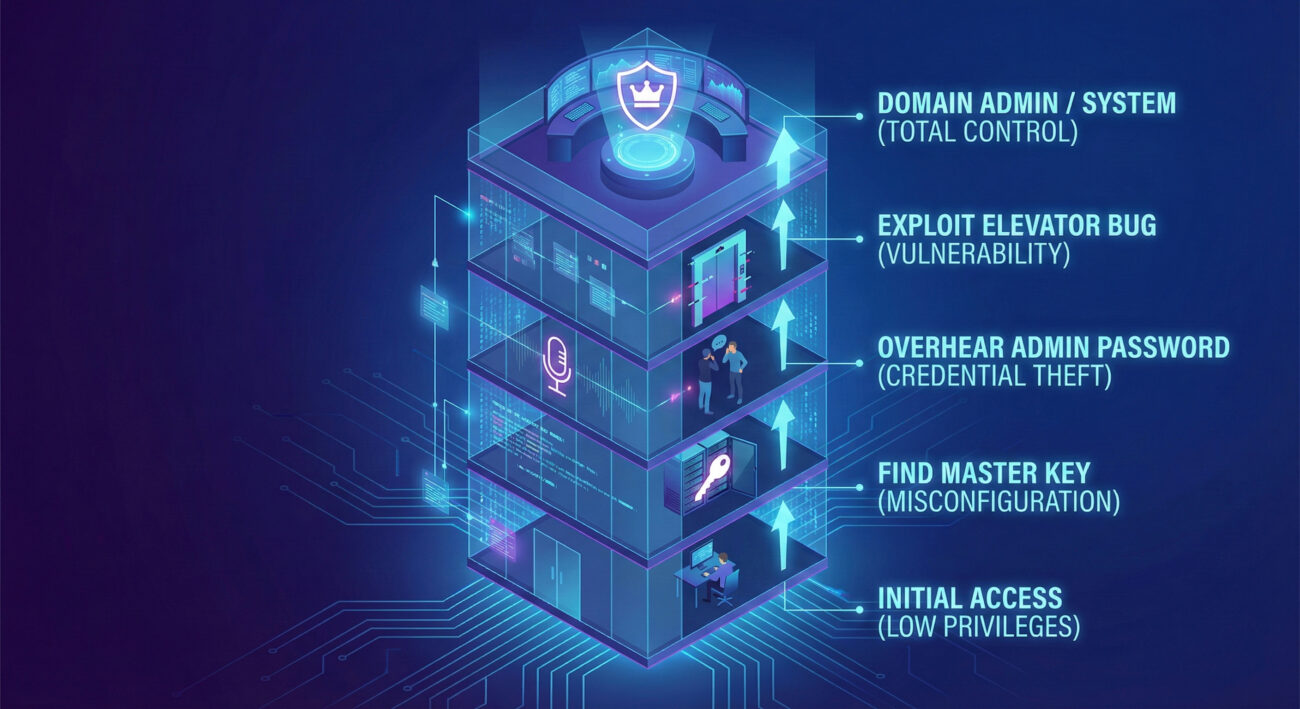
Imagine a sprawling corporate headquarters. An attacker doesn't start in the boardroom; they might slip in disguised as a delivery person or sneak in through an unlocked service entrance (Initial Access). They're now in the building, but they only have access to the mailroom or a hallway. They're a "low-privilege user."
Privilege Escalation is the process of that intruder finding ways to gain ever-higher levels of access. They might:
Their goal isn't just to be in the building it's to reach the server room, the CFO's office, or the boardroom where the real power resides. Every step up the privilege ladder unlocks new areas, sensitive information, and the ability to cause far greater damage.
Before we dive deeper, let's decode the essential jargon.
In our building analogy, the attacker is methodical and opportunistic. Their goal is clear: find the fastest, stealthiest path upward. The feeling is one of calculated progression each new privilege level is a victory that opens new avenues. They're looking for lax policies (keys left in drawers), trusted but vulnerable systems (the elevator with a bug), and careless users (the talking admin).
Attackers have a suite of powerful tools: Mimikatz (the legendary credential dumper), PowerSploit/PowerUp (PowerShell scripts to find misconfigurations), and WinPEAS/LinPEAS (automated scripts that scour systems for escalation paths).
You're monitoring the building's security cameras and access logs. You're not looking for a person in a black hoodie; you're looking for abnormal behavior. Why is the janitor's keycard being used at 3 AM to enter the server wing? Why did a standard user account just attempt to query the list of all domain admins? Your job is to connect these anomalous dots before the intruder reaches their final target.
In your SIEM, Privilege Escalation looks like a series of suspicious events:
Hunt Query Idea: "Find all instances where a user account successfully authenticates from a host, and within a short time window (e.g., 5 minutes), that same host generates authentication attempts (like Kerberos ticket requests) for significantly higher-privilege accounts (e.g., Domain Admins)." This pattern suggests credential theft followed by recon or lateral movement using those stolen credentials.
Endpoint Detection and Response (EDR) platforms are essential for tracing process lineage and detecting token manipulation. Privileged Access Management (PAM) solutions tightly control and audit the use of admin accounts. A well-tuned SIEM with curated rules is your correlation engine.
# Sigma Rule for detecting potential Access Token Manipulation (T1134)
title: Process Access to LSASS with Suspicious Rights
status: experimental
logsource:
    category: process_access
    product: windows
detection:
    selection:
        TargetImage|endswith: '\lsass.exe'
        GrantedAccess|contains:
            - '0x1FFFFF'   # PROCESS_ALL_ACCESS
            - '0x1410'     # PROCESS_VM_READ | PROCESS_QUERY_INFORMATION
    filter:
        SourceImage|endswith:
            - '\taskmgr.exe'
            - '\procexp.exe'
            - '\vmtoolsd.exe'
    condition: selection and not filter
falsepositives:
    - Legitimate administration tools not excluded in filter
level: high
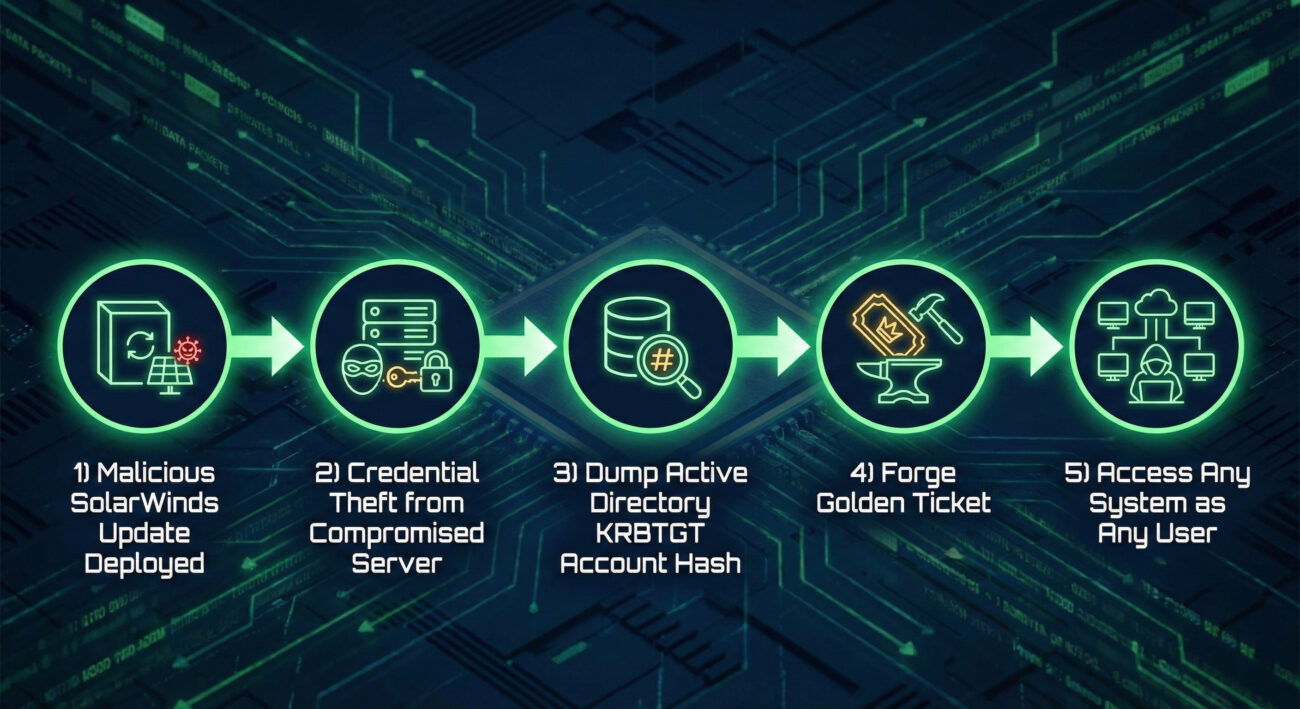
The 2020 SolarWinds compromise is a masterclass in a patient, sophisticated attack chain. After gaining initial access via a trojanized software update, the threat group (often called Nobelium or UNC2452) needed to move and escalate.
Explicit Connection: In the SolarWinds attack, the threat actors used Privilege Escalation when they stole and forged Kerberos authentication tickets (a technique called "Golden Ticket" attack). This allowed them to impersonate any user in the Active Directory domain, including highly privileged accounts, giving them unrestricted access to critical systems and enabling the massive, stealthy data exfiltration that followed.
Below is a high-level map of the primary Privilege Escalation techniques. Remember, each of these contains numerous sub-techniques
| Technique ID | Name | Brief Purpose |
|---|---|---|
| T1548 | Abuse Elevation Control Mechanism | Exploit mechanisms like sudo or UAC to execute code at a higher privilege level. |
| T1555 | Credentials from Password Stores | Extract credentials from stored locations like keychains, vaults, or configuration files. |
| T1068 | Exploitation for Privilege Escalation | Use a software vulnerability to escape a sandbox or gain higher privileges on a system. |
| T1134 | Access Token Manipulation | Make a process run under a different user's token to assume their identity and privileges. |
| T1078 | Valid Accounts | Use existing accounts with higher privileges, obtained through phishing, leaks, or purchase. |
| T1547 | Boot or Logon Autostart Execution | Configure malicious code to run at system start or user logon, often with high privileges. |
| T1484 | Domain Policy Modification | Modify domain-wide policies (like Group Policy) to weaken security and aid further escalation. |
Continue your journey with these essential resources:
Every contribution moves us closer to our goal: making world-class cybersecurity education accessible to ALL.
Choose the amount of donation by yourself.