













Cyber Pulse Academy

Latest News
  • Home
  • /
  • News
  • /
  • Notepad++ Update Hijack: Critical Supply Chain Attack Exposed

Notepad++ Update Hijack: Critical Supply Chain Attack Exposed


📋 Executive Summary

In February 2026, the maintainer of Notepad++ disclosed a sophisticated supply chain attack where the official update mechanism was hijacked to deliver malware to selected users. This attack leveraged an infrastructure-level compromise at the hosting provider, not a vulnerability in Notepad++ code. The updater (WinGUp) was tricked into downloading malicious binaries due to weak integrity verification. Attributed to Violet Typhoon (APT31), the attack targeted East Asian telecom and financial sectors. This post dissects the attack from a beginner-friendly perspective, maps it to MITRE ATT&CK, and provides actionable defenses.


Focus keyword: This Notepad++ update hijack serves as a critical case study in software supply chain security.


🔍 Attack Breakdown & MITRE ATT&CK Mapping

The attack exploited the trust relationship between the Notepad++ application and its update server. Here’s how it unfolded technically:

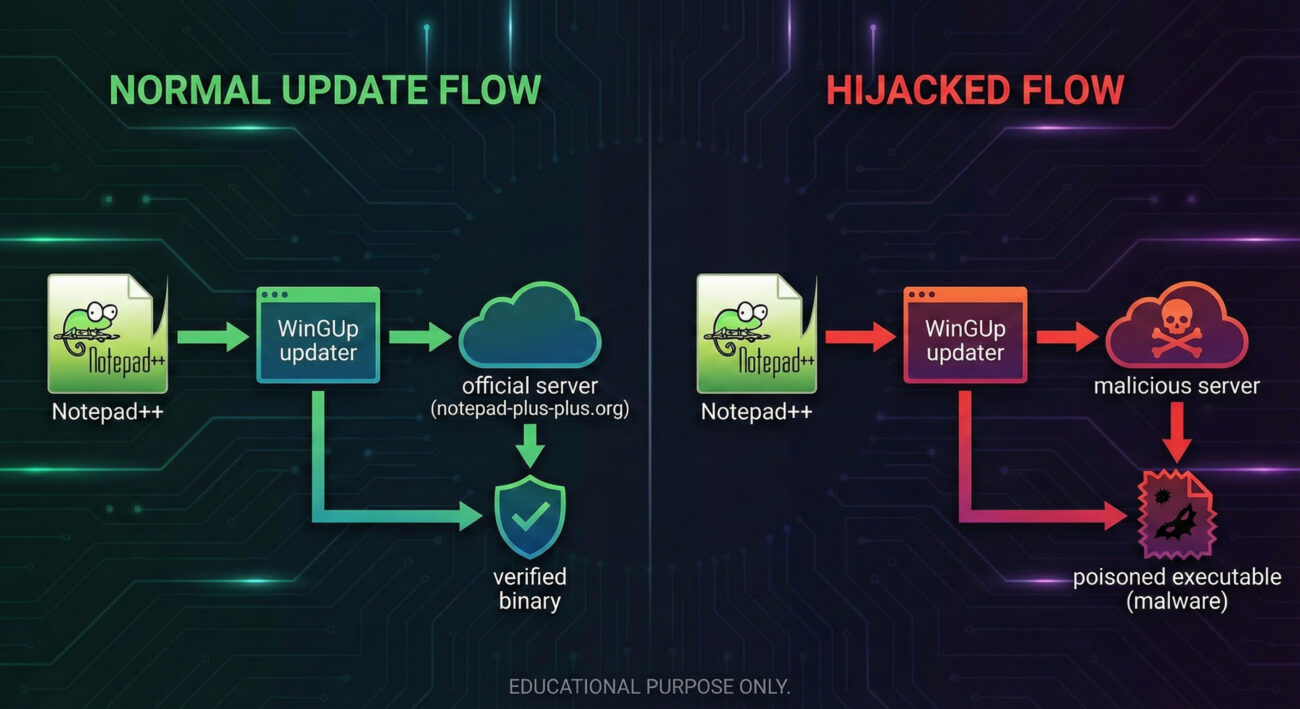
  • Infrastructure compromise: Attackers gained access to the hosting provider’s systems, redirecting traffic from notepad-plus-plus.org to malicious servers.
  • Update mechanism flaw: WinGUp (the updater) did not properly validate the integrity and authenticity of downloaded updates, allowing a man-in-the-middle to substitute a legitimate binary with a poisoned one.
  • Targeted delivery: Only specific users (based on IP or geolocation) were redirected, making detection difficult.

Below is the mapping to MITRE ATT&CK techniques (v14):

TacticTechnique IDTechnique NameContext
Initial AccessT1195.001Supply Chain Compromise: Compromise Software DependenciesUpdate mechanism hijacked at infrastructure level
Initial AccessT1190Exploit Public-Facing ApplicationLikely exploitation of hosting provider vulnerabilities
Command and ControlT1071.001Application Layer Protocol: Web ProtocolsMalicious servers communicated via HTTPS to deliver payloads
Credential AccessT1557Adversary-in-the-MiddleIntercepted update traffic to inject malicious binaries

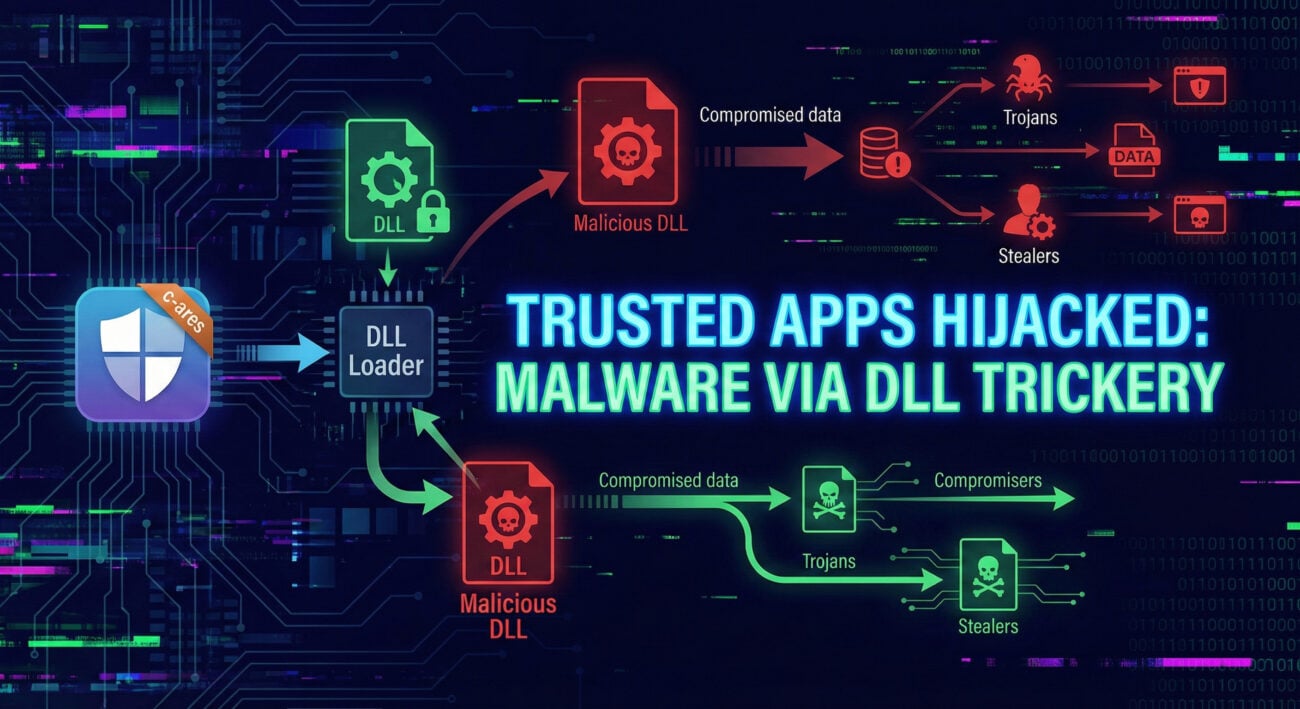
Notepad++ update hijack attack flow diagram comparing normal and compromised update paths

🌍 Real-World Scenario: Who Was Targeted?

According to researcher Kevin Beaumont, the attack was highly targeted. The threat actor Violet Typhoon (APT31), a Chinese state-sponsored group, focused on:

  • Telecommunications companies in East Asia (e.g., Taiwan, Japan, South Korea).
  • Financial services institutions in the same region.
  • Only traffic originating from specific IP ranges was redirected to malicious servers, making the attack nearly invisible to global users.

The compromise lasted from June 2025 until discovery in February 2026, even after the hosting provider was cleaned in September 2025, attackers maintained access to internal services until December 2025, allowing continued redirection.


🕵️ Step-by-Step Attack Flow

How did the Notepad++ update hijack actually work? Follow these steps:

Step 1: Infrastructure Compromise

Attackers breached the hosting provider serving notepad-plus-plus.org. They gained control over DNS settings or web server configurations to redirect update traffic.

Step 2: Traffic Redirection

When a Notepad++ user in a targeted region triggered an update check, the request was sent to a malicious server instead of the legitimate one. This was done by altering DNS responses or through a reverse proxy at the hosting level.

Step 3: Weak Integrity Check

WinGUp downloaded what it believed was an update. The updater only performed a simple hash check (likely MD5) which could be easily spoofed by the attacker. No digital signature verification was enforced.

Step 4: Malware Delivery

Users received a trojanized Notepad++ installer that installed backdoors, enabling persistence and lateral movement within target networks.

Step 5: Long-Term Access

Even after the hosting provider removed the attackers from the server in September 2025, they retained credentials to internal services until December, continuing to redirect traffic.
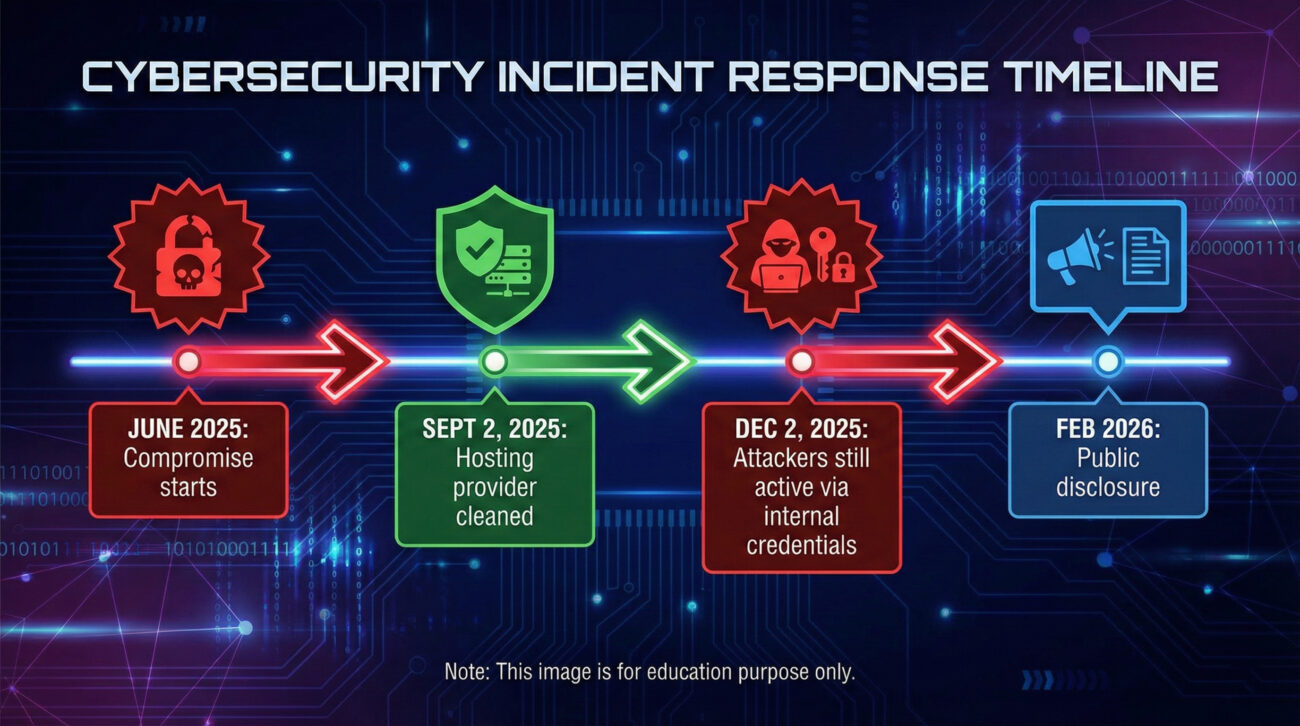

Timeline of Notepad++ update hijack attack from June 2025 to February 2026

⚠️ Common Mistakes & Best Practices

What went wrong, and how can we defend against similar attacks?

Mistakes Made

  • Weak update integrity checks – Only a simple hash, no code signing enforcement.
  • Over-reliance on hosting provider – No monitoring for DNS/route hijacking.
  • Delayed credential revocation – Attackers retained access for months after initial cleanup.
  • No targeted user segmentation – All users treated equally, allowing targeted redirection to go unnoticed.

Best Practices to Implement

  • Enforce code signing – Updates must be signed with a trusted certificate and verified before installation.
  • Use HTTPS with certificate pinning – Prevents man-in-the-middle even if DNS is hijacked.
  • Implement binary transparency logs – Similar to certificate transparency, log all update hashes.
  • Regularly rotate credentials and audit provider security – Assume breach and limit blast radius.
  • Monitor update traffic anomalies – Sudden redirects or download sources should trigger alerts.

🔴 Red Team vs 🔵 Blue Team Perspectives

🔴 Red Team (Attacker View)

  • Objective: Hijack trusted update flow to deliver custom malware.
  • TTPs: Compromise hosting provider, use AiTM, target specific sectors.
  • Success factor: Weak integrity checks and lack of code signing.
  • Persistence: Maintain internal access even after initial cleanup.

🔵 Blue Team (Defender View)

  • Detection: Monitor for unexpected update sources, anomalous network connections from updater processes.
  • Prevention: Implement certificate pinning, use signed updates, conduct regular third-party security audits.
  • Response: Have an incident plan for supply chain compromises, revoke trust, force reinstall from known-good media.
  • Hardening: Segment networks so that even if one endpoint is compromised, lateral movement is limited.

🛡️ Implementation Framework: Securing Update Mechanisms

Based on the Notepad++ update hijack, here’s a framework for developers and security teams to harden software update processes:

  1. Code Signing & Verification – Use strong signatures (RSA/SHA-256) and enforce verification before execution.
  2. Secure Channel with Pinning – HTTPS + public key pinning to prevent interception.
  3. Binary Transparency – Publish expected hashes of updates in a public log (e.g., Sigstore).
  4. Provider Security Audits – Regularly assess hosting providers’ security practices and SLAs.
  5. Fallback & Recovery – Have a manual update option and ability to revoke compromised versions.
  6. User Segmentation & Monitoring – Monitor for unusual update requests and consider gradual rollouts.

❓ Frequently Asked Questions

Q: Was Notepad++ itself vulnerable?
A: No. The attack occurred at the infrastructure level (hosting provider), not in Notepad++ code.

Q: How many users were affected?
A: The attack was highly targeted; only users in specific East Asian organizations (telecom/finance) were redirected.

Q: How can I check if I was affected?
A: Look for unexpected Notepad++ updates installed between June 2025 and February 2026. Verify hashes against official announcements. Use endpoint detection tools to scan for known APT31 indicators.

Q: What should developers learn from this?
A: Never trust the transport layer alone; implement defense-in-depth for updates: code signing, certificate pinning, and integrity validation.


✅ Key Takeaways

  • The Notepad++ update hijack demonstrates that supply chain attacks can target update mechanisms without touching application code.
  • Defense in depth is crucial: code signing, certificate pinning, and continuous monitoring would have prevented or detected this attack.
  • Even after remediation, attackers retained access for months target="_blank" rel="noopener noreferrer" class="tactic-name">highlighting the need for complete credential revocation and provider reassessment.
  • Targeted attacks can fly under the radar; global user bases may not notice small-scale redirections.
  • MITRE ATT&CK provides a common language to understand and communicate such threats (T1195.001, T1557).

🔒 Secure Your Software Supply Chain Today

Don’t wait for the next update hijack. Audit your update mechanisms, implement code signing, and educate your team. For a deep dive into supply chain security, explore our free resources or book a consultation.

Download Supply Chain Security Checklist

Already using Notepad++? Verify your version and learn more from official Notepad++ site and the MITRE ATT&CK database.

📚 Further reading: Original Hacker News report | APT31 (Violet Typhoon) on MITRE | CISA supply chain guidance | Binary transparency explained | MitM attack defense

DONATE · SUPPORT

We keep threat intelligence free. No paywalls, no ads. Your donation directly funds server infrastructure, research, and tools. Every contribution - no matter the size - makes this platform sustainable.
100% of your support goes to the platform. No corporate sponsors, just the community.
ROOT::DONATE

Leave a Comment

Your email address will not be published. Required fields are marked *

Ask ChatGPT
Set ChatGPT API key
Find your Secret API key in your ChatGPT User settings and paste it here to connect ChatGPT with your Courses LMS website.
Certification Courses
Hands-On Labs
Threat Intelligence
Latest Cyber News
MITRE ATT&CK Breakdown
All Cyber Keywords

Every contribution moves us closer to our goal: making world-class cybersecurity education accessible to ALL.

Choose the amount of donation by yourself.