












Certification Courses
Hands-On Labs
Threat Intelligence
Latest Cyber News
MITRE ATT&CK Breakdown
All Cyber Keywords
Have you ever worried that a hacker could turn off the power in your entire city? Or wondered how a digital attack could cause real-world panic? You're not alone. In our connected world, a new kind of warfare has emerged, one fought with keyboards instead of missiles.
Cyber terrorism is the use of digital attacks to intimidate, coerce, or harm societies for ideological, political, or religious reasons. Think of it like traditional terrorism, but instead of physical bombs, they use malware, data breaches, and network intrusions as their weapons.
Imagine a bank robber who doesn't need a mask or gun, they can steal millions from their bedroom while wearing pajamas. Now imagine that robber isn't just after money, but wants to create widespread fear and disrupt an entire nation. That's the threat of cyber terrorism.
In this guide, you'll learn: exactly what cyber terrorism is (in plain English), real-world examples that changed history, key terms explained simply, and most importantly, 7 practical steps you can take to protect yourself and your community from becoming collateral damage in this digital war.
What if I told you that right now, as you read this, invisible battles are being fought that could affect whether your lights stay on, your water runs clean, and your hospitals function? This isn't science fiction, it's the reality of cyber terrorism in the 21st century.
When we hear "terrorism," we often picture physical violence. Cyber terrorism replaces physical weapons with digital ones, aiming to achieve the same goals: fear, chaos, and political change. A successful attack doesn't need to cause physical injuries to be devastating. Shutting down a power grid during a winter storm or disabling a city's traffic lights during rush hour can create panic and demonstrate vulnerability.
Think of it this way: Your city is like a human body. The power grid is the heart, the internet is the nervous system, and water treatment plants are the kidneys. Cyber terrorists aim to give this "body" a heart attack or stroke through digital means, causing systemic failure that paralyzes society.
By the end of this guide, you'll move from feeling overwhelmed to being empowered. You'll understand this complex topic in simple terms and have actionable knowledge to protect what matters most.

You might think, "I'm not a government official or running a power plant, why should I care about cyber terrorism?" The truth is, in our interconnected world, we're all potential targets or collateral damage. When essential services go down, everyone suffers.
Consider these real impacts: In 2021, a ransomware attack on the Colonial Pipeline caused fuel shortages across the U.S. East Coast, leading to panic buying and economic disruption. While this was criminal rather than strictly terrorist, it demonstrated how a single digital breach could affect millions of ordinary people. According to the Cybersecurity and Infrastructure Security Agency (CISA), attacks on critical infrastructure have increased by over 300% in recent years.
Cyber terrorism matters because it's asymmetric warfare. A small group with limited resources can potentially cause massive damage to a much larger nation. The barriers to entry are lowering, malicious tools and techniques once available only to nation-states are now for sale on the dark web. As reported by CSO Online, ransomware-as-a-service kits allow even non-technical actors to launch sophisticated attacks.
This isn't just about technology, it's about psychology. The goal of cyber terrorism is often to erode public trust in institutions, create division, and demonstrate that those in power cannot protect their citizens. When people lose faith in their government's ability to keep the lights on or the water clean, society itself begins to fray.
Every one of us has a role to play in defense. Just as neighborhood watch programs help prevent crime, informed citizens practicing good cyber hygiene create a more resilient society. Your strong password or timely software update might seem small, but collectively, these actions create a digital immune system that makes cyber terrorism less effective.
Let's break down the jargon. Understanding these five key terms will give you the foundation to grasp cyber terrorism discussions without feeling lost.
| Term | Simple Definition | Everyday Analogy |
|---|---|---|
| Cyber Terrorism | Using digital attacks to create fear, advance political/ideological goals, or harm societies. | Like traditional protest terrorism, but using computer code instead of physical weapons to create the same public fear and disruption. |
| Critical Infrastructure | Essential systems society depends on: power grids, water treatment, hospitals, transportation, communications. | The vital organs of a city or country. If the heart (power) stops, everything else begins to fail. |
| Ransomware | Malware that locks systems/data until a ransom is paid. | A digital kidnapper who locks your files in a safe and demands money for the combination. |
| Cyber Hygiene | Basic security practices that protect devices and data, like updating software and using strong passwords. | Like brushing your teeth to prevent cavities, regular maintenance prevents bigger problems. |
| Multi-Factor Authentication (MFA) | Requiring two or more proofs of identity to access an account (password + phone code). | Like needing both a key AND a fingerprint scan to enter a building instead of just a key. |
Let's follow Maria, a hospital administrator in a mid-sized city, through a hypothetical but realistic cyber terrorism scenario. This illustrates how an attack unfolds and its human impact.
Maria's Regional Medical Center serves 200,000 people. The hospital has modern equipment but, like many healthcare organizations, operates on a tight budget with some older computer systems. A politically motivated hacker group, aiming to create chaos and protest government policies, targets healthcare systems across the country.
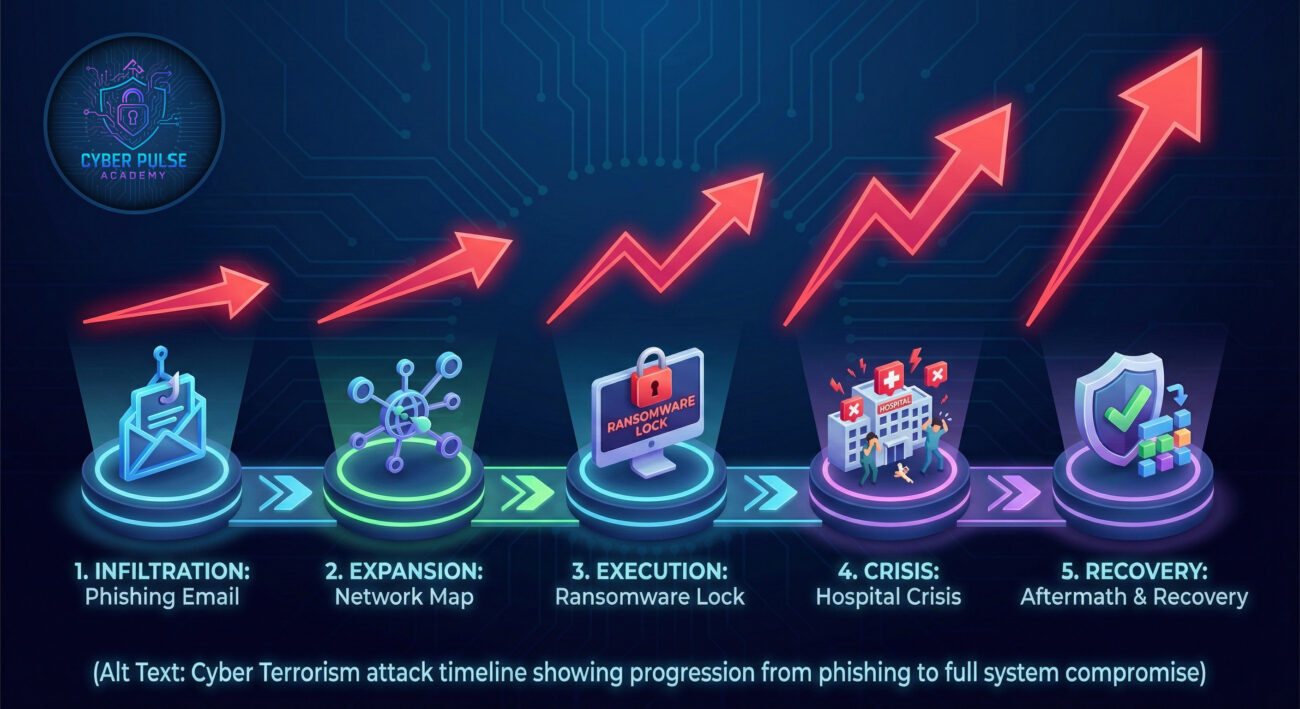
The Timeline of an Attack:
| Time/Stage | What Happened | Impact |
|---|---|---|
| Day 1: Infiltration | An employee clicks a phishing email disguised as a software update request. Malware silently installs. | Hackers now have a foothold in the network. No immediate visible effect. |
| Days 2-7: Exploration | Hackers move laterally through the network, mapping systems, accessing patient databases, and identifying critical systems. | The hospital's entire digital layout is now in enemy hands, but systems still function normally. |
| Day 8: Attack | At 3 AM, ransomware encrypts patient records, appointment systems, and equipment control software. A demand for $5 million in cryptocurrency appears on every screen. | Emergency rooms cannot access patient histories. MRI machines won't start. New patients cannot be registered. |
| Day 8-14: Crisis | The hospital refuses to pay, declaring a state of emergency. They revert to paper records, but critical surgeries are delayed. Media coverage creates public panic. | Patient care deteriorates. Elective procedures canceled. Ambulances redirected to distant hospitals. Public trust plummets. |
| Day 15+: Aftermath | With help from cybersecurity firms and government agencies, systems are gradually restored from backups. The investigation lasts months. | Hospital faces lawsuits, increased insurance costs, and permanent reputation damage. Some patients may have suffered harm due to delayed care. |
This scenario shows how cyber terrorism achieves its goals: creating tangible harm, generating fear, and demonstrating institutional vulnerability. The hackers achieved psychological impact regardless of whether the ransom was paid.
While large-scale cyber terrorism defense requires government and corporate action, individual preparedness creates collective resilience. Here are seven practical steps you can implement today.
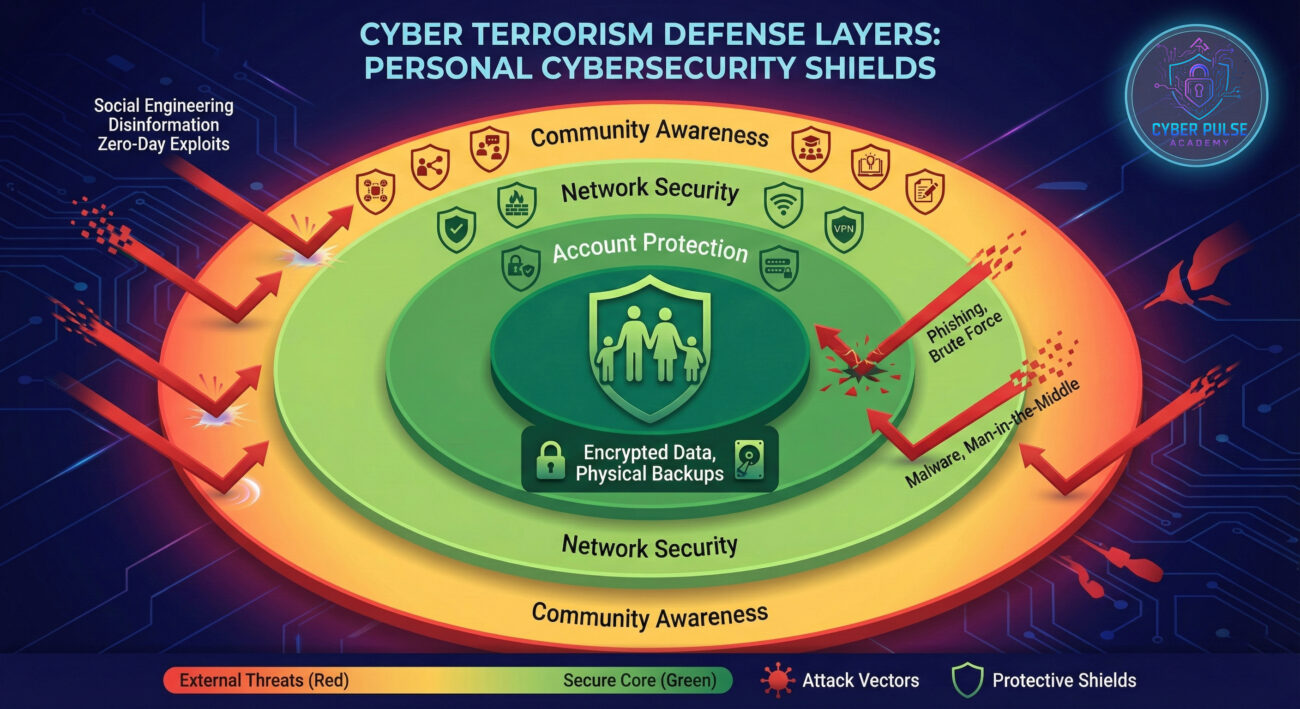
Your online accounts are gateways. Secure them like you would your home's front door.
Internal Resource: Learn more about implementing MFA effectively.
Software updates fix security vulnerabilities that attackers exploit.
Most attacks start with social engineering. Learn to spot the red flags.
Your home Wi-Fi is a gateway to all your connected devices.
Internal Resource: Our guide to home network security goes deeper.
Minimize your digital footprint and protect what matters most.
Security is only as strong as the least informed person in your network.
Have a plan for if critical services go down temporarily.
Let's examine how a threat actor might approach a cyber terrorism campaign, and how defenders think about stopping it.
The Simple Attack Path: A group wanting to disrupt public transportation might start not with hacking trains directly (heavily fortified), but by targeting a smaller vendor that supplies scheduling software to the transit authority. They'd research employees on LinkedIn, craft convincing phishing emails pretending to be from the vendor's IT department, and gain access through one compromised account. From there, they'd move to the main transit systems, planting malware that could be activated remotely during rush hour.
The Defender's Counter-Move: Security professionals practice "assume breach" thinking. They segment networks so a compromise in one area (like vendor software) can't easily spread to critical systems. They monitor for unusual activity, like an accounting employee suddenly accessing control system files. They conduct regular penetration testing to find vulnerabilities before attackers do. The key mindset shift: It's not about preventing all intrusions (impossible), but about detecting them quickly and limiting damage.
"We look for the path of least resistance. We don't break down fortified walls, we find the unlocked side door, or trick someone into letting us in. For cyber terrorism, our goal isn't just access, but maximum psychological impact. We want operations that create media headlines, erode public trust, and demonstrate power. We study our target's dependencies: Which small supplier has access to the big system? Which employee might be overworked and more likely to click a urgent-looking email? We're patient, sometimes dwelling in networks for months before striking."
They care about: Exploiting human psychology, finding hidden connections between systems, creating deniable attribution, achieving symbolic impact beyond technical damage.
"We assume they're already inside. Our job is to make their mission as difficult, slow, and noisy as possible. We build layers of defense so if one fails, others stand. We monitor for anomalies: Why is this user logging in at 3 AM from a foreign country? Why is this workstation communicating with a known malicious server? For cyber terrorism defense, we focus on critical systems' resilience: Can they operate manually if digital systems fail? How quickly can we isolate and contain a breach? We practice incident response like firefighters drill, so when it happens, muscle memory takes over."
They care about: Reducing attack surface, detecting anomalies quickly, maintaining system resilience, ensuring rapid recovery, building organizational awareness.

Cyber terrorism represents one of the most significant emerging threats of our connected age. But as we've explored, understanding and resilience are within your reach.
Let's recap your key takeaways:
The digital battlefield may seem abstract, but its consequences are very real. The most powerful defense against cyber terrorism isn't just technology, it's an informed, vigilant populace that doesn't panic, practices good digital habits, and understands that cybersecurity is a shared responsibility.
You now have the knowledge that transforms you from a potential victim into a resilient node in our collective digital defense. Share this understanding. Practice these steps. Together, we build a digital world that's not just connected, but secure.
What questions do you still have about cyber terrorism? Have you encountered security situations that made you think differently about digital safety?
Share your thoughts in the comments below, let's build a community of cyber-aware citizens. Your question might help someone else overcome their confusion.
For deeper learning, explore our related guides on phishing awareness and protecting critical infrastructure.
Every contribution moves us closer to our goal: making world-class cybersecurity education accessible to ALL.
Choose the amount of donation by yourself.