


















































Certification Courses
Hands-On Labs
Threat Intelligence
Latest Cyber News
MITRE ATT&CK Breakdown
All Cyber Keywords
Have you ever wondered what happens to your stolen data after a breach? Or where cybercriminals buy and sell hacked information? The answer often lies in a hidden layer of the internet most people never see, the Dark Web.
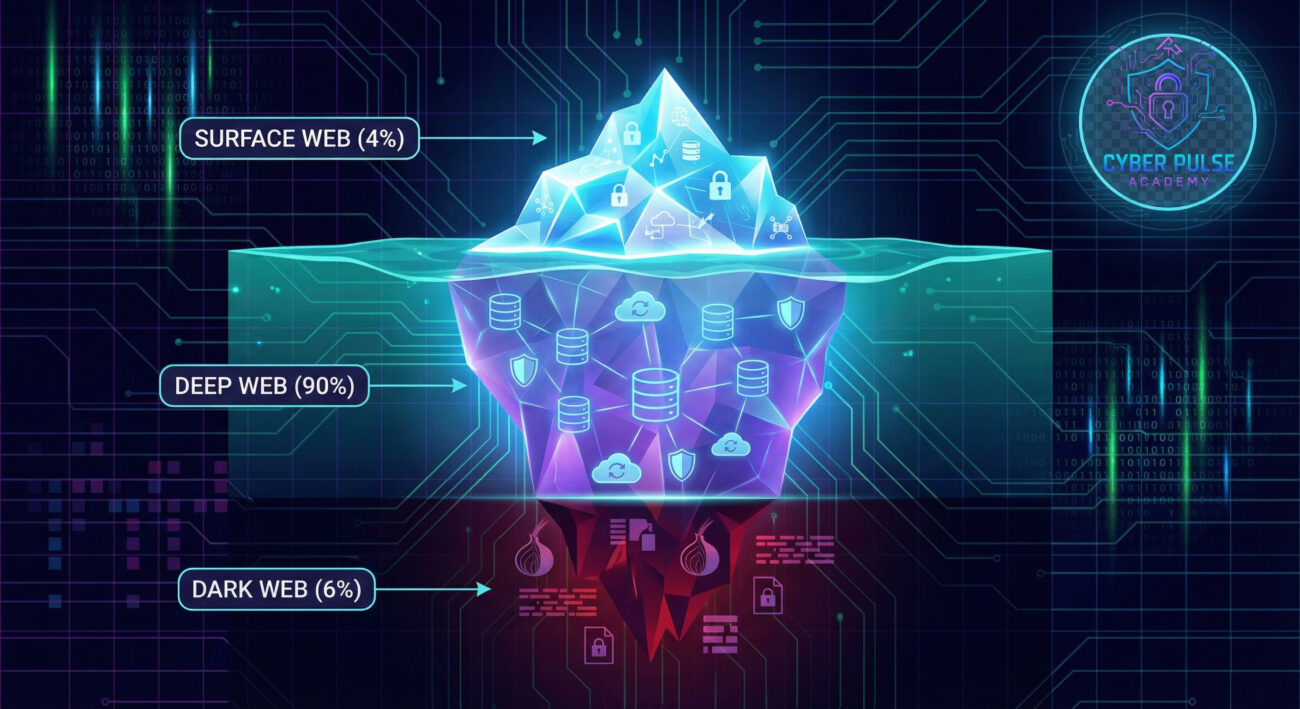
Imagine the internet as an iceberg. The tip above water represents the websites you visit daily, Google, Facebook, news sites. This is the Surface Web. Below the surface lies the Deep Web, private databases, medical records, banking portals. And at the very bottom rests the Dark Web, a deliberately hidden network requiring special tools to access.
In this guide, you'll learn: exactly what the Dark Web is, how it impacts your security, real-world examples of Dark Web dangers, and practical steps to protect yourself.
When you hear "Dark Web," what comes to mind? Hollywood portrayals of drug markets and hitmen? While those extremes exist, the Dark Web is fundamentally a network of websites that are intentionally hidden and require special software (like Tor) to access. Think of it as a neighborhood with no street signs or addresses, you need specific directions to find anything.
The Dark Web isn't inherently evil, it's a tool. Journalists use it to communicate with whistleblowers safely. Activists in oppressive countries use it to organize. But its anonymity also attracts cybercriminals who sell stolen data, malware, and hacking services.
Your personal information, email addresses, passwords, Social Security numbers, might already be for sale on the Dark Web without you knowing. Major breaches at companies like Equifax, Yahoo, and LinkedIn have dumped billions of records into these hidden markets.
By understanding the Dark Web, you're not learning to access it (and I don't recommend you do). You're learning to protect yourself from threats that originate there. This knowledge transforms you from a potential victim into an informed defender of your own digital life.
The Dark Web matters because it's where cybercrime becomes a business. According to a CISA report, over 60% of all stolen data ends up on Dark Web markets within 24 hours of a breach. Your information has value to criminals, a stolen credit card sells for $5-$30, a complete identity package for $30-$100, and corporate login credentials for thousands.
Recent statistics from Privacy Affairs' Dark Web Price Index show that hacked social media accounts sell for as little as $2, while ransomware-as-a-service subscriptions go for $50/month. This commoditization of crime makes it easier than ever for attackers to launch sophisticated attacks.
But here's what really impacts you: phishing campaigns are often planned on Dark Web forums. The malware that might lock your computer is sold there. The credentials used to hack into your accounts are traded there. Understanding the Dark Web ecosystem helps you appreciate why basic security practices, like using unique passwords and enabling two-factor authentication, aren't optional.
Every time you reuse a password, you're potentially giving criminals a master key to multiple aspects of your life. When that password appears in a data breach (and gets sold on the Dark Web), every account using it becomes vulnerable.
| Term | Simple Definition | Everyday Analogy |
|---|---|---|
| Surface Web | The portion of the internet indexed by search engines like Google (websites, blogs, news) | The storefronts on Main Street, visible to everyone walking by |
| Deep Web | Internet content not indexed by search engines (private databases, medical records, emails) | The back offices and storage rooms of stores, not public, but not secret either |
| Dark Web | A hidden network requiring special tools to access, often used for anonymity | Secret underground clubs with unmarked entrances, you need an invitation and directions |
| Tor Browser | Special software that routes your connection through multiple layers of encryption to hide your location | Taking three different subway lines in random order so no one can track where you started |
| Encryption | The process of scrambling information so only authorized parties can read it | Sending a letter in a locked box that only the recipient has the key to open |
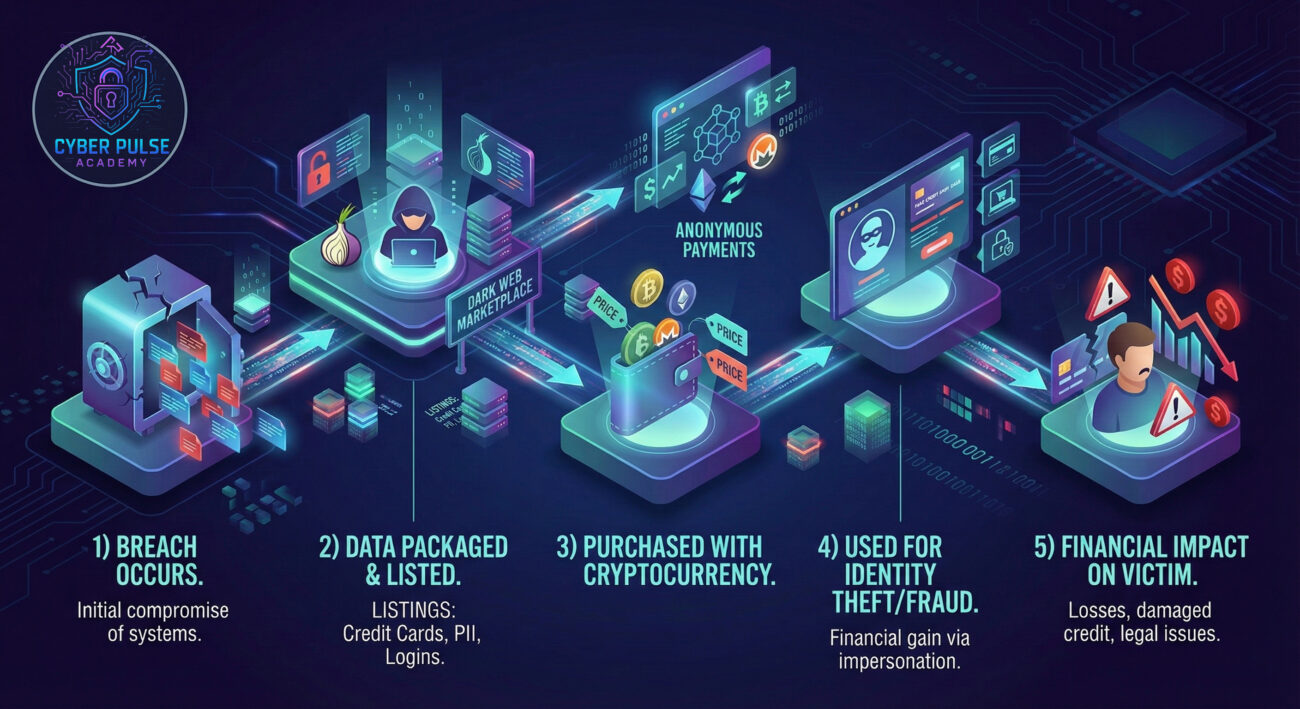
Sarah, a marketing manager, received an email from her bank about suspicious activity. She ignored it, thinking it was spam. Two weeks later, her credit card was maxed out, and she couldn't access her email.
What Sarah didn't know: Her information had been part of a data breach at a retail website where she shopped years ago. The stolen data, email, password, and partial credit card info, was sold on a Dark Web marketplace for $12. The buyer used Sarah's reused password to access her email, then her bank account, and finally opened new credit lines in her name.
| Time/Stage | What Happened | Impact on Sarah |
|---|---|---|
| Day 0 | Retail company suffers a data breach | Sarah's credentials are stolen (unbeknownst to her) |
| Day 3 | Hacker posts Sarah's data on Dark Web forum | Her information is now available to thousands of criminals |
| Day 5 | Buyer purchases data package for $12 using cryptocurrency | Criminal now has everything needed to impersonate Sarah |
| Day 7-14 | Criminal uses Sarah's reused password to access email, then bank | Sarah's accounts are compromised one by one |
| Day 21 | New credit cards opened in Sarah's name via identity theft | $25,000 in fraudulent debt now in Sarah's name |
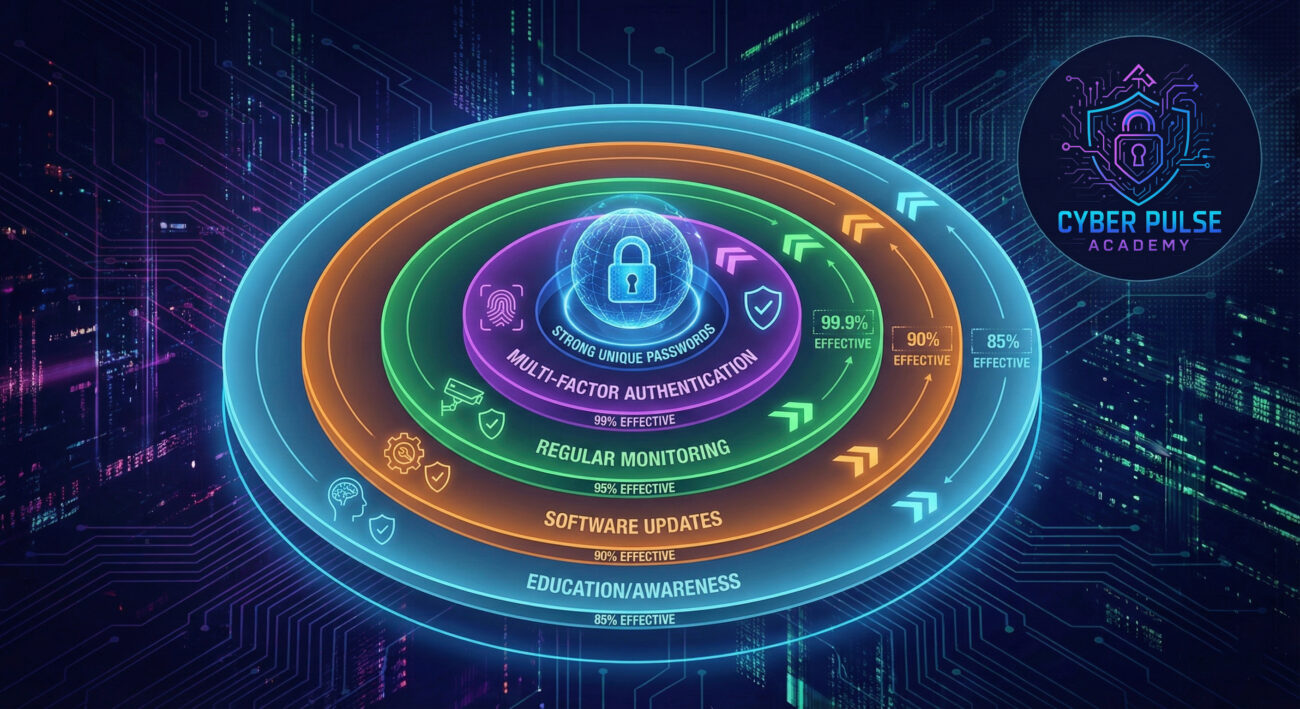
Before you can protect yourself, you need to know what's already at risk.
Weak or reused passwords are the #1 way criminals access your accounts.
MFA adds an extra layer of protection even if your password is compromised.
Regular monitoring helps you catch issues before they become disasters.
Security isn't a one-time task, it's an ongoing practice.
Let's examine how an attacker thinks about the Dark Web and your data. Understanding their perspective makes you a better defender.
An attacker doesn't target you specifically, they target data. After a major breach, they might purchase 10,000 email/password combinations for $500 on a Dark Web market. Using automated tools, they test these credentials on banking sites, email providers, and social media. For every 1,000 credentials, maybe 50 work due to password reuse. That's 50 compromised accounts from one $500 investment.
As a defender, you break this attack chain at multiple points. Unique passwords make credential stuffing (testing breached passwords on other sites) ineffective. MFA stops attackers even if they have your password. Regular monitoring helps you detect and respond to unauthorized access quickly. By understanding that your data has value in a criminal marketplace, you're motivated to protect it accordingly.
The Dark Web is a marketplace and collaboration space. It's where I buy initial access to networks, purchase stolen credentials, or hire fellow hackers for specialized tasks. I look for the easiest path to profit, why spend days hacking one person when I can buy 10,000 compromised accounts for less than an hour's work? I'm not breaking into Fort Knox; I'm checking if you left your back door unlocked with a reused password from the 2017 LinkedIn breach.
My success depends on volume and automation. I need tools that test thousands of credentials per minute, and I need fresh data to feed those tools. The Dark Web provides both.
The Dark Web is an intelligence source and threat indicator. By monitoring it (legally, through services), I can see if my organization's data appears in new breaches. I understand that attackers have efficient marketplaces, so my defense must be equally efficient. I implement security measures that scale: password policies that prevent reuse, mandatory MFA, and automated alerting for suspicious logins.
My goal is to make each account a "hard target" so attackers move on to easier victims. I assume breaches will happen, so I focus on limiting their impact through segmentation, monitoring, and rapid response.
Understanding the Dark Web isn't about learning to access hidden corners of the internet, it's about recognizing where cyber threats originate and how to defend against them. By now, you should understand:
The most important shift isn't technical, it's mental. When you recognize that your digital identity has value in a hidden economy, you start treating it with the same care you'd give your physical wallet. You wouldn't use the same key for your house, car, and office; don't use the same password for your email, bank, and social media.
The Dark Web will continue to exist, but armed with knowledge and good habits, you can ensure your data isn't part of its marketplace.
Cybersecurity is a journey, not a destination. Start today by checking your email at Have I Been Pwned, then enable MFA on your most important accounts.
Questions about the Dark Web or cybersecurity basics? Share them in the comments below or explore our Cybersecurity 101 series for more beginner-friendly guides.
Remember: In cybersecurity, the best defense is an educated user.
Every contribution moves us closer to our goal: making world-class cybersecurity education accessible to ALL.
Choose the amount of donation by yourself.