


























Certification Courses
Hands-On Labs
Threat Intelligence
Latest Cyber News
MITRE ATT&CK Breakdown
All Cyber Keywords
Have you ever found a wallet on the street and faced the dilemma of whether to keep it, return it anonymously, or track down the owner yourself? That exact moral gray area exists in cybersecurity, and it's called Gray Hat hacking. In our digital world where security breaches make daily headlines, understanding these ambiguous actors isn't just interesting, it's essential knowledge for anyone starting their cybersecurity journey.
A Gray Hat hacker operates in the ethical twilight zone between good and evil. They break digital rules without permission but usually aim to expose vulnerabilities rather than cause harm. Think of them as the neighborhood watch that occasionally picks your lock to prove it's unsafe, then leaves a note telling you to get a better deadbolt.
In this comprehensive guide, you'll learn: what Gray Hat hacking really means, real-world examples that changed cybersecurity, the legal tightrope these hackers walk, and most importantly, how this gray area impacts your digital security today. Let's illuminate this critical cybersecurity concept together.
Imagine discovering your apartment building's master key hidden under a fake rock in the lobby. Do you immediately tell management, test it yourself to see what doors it opens, or quietly fix the hiding spot so no one else finds it? This is the daily reality for Gray Hat hackers in cyberspace.
For cybersecurity beginners, grasping this concept is crucial because the digital world isn't simply divided into heroes and villains. The Gray Hat space is where much actual security discovery happens, outside formal programs, beyond legal boundaries, but often with public safety in mind. These individuals find critical vulnerabilities that authorized testers miss, forcing companies to improve their security posture through unconventional pressure.
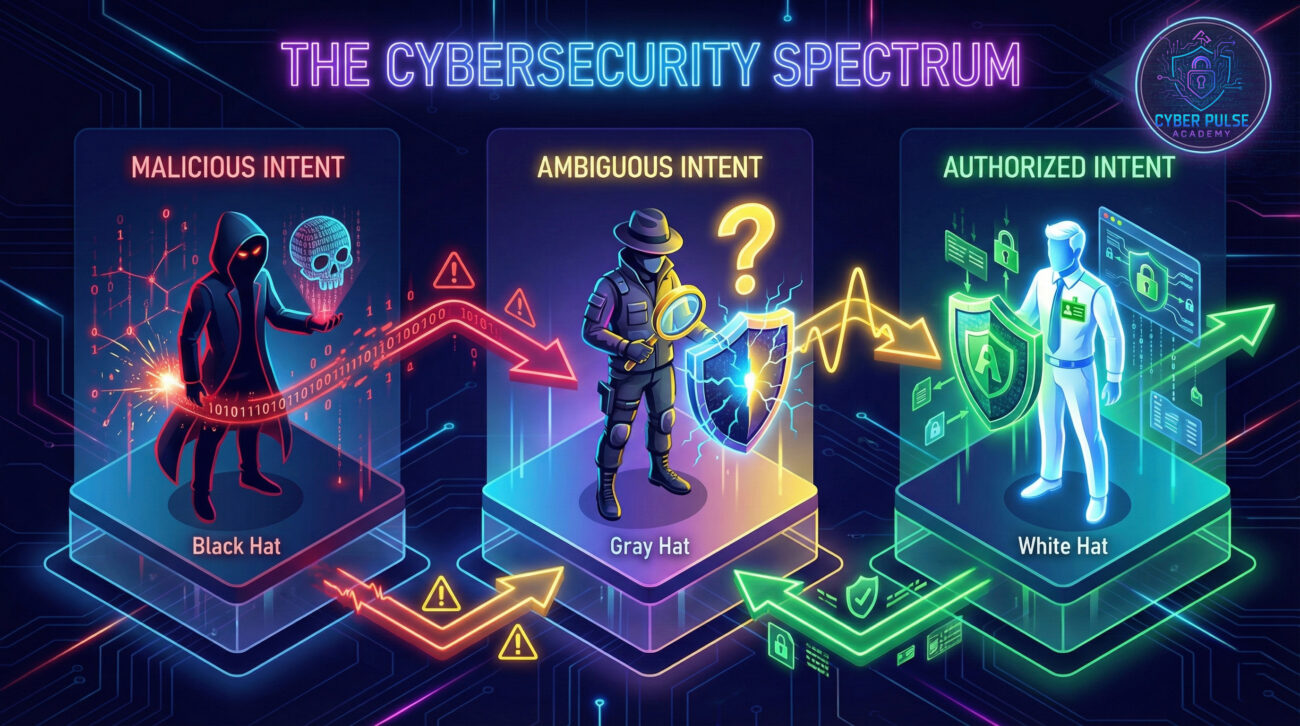
Gray Hat hackers matter because they often discover flaws that slip through billion-dollar security programs. According to NIST's National Vulnerability Database, over 28,000 new vulnerabilities were recorded in 2023 alone. Not all were found by authorized security teams, many were uncovered by independent researchers operating in ethical gray areas.
These hackers create constant pressure on organizations to patch and update their systems. When a Gray Hat publicly discloses a flaw, companies face immediate reputational damage and regulatory scrutiny, forcing faster action than any internal report might. For you, this means the apps you use daily might become safer because a Gray Hat forced the issue into the spotlight.
However, their methods remain controversial and illegal under laws like the Computer Fraud and Abuse Act (CFAA). The Cybersecurity and Infrastructure Security Agency (CISA) advocates for responsible vulnerability disclosure programs specifically to channel this energy into legal, constructive pathways.
Let's break down the essential jargon with clear analogies anyone can understand.
| Term | Simple Definition | Everyday Analogy |
|---|---|---|
| Gray Hat Hacker | A security researcher who operates without authorization but without malicious intent, often exposing vulnerabilities through unconventional means. | A citizen who fixes a dangerous pothole on a public road without waiting for city approval. They trespassed but improved public safety. |
| Vulnerability | A weakness in software, hardware, or processes that can be exploited to cause harm or gain unauthorized access. | A broken window latch in your house. It's not inherently dangerous, but it makes a break-in much easier. |
| Exploit | Code or technique that takes advantage of a vulnerability to achieve an unintended outcome. | A specific method of jiggling the broken window latch just right to open it without breaking the glass. |
| Responsible Disclosure | The ethical practice of privately reporting a vulnerability to the vendor and allowing time for a fix before any public announcement. | Quietly telling the building manager about the broken lock and giving them 90 days to fix it before telling other residents. |
| Bug Bounty Program | A formal, legal program where companies reward security researchers for finding and responsibly reporting vulnerabilities. | The city offering cash rewards for reporting potholes through their official app, legal, documented, and rewarded. |
Meet Jordan, a 28-year-old software developer with a passion for cybersecurity. While using a popular fitness tracking app, Jordan noticed unusual network requests. Curiosity led to investigation, and within hours, Jordan discovered a critical vulnerability that exposed the real-time location data of over 5 million users.
Frustrated by the company's history of ignoring security reports, Jordan faced a dilemma: follow official channels and likely be ignored, or force action through public pressure.
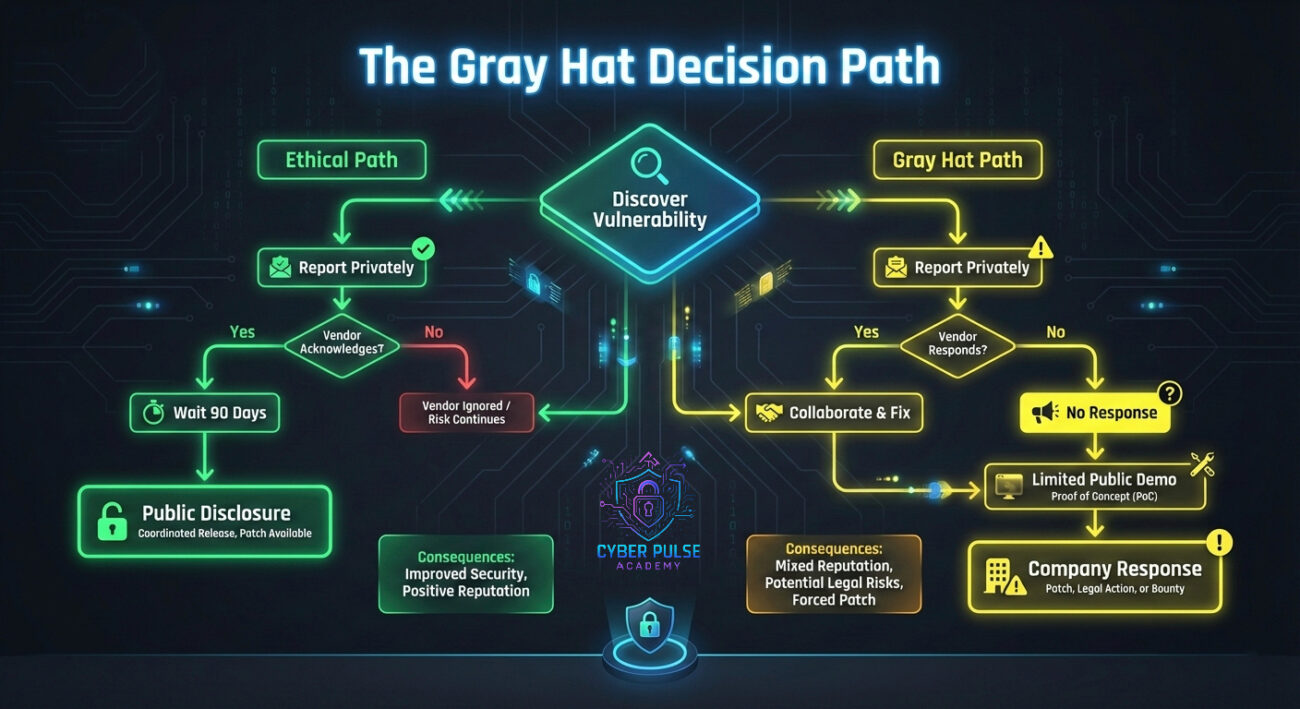
The Gray Hat Timeline:
| Time/Stage | What Happened | Impact & Consequences |
|---|---|---|
| Day 1-7: Discovery & Initial Contact | Jordan finds the flaw and submits a detailed report through the company's security email (which had no auto-acknowledgment). | The vulnerability exists undetected. Millions of users remain unaware their location data could be exposed. |
| Day 8-14: Silence & Dilemma | No response from the company. Jordan researches and finds 12 similar ignored reports from other researchers over 2 years. | Jordan faces ethical crossroads: stay silent, go fully public, or take limited Gray Hat action to force attention. |
| Day 15: The Gray Hat Action | Jordan creates a minimal proof-of-concept showing only THEIR OWN data exposure, posts technical details on a research blog, and tweets at the company's CEO. | Immediate media attention. Company stock drops 3%. Legal reviews Jordan's actions. Other hackers now have partial exploit details. |
| Day 16-30: Resolution & Aftermath | Company issues emergency patch within 48 hours. They launch a proper bug bounty program but don't reward Jordan. No legal action taken. | Flaw is fixed. Users are safer. Jordan is labeled both "hero" and "criminal" in different circles. Legal precedent remains unchanged. |
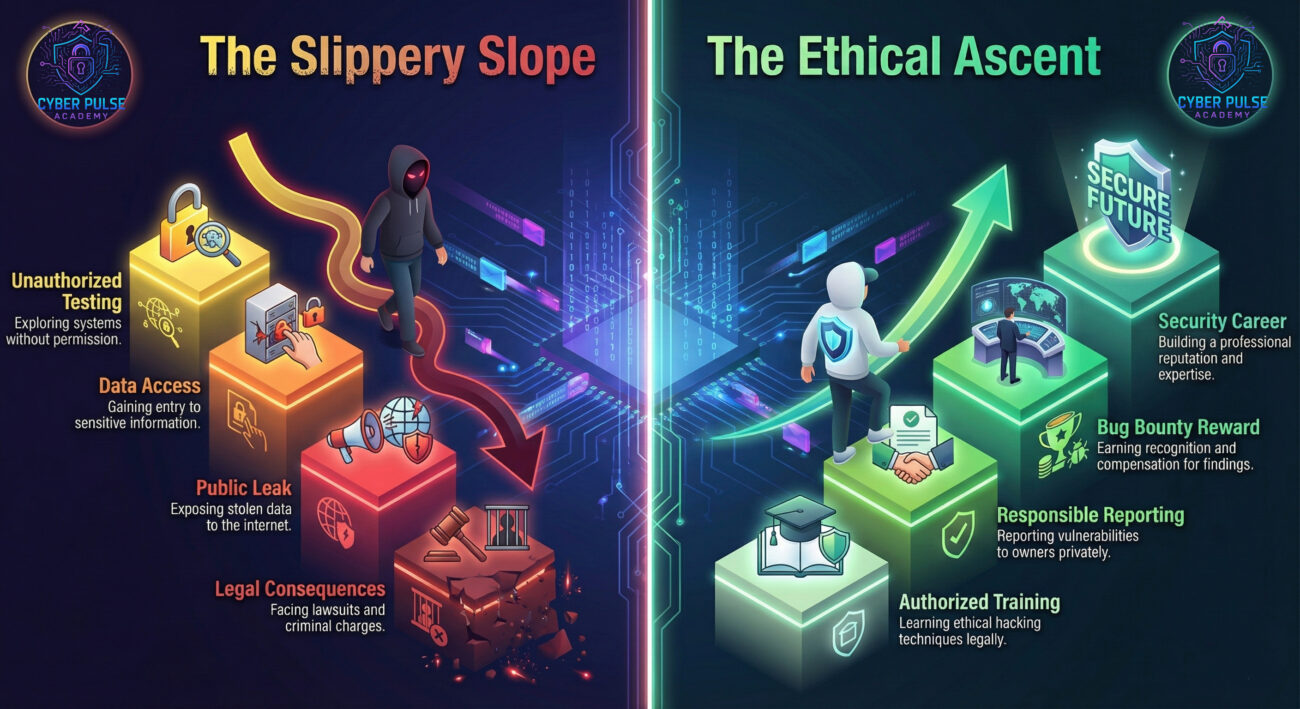
Before touching any system, develop an ethical foundation that prioritizes security improvement over ego or notoriety.
Ignorance of cybersecurity laws isn't just dangerous, it's potentially career-ending.
Develop your skills without legal risk using intentionally vulnerable systems.
If you accidentally find a real-world flaw, handle it with professionalism and ethics.
Channel your skills into legitimate cybersecurity career opportunities.
From a defensive standpoint, Gray Hat activity represents both a warning signal and an intelligence source. Consider this simple attack chain: A Gray Hat publicly discloses a vulnerability in a widely-used content management system with proof-of-concept code. Within hours, criminal groups automate this exploit into their attack toolkits. Now, thousands of unpatched websites become breach targets before most administrators even learn about the vulnerability.
The defender's counter-move is proactive monitoring. This means subscribing to vulnerability disclosure feeds, monitoring GitHub for proof-of-concept code, and implementing automated patch management systems. The mindset shift is crucial: assume details of your systems' flaws will become public through Gray Hat channels, and have response plans ready. This defensive posture, informed by understanding Gray Hat behavior, transforms potential crises into manageable incidents.
Gray Hats are unpredictable wild cards. They might drop free exploits we can weaponize immediately (valuable R&D), or they might spotlight a target we've been quietly infiltrating for months, causing security teams to lock everything down (ruining our access). Their public disclosures are like early Christmas presents, free intelligence on fresh attack vectors. But we must move fast because their actions create small windows of opportunity before patches roll out. We monitor their blogs and GitHub repos as carefully as any security vendor announcement.
Gray Hats create urgent, unplanned work that disrupts our security roadmap. While they occasionally find critical flaws our scanners missed, their methods force us into reactive firefighting mode. Our strategy is to make them irrelevant through comprehensive security programs: aggressive internal testing, regular penetration tests with authorized partners, and robust vulnerability management processes. We maintain clear, welcoming reporting channels to steer independent researchers toward responsible disclosure. Every Gray Hat report that comes through proper channels is a win; every public dump is a security incident we must manage.
The world of Gray Hat hacking represents cybersecurity's most fascinating ethical frontier. These individuals operate in the space between legal frameworks and practical security needs, challenging our definitions of both "hacker" and "hero."
Your Essential Takeaways:
Cybersecurity isn't just about technology, it's about people, ethics, and the constant balance between security and freedom. The Gray Hat phenomenon perfectly embodies this complex reality, reminding us that in the digital world, not everything is black and white.
The world of digital security is vast and constantly evolving. Did this exploration of Gray Hat hackers help clarify this complex topic? What other cybersecurity concepts would you like us to break down in simple terms?
Share your thoughts, questions, or experiences in the comments below, let's build our collective security knowledge together. Remember: Stay curious, stay ethical, and above all, stay secure.
Want to dive deeper? Check out our related guides on ethical hacking for beginners and how to start with bug bounties.
Every contribution moves us closer to our goal: making world-class cybersecurity education accessible to ALL.
Choose the amount of donation by yourself.