



















Certification Courses
Hands-On Labs
Threat Intelligence
Latest Cyber News
MITRE ATT&CK Breakdown
All Cyber Keywords
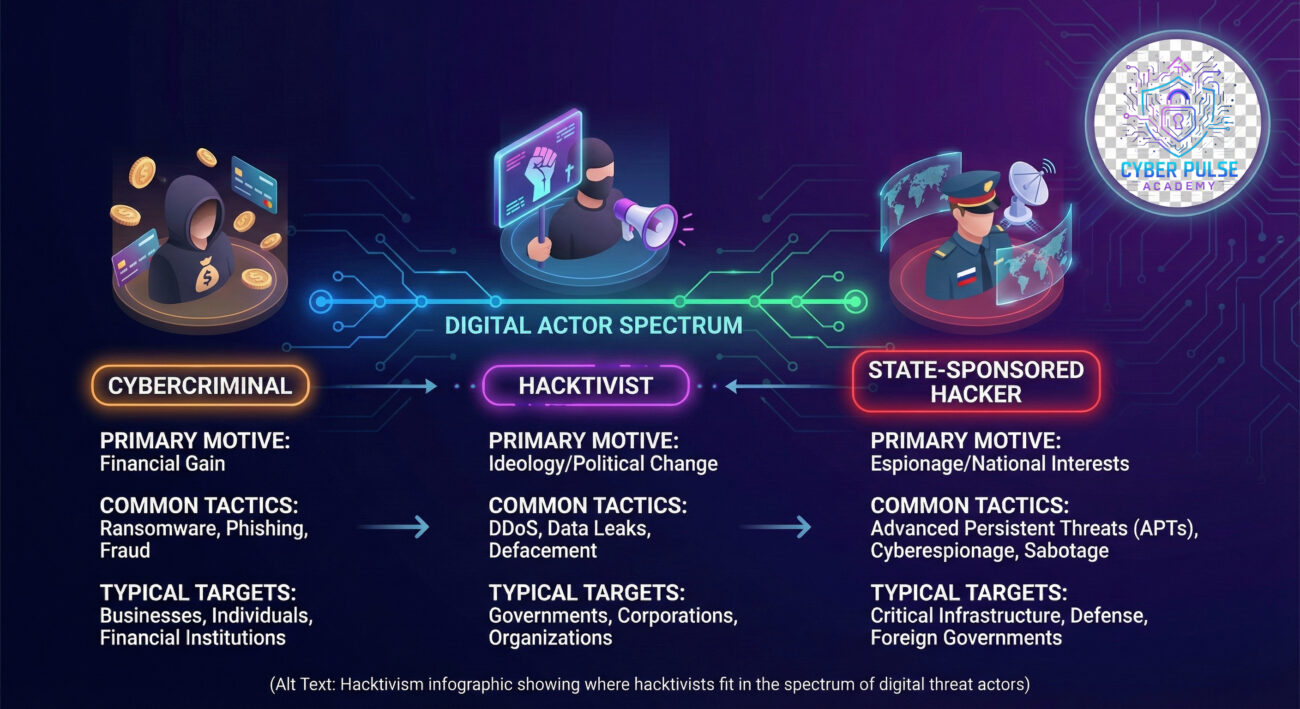
Have you ever seen news headlines about websites being taken down or data leaked by groups with names like Anonymous or LulzSec? Wondered if these were hackers or activists? The answer is both. Welcome to the world of hacktivism.
A hacktivist is a person or group who uses digital tools and cyber-attack techniques to promote political or social change. Think of them as the digital version of protestors who, instead of holding signs, use lines of code to make their voices heard. Their targets are often governments, corporations, or organizations they believe are acting unethically.
In this guide, you'll learn: what motivates hacktivists, see a real-world scenario broken down, discover how to critically analyze their actions, and understand the security practices that protect you from collateral damage. No technical jargon, just clear explanations.
Hacktivism sits at the volatile intersection of technology, politics, and ethics. It matters because it can affect anyone, from the multi-national corporation being targeted to the ordinary citizen whose data is on the breached server. Unlike financially-motivated cybercrime, hacktivism is driven by ideology, making its campaigns unpredictable and often highly publicized.
A recent report from IBM Security highlights that while financially motivated breaches are more common, ideologically-driven attacks (like those from hacktivists) often cause significant reputational and operational damage. For instance, a distributed denial-of-service (DDoS) attack can take a news website offline during a critical election, impacting public information access.
For the beginner, understanding hacktivism is crucial. It helps you decipher the news, recognize when you might be caught in the crossfire (like if your social media platform is targeted), and reinforces why basic cyber hygiene, like using strong passwords and being wary of leaks, is non-negotiable. You become an informed digital citizen, not just a passive spectator.
| Term | Simple Definition | Everyday Analogy |
|---|---|---|
| Hacktivist | A person who hacks computer systems for political or social activist purposes. | A protestor who uses a digital megaphone (code) instead of a physical one to broadcast their message. |
| DDoS Attack | Flooding a website with so much fake traffic that it becomes inaccessible to real users. | Blocking a store entrance with a huge crowd so legitimate customers can't get in. |
| Data Dump / Leak | Publicly releasing stolen private or confidential data to expose wrongdoing or shame a target. | Taking internal company memos and posting them on a public bulletin board for everyone to see. |
| Defacement | Changing the visual appearance of a website, often to display a political or social message. | Graffiti sprayed on a building's front wall, changing its look to convey a message. |
| Doxxing | Researching and broadcasting a person's private identifying information (like address, phone) without consent. | Shouting someone's home address and personal secrets through a loudspeaker in a town square. |
Let's follow "Ava," a fictional hacktivist aligned with a group calling itself "Digital Dawn." They believe a large energy corporation, "PowerGrid Inc.," is covering up environmental violations. Ava's goal isn't to steal money but to force transparency and public accountability.
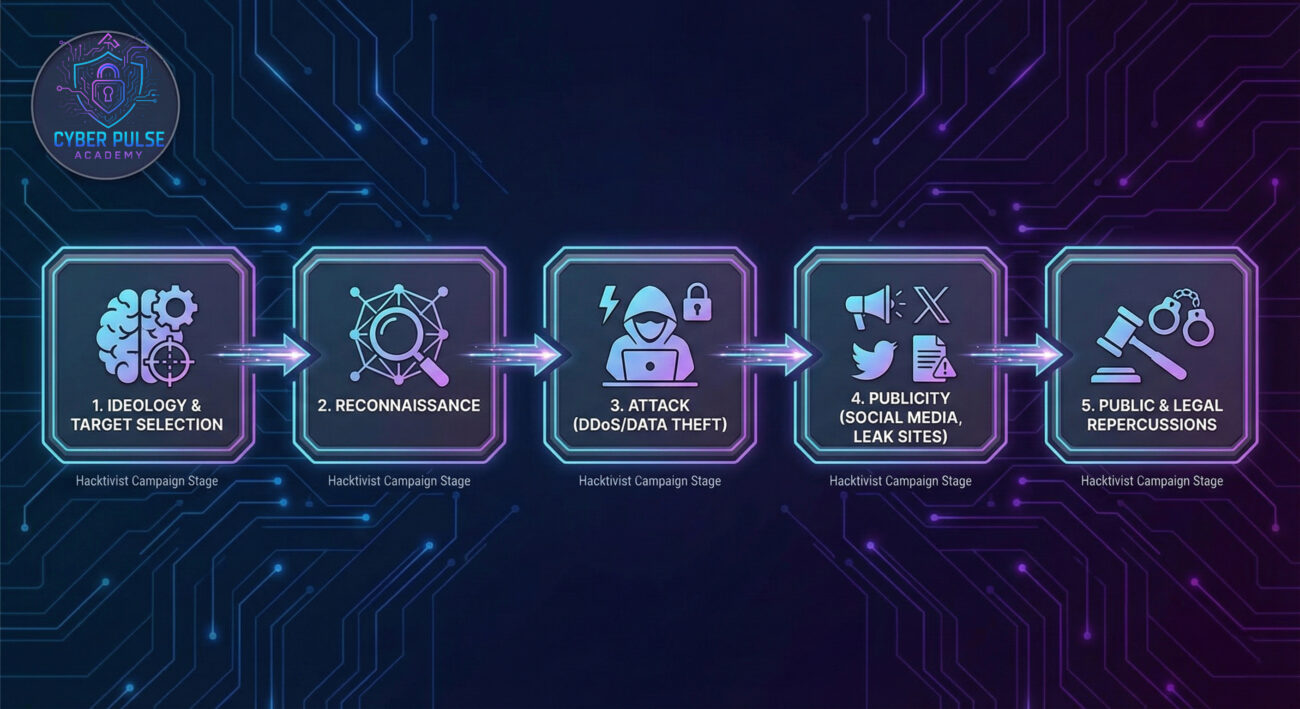
Ava and Digital Dawn execute "Operation #DigitalJustice." Here's how it unfolds:
| Time/Stage | What Happened | Impact |
|---|---|---|
| Week 1: Recon | The group scans PowerGrid's public websites and employee social media for vulnerabilities. | They find an outdated public file server with weak security. |
| Day of Attack | They launch a coordinated DDoS attack on the main website AND exploit the server to download internal documents. | The website goes down for 8 hours. They obtain thousands of files, including damaging emails. |
| Day After | Digital Dawn releases a curated "data dump" on a public leak site and promotes it on Twitter with #DigitalJustice. | Major news outlets pick up the story. PowerGrid's stock price drops. Public outrage grows. |
| Weeks Later | Authorities investigate both the corporation's cover-up AND the illegal breach. Some group members are identified. | PowerGrid faces fines and reforms. Some hacktivists face criminal charges for unauthorized access. |
This scenario shows the dual-edged nature of hacktivism: it can expose real wrongdoing but through illegal means that carry serious personal risk for the perpetrators and potential collateral damage (e.g., innocent employee data exposed).
As a beginner, you don't need to know how to code an attack, but you should know how to navigate a world where they happen. Here’s a step-by-step guide to developing a critical mindset.
When you see news about a hacktivist action, don't share immediately. Ask questions.
You could be an indirect target if a service you use is attacked. Strengthen your position.
Recognize the complex debate surrounding hacktivism.
Don't rely on social media hype. Follow cybersecurity journalists and official sources.
Hacktivist groups often use bold branding (like Guy Fawkes masks). Look past the symbol.
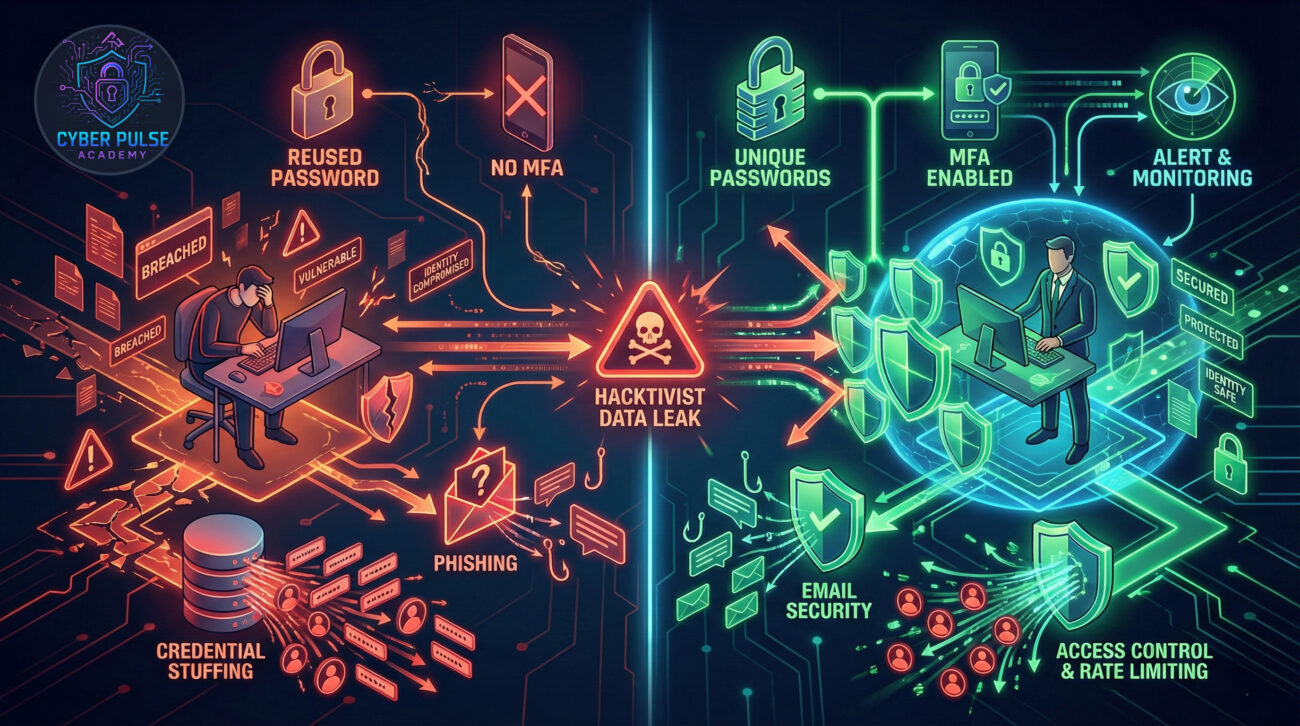
Simple Attack Path: A hacktivist group wants to silence a controversial website. Instead of a complex hack, they look for the easiest vulnerability. They discover the website uses a popular but outdated commenting plugin. Using a known exploit for that plugin, they gain a foothold, deface the homepage with their message, and delete the site's backups from the server to maximize disruption.
Defender's Counter-Move: The website owner, practicing good cybersecurity hygiene, had subscribed to vulnerability alerts for all their software. They had applied the patch for this plugin two days after it was released, closing the security hole. Furthermore, they used an external, encrypted backup service, so even if the server was compromised, they could restore the site quickly. The attacker's plan fails at the first step.
A hacktivist views the digital landscape as a political battlefield. They care about maximum visibility and symbolic impact. Their target selection is driven by ideology, not profit. They look for targets with high symbolic value and weak technical defenses, the "low-hanging fruit" that will get their message trending. Speed and public relations are often more important than stealth. They rely on the target's poor security practices (like unpatched software or reused passwords) as their primary weapon.
A defender sees hacktivists as a persistent, ideologically-driven threat. They care about maintaining availability (keeping services online), protecting data integrity, and preserving reputation. Defense isn't just about firewalls; it's about consistent, boring hygiene: patch management, employee training to avoid social engineering, and having an incident response plan. The defender knows they can't prevent all ideology, but they can harden their systems enough to not be the easiest target, often causing the hacktivist to move on.
Understanding hacktivism is a crucial step in your cybersecurity literacy. It’s a complex phenomenon that blends technology with societal conflict.
Cybersecurity isn't just about stopping thieves; it's about navigating a digital world where information itself is a weapon, a tool, and a target. By learning about forces like hacktivism, you move from being a potential victim to an informed, resilient participant in the digital age.
What's your take on hacktivism? Is it a necessary form of digital civil disobedience, or does the end never justify the means? Do you have questions about a specific hacktivist group or event? Share your thoughts and questions in the comments below! Let's build a community of informed, security-conscious beginners together.
Every contribution moves us closer to our goal: making world-class cybersecurity education accessible to ALL.
Choose the amount of donation by yourself.