











Certification Courses
Hands-On Labs
Threat Intelligence
Latest Cyber News
MITRE ATT&CK Breakdown
All Cyber Keywords
Have you ever worried about a trusted colleague accidentally, or intentionally, causing a data disaster? This is the unsettling reality of insider threats, one of cybersecurity's most complex and dangerous challenges. Unlike external hackers, these threats come from within your own walls.
An insider threat is any security risk that originates from within an organization, from employees, contractors, or business partners who have inside access to sensitive data and systems. Think of it like having a house with strong locks and alarms (your firewall and antivirus), but the danger comes from someone who already has a key.
In this guide, you'll learn: what insider threats really are, how they happen in the real world, step-by-step protection strategies, and the critical mistakes even smart organizations make.
Imagine your office building is protected by security guards, cameras, and badge access. One day, an employee, someone everyone trusts, quietly copies sensitive customer files onto a personal USB drive and walks out. No alarms sound. No guards stop them. This is the essence of an insider threat.
An insider threat isn't just about malicious intent. It could be a well-meaning employee who clicks on a phishing link, accidentally exposing the network. Or a contractor who misconfigures a cloud storage bucket, leaving it open to the internet. The common thread? Trusted access turned into a vulnerability.
This guide will demystify insider threats, showing you not only how they happen but, more importantly, how you can build a resilient defense using practical, proven strategies.
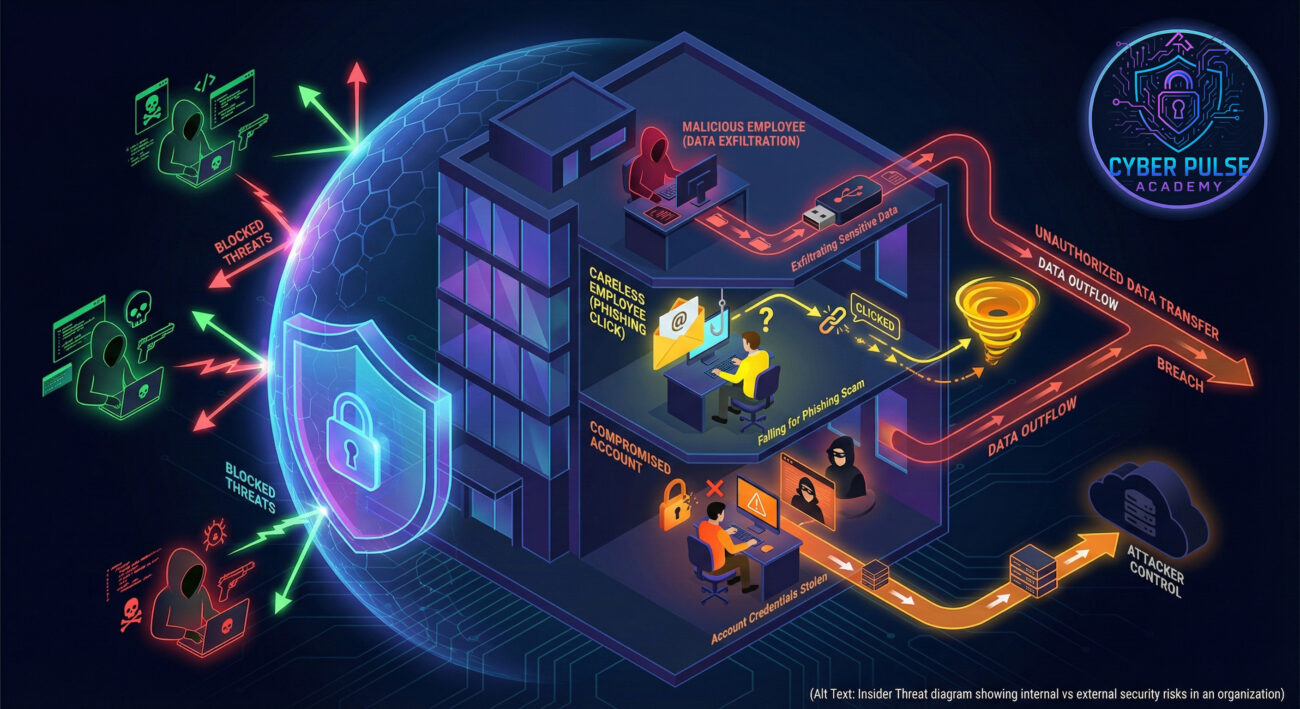
Insider threats are uniquely dangerous because they bypass most traditional security measures. Firewalls don't stop an employee from downloading a customer list, and antivirus software won't flag a manager accessing files they're authorized to see, even if their intent is malicious.
According to the IBM Cost of a Data Breach Report 2023, insider threats are among the costliest, with an average price tag of $4.90 million per incident. What's more frightening? The Verizon Data Breach Investigations Report consistently shows that a significant percentage of breaches involve internal actors.
This isn't just a big-company problem. Small businesses are especially vulnerable because they often operate on high trust with minimal oversight. Every organization that has people with access to data, money, or systems is at risk.
| Term | Simple Definition | Everyday Analogy |
|---|---|---|
| Malicious Insider | An employee or associate who intentionally harms the organization by stealing data or sabotaging systems. | A security guard who purposely leaves a back door unlocked for thieves. |
| Negligent Insider | A well-meaning person who causes a breach through carelessness, like losing a laptop or falling for a scam. | A roommate who forgets to lock the apartment door when they leave. |
| Compromised Insider | An employee whose credentials or computer have been taken over by an external attacker. | A friend whose phone is stolen; the thief now has access to all their social accounts. |
| Privileged Access | Special permissions that allow a user to perform sensitive actions (accessing financial records, admin panels). | Having the master key to an entire office building, not just your own room. |
| User Behavior Analytics (UBA) | Technology that uses machine learning to detect abnormal activity that might indicate a threat. | A credit card company calling you because your card was used in a foreign country, unusual for your pattern. |
Meet Alex, a senior software developer at "TechFlow Inc." passed over for a promotion. Feeling undervalued, Alex begins planning their exit, and decides to take something valuable with them.
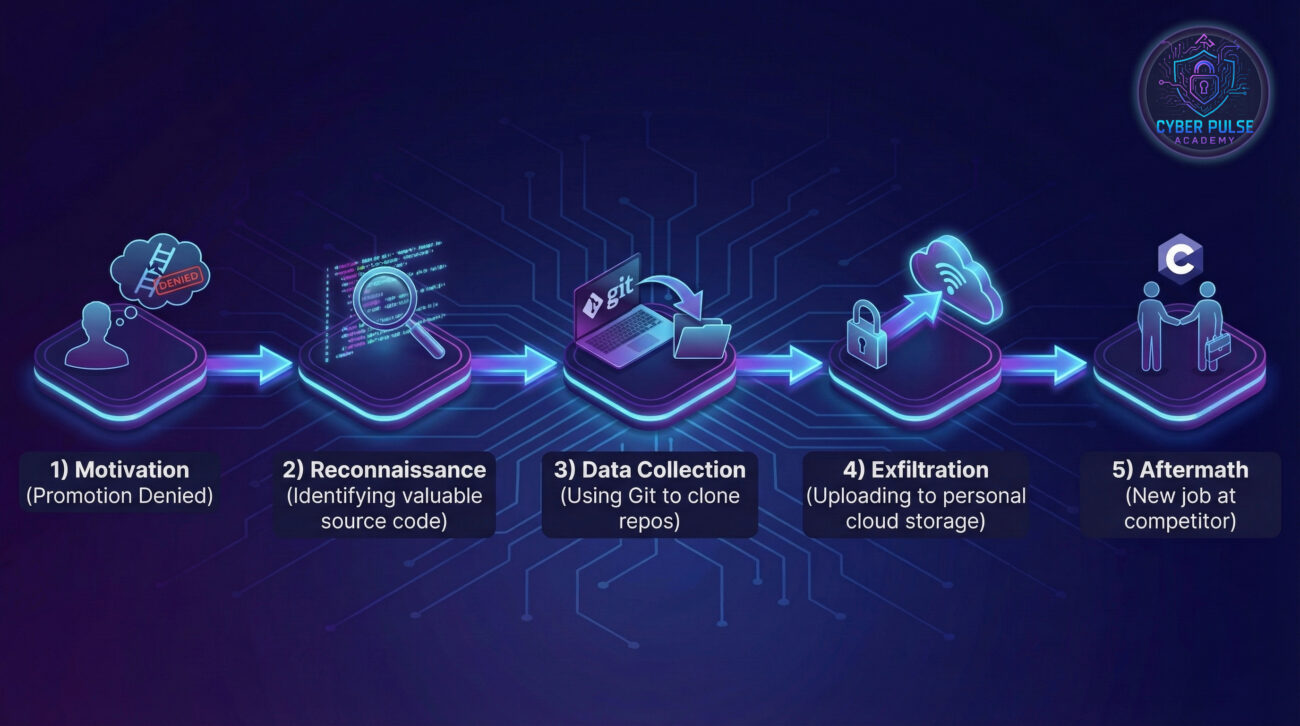
Over the next month, Alex uses their legitimate access to clone the company's entire proprietary source code repository to a personal external hard drive. They work late hours when fewer people are around, and because they're a senior developer, this activity doesn't trigger any alerts. Alex then secures a job at a direct competitor and hands over the code as a "portfolio piece."
| Time/Stage | What Happened | Impact |
|---|---|---|
| Week 1-2 | Alex feels resentful after promotion denial. Starts identifying the most valuable projects and source code. | Psychological breach of trust; planning begins. |
| Week 3 | Uses company Git credentials to create a full backup of key repositories. Activity blends with normal work. | Intellectual property theft in progress, undetected. |
| Week 4 | Transfers compressed code files to a personal cloud storage account during lunch breaks. | Data exfiltration complete. TechFlow's core asset is now in the wild. |
| Week 6 | Alex resigns, joins competitor. TechFlow discovers the theft months later when a similar product launches. | Massive financial loss, competitive disadvantage, and legal costs. |
Only grant access to the data and systems absolutely necessary for a person's job role.
You can't protect what you can't see. Monitor access to sensitive data and critical systems.
Turn your employees from potential vulnerabilities into active defenders.
Protect the devices (laptops, phones, USBs) where data is accessed and stored.
A departing employee's access must be terminated systematically and immediately.
Use technology to detect subtle, anomalous behavior that human monitors might miss.
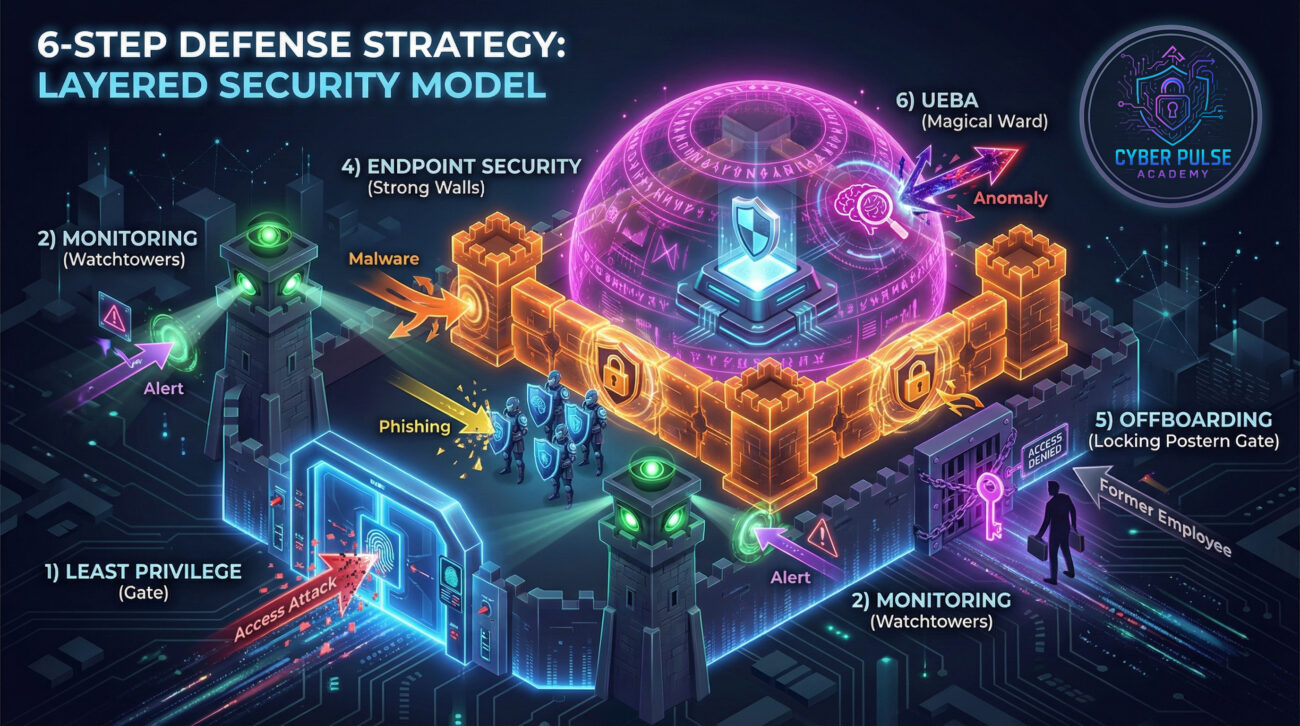
Let's walk through how an attacker might exploit insider vulnerabilities and how a defender can counter them.
The Simple Attack Path: An external attacker doesn't need to hack a firewall. They might target a specific employee on LinkedIn (like a finance staffer), send them a tailored phishing email pretending to be the CEO asking for "an urgent wire transfer." If successful, they now have the employee's email credentials. Logging in from a "trusted" account, they can bypass many controls to initiate fraudulent payments or access financial reports.
The Defender's Counter-Move: A savvy defender implements two key controls. First, they enforce MFA on all email and financial systems, so stolen passwords alone are useless. Second, they establish a secondary verification process for all financial transactions (like a phone call confirmation), creating a separation-of-duties hurdle that an attacker, even with one compromised account, cannot easily clear.
An attacker, whether external or a malicious insider, sees the human element as the most reliable vulnerability. They care about finding individuals with high levels of access, low security awareness, or potential grievances. Their goal is to obtain and abuse trusted credentials to move laterally, escalate privileges, and exfiltrate data without triggering alarms. They exploit the inherent trust an organization places in its people.
A defender must balance trust with verification. They care about establishing a baseline of normal behavior for every user and system. Their goal is to detect anomalies, enforce least privilege, and educate the workforce. They focus on building layered defenses (technology, process, people) that can identify and contain an insider attack at multiple stages, minimizing damage while protecting employee privacy and morale.
Insider threats represent a fundamental cybersecurity challenge because they turn necessary trust into a potential weakness. Protecting against them isn't about creating a culture of paranoia, but one of shared responsibility and intelligent oversight.
Let's recap the essentials:
By understanding the motivations and methods behind insider threats, you can begin to build the layered, people-aware defense necessary to protect your organization's most valuable assets.
Ready to start building your defense? Begin with Step 1 today: Conduct a quick review of who in your organization has access to your most critical data. You might be surprised.
Have questions or a story to share about insider risks? Join the conversation in the comments below! Let's learn from each other to build more secure organizations.
Every contribution moves us closer to our goal: making world-class cybersecurity education accessible to ALL.
Choose the amount of donation by yourself.