











Certification Courses
Hands-On Labs
Threat Intelligence
Latest Cyber News
MITRE ATT&CK Breakdown
All Cyber Keywords
Imagine a thief who doesn't bring tools to break into your house, instead, they use the screwdriver you left on your counter and the ladder leaning against your shed. That's the essence of a Living off the Land (LotL) cyber attack. It's one of the most deceptive and successful techniques used by modern hackers, and understanding it is your first step toward better digital safety.
In this comprehensive guide, you'll learn exactly what Living off the Land means, see how it works through relatable stories, and discover practical steps to protect yourself or your organization from these invisible threats. We're breaking down complex cybersecurity concepts into plain English, perfect for beginners.
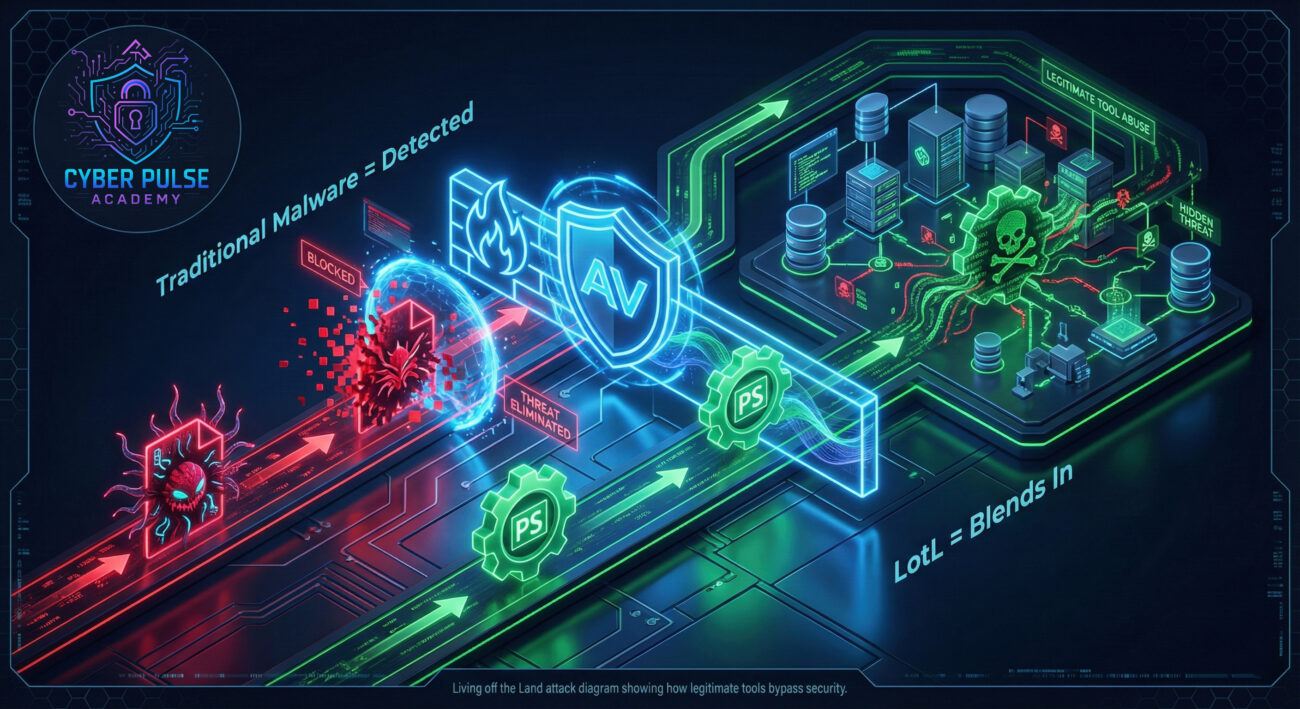
Have you ever wondered how a major company with expensive security software still gets hacked? Often, the answer is Living off the Land. Unlike traditional malware that must be snuck onto your system, LotL attacks use tools that are already there, making them incredibly hard to detect.
Living off the Land (LotL) refers to a cyber attack technique where hackers misuse legitimate, pre-installed system administration tools (like PowerShell, Windows Management Instrumentation, or even simple scripting) to carry out malicious activities. Think of it as digital camouflage, the attacker blends in by using what's already trusted and authorized.
By the end of this guide, you'll understand not just the "what" but the "how" and "why," empowering you to recognize the signs and implement effective protection.
According to a report by CISA, LotL techniques are now used in over 60% of sophisticated intrusions. Why? Because they bypass traditional defenses beautifully. Your antivirus won't flag PowerShell as a threat because it's a core Windows tool. Your firewall allows it because it's trusted. This creates a perfect blind spot.
For a beginner, this matters because it changes how you think about security. It's not just about blocking bad files; it's about monitoring *behavior* of good files. Whether you're protecting personal data or responsible for a business network, understanding Living off the Land principles helps you shift from a reactive to a proactive security mindset.
Recent major incidents, like the SolarWinds breach, involved LotL tactics. Attackers used trusted software update channels and system tools to move undetected for months. This isn't a niche technique, it's the mainstream method for advanced persistent threats (APTs).
Don't let the jargon intimidate you. Here are the essential terms you need to know, explained with simple analogies.
| Term | Simple Definition | Everyday Analogy |
|---|---|---|
| Living off the Land (LotL) | Using a system's own trusted tools for malicious purposes. | A burglar using your kitchen knife to cut open a locked drawer instead of bringing their own crowbar. |
| PowerShell | A powerful scripting tool built into Windows for system administration. | The master remote control for everything in your Windows house, lights, locks, thermostat. In the wrong hands, it opens everything. |
| Fileless Malware | Malicious code that runs in memory, never saving a file to disk. | A conversation where a spy gives verbal instructions that leave no written record. Once the conversation ends, the evidence is gone. |
| Behavioral Analysis | Security focused on detecting suspicious *actions* rather than bad *files*. | A security guard who doesn't just check IDs but watches for people acting nervously or trying doors they shouldn't. |
| Attack Surface | The total number of points (tools, software, ports) an attacker can try to exploit. | Every window, door, and doggy flap on your house. LotL attacks exploit the doors you leave unlocked for legitimate use. |
Let's follow "Alex," a systems administrator at "City General Hospital." Alex's network has a firewall, updated antivirus, and regular patches. It feels secure.
The Infiltration: An attacker sends a phishing email to a receptionist. It looks like a legitimate medical supply form. The receptionist clicks a link, which doesn't download a virus. Instead, it runs a hidden script that opens a backdoor using a trusted web browser process (a classic LotL move).
The Spread: From inside, the attacker uses the hospital's own Windows Script Host (WSH) to run commands. They use PowerShell, present on every hospital PC for admin tasks, to quietly explore the network, locate the patient database server, and steal credentials.
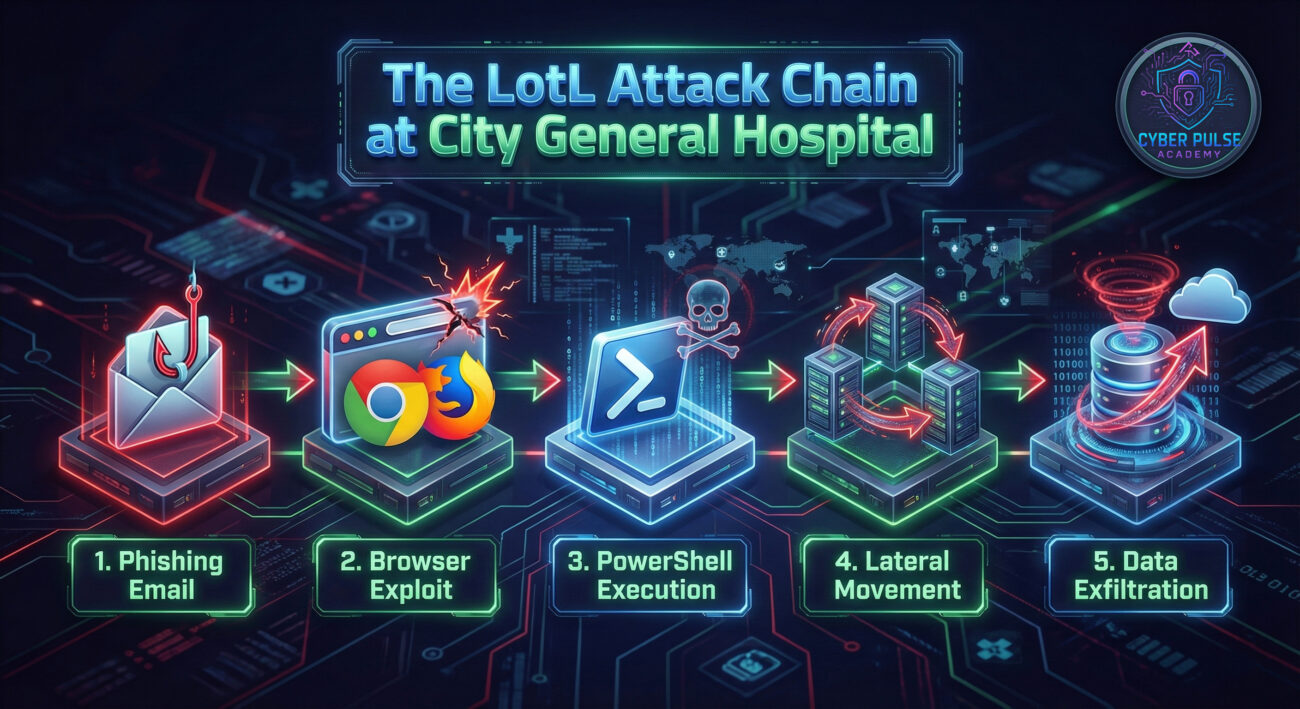
The Timeline & Impact:
| Time/Stage | What Happened (LotL Technique) | Impact |
|---|---|---|
| Day 1 | Initial phishing → Browser exploit (no file download). | Foot in the door. No alerts triggered. |
| Day 2-5 | Attacker uses built-in PowerShell to map network and discover servers. | Attacker learns the layout. Looks like normal admin activity. |
| Day 6 | Uses Windows Management Instrumentation (WMI) to move to the database server. | Accesses sensitive patient records (names, SSNs, medical history). |
| Day 7 | Uses legitimate FTP client already on server to send stolen data out, disguised as a backup. | Data breach of 50,000 records. Reputation damage, regulatory fines. |
The scary part? Traditional antivirus missed it all because no "malware" was ever installed.
Defending against Living off the Land requires a mindset shift. Here’s your actionable plan.
You can't spot suspicious behavior if you don't know what normal looks like.
Limit the power each user and tool has. If an account gets compromised, the damage is contained.
LotL attacks leave subtle traces in system logs. Turn on the right lights to see them.
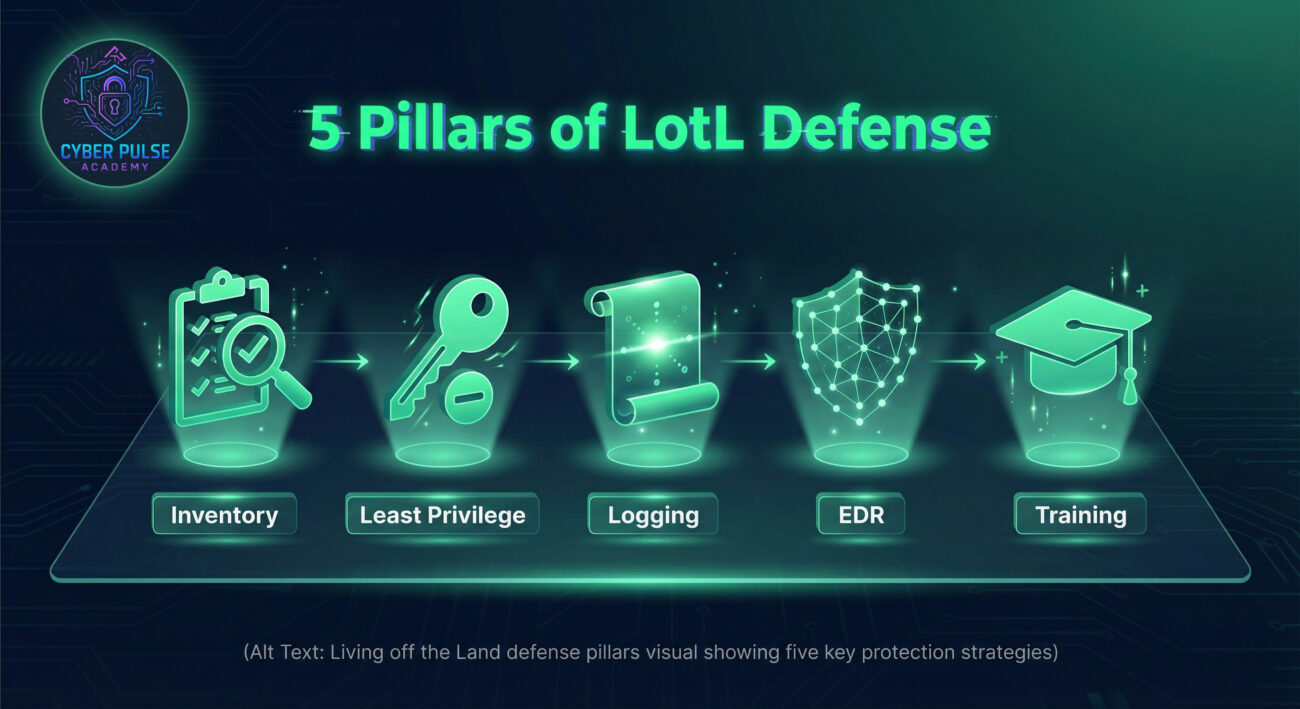
Traditional antivirus fails against LotL. You need tools that watch behavior.
The first step of many LotL attacks is still a phishing email. Educate your team.
Let's walk through a simple hypothetical. An attacker wants to steal files. Instead of malware, they use certutil.exe, a trusted Windows tool for managing certificates, to download a malicious script from the internet. The command looks technical but benign to casual inspection.
The Defender's Counter-Move: A threat hunter sets up an alert for any use of certutil.exe that includes web addresses (URLs) in its parameters, as this is not its normal function. They also correlate this event with logins from unusual geographical locations. The mindset shift? Don't just look for bad things, look for good things doing bad stuff.
"Our goal is stealth and persistence. We love Living off the Land because it's reliable. We don't need to risk payloads being detected on disk. We use PowerShell, WMI, and scheduled tasks because they're already whitelisted. We spend time learning the target's environment to mimic their admins. Every action is designed to look boring and legitimate in logs. Our success is measured in months undetected, not minutes."
"Our goal is to reduce noise and increase signal. We assume breach and focus on detection. We know LotL is the primary threat, so we log everything, enforce least privilege, and hunt for anomalies in tool usage. We care about context: Who ran what, from where, at what time, and does it match their job? We build behavioral profiles and look for deviations. It's a continuous game of cat and mouse, where understanding normal is our superpower."
Understanding Living off the Land is a game-changer for your cybersecurity knowledge. You've moved beyond the myth that only shady-looking files are dangerous and learned that the greatest risk often comes from trusted tools used maliciously.
Key Takeaways:
The landscape of cyber threats is always evolving, but the core principle of Living off the Land, blending in, remains a constant. By applying the steps and mindset outlined here, you're building a more resilient and aware defense.
Did this guide help demystify Living off the Land attacks? Do you have questions about implementing least privilege or interpreting Windows logs? Share your thoughts or questions below! Engaging with the community is one of the best ways to learn. If you're responsible for a network, pick one step from the guide, like enabling PowerShell logging, and implement it this week.
For further reading, explore authoritative resources from NIST on Zero Trust frameworks or SANS Institute white papers on incident response.
Every contribution moves us closer to our goal: making world-class cybersecurity education accessible to ALL.
Choose the amount of donation by yourself.