

Certification Courses
Hands-On Labs
Threat Intelligence
Latest Cyber News
MITRE ATT&CK Breakdown
All Cyber Keywords
Have you ever wondered why major news outlets keep reporting on cyber attacks from other countries? It might seem like something from a spy movie, far removed from your daily life. But what if I told you that state-sponsored cyber attacks could be targeting the very websites you visit, the infrastructure you rely on, and even your personal data?
In this beginner-friendly guide, we’ll demystify this complex topic. You’ll learn what it really means, why it matters to you, and how you can build a strong digital defense. No technical jargon, just clear explanations.
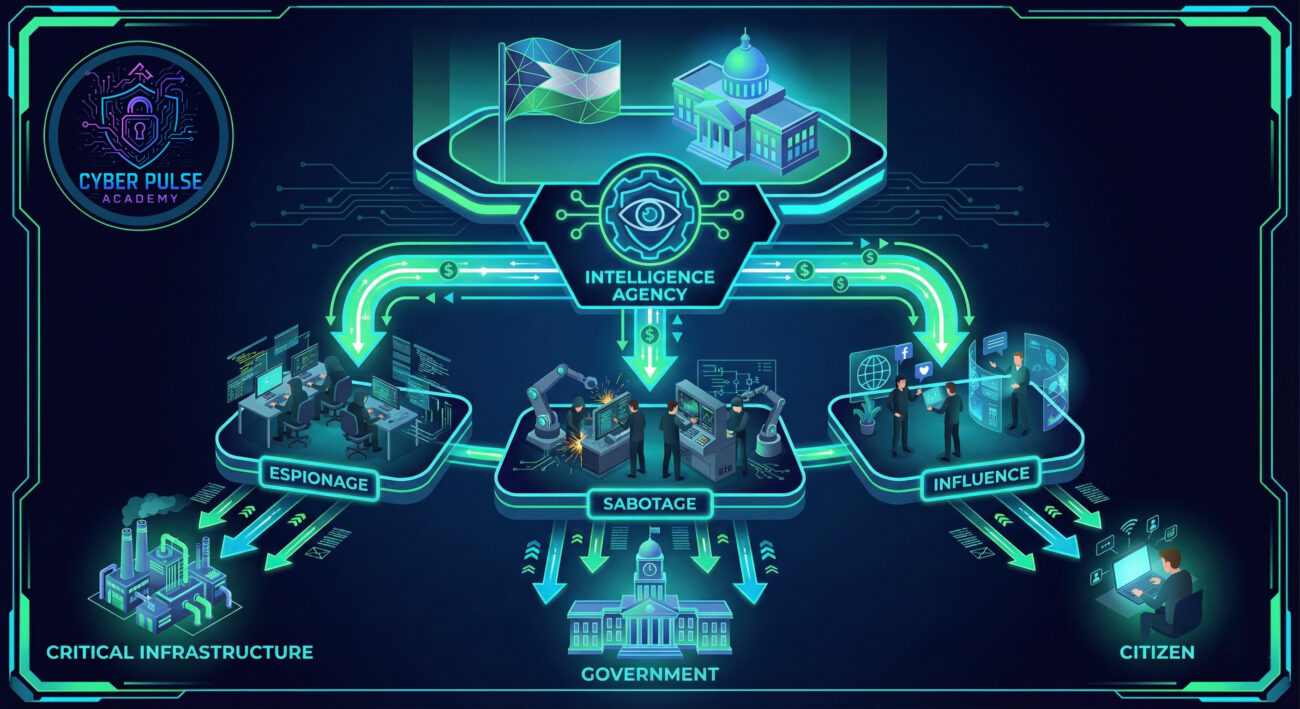
A state-sponsored cyber attack is when a government directly or indirectly supports, funds, or conducts hacking operations against another nation, its companies, or its citizens. Think of it not as a lone hacker in a basement, but as a well-funded, organized digital espionage unit with the resources of an entire country.
The impact is massive. According to the Cybersecurity and Infrastructure Security Agency (CISA), these actors are often behind the most damaging and stealthy breaches. Their goals aren't just financial theft; they aim to steal intellectual property, influence elections, disrupt critical infrastructure (like power grids), and gather intelligence.
For you, this means the digital landscape is more complex. That "phishing" email might be more sophisticated because it's backed by a national intelligence service. A vulnerability in software you use could be exploited not just by criminals, but by teams seeking to compromise millions of devices for a larger geopolitical goal. Understanding this helps you appreciate the importance of basic cyber hygiene.
Let's break down the essential lingo so you can follow any news article or report with confidence.
| Term | Simple Definition | Everyday Analogy |
|---|---|---|
| APT (Advanced Persistent Threat) | A stealthy, continuous hacking process often conducted by a state-sponsored group. They get in, stay hidden, and steal data over a long time. | Like a spy who infiltrates a company, gets a janitor job, and secretly photographs documents for years without getting caught. |
| Cyber Espionage | The act of using cyber techniques to steal secrets, intellectual property, or sensitive data. | Digital reconnaissance. Instead of using satellites to photograph a military base, they hack a defense contractor's network to download blueprints. |
| Zero-Day Exploit | An attack that takes advantage of a software vulnerability unknown to the vendor. Highly valuable. | A secret trap door in a house that even the builder doesn't know about. Only the attacker has the key. |
| Supply Chain Attack | Compromising a trusted third-party (like a software provider) to reach all of its customers. | Poisoning the water supply at a bottling plant to sicken everyone who drinks from that brand. |
| Attribution | The difficult process of identifying who is behind a cyber attack. | Figuring out which country launched a missile based on the fragments left behind. In cyberspace, attackers often use false flags. |
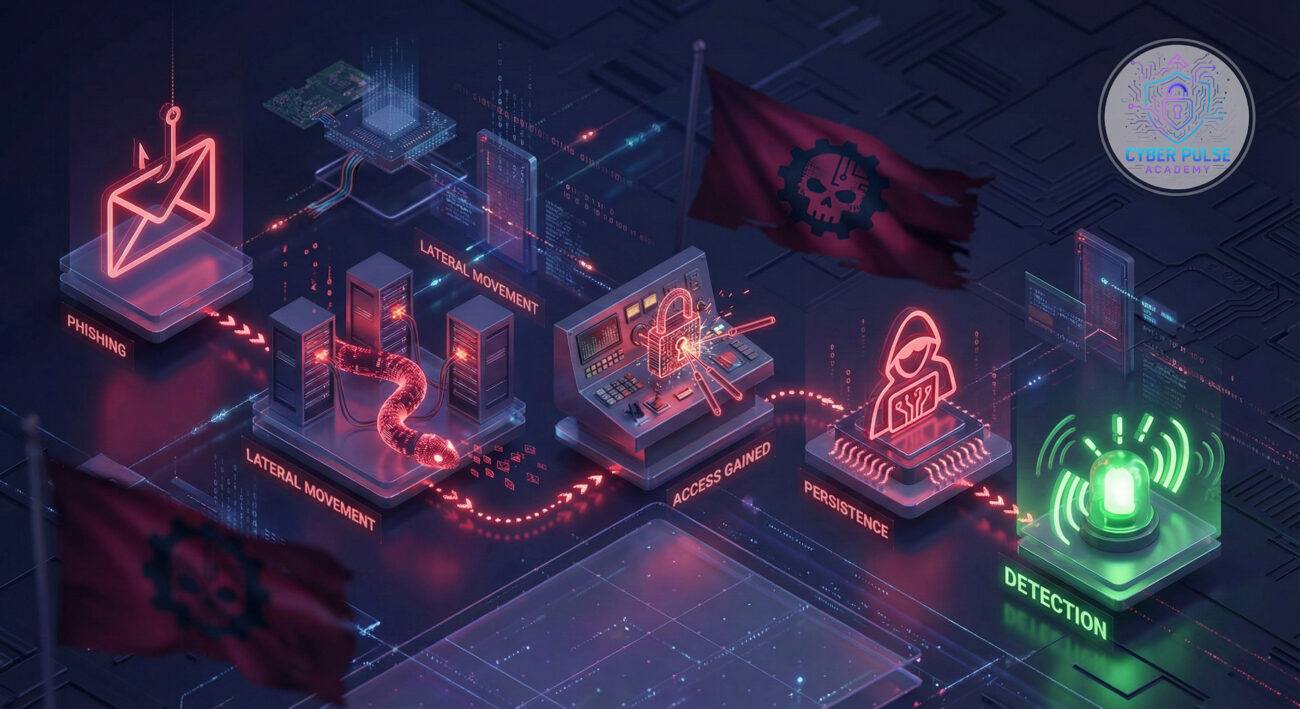
Let's follow "Maria," a systems engineer at "Metro Power Co." Her story illustrates how a state-sponsored attack can unfold and its real-world consequences.
It started with a sophisticated phishing email, seemingly from a trusted industry partner, inviting her to view a "critical safety update." The email was nearly flawless, a sign of the resources behind it. Maria, busy and trusting the sender's name, clicked a link that installed stealthy malware.
For months, the attackers lurked inside Metro Power's network. They mapped every system, stole engineering credentials, and learned how the grid operated. Their goal wasn't immediate chaos; it was positioning for potential future disruption during a geopolitical crisis.
| Time/Stage | What Happened | Impact |
|---|---|---|
| Week 1: Initial Compromise | Maria clicks the phishing link. Credential-stealing malware is installed. | Attackers have a foothold inside the corporate network. A major breach has begun. |
| Month 2-3: Lateral Movement | Using Maria's access, attackers move from the office network to the industrial control systems that manage physical power flow. | The "crown jewels" - the systems that control breakers and generators - are now accessible. |
| Month 4: Persistence & Discovery | Attackers install backdoors and study operational manuals. They identify how to cause a controlled blackout without permanent damage. | The utility is now completely compromised, but unaware. The attackers have a "switch" they can flip at a time of their choosing. |
| Month 5: Detection & Response | An anomaly in network traffic is spotted by a new monitoring tool. A cyber-incident response team is activated. | The long, costly process of evicting the attackers and repairing systems begins. National authorities are notified. |
This scenario, inspired by real events like the Ukraine power grid attacks, shows the patience and strategic nature of these threats. The "impact" wasn't an immediate blackout, but a profound loss of security and trust.
You can't single-handedly stop a nation-state, but you can drastically reduce your risk and avoid being an easy target. Think of it as making your digital house a fortress, not an open door.
This is your first and most critical line of defense.
This adds a second lock that requires physical proof (like your phone) to open.
Updates patch the secret doors (vulnerabilities) attackers use.
State-sponsored phishing is incredibly convincing.
Make stolen data useless and ensure you can recover.
Your router is the gateway to all your devices.
You are a sensor in the global defense network.
Let's briefly peek at the high-level game of cat and mouse.
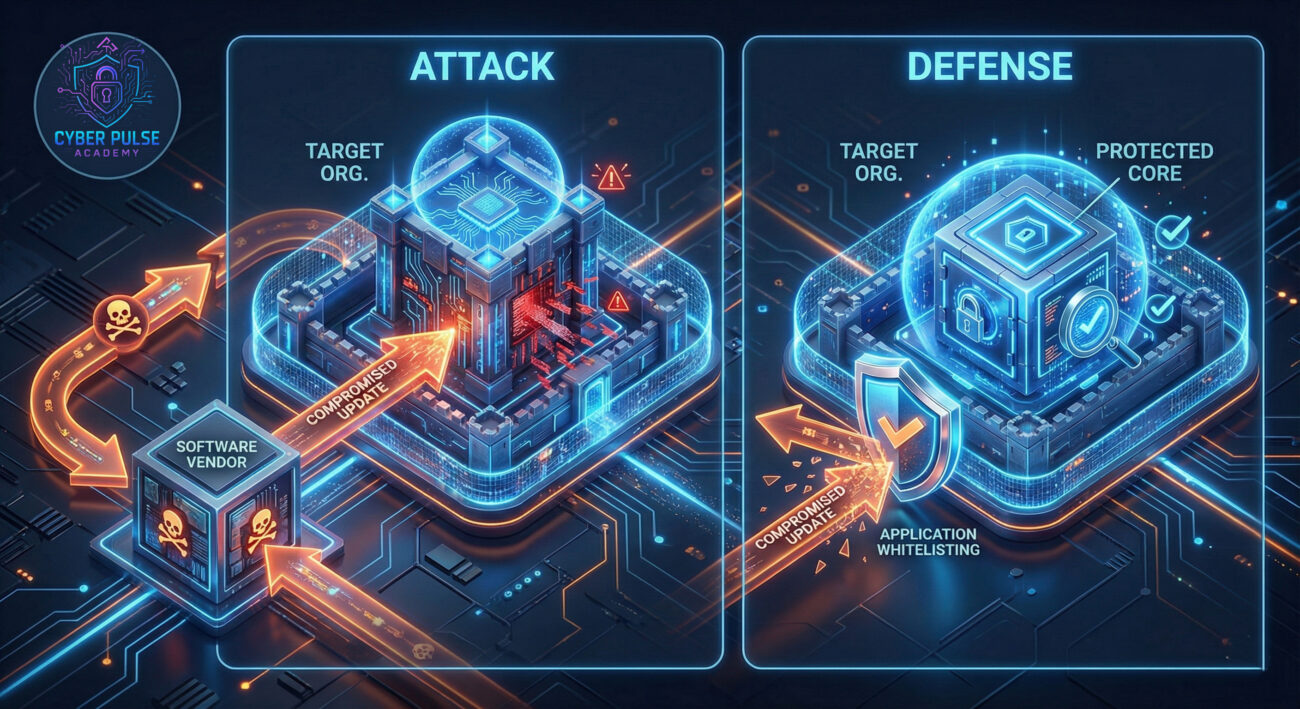
The Attack Path (Simplified): A state-sponsored team doesn't bash on the front door of a government agency. They look for the softest entry point, often a supplier. They might spend months compromising a small software company that provides IT services to the target. By injecting malware into a legitimate software update, they get their tools installed on hundreds of target networks automatically, with inherent trust. This is a supply chain attack.
The Defender's Counter-Move: Vigilant defenders monitor not just their own networks, but also the behavior of their trusted partners. They implement "application whitelisting," which only allows pre-approved software to run, blocking even tampered-with updates. They practice "assumed breach" drills, constantly hunting for hidden attackers inside their network, knowing a breach is possible.
For a state-sponsored hacker, success is defined by stealth and achieving a strategic objective. They care about access, persistence, and evasion. Their goal is to get in, stay in as long as needed, and move laterally to the high-value target without triggering alarms. Time is on their side; they can spend months planning a single operation. They view your weak password or unpatched software not as a petty crime opportunity, but as a potential "jump point" into a much larger network.
The defender's mission is to protect, detect, and respond. They assume the adversary is already inside or will get in. Their focus is on minimizing the "attack surface" (fewer doors), monitoring for anomalous behavior (strange activity in the logs), and having a plan to contain and evict an attacker when found. They care deeply about asset inventory (knowing what's on the network), patch management, and user training. Their victory is maintaining operations and keeping data secure and encrypted.
Understanding state-sponsored cyber attacks is less about fear and more about empowerment. You now see the bigger picture behind many cybersecurity headlines.
Cybersecurity in the age of state-sponsored threats is a shared responsibility. By taking informed, practical steps, you move from being a potential vulnerability to becoming an active node in a more resilient network.
What's the first step you'll take? Enabling MFA on your main email? Installing a password manager? Share your thoughts or questions in the comments below, let's build a safer digital world together.
Further Reading: Deepen your knowledge with our guides on Two-Factor Authentication and Spotting Phishing Attacks.
Every contribution moves us closer to our goal: making world-class cybersecurity education accessible to ALL.
Choose the amount of donation by yourself.