














Certification Courses
Hands-On Labs
Threat Intelligence
Latest Cyber News
MITRE ATT&CK Breakdown
All Cyber Keywords
Ever wondered who's really behind those alarming news headlines about data breaches and massive ransomware attacks? You're not alone. For anyone new to cybersecurity, the term "threat actor" can sound like technical jargon from a spy movie. But understanding who these digital adversaries are is your first, most powerful step toward true online safety.
In simple terms, a threat actor is any individual or group that performs actions intended to cause harm to digital systems, networks, or data. Think of them not as faceless hackers in hoodies, but as digital adversaries with specific goals, tools, and motivations. Just as you'd want to know if you're dealing with a petty thief or an organized crime ring in the physical world, knowing your cyber adversary is key to defense.
In this guide, you'll learn: Who threat actors really are, their different motivations and methods, a real-world scenario of how they operate, and most importantly, practical steps you can take to protect yourself.
Imagine your personal data, emails, photos, bank details, is cash in a vault. A threat actor is anyone trying to pick the lock, smash the window, or trick the guard to get inside. They aren't always after your money directly; sometimes they want your computer's power, your personal information to sell, or simply to cause disruption.
This isn't just about big corporations. From your social media accounts to your smart home devices, you are a potential target. The first step in building a strong digital defense is knowing who you're defending against. By the end of this post, the term threat actor will shift from a vague threat to a recognizable set of profiles, each with weaknesses you can guard against.
Cybersecurity isn't just about installing an antivirus. It's about understanding the landscape of risk. A 2023 report by IBM found the average cost of a data breach soared to $4.45 million, a figure driven by sophisticated threat actors. Knowing whether you're a target of a financially motivated cybercriminal or a state-sponsored group changes your entire defense strategy.
For individuals, the impact is personal. A threat actor gaining access to your email can lead to identity theft, financial loss, and a massive invasion of privacy. For small businesses, it can mean reputational ruin. Recognizing that different threat actors use different methods, from sophisticated phishing lures to brute-force attacks, allows you to prioritize your protections effectively, focusing on the most likely dangers first.
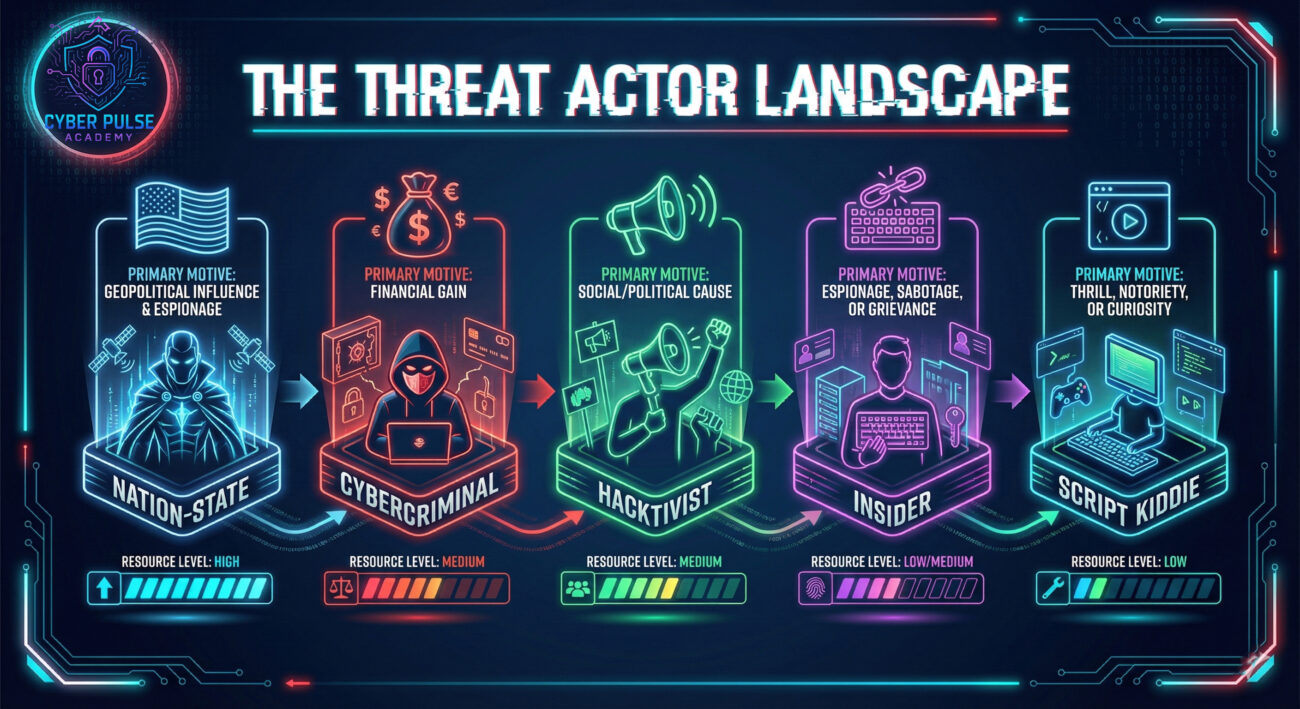
Let's break down the essential vocabulary. This table translates cybersecurity jargon into plain English with everyday analogies.
| Term | Simple Definition | Everyday Analogy |
|---|---|---|
| Threat Actor | Any person or group that performs a malicious action against a computer system or network. | A burglar, but for digital assets instead of physical homes. |
| Attack Vector | The path or method a threat actor uses to gain unauthorized access. | The way a burglar gets in: an unlocked window (weak password), a copied key (phishing email), or tricking the homeowner (social engineering). |
| Motivation | The "why" behind the attack. Drives the actor's goals and methods. | A burglar's motive: money (cybercriminal), protest (hacktivist), or gathering intelligence (nation-state spy). |
| Capability | The resources, skills, and tools available to the threat actor. | The difference between a lone pickpocket (low capability) and an organized crime ring with surveillance gear and getaway cars (high capability). |
| Attack Surface | All the different points where an unauthorized user can try to enter or extract data from your digital environment. | Every door, window, vent, and gate to your house. The more you have, the more you need to secure. |
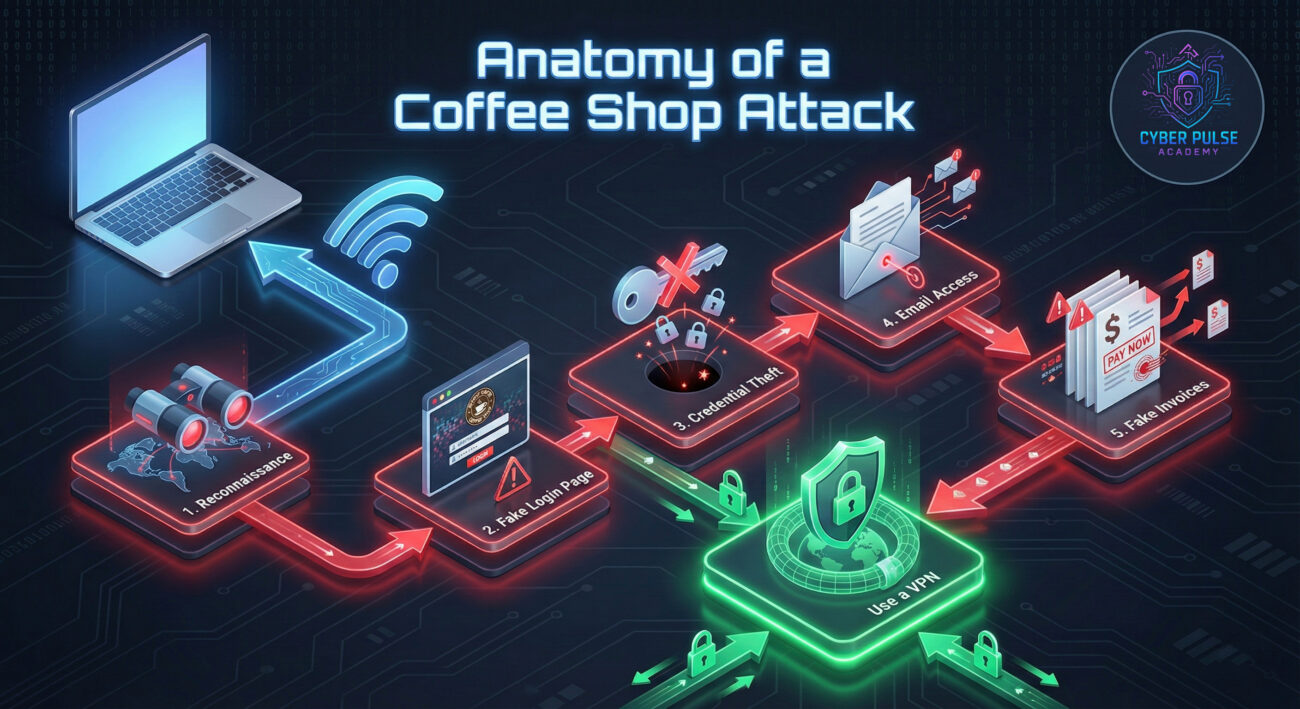
Let's follow "Maria," a freelance graphic designer. Maria often works from her local café using public Wi-Fi. An attack unfolds over a few days, orchestrated by a financially motivated cybercriminal threat actor.
| Time/Stage | What Happened (Threat Actor's Action) | Impact on Maria |
|---|---|---|
| Day 1: Reconnaissance | The actor scans the café's unsecured Wi-Fi network, identifying connected devices, including Maria's laptop. | Maria is unaware she's been identified as a potential target. No immediate impact. |
| Day 1: Weaponization | The actor creates a fake "Public Wi-Fi Login" page that looks legitimate, a classic phishing tactic. | Maria's digital risk increases, but she remains unaware of the trap. |
| Day 2: Delivery & Exploitation | When Maria connects the next day, she's redirected to the fake page. She enters her email password to "log in," unknowingly giving it to the hacker. | Credentials are stolen. A critical breach occurs. |
| Day 3: Actions & Monetization | The actor accesses Maria's email, finds invoices, and sends fake payment requests to her clients, redirecting payments to the actor's account. | Financial loss, damaged client relationships, and a stressful recovery process begin. |
This scenario shows how a single vulnerability (unsecured public Wi-Fi use) can be exploited by a threat actor through a series of logical steps, leading to significant harm.
Your goal isn't to become a hacker, but to adopt a defender's mindset. Follow these steps to shrink your attack surface and become a harder target for any threat actor.
Identify your "crown jewels", the data that would hurt the most if lost or stolen.
Implement foundational security hygiene to block the most common attack vectors.
Guard against social engineering, a favorite tool of threat actors.
Protect the environment where your data lives and travels.
Assume some attacks will get through. Your recovery plan is your last line of defense.
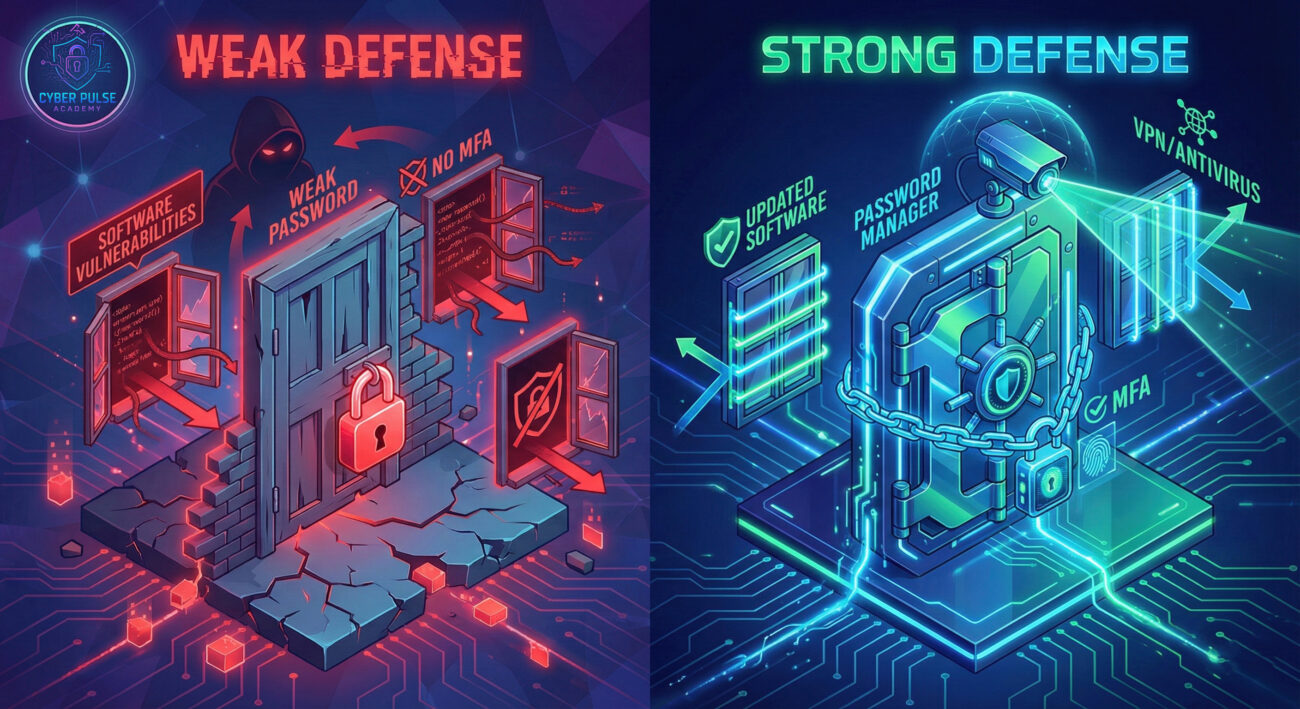
Let's briefly look through the lens of both attacker and defender to understand the chess match.
The Simple Attack Path: A threat actor doesn't need to be a genius to be effective. They often start with the easiest vulnerability. For example, they might scan the internet for routers still using default admin credentials (admin/password). Once they find one, they can log in, change settings to redirect your internet traffic, or install malware. Their reasoning is simple: why pick a high-security lock when thousands of doors are wide open?
The Defender's Counter-Move: A defender thinking like a threat actor asks, "What's the easiest way into my own systems?" They then systematically eliminate those easy paths. This starts with changing all default passwords, disabling unnecessary remote access features, and monitoring their network for any unusual login attempts or configuration changes. The mindset shift is from "I hope I don't get attacked" to "I've made it unnecessarily hard for an attack to succeed."
A threat actor (the Red Team perspective) is focused on efficiency and return on investment. They look for the path of least resistance. Is there an unpatched server? A user likely to click a phishing link? They care about stealth (avoiding detection), access (getting in), and persistence (staying in). Their goal is to achieve their objective, whether financial gain, data theft, or disruption, with minimal cost and effort. They aren't trying to break the strongest defense; they're looking for the weakest link in the chain.
The defender (Blue Team) focuses on resilience and risk reduction. They assume a threat actor will eventually get in, so they work to secure critical assets, monitor for suspicious activity, and ensure they can recover quickly. They care about protection (layered defenses), detection (spotting anomalies), and response (containing and remediating incidents). Their mindset is about building a system that remains functional and secure even under pressure.
Understanding the threat actor is the cornerstone of practical cybersecurity. You don't need to be an expert to significantly improve your safety; you just need to think strategically about who might want to cause harm and how they might try to do it.
Let's recap the essential lessons:
By demystifying the term threat actor, you've taken control. You're no longer defending against a scary, unknown monster. You're now equipped to identify potential digital adversaries and build sensible, effective defenses against them.
What part of the threat actor landscape surprised you the most? Do you have a specific type of digital threat you'd like us to break down next? Share your thoughts and questions in the comments below, let's build a safer digital world, one step at a time.
Every contribution moves us closer to our goal: making world-class cybersecurity education accessible to ALL.
Choose the amount of donation by yourself.