


























Certification Courses
Hands-On Labs
Threat Intelligence
Latest Cyber News
MITRE ATT&CK Breakdown
All Cyber Keywords
You’ve pitched a new Attack Surface Management (ASM) platform to your leadership. You’ve talked about shadow IT, unknown attack vectors, and digital risk. Yet, when the CFO asks for the Return on Investment (ROI), the conversation stalls. How do you quantify the value of a threat that was never allowed to become a breach? This is the fundamental ROI problem in cybersecurity, and it's particularly acute for proactive disciplines like attack surface management.
This guide will deconstruct the attack surface management ROI challenge, move beyond traditional financial formulas, and provide you with a practical framework to build an ironclad business case that secures the budget and resources you need.
In business, ROI is typically calculated as (Gain from Investment - Cost of Investment) / Cost of Investment. For a sales tool, the "gain" is increased revenue. For a manufacturing robot, it's higher output and lower labor costs. But for a proactive security control like ASM, the primary "gain" is a negative: incidents that didn't happen, data that wasn't stolen, and fines that weren't levied.
This creates several unique challenges:
Imagine a development team spins up a cloud server for testing, forgets about it, and leaves it running with default credentials. This server is now a critical vulnerability, part of your shadow IT and unknown attack surface.
Without ASM: An automated bot finds it, exploits it, and installs ransomware that spreads. The result? A multi-million dollar incident, downtime, and front-page news.
With ASM: Your platform discovers the server within 24 hours, alerts the team, and the vulnerability is closed. The result? Nothing happens. The "gain" is the avoidance of a multi-million dollar loss, but proving that specific loss was imminent is the core of the attack surface management ROI challenge.
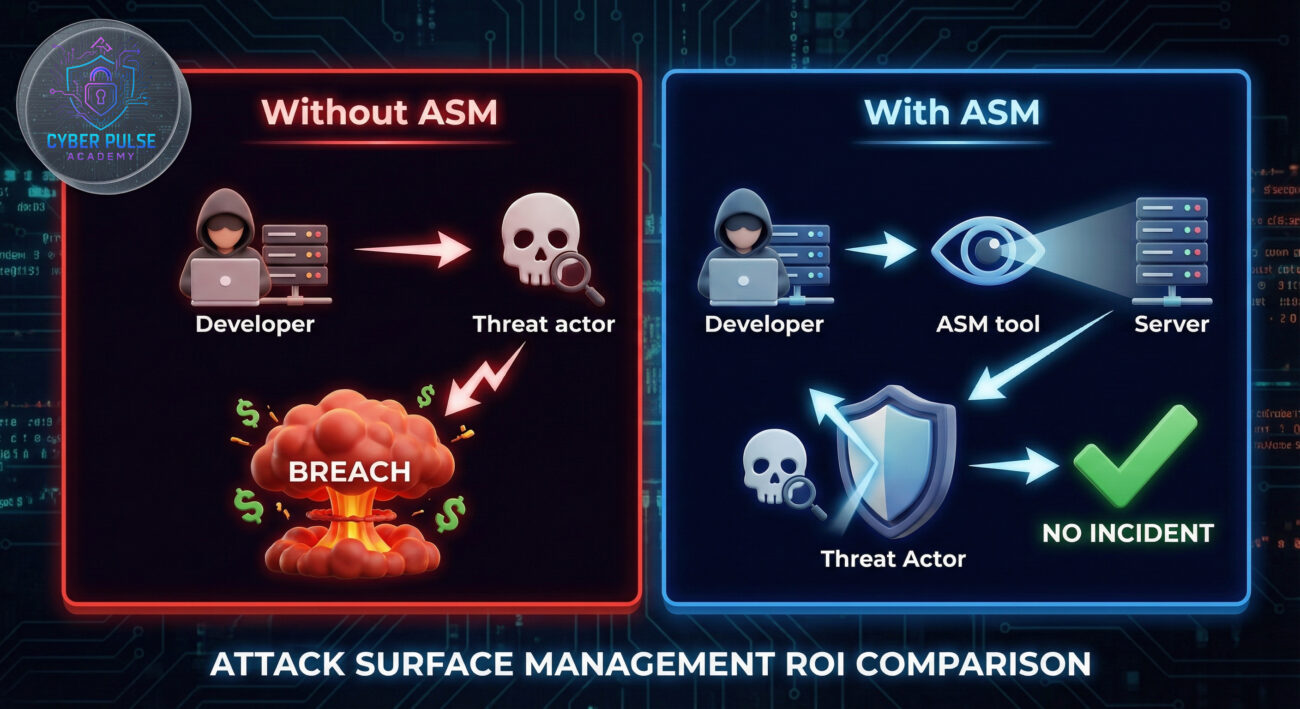
To solve the attack surface management ROI problem, we must shift from pure financial ROI to a Value-Based Justification Framework. This framework articulates value across four key pillars:
| Pillar | What It Measures | Key Metrics & Examples |
|---|---|---|
| 1. Risk Reduction | The decrease in exposure and likelihood of a successful attack. | • Reduction in mean time to discovery (MTTD) of assets • Percentage decrease in exposed, high-severity vulnerabilities • Number of unknown internet-facing assets discovered and secured |
| 2. Operational Efficiency | Time and resource savings for the security and IT teams. | • Hours saved per week on manual asset discovery • Reduction in time to investigate incidents due to better context • Automated workflow triggers for remediation |
| 3. Compliance & Governance | Ability to meet regulatory requirements and demonstrate due diligence. | • Automated reports for audits (e.g., SOC 2, ISO 27001) • Proof of continuous monitoring for cyber insurance • Mapping of assets to compliance frameworks |
| 4. Strategic Enablement | How ASM supports business goals like safe digital expansion. | • Enabling secure mergers & acquisitions by rapidly assessing new assets • Providing a "security bill of health" for new product launches • Reducing business interruption risk |
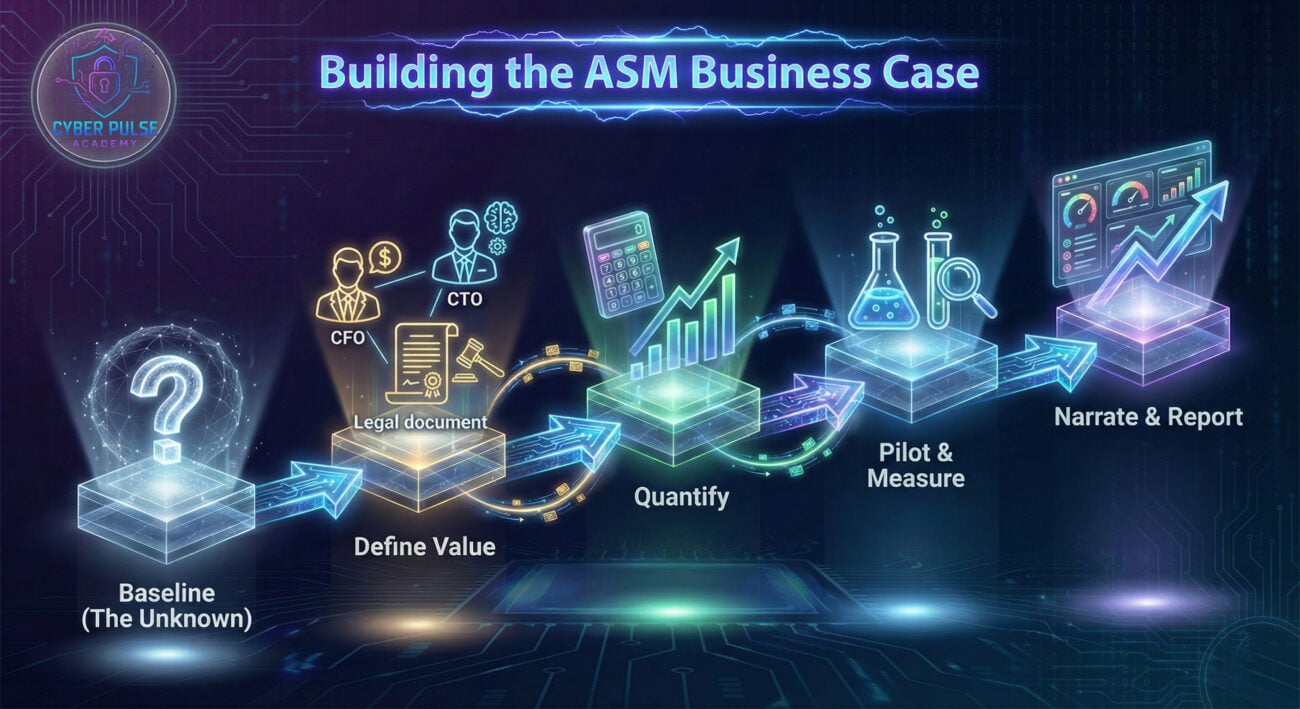
Follow this step-by-step framework to translate the value pillars into a compelling narrative for your leadership.
You can't measure improvement without a starting point. Use a combination of free tools and manual audits to ask: How many assets do we *think* we have vs. how many an attacker can see? Document the time spent on manual discovery and the typical timeline from asset creation to security oversight.
Hard Metrics (Direct Savings):
• Labor Cost Savings: (Hours saved per week) x (Fully-loaded employee cost per hour)
• Reduced Tool Overlap: Cost of retiring redundant legacy discovery tools.
• Insurance Premium Impact: Potential for reduced cyber insurance premiums.
Soft Metrics (Risk & Efficiency):
• "We reduced our unknown external attack surface by 40% in 6 months."
• "We cut the time to discover a new, unauthorized cloud instance from 30 days to 2 hours."
• "We now have 100% visibility into assets covered by our compliance framework."
Run a controlled pilot of an ASM solution on a segment of your infrastructure (e.g., all cloud assets). Use the baseline from Step 1 to measure the pilot's impact on discovery time, vulnerability counts, and team hours. This real, internal data is your most powerful proof point.
Don't just send a one-time report. Create a monthly or quarterly "Cyber Risk Posture" dashboard for leadership. Tie findings back to business units. Show trends over time. The narrative should be: "This is the risk we identified and eliminated before it could hurt us. Here is the efficiency we gained."
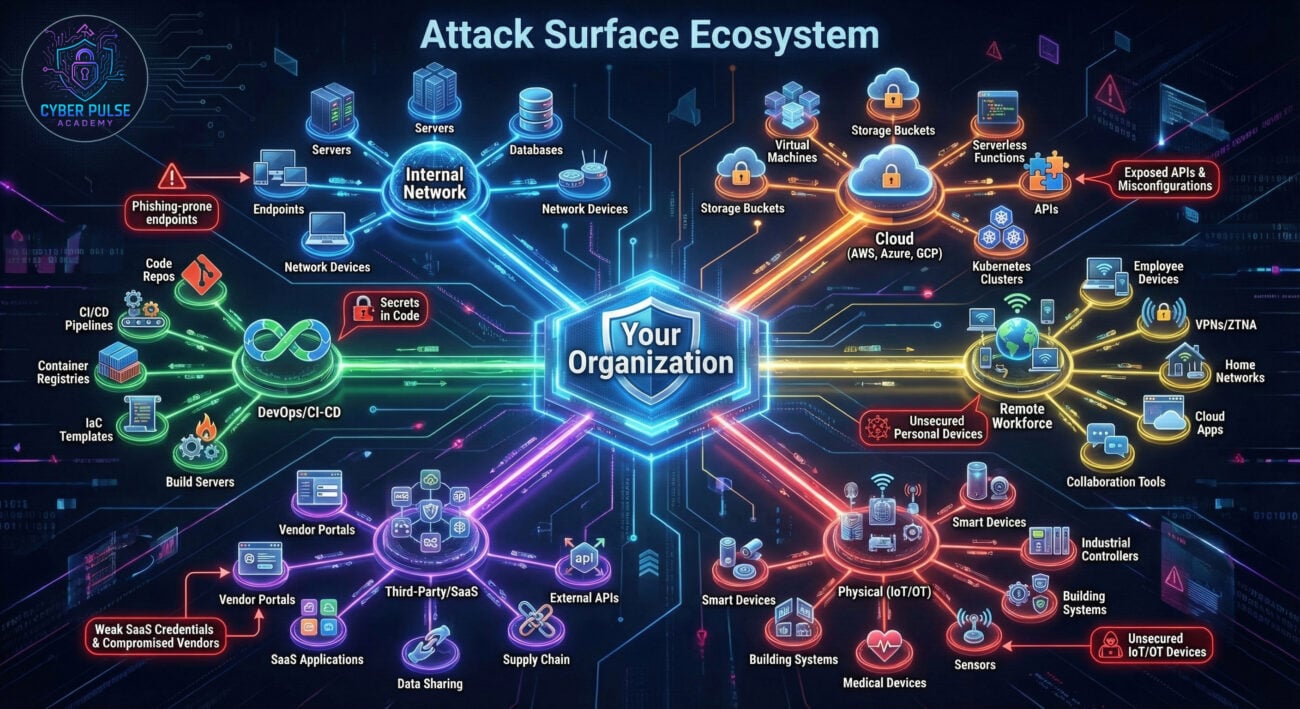
For a threat actor or penetration tester, an organization's attack surface is a treasure map. Their value proposition is clear: find the easiest, fastest path in.
An effective ASM program directly attacks their business model by systematically finding and eliminating these easy entry points, forcing them to pursue more difficult, costly, and detectable attacks.
For the security team, the attack surface is a constantly shifting frontier they must guard. Their challenge is visibility and prioritization.
The value is measured in reduced risk, regained time, and informed decision-making. It transforms security from a reactive firefight to a proactive risk management function.
Q: Isn't ASM just a more expensive vulnerability scanner?
A: No. Traditional vulnerability scanners require a known IP/asset list to scan. ASM starts by discovering what you own from an external, adversary-like perspective, including assets you didn't know existed. It then contextualizes vulnerabilities with business risk and often covers areas scanners miss, like sensitive data leaks and third-party exposures.
Q: Can't we just do this manually or with open-source tools?
A: You can start with tools like Nuclei or Amass. However, manual efforts are not continuous, struggle to scale, require significant expertise to run and interpret, and lack the correlation and prioritization engines of commercial platforms. The ROI of a commercial tool comes from automation, scalability, and integration, freeing your skilled staff for higher-value tasks.
Q: How do we handle the flood of alerts an ASM tool generates?
A: This is a critical implementation detail. Start with a narrow scope (e.g., only critical and high-severity findings related to externally-facing assets). Use the tool's risk-scoring features to prioritize. Most importantly, integrate findings directly into the workflow of the team that can fix them (e.g., automatically create Jira tickets for the DevOps team). Tune the tool over time to reduce noise.
Q: What's the #1 metric I should track to prove value in the first 90 days?
A: "Reduction in Mean Time to Discovery (MTTD) of New, High-Risk External Assets." If you can show that you now find and assess rogue cloud instances or exposed databases in hours instead of weeks or months, you've demonstrated a direct, massive reduction in dwell time for an attacker.
Stop struggling to justify proactive security. Begin building your data-driven case today.
Your Action Plan:
With this foundation, you can transform the attack surface management ROI conversation from a defensive debate into a strategic discussion about business resilience and growth.
© 2026 Cyber Pulse Academy. This content is provided for educational purposes only.
Always consult with security professionals for organization-specific guidance.
Every contribution moves us closer to our goal: making world-class cybersecurity education accessible to ALL.
Choose the amount of donation by yourself.