






























Certification Courses
Hands-On Labs
Threat Intelligence
Latest Cyber News
MITRE ATT&CK Breakdown
All Cyber Keywords
A critical security flaw designated as CVE-2025-2009 (CVSS Score: 9.8) has been discovered in the BodyParser middleware of the AdonisJS Node.js framework. This vulnerability allows attackers to perform prototype pollution through specially crafted HTTP requests, which can be chained to achieve Remote Code Execution (RCE) on vulnerable servers. This comprehensive guide breaks down the technical exploit mechanics and provides actionable defense strategies.
The AdonisJS BodyParser vulnerability (CVE-2025-2009) is a prototype pollution flaw in the framework's request body parsing middleware. With a CVSS score of 9.8 (Critical), this vulnerability affects applications using AdonisJS versions before the security patch.
At its core, the BodyParser middleware is responsible for parsing incoming HTTP request data (JSON, form data, etc.) and making it available to application controllers. The flaw existed in how this parser handled nested objects during the merging process.
In JavaScript, every object inherits properties from a prototype. Prototype pollution occurs when an attacker can inject properties into this prototype chain, causing all objects to inherit these malicious properties. This can lead to:
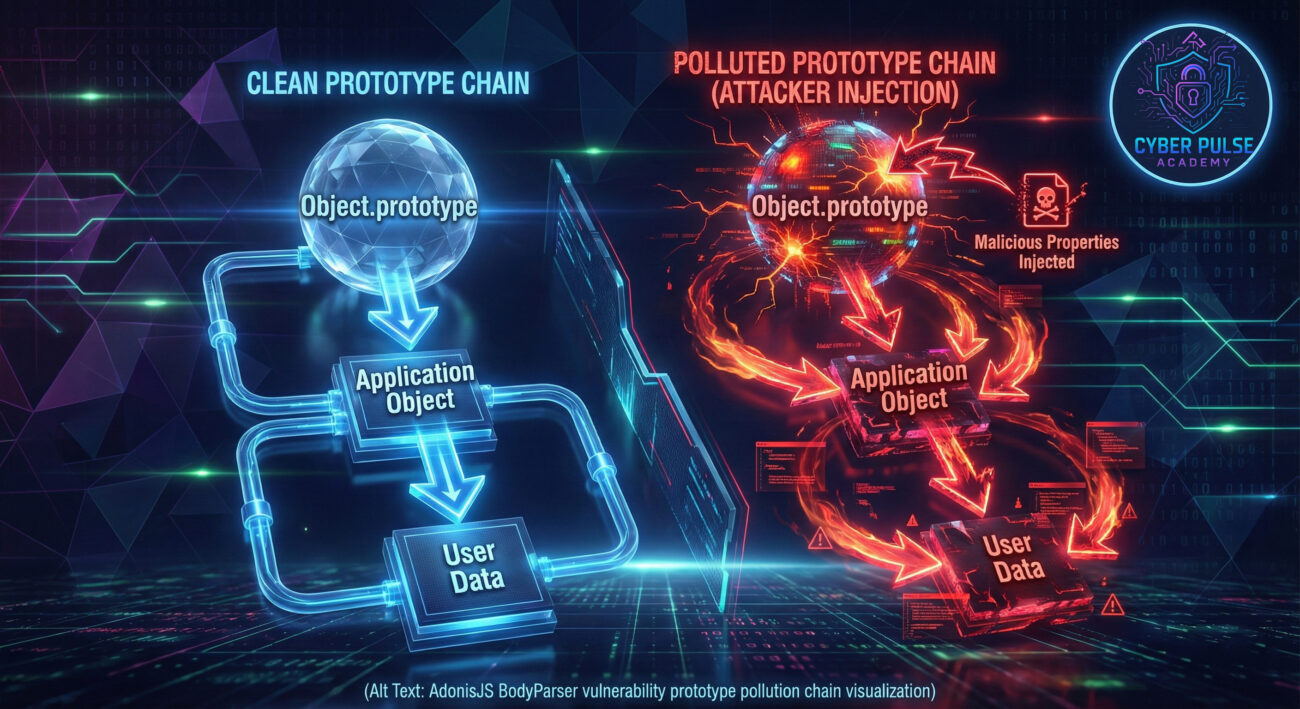
The AdonisJS BodyParser vulnerability enables a multi-stage attack chain that transforms a seemingly benign JSON payload into full server compromise.
The attacker sends a specially crafted HTTP POST request with a JSON payload containing prototype pollution primitives:
POST /api/user/profile HTTP/1.1

Content-Type: application/json


{

  "user": "attacker",

  "__proto__": {

    "polluted": "malicious_value",

    "toString": "malicious_function"

  },

  "constructor": {

    "prototype": {

      "admin": true

    }

  }

}
The vulnerable BodyParser recursively merges this data without sanitizing special JavaScript properties. The insecure merge function looks similar to this:
// VULNERABLE CODE (Simplified example)

function merge(target, source) {

  for (const key in source) {

    if (typeof source[key] === 'object' && source[key] !== null) {

      // Recursive merge without prototype check

      target[key] = merge(target[key] || {}, source[key]);

    } else {

      // Direct assignment - allows __proto__ injection

      target[key] = source[key];

    }

  }

  return target;

}
This function doesn't check if key equals __proto__ or constructor, allowing the pollution to occur.
The polluted prototype becomes dangerous when combined with "gadgets" - code that uses polluted properties in dangerous ways. Common RCE pathways include:
child_process.exec() or eval()The attacker identifies an AdonisJS application through HTTP headers, error messages, or fingerprinting tools. Common indicators include:
X-Powered-By: AdonisJS

Server: AdonisJS

Error messages containing "Adonis" or "@adonisjs"
The attacker creates a multi-layered payload that exploits the recursive merge vulnerability:
{

  "normal_data": "value",

  "__proto__": {

    "execPath": "/bin/sh",

    "NODE_OPTIONS": "--inspect=0.0.0.0:9229"

  },

  "constructor": {

    "prototype": {

      "shell": "bash",

      "env": {"EVIL": "code"}

    }

  }

}
After successful pollution, the attacker triggers code execution through various application features:
// Example vulnerable code pattern in the application

const userInput = req.body.templateName;

const template = require(`./templates/${Object.prototype[userInput]}`);

// If polluted: Object.prototype["../../etc/passwd"] = "../../etc/passwd"
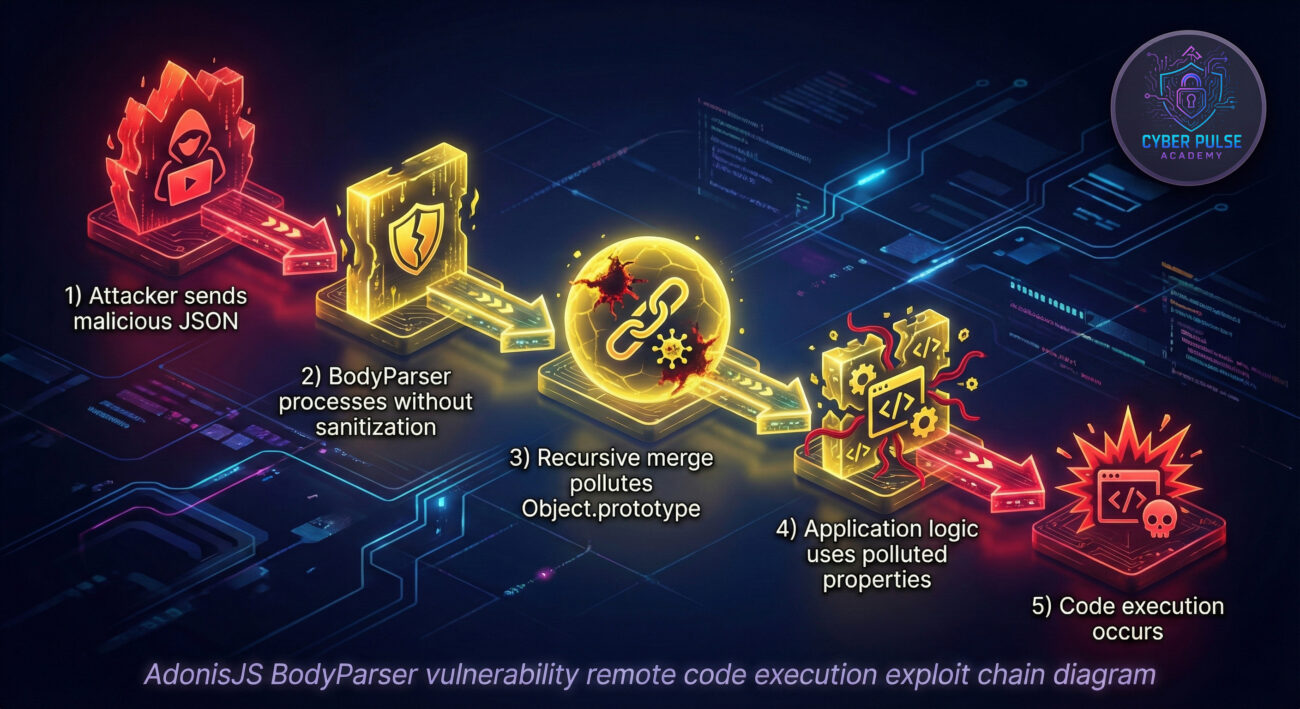
Consider a Software-as-a-Service platform built with AdonisJS that handles user data, payments, and administrative functions. An attacker discovers the platform through a routine web scan.
| Attack Phase | Technique Used | Impact |
|---|---|---|
| Initial Access | Send polluted JSON to user profile update endpoint | Pollutes the global Object prototype across the application |
| Privilege Escalation | Pollute authentication-related properties | Bypass authentication checks, gain admin access |
| Remote Code Execution | Chain pollution with template rendering function | Execute arbitrary commands on the server |
| Data Exfiltration | Use RCE to access databases and files | Steal sensitive user data, payment information |
| Persistence | Install backdoors, create new admin accounts | Maintain access even after initial vulnerability is patched |
Check your package.json for vulnerable AdonisJS packages:
"dependencies": {

  "@adonisjs/core": "^5.9.0", // Check if < patched version

  "@adonisjs/bodyparser": "^3.1.0" // Check if < patched version

}
Consult the official security advisory for exact vulnerable versions.
Update all affected packages to their patched versions:
npm update @adonisjs/core @adonisjs/bodyparser

# OR

yarn upgrade @adonisjs/core @adonisjs/bodyparser --latest
Verify the update by checking package-lock.json or yarn.lock for the new versions.
Add strict schema validation to all endpoints using AdonisJS Validator:
import { schema, validator } from '@adonisjs/validator'


const userSchema = schema.create({

  username: schema.string(),

  email: schema.string.email(),

  // Explicitly reject unexpected properties

  $$strict: true

})


// This will reject any request with __proto__ or constructor
Configure WAF rules to block requests containing prototype pollution patterns:
"__proto__" in JSON keys"constructor" and "prototype" patterns--disable-proto=throw flag to prevent prototype pollutionIf you need to implement object merging in your code, use this secure pattern:
function safeMerge(target, source) {

  for (const key in source) {

    // Block prototype pollution attempts

    if (key === '__proto__' || key === 'constructor' || key === 'prototype') {

      continue;

    }


    if (typeof source[key] === 'object' && source[key] !== null) {

      target[key] = safeMerge(target[key] || {}, source[key]);

    } else {

      target[key] = source[key];

    }

  }

  return target;

}
A: Use controlled security testing tools like Burp Suite with the "Prototype Pollution Scanner" extension, or run automated scanners in a development environment. Never test on production systems without explicit authorization.
A: While this specific vulnerability is unique to AdonisJS, prototype pollution is a JavaScript anti-pattern that can affect any Node.js application with insecure object merging. Always validate and sanitize object operations in any framework.
A: Critical vulnerabilities like CVE-2025-2009 typically see exploitation attempts within 24-72 hours of public disclosure. Automated scanning for this vulnerability began immediately after the advisory was published.
A: Traditional network firewalls cannot effectively block this attack because it uses legitimate HTTP requests. However, Web Application Firewalls (WAFs) with custom rules can detect and block prototype pollution patterns in request bodies.
A: Immediately follow your incident response plan: 1) Isolate the affected system, 2) Preserve forensic evidence, 3) Rotate all credentials and keys, 4) Conduct a thorough security audit, 5) Rebuild systems from clean backups, 6) Implement additional monitoring.
Stay vigilant, patch promptly, and implement defense in depth. The AdonisJS BodyParser vulnerability serves as a critical reminder that framework components require the same security scrutiny as custom code.
Share this guide with your development and security teams to ensure comprehensive protection against this and similar vulnerabilities.
© 2026 Cyber Pulse Academy. This content is provided for educational purposes only.
Always consult with security professionals for organization-specific guidance.
Every contribution moves us closer to our goal: making world-class cybersecurity education accessible to ALL.
Choose the amount of donation by yourself.