


















































Certification Courses
Hands-On Labs
Threat Intelligence
Latest Cyber News
MITRE ATT&CK Breakdown
All Cyber Keywords
Quick Takeaway: A buffer overflow happens when a program tries to stuff more data into a temporary storage area (buffer) than it can hold. Think of pouring a 2-liter soda into a 1-liter bottle – it overflows and makes a mess. In computing, this "mess" can let attackers take control of systems, making it one of the most dangerous vulnerabilities in cybersecurity history.
Have you ever filled a glass with water until it overflowed onto your table? That simple, everyday accident perfectly illustrates one of cybersecurity's oldest yet most dangerous threats. Despite being known since the 1970s, buffer overflow vulnerabilities continue to plague software today, causing major breaches and system compromises.
In this beginner-friendly guide, you'll learn:
Imagine you're at a concert venue with a security checkpoint designed to handle 100 people at a time. What happens when 500 people suddenly rush through? Chaos, confusion, and security breakdowns occur. This is exactly what happens with a buffer overflow in the digital world.
A buffer overflow occurs when a program or process tries to store more data in a temporary storage area (called a buffer) than it was designed to hold. When this happens, the extra data "overflows" into adjacent memory spaces, potentially overwriting critical information and creating opportunities for attackers to execute malicious code.
This vulnerability isn't just theoretical – it's been responsible for some of the most famous cyber attacks in history, including the Code Red worm that infected 359,000 computers in 2001 and the more recent EternalBlue exploit that powered the WannaCry ransomware attack.
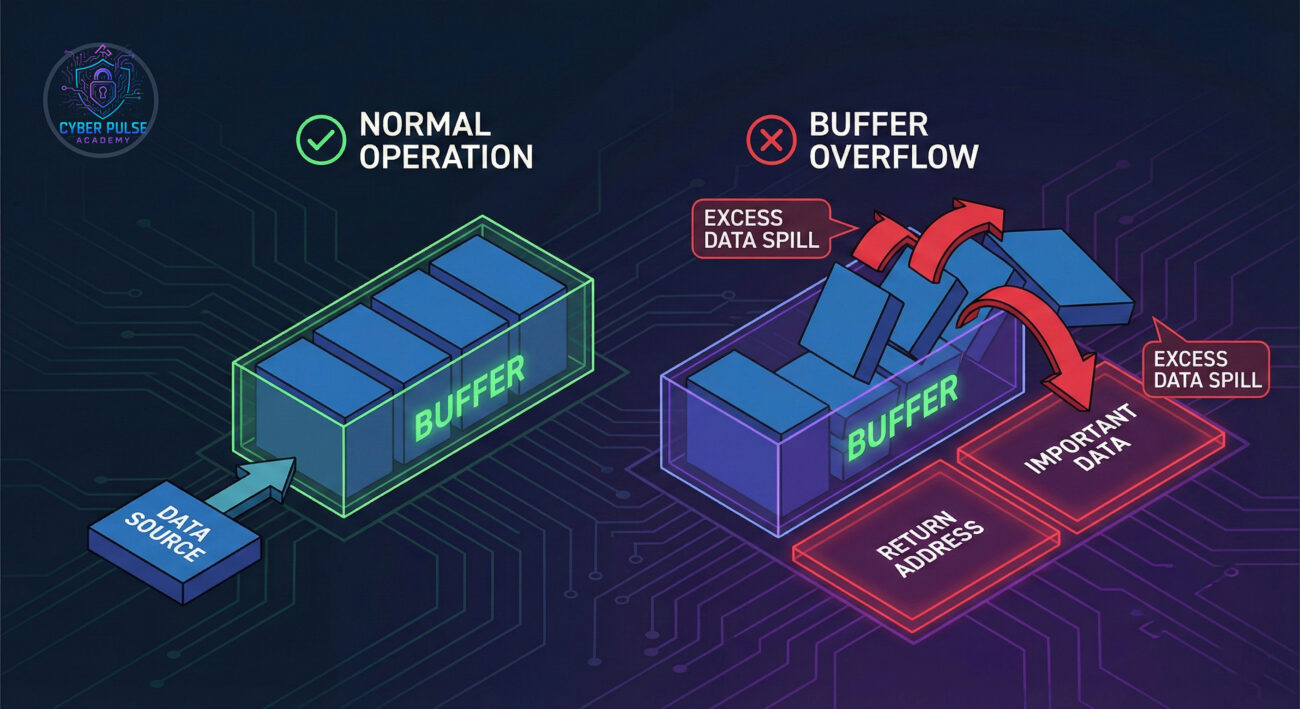
You might wonder why we're still talking about a vulnerability discovered in the 1970s. The surprising truth is that buffer overflow vulnerabilities consistently appear in the CWE Top 25 Most Dangerous Software Weaknesses, with variations ranking #1 and #2 in recent years. Despite decades of awareness, developers continue to make the same mistakes, and legacy systems with these flaws remain in operation worldwide.
The impact is staggering:
According to CISA's Secure by Design initiative, memory safety vulnerabilities (including buffer overflows) represent a significant percentage of exploited vulnerabilities. What makes buffer overflow particularly dangerous is its predictability – skilled attackers can systematically test for and exploit these weaknesses, often with devastating results.
Let's break down the technical jargon into simple concepts anyone can understand:
| Term | Simple Definition | Everyday Analogy |
|---|---|---|
| Buffer | A temporary storage area in a computer's memory reserved for holding data while it's being processed or transferred | A waiting area at a restaurant where guests wait before being seated |
| Stack | A specific type of memory structure that stores temporary data in a "last-in, first-out" manner | A stack of plates – you add to the top and remove from the top |
| Overflow | When data exceeds the allocated space and spills into adjacent memory areas | Overfilling a glass so water spills onto the table |
| Exploit | Malicious code or technique designed to take advantage of a vulnerability | A thief finding and using an unlocked window to enter a house |
| Bounds Checking | A defensive programming technique that verifies data fits within allocated space before processing | A bouncer checking IDs and counting people before letting them into a club |
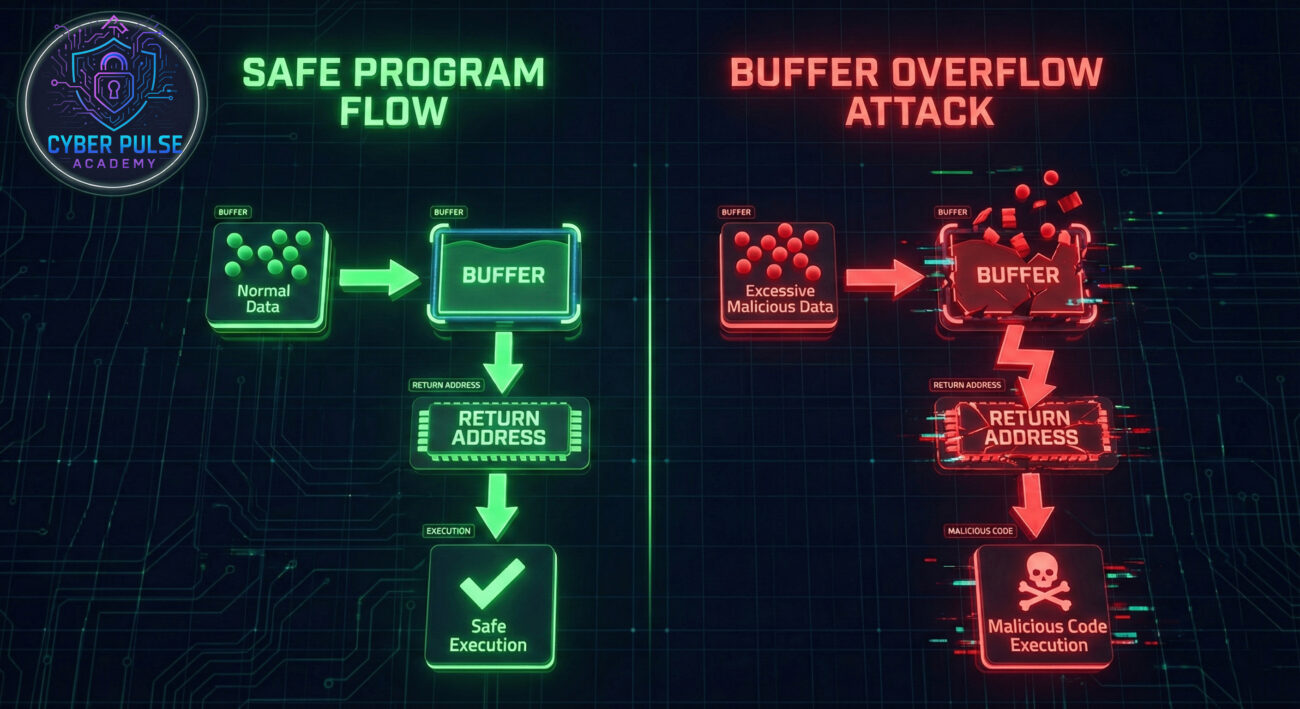
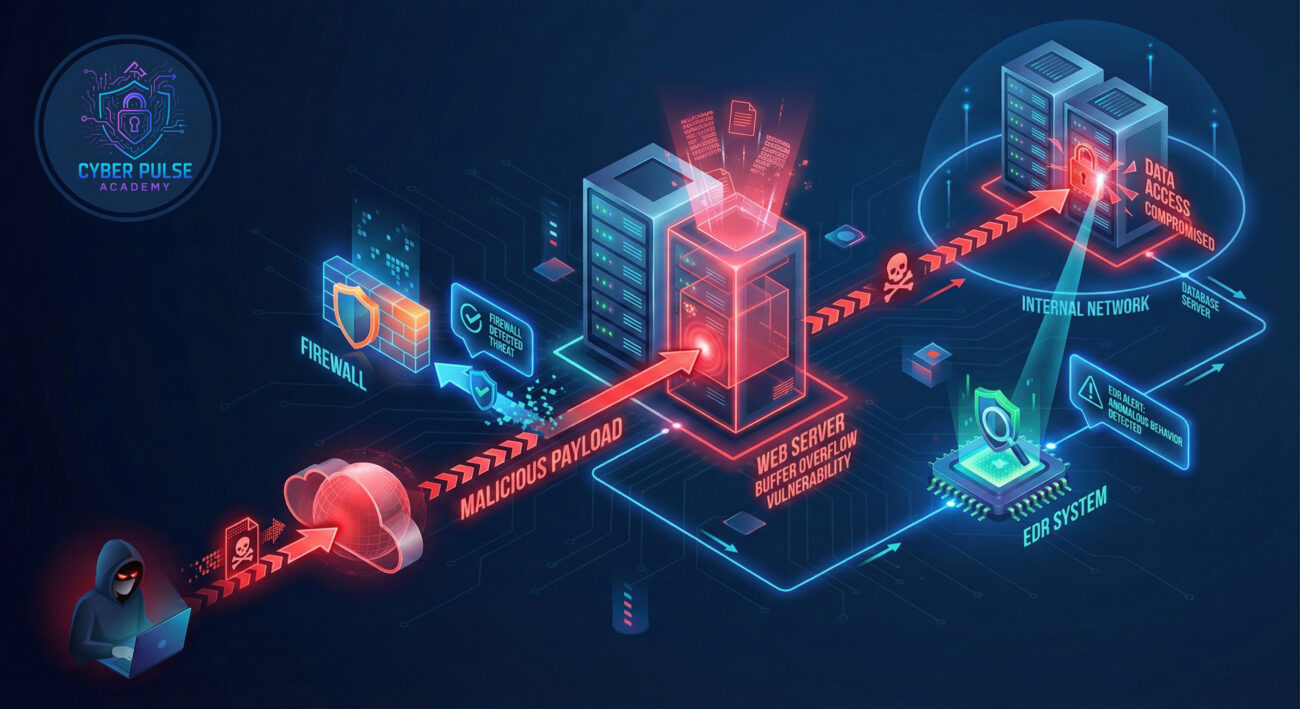
Let's follow Alex, a fictional system administrator at "SecureCorp," as he discovers and responds to a buffer overflow attack. This scenario illustrates how these attacks unfold in real organizations.
The Setup: SecureCorp uses an older web application for employee file sharing. The application was developed in C++ five years ago and hasn't been updated due to "if it ain't broke, don't fix it" thinking. The application has a file upload feature with a buffer designed to handle filenames up to 255 characters.
| Time/Stage | What Happened | Impact |
|---|---|---|
| Day 1: 9:00 AM | An attacker discovers the web app through a routine scan. They notice it accepts file uploads and begins testing with unusually long filenames. | Initial reconnaissance – no damage yet |
| Day 1: 2:30 PM | The attacker crafts a 500-character filename containing hidden malicious code. When uploaded, this triggers a buffer overflow in the application's filename processing function. | The overflow overwrites the return address in memory |
| Day 1: 2:31 PM | The corrupted return address points to the attacker's malicious code (included in the long filename). The application executes this code instead of returning to normal operations. | Remote code execution achieved – attacker gains system access |
| Day 1: 2:35 PM | Alex receives an alert about unusual process behavior from the company's Endpoint Detection and Response (EDR) system. | Defense systems activate – detection occurs |
| Day 1: 3:15 PM | Alex investigates, isolates the affected server, and discovers the malicious upload in logs. He immediately applies a temporary patch disabling file uploads. | Containment achieved – breach limited to one server |
| Day 2: 10:00 AM | The development team implements proper bounds checking and updates the application with input validation. | Vulnerability permanently fixed |
This scenario shows how a simple programming oversight – not checking input length – created a critical vulnerability. The attacker didn't need sophisticated tools; they just needed to find where the program didn't enforce limits.
Always validate and sanitize user input before processing it. This is your first line of defense.
When possible, choose languages with built-in protection against memory errors.
strncpy() instead of strcpy()Modern compilers include security features that help prevent buffer overflows.
Adopt and follow established secure coding practices throughout development.
Regular updates address known vulnerabilities, including buffer overflows.
Even if one layer fails, others should provide protection.
gets(), strcpy(), and sprintf() in C/C++ don't check bounds – use their safe alternatives instead.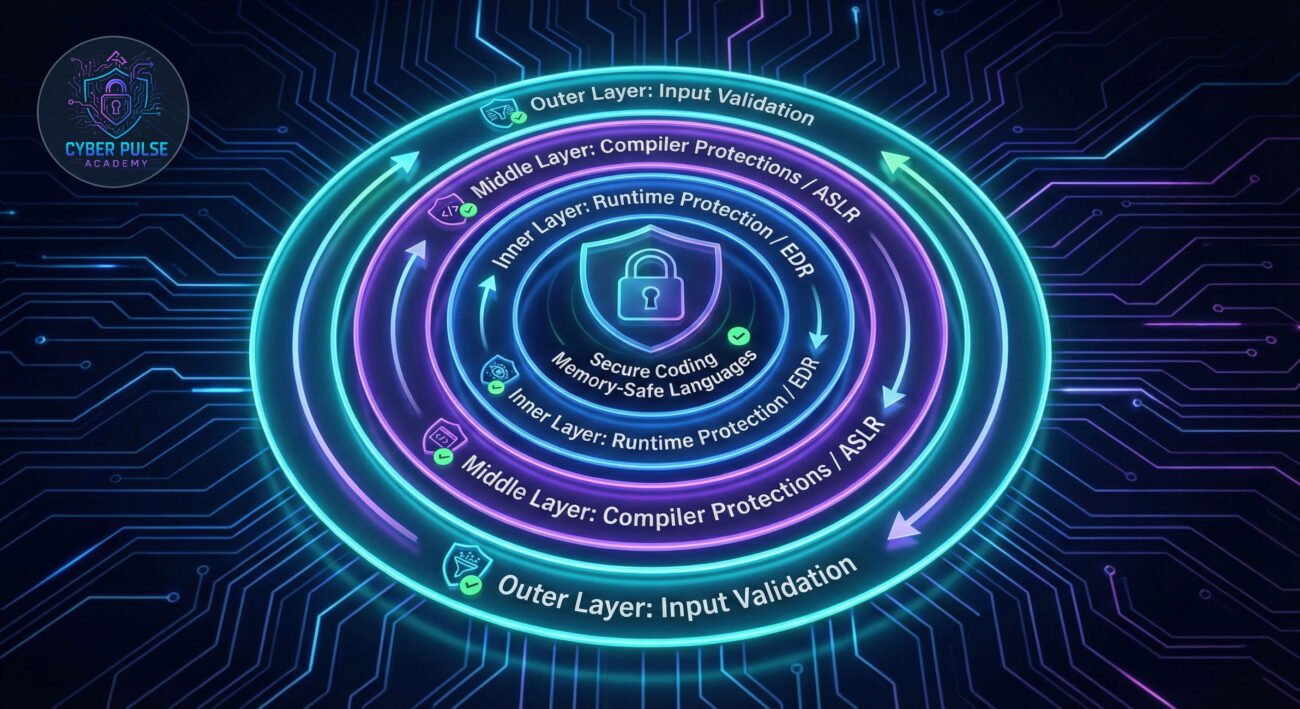
An attacker looking for buffer overflow vulnerabilities follows a predictable pattern. First, they identify software that accepts user input – web forms, file uploads, network services, or APIs. They then systematically test these input points with increasingly long or malformed data, watching for program crashes or unusual behavior. A crash often indicates a potential overflow. The attacker then carefully crafts their malicious payload, embedding it within the overflow data to hijack the program's execution flow.
Defenders think like attackers but act as protectors. They use the same techniques – like fuzzing – but during development and testing, not exploitation. By proactively testing their own software with the same tools attackers use, they discover and fix vulnerabilities first. The key defender mindset shift is assuming all inputs are potentially malicious until proven otherwise, implementing validation at every layer, and designing systems to fail safely rather than catastrophically.
For red teams and ethical hackers, buffer overflow represents opportunity. They view software through the lens of "where are the boundaries, and what happens when I cross them?" Their toolkit includes fuzzers, debuggers, and custom scripts to probe for weak input validation. Successful overflow exploitation is celebrated as a puzzle solved – understanding memory layout, calculating offsets, and crafting precise payloads. They're constantly asking: "What unexpected inputs can I provide, and how will the system handle them poorly?"
Blue teams see buffer overflow as preventable failure. Their focus is on implementing layered defenses: secure coding standards, compiler flags, runtime protections, and monitoring. They value consistency, process, and resilience. A blue team's victory isn't a clever exploit but an application that withstands all attack attempts through proper design. They prioritize creating systems where overflows either can't happen or can't be exploited, asking: "How can we design this so it remains secure even with unexpected inputs?"
Buffer overflow may be one of cybersecurity's oldest vulnerabilities, but it remains dangerously relevant today. By understanding this threat, you've taken an important step in your cybersecurity education journey.
Let's recap the essential points:
Remember, the battle against buffer overflow and other vulnerabilities isn't just about tools and technologies – it's about mindset. Adopting a security-first perspective in development and operations creates inherently more resilient systems. Whether you're a developer, system administrator, or cybersecurity enthusiast, understanding these fundamental concepts makes you part of the solution.
Ready to dive deeper? Check out our related guides on Secure Coding Basics, Memory Safety Explained, and Web Application Security Fundamentals. Each builds on the concepts you've learned today.
Question for you: Have you encountered buffer overflow vulnerabilities in your work or studies? What protective measures have you found most effective? Share your experiences in the comments below – let's learn from each other's journeys in cybersecurity!
© 2026 Cyber Pulse Academy. This content is provided for educational purposes only.
Always consult with security professionals for organization-specific guidance.
Every contribution moves us closer to our goal: making world-class cybersecurity education accessible to ALL.
Choose the amount of donation by yourself.