

















Certification Courses
Hands-On Labs
Threat Intelligence
Latest Cyber News
MITRE ATT&CK Breakdown
All Cyber Keywords
Have you ever used a coupon code more times than allowed? Or found a way to bypass a website's restrictions? What feels like a clever trick might actually be a dangerous cybersecurity vulnerability called a business logic flaw. Unlike malware or hacking attacks you see in movies, these flaws hide in plain sight within an application's normal operations.
In this comprehensive guide, you'll discover what business logic flaws really are, why they're so dangerous, and how both developers and users can protect themselves. We'll break down complex cybersecurity concepts into simple, relatable examples anyone can understand.
A business logic flaw is a vulnerability that occurs when an application's programming doesn't properly enforce the intended business rules or workflow. Unlike technical bugs (like buffer overflows), these flaws exist in the application's purpose and design.
Simple Analogy: Imagine a library that allows you to borrow 5 books at once, but the checkout system forgets to count how many books you already have. You could theoretically borrow 50 books by making 10 separate transactions. The system works "correctly" but violates the business rule ("5 books maximum per person").
These flaws are particularly dangerous because:
According to the OWASP Top 10, business logic flaws are increasingly responsible for major security incidents. While exact statistics are hard to track (many go unreported), security researchers estimate that 15-20% of critical vulnerabilities in web applications involve business logic issues.
What makes business logic flaws so concerning?
Recent incidents include e-commerce sites where attackers manipulated prices, banking apps allowing unauthorized transfers, and social media platforms where privacy settings could be bypassed. The Cybersecurity and Infrastructure Security Agency (CISA) regularly warns about logic-based vulnerabilities in critical systems.
| Term | Simple Definition | Everyday Analogy |
|---|---|---|
| Business Logic | The rules and workflows that define how an application should operate to meet business requirements | A restaurant's process: Take order → Cook food → Serve → Collect payment |
| Logic Flaw | A vulnerability where an application's implementation fails to properly enforce business rules | A movie theater that doesn't verify if your "child ticket" is for an actual child |
| Parameter Tampering | Manipulating data sent between client and server to exploit business logic | Changing the price in a hidden form field before submitting an order |
| Input Validation | Verifying that user input meets expected criteria before processing | A bouncer checking IDs before allowing entry to a club |
| State Management | Properly tracking application state and user session throughout interactions | Keeping score accurately throughout a basketball game |
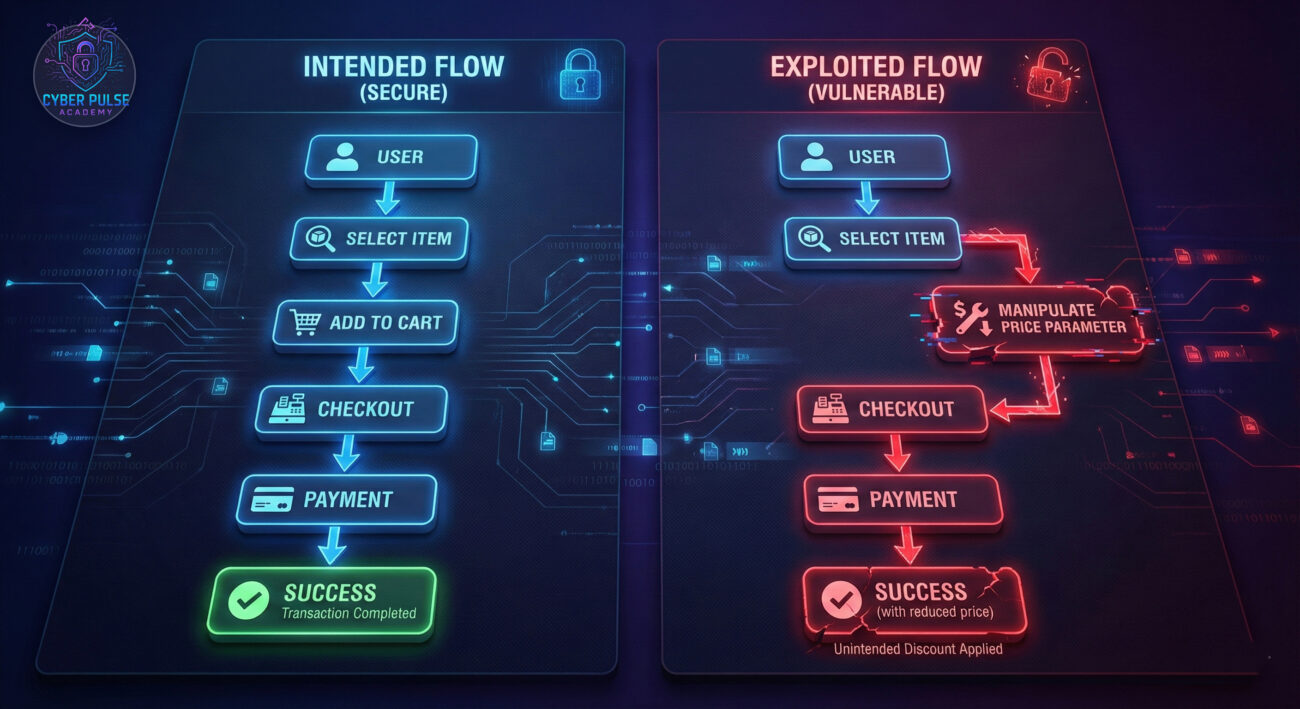
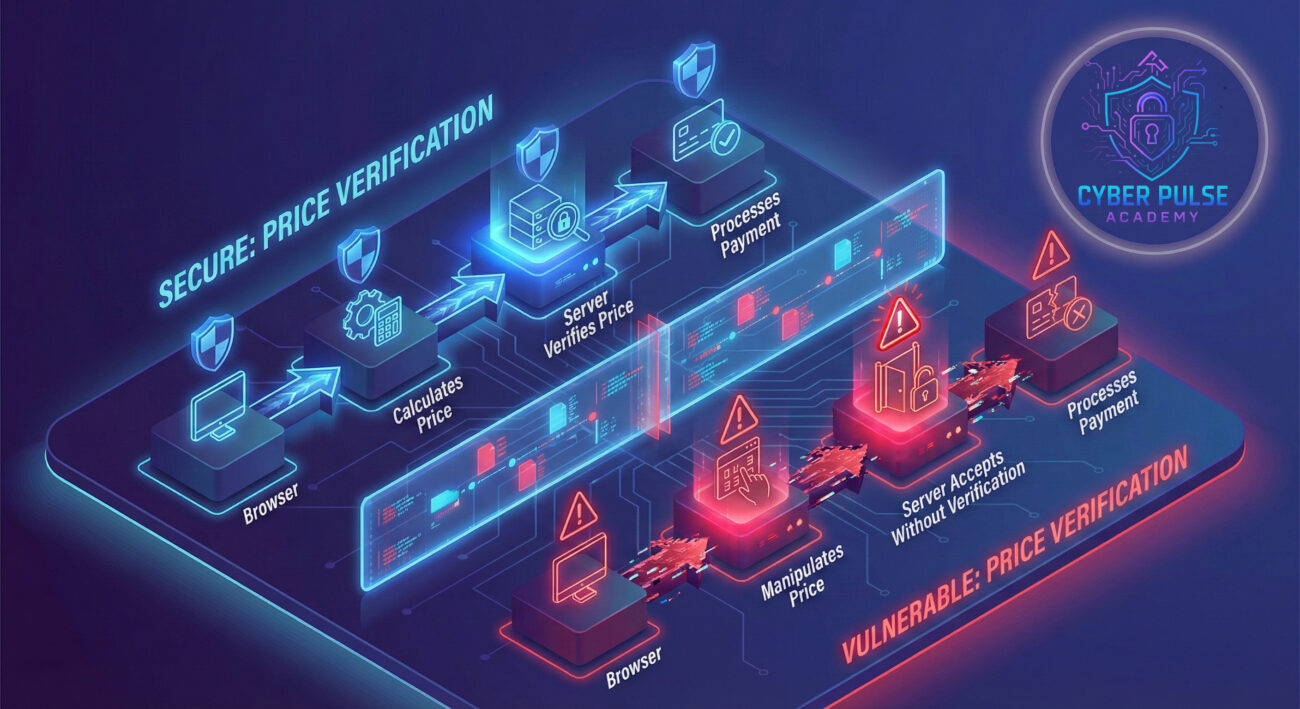
Meet Sarah, a developer at "QuickShop," a growing e-commerce platform. She built a shopping cart system that calculates totals on the client-side (in the browser) to improve speed. The server simply accepts the final total sent from the browser.
The Flaw: Sarah trusted that users wouldn't modify the JavaScript that calculates prices. An attacker named Alex discovers that by using browser developer tools, he can change the price of a $1,000 laptop to $1 before checkout.
The Result: Because the server doesn't re-verify prices against its database, Alex successfully purchases high-value items for pennies. QuickShop loses $50,000 before discovering the issue.
| Time/Stage | What Happened | Impact |
|---|---|---|
| Day 1 | Alex discovers price manipulation through browser tools | Minor testing; purchases one item at 90% discount |
| Day 3 | Alex creates automated script to exploit the flaw | 10 fraudulent purchases totaling $5,000 loss |
| Day 5 | Alex shares method on underground forum | Multiple attackers begin exploiting the flaw |
| Day 7 | QuickShop's fraud detection flags unusual patterns | Company discovers $50,000 in losses |
| Day 8 | QuickShop implements server-side price verification | Exploitation stops; begins damage control |
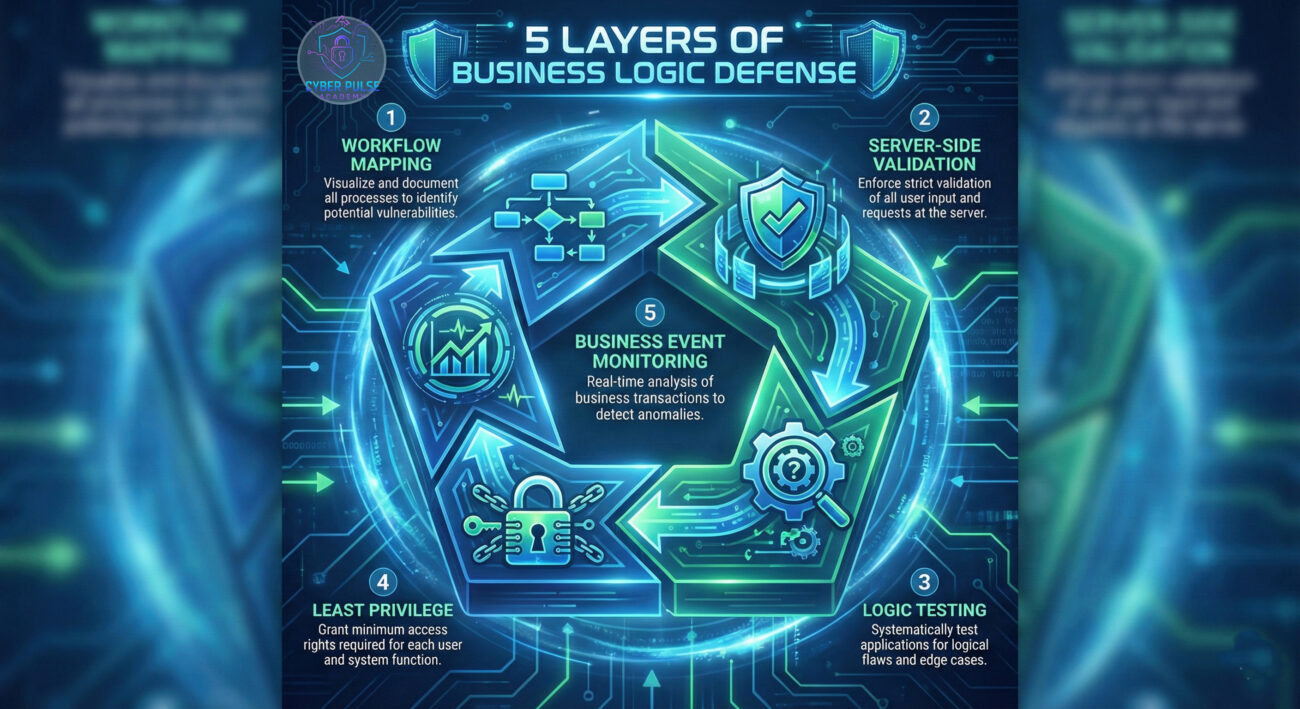
Document every user journey and business rule in your application. Ask: "What should happen vs. what could happen?"
Never trust client-side calculations or validations. Always verify on the server.
Go beyond standard security testing to specifically test business logic.
Users and processes should have only the minimum access needed.
Track business-level events, not just technical errors.
Attack Path: An attacker targeting an online voting application notices that each vote submission sends a simple HTTP request. The request includes parameters for "poll_id" and "candidate_id." The attacker wonders: "What if I change the poll_id to vote in a different poll? What if I submit the same vote 100 times?" They test this and discover no validation checks exist, they can vote multiple times in any poll.
Defender's Counter-Move: The secure implementation would: 1) Associate each vote with a user session, 2) Check if the user has already voted in that poll, 3) Validate that the poll_id belongs to an active, accessible poll for that user, and 4) Implement rate limiting to prevent mass submissions. The key is verifying not just the technical correctness of data, but its business logic validity.
"I look for gaps between what the application should do and what it actually allows. I test limits: Can I apply a discount twice? Can I skip payment steps? Can I access another user's data by changing an ID parameter? I don't break systems, I use them in unintended ways. The most valuable flaws are those that bypass business rules while looking like legitimate activity to security monitors."
"We must understand our business processes as well as our technical stack. We implement validation at every trust boundary, log business-level events, and regularly test for logic flaws. Our goal is to ensure the application enforces all business rules consistently, regardless of how users interact with it. We assume users will find every possible way to misuse features and build defenses accordingly."
Business logic flaws represent one of the most insidious cybersecurity threats because they exploit legitimate functionality. Remember these key points:
To continue your cybersecurity education, explore our guides on input validation techniques, secure coding practices, and threat modeling for beginners.
Have questions about business logic flaws or other cybersecurity topics? Share your thoughts in the comments below!
What application workflows concern you most? Have you encountered any interesting logic issues? Let's discuss how to build more secure systems together.
🔒 Stay curious, stay secure! 🔒
References & Further Reading:
OWASP Top 10 Application Security Risks | CISA Secure Coding Guidelines | NIST Cybersecurity Framework
© 2026 Cyber Pulse Academy. This content is provided for educational purposes only.
Always consult with security professionals for organization-specific guidance.
Every contribution moves us closer to our goal: making world-class cybersecurity education accessible to ALL.
Choose the amount of donation by yourself.