














































Certification Courses
Hands-On Labs
Threat Intelligence
Latest Cyber News
MITRE ATT&CK Breakdown
All Cyber Keywords
In a significant move signaling a shift in the national cybersecurity posture, the U.S. Cybersecurity and Infrastructure Security Agency (CISA) recently announced the retirement of ten emergency directives issued between 2019 and 2024. This CISA emergency directives retirement is not a rollback of security but a landmark achievement, it represents the successful institutionalization of urgent, reactive patches into enduring, proactive defense frameworks. For cybersecurity professionals and beginners alike, this event offers a masterclass in effective vulnerability management and the evolution from crisis response to strategic resilience. This blog post will decode the technical and strategic implications of this milestone, linking the retired directives to real-world attacks and the MITRE ATT&CK framework, and provide actionable lessons for organizations of all sizes.
An Emergency Directive (ED) is CISA's "break glass in case of fire" tool. It mandates immediate action for Federal Civilian Executive Branch (FCEB) agencies to mitigate an active, unacceptable threat. Think of it as a nationwide emergency alert for a specific, critical cybersecurity vulnerability being exploited. The retirement of ten such directives means the fires have been put out, the root causes addressed, and the lessons learned baked into the standard operating procedure.
CISA stated these actions are now enforced through the more permanent Binding Operational Directive (BOD) 22-01, which maintains the Known Exploited Vulnerabilities (KEV) catalog. This transition is crucial. It moves urgent, one-off fixes into a structured, continuous, and predictable process for managing known threats. For defenders, this is evidence that a reactive security posture is maturing into a proactive, intelligence-driven one.
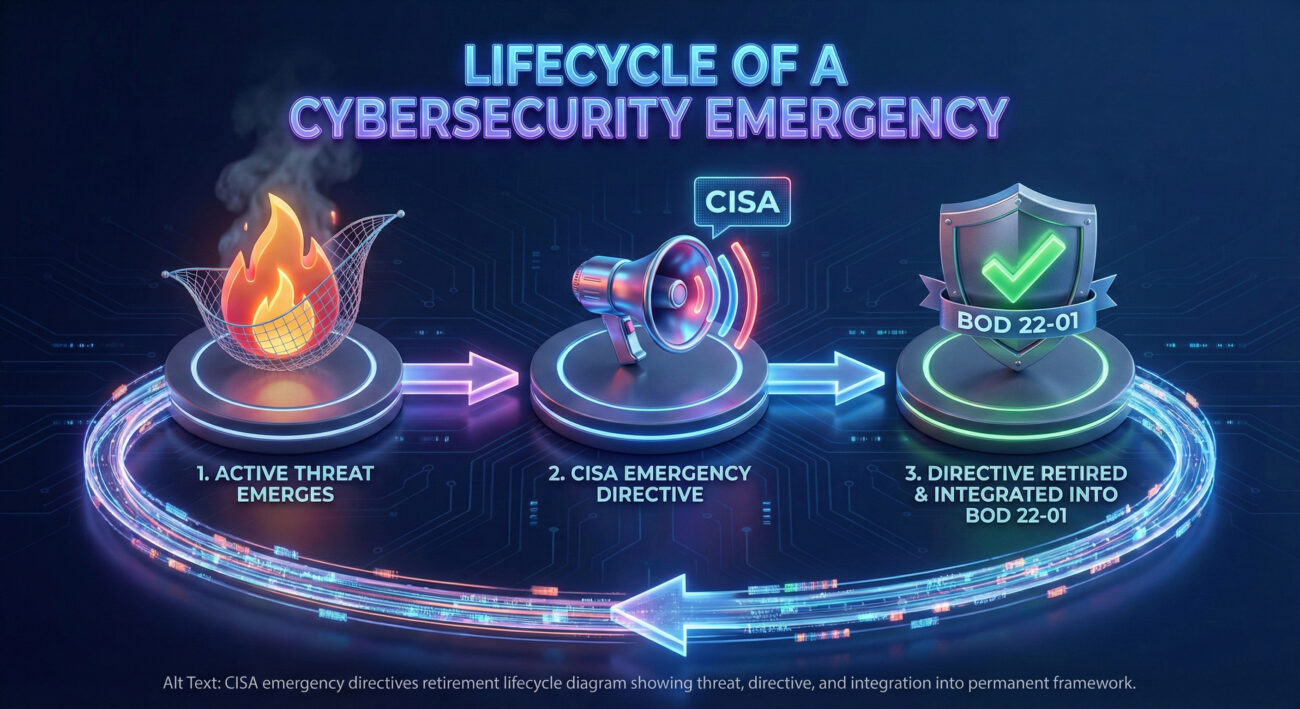
While CISA's announcement didn't list all ten retired EDs, historical data points to major campaigns they countered. These directives were often responses to widespread exploitation of critical vulnerabilities in foundational technologies.
For example, ED 19-01 (2019) addressed critical vulnerabilities in Domain Name System (DNS) infrastructure. An attack on DNS is like tampering with the phonebook of the internet, it can redirect users from legitimate sites to malicious ones for credential theft or malware deployment without their knowledge. Another, ED 21-02, focused on on-premises Microsoft Exchange Server vulnerabilities (like ProxyLogon) which were being exploited by state-sponsored actors to gain persistent, deep access to email systems for espionage.
| Emergency Directive (Sample) | Vulnerability / Threat Targeted | Potential Consequence if Unpatched |
|---|---|---|
| ED 19-01 | DNS Infrastructure Vulnerabilities | Traffic hijacking, broad user compromise, data theft. |
| ED 20-02 / 20-03 | Pulse Secure VPN & Citrix ADC Flaws | Remote network access for hackers, lateral movement, ransomware deployment. |
| ED 21-02 / 21-03 | Microsoft Exchange Server (ProxyLogon) | Full server control, email exfiltration, persistent backdoor for espionage. |
| ED 22-03 / 23-03 | VMware & Atlassian Confluence Flaws | Access to virtualization management and collaboration tools, massive data breach. |
To understand the significance of the CISA emergency directives retirement, we must view the original threats through the lens of the adversary. The MITRE ATT&CK framework categorizes the techniques threat actors use. The retired directives primarily countered techniques in the initial stages of a attack chain.
Let's take ED 21-02 (Microsoft Exchange ProxyLogon) as a case study. This was not one bug but a chain of vulnerabilities (CVE-2021-26855, 26857, 26858, 27065). At its core, it allowed an attacker to bypass authentication and execute code as the powerful SYSTEM user on the server. Here's a simplified view of the attack flow:
The attacker sends a specially crafted HTTP request to the vulnerable Exchange server's web front-end (Outlook Web Access). The server incorrectly authenticates this request, granting access.
Using the gained access, the attacker uploads a malicious web shell (a small piece of code) to a writable directory on the server. This web shell executes commands with the high privileges of the underlying system.
The web shell provides a permanent backdoor. The attacker can now steal all emails, install ransomware, or use the compromised server as a foothold to attack other systems inside the network.
This sequence maps directly to MITRE ATT&CK techniques like Exploit Public-Facing Application (T1190), Web Shell (T1505.003), and Account Manipulation (T1098). CISA's directive forced a mass patch and cleanup operation, directly disrupting the Initial Access and Persistence tactics for a wide range of adversaries.
The retirement of these directives highlights both past failures and current best practices. Organizations often fall into traps that make them vulnerable to the exact threats CISA had to address nationally.
"The CISA emergency directives retirement is a signal to adapt. Our favorite 'low-hanging fruit', unpatched Exchange servers, vulnerable VPN appliances, are becoming harder to find in the federal space because the directive forced a massive cleanup. This raises the cost of entry for broad campaigns.
Our focus shifts to:
The retirement doesn't mean we've lost; it means we must be more sophisticated, precise, and patient."
"This retirement is a major validation of our work. It shows that systemic, mandated action on known vulnerabilities works. It has literally removed entire classes of easy attacks from the adversary's playbook against federal systems.
Our takeaways and new focus are:
This is a win, but vigilance is eternal. We're moving from fighting fires to strengthening the fireproofing of the entire building."
Inspired by the success behind the CISA emergency directives retirement, here is a step-by-step framework any organization can adopt to mature its own vulnerability management program.
You cannot defend what you cannot see. Use tools to discover all assets (hardware, software, cloud instances) on your network, especially those facing the internet. Continuously scan them for vulnerabilities to create a live inventory.
Connect your vulnerability scanner to a threat intelligence feed. The highest priority must be vulnerabilities tagged as "Actively Exploited" in CISA's KEV catalog or by other reputable sources. This moves you from patching based on theoretical severity to patching based on actual risk.
Define and enforce strict Service Level Agreements (SLAs) for patching:
Critical/Actively Exploited: Patch within 48-72 hours.
High Severity: Patch within 2 weeks.
All others: Patch within a standard monthly cycle.
Automate patch deployment where possible, especially for common, high-volume software. After patching, re-scan the asset to validate the fix was applied correctly and the vulnerability is closed. This closes the loop.
Look beyond patching. Work with procurement and development teams to prioritize purchasing and building software with security features (like MFA and logging) enabled by default. This is the long-term vision CISA advocates to prevent future emergencies.
Q: Does the retirement mean these vulnerabilities are no longer dangerous?
A: Absolutely not. The vulnerabilities are still technically present in the code. Their "retirement" means the mandated, emergency-level response is over because the federal enterprise has largely implemented the required patches and mitigations. Any organization that has not patched these old flaws remains extremely vulnerable.
Q: As a small business, do CISA's directives apply to me?
A: While not legally binding for you, they are the most critical guidance you can follow. The threats targeted nation-state actors going after federal agencies. If you use the same technology (Microsoft Windows, VMware, Cisco VPNs), you are on the same attack surface. Adversaries will test these exploits against every organization. Treat CISA's KEV catalog as your mandatory patching list.
Q: What's the difference between an Emergency Directive (ED) and a Binding Operational Directive (BOD)?
A: An ED is an urgent, time-bound order for an imminent threat. It's like a fire alarm. A BOD is a standing, ongoing requirement to maintain a certain security baseline, like BOD 22-01 which requires agencies to patch vulnerabilities on the KEV catalog on a defined timeline. It's like a building's ongoing fire code. The retirement of EDs into BODs shows a transition from crisis to compliance.
Q: How can I stay updated on new threats like these?
A: Subscribe to CISA's Alerts and Announcements. Follow reputable cybersecurity news sources like Krebs on Security or SecurityWeek. For technical details on vulnerabilities, the NIST National Vulnerability Database (NVD) is the primary source.
The CISA emergency directives retirement is a defining moment in cybersecurity. It proves that coordinated, forceful action on known vulnerabilities is the most effective way to disrupt adversaries and raise national cyber resilience. The transition from reactive EDs to the proactive BOD 22-01 framework is a model every organization should emulate.

The era of waiting for an emergency directive is over. The strategy is clear: know your assets, prioritize by active threat, patch ruthlessly, and build secure foundations. By learning from the success behind this CISA emergency directives retirement, you can transform your organization's cybersecurity from a cost center focused on breach response into a strategic advantage built on resilience and confidence.
Start by reviewing your systems against the KEV catalog today.
© 2026 Cyber Pulse Academy. This content is provided for educational purposes only.
Always consult with security professionals for organization-specific guidance.
Every contribution moves us closer to our goal: making world-class cybersecurity education accessible to ALL.
Choose the amount of donation by yourself.