















Certification Courses
Hands-On Labs
Threat Intelligence
Latest Cyber News
MITRE ATT&CK Breakdown
All Cyber Keywords
In December 2025, cybersecurity defenders intercepted a chillingly sophisticated attack that targeted the very foundation of modern cloud infrastructure: the VMware ESXi hypervisor. This wasn't a simple malware infection; it was a surgical breach designed to shatter the fundamental security promise of virtualization, isolation. By chaining together three previously unknown zero-day vulnerabilities, threat actors linked to Chinese-speaking regions demonstrated a capability to escape from within a confined virtual machine (VM) and seize full control of the host server. This VMware ESXi VM escape exploit represents a worst-case scenario for data center and cloud security, granting attackers the keys to the entire virtual kingdom. This guide breaks down this complex attack, explains the technical wizardry behind it, and provides a clear blueprint for defense.
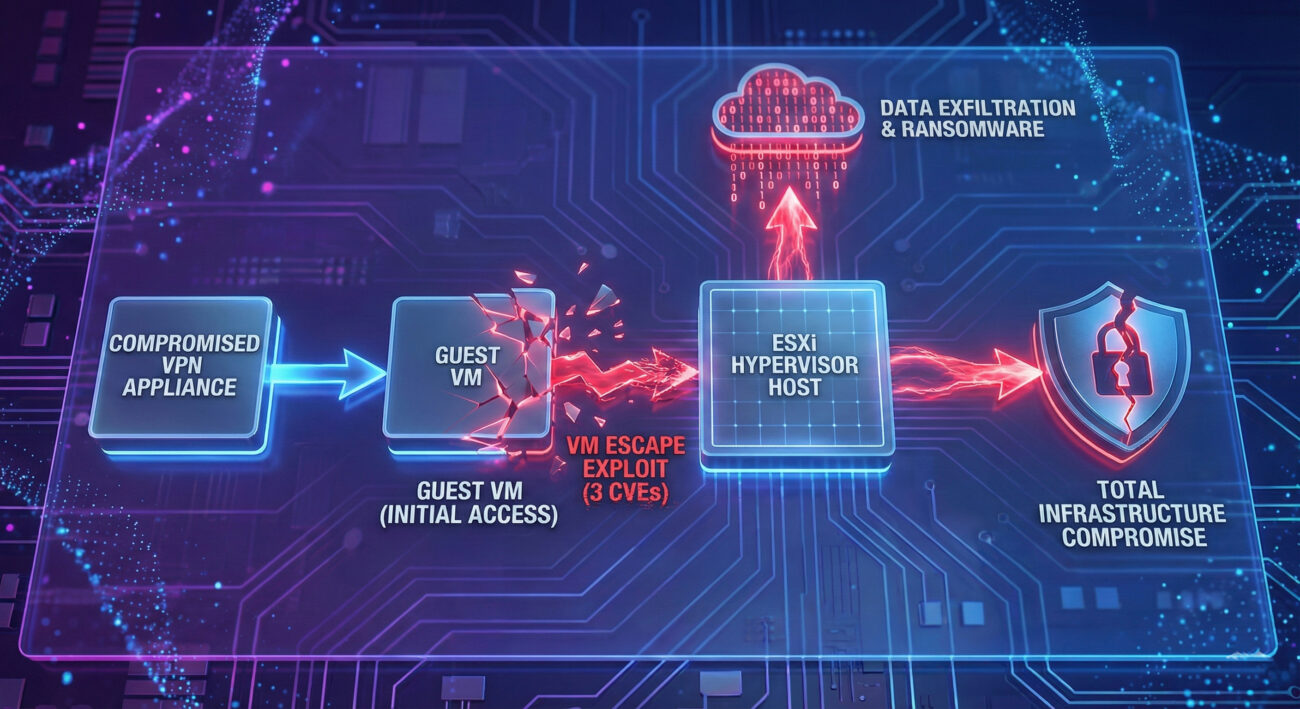
In late 2025, security analysts at Huntress uncovered a targeted intrusion with one ultimate goal: to achieve a full virtual machine escape on VMware ESXi platforms. The attackers first compromised a network's perimeter via a SonicWall VPN appliance. Once inside, they deployed a custom-built exploit toolkit, codenamed "MAESTRO," which weaponized three critical VMware ESXi vulnerabilities (CVE-2025-22224, CVE-2025-22225, CVE-2025-22226).
The sophistication was staggering. Evidence suggested the exploit was developed as a zero-day over a year before VMware's public disclosure in March 2025. The toolkit's internal use of Simplified Chinese strings and its precision pointed to a well-resourced, state-linked actor. The attack chain involved memory leaks, kernel driver manipulation, and ultimately the execution of a stealthy backdoor (VSOCKpuppet) that communicated over a virtual socket channel, rendering it invisible to standard network monitoring. This VMware ESXi VM escape exploit is a masterclass in offensive security, turning the hypervisor from a defender's fortress into an attacker's playground.
Imagine a mid-sized financial services firm that relies on a private VMware cloud to host its customer portal, transaction databases, and internal applications. Their security team has rightly focused on protecting the individual VMs with anti-virus and intrusion detection systems. The network perimeter is guarded by a SonicWall VPN for remote employee access.
An advanced persistent threat (APT) group, after some reconnaissance, discovers an unpatched vulnerability in the specific SonicWall VPN model the firm uses. They gain an initial foothold, not into a critical server, but into a low-privilege virtual machine used for general employee workloads. From this seemingly insignificant beachhead, they deploy the MAESTRO toolkit. Within minutes, the exploit executes, the VM's walls vanish, and the attackers now have code running directly on the ESXi hypervisor with the highest privileges.
From here, the impact is catastrophic: they can create, delete, or snapshot any VM (including the domain controllers and SQL servers), intercept all traffic flowing between VMs, and install persistent backdoors at a layer below the operating system. They could silently exfiltrate data for months or deploy ransomware that encrypts every virtual disk file (.vmdk) at the storage level, making restoration from backup nearly impossible. This scenario underscores why a VMware ESXi VM escape exploit is a game-ending event in cybersecurity.
The potency of this attack came from chaining three specific vulnerabilities in VMware's ESXi, Workstation, Fusion, and Cloud Foundation products. Broadcom disclosed them as zero-days in March 2025, and CISA immediately added them to its Known Exploited Vulnerabilities (KEV) catalog.
| CVE Identifier | CVSS Score | Technical Description | Role in the Exploit Chain |
|---|---|---|---|
| CVE-2025-22224 | 9.3 (Critical) | An out-of-bounds read vulnerability in the Host-Guest File System (HGFS). Allows an attacker with admin privileges in the guest VM to leak memory contents from the VMX process on the host. | Information Gathering: Used to leak critical memory addresses from the VMX process, which are essential for the next stages to work. It's the "reconnaissance" step of the exploit. |
| CVE-2025-22226 | 7.1 (High) | A heap-based buffer overflow vulnerability in the Virtual Machine Communication Interface (VMCI). Allows an attacker to corrupt memory in the host's VMX process. | Memory Corruption: Provides the initial ability to write and corrupt memory in the target VMX process, setting the stage for code execution. |
| CVE-2025-22225 | 8.2 (High) | An arbitrary write vulnerability in the VMCI. Allows an attacker to write data to arbitrary locations in the VMX process memory. | Sandbox Escape & Code Execution: The final blow. This flaw is exploited to overwrite a critical function pointer in VMX memory, redirecting execution to the attacker's shellcode and completing the escape from the VM sandbox. |
Individually, these flaws are dangerous. Together, they form a devastating chain: Leak information to understand the target's memory layout (CVE-2025-22224), use that knowledge to corrupt memory precisely (CVE-2025-22226), and finally hijack the program's execution flow to run your own code on the host (CVE-2025-22225). This trifecta is what enables the full VMware ESXi VM escape exploit.
Let's walk through the exact sequence of events as executed by the MAESTRO toolkit. This demonstrates the precision required for a successful hypervisor breach.
The attacker, already inside a Windows guest VM, executes exploit.exe (MAESTRO). The first action is reconnaissance. It uses the HGFS vulnerability (CVE-2025-22224) to leak memory from the host's VMX process. This leak reveals the exact ESXi version and, crucially, the memory addresses of key structures needed for the next steps. Simultaneously, it uses devcon.exe to disable the guest's VMCI drivers, preventing interference.
The toolkit then loads an unsigned kernel driver, MyDriver.sys, into the guest VM's kernel memory using a tool called Kernel Driver Utility (KDU). This driver is the workhorse. It now operates with high privileges inside the guest and triggers the VMCI buffer overflow (CVE-2025-22226). This corruption allows the attacker to write three payloads directly into the VMX process's memory on the host:
This is the critical escape moment. The exploit leverages the arbitrary write flaw (CVE-2025-22225). It overwrites a function pointer inside the VMX process memory, replacing it with the address of the Stage 1 shellcode it just planted. It then sends a VMCI message to the host. When the VMX process handles this message, it follows the corrupted pointer and jumps to the attacker's shellcode instead of its legitimate code. The sandbox is now broken.
With the VSOCKpuppet backdoor running on the ESXi host, the attacker uses a separate component, client.exe (GetShell Plugin), from any guest VM on the compromised host. This client communicates with the backdoor over the VSOCK channel (port 10000), a pathway invisible to physical network cards. The attacker can now execute shell commands on the hypervisor, upload/download files, and maintain persistent, stealthy control.
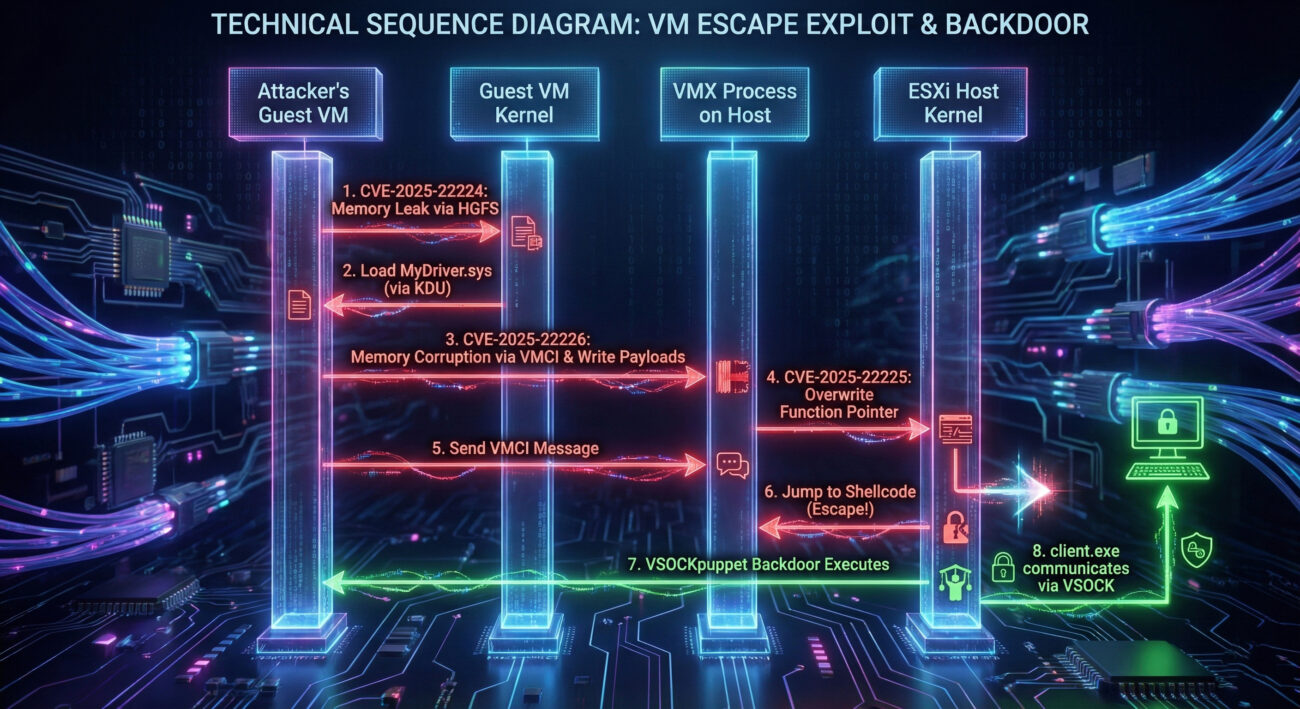
Framing this attack within the MITRE ATT&CK framework helps defenders understand the tactics, techniques, and procedures (TTPs) used and where to look for detection opportunities.
| MITRE ATT&CK Tactic | Technique (ID & Name) | How It Was Applied in This Attack |
|---|---|---|
| Initial Access | T1190 • Exploit Public-Facing Application | The initial compromise of the SonicWall VPN appliance provided the first entry point into the network. |
| Execution | T1203 • Exploitation for Client Execution | The MAESTRO toolkit (exploit.exe) was executed on a guest VM to trigger the vulnerability chain. |
| Privilege Escalation | T1068 • Exploitation for Privilege Escalation | The core of the VMware ESXi VM escape exploit: chaining three CVEs to escalate from guest VM user privileges to hypervisor kernel-level privileges. |
| T1547.012 • Boot or Logon Autostart Execution: Kernel Modules and Extensions | Loading the malicious MyDriver.sys kernel driver via KDU to gain elevated execution within the guest. |
|
| Defense Evasion | T1622 • Debugger Evasion / T1036 • Masquerading | Disabling VMCI drivers temporarily to avoid detection/crashes; using an unsigned driver; VSOCK communication bypasses network monitoring. |
| Command and Control | T1573 • Encrypted Channel & T1095 • Non-Application Layer Protocol | The VSOCKpuppet backdoor used the VSOCK protocol (a non-IP, host-guest channel) for stealthy C2, bypassing traditional firewall/IDS. |
For detailed information on these techniques, refer to the official MITRE ATT&CK page for Exploitation for Privilege Escalation (T1068).
For a red teamer or threat actor, this exploit is a golden ticket. The attack surface is the hypervisor, a high-value, foundational target often assumed to be secure by virtue of isolation.
For defenders, this is a sobering reminder that perimeter and VM-level security are insufficient. The blue team's focus must shift "left and down", earlier in the kill chain and deeper into the infrastructure stack.
Learning from this incident, here are critical errors to avoid and proactive measures to implement.
A: Forensics require specialized tools. Start by checking your ESXi host for:
ps -c on the ESXi shell to look for unfamiliar processes, especially any listening on unusual ports.Consider engaging a professional incident response team if you suspect a compromise.
A: Applying the patches for CVE-2025-22224, -22225, and -22226 closes the specific technical door used in this exploit. However, you are not "completely safe." Other hypervisor vulnerabilities may exist. Safety comes from a layered security posture: ongoing patching, network segmentation, strong credential hygiene, and dedicated monitoring. Patching is the most critical single action, but it's just one layer of defense.
A: VSOCK is a communication channel between the host and guest that doesn't use the traditional TCP/IP network stack. It's like a private, internal phone line that bypasses the company's main switchboard (the physical network). Standard network-based intrusion detection systems (IDS) and firewalls cannot see this traffic because it never hits a physical network interface card (NIC). This makes VSOCK an ideal stealth channel for advanced backdoors, as detection requires inspecting activity on the hypervisor itself.
A: The concept of VM escape is a universal threat to all virtualization platforms. While the specific code vulnerabilities (CVEs) discussed here are unique to VMware products, other hypervisors have had their own critical escape vulnerabilities in the past. The defense principles remain the same across platforms: diligent patching, minimal attack surface (hardening), principle of least privilege for management, and dedicated monitoring of the virtualization layer. No platform is inherently immune.
The discovery of this VMware ESXi VM escape exploit toolkit is a watershed moment. It demonstrates that advanced, state-sponsored actors possess and are willing to use capabilities that fundamentally undermine the security model of global cloud infrastructure.
Don't let this be just another article you read. Take these three concrete steps today:
The battle for security has moved to a new layer. Secure your foundation, or risk losing everything built upon it.
© 2026 Cyber Pulse Academy. This content is provided for educational purposes only.
Always consult with security professionals for organization-specific guidance.
Every contribution moves us closer to our goal: making world-class cybersecurity education accessible to ALL.
Choose the amount of donation by yourself.