























Certification Courses
Hands-On Labs
Threat Intelligence
Latest Cyber News
MITRE ATT&CK Breakdown
All Cyber Keywords
A Deep Dive into the Techniques, Global Impact, and Cybersecurity Lessons from a Landmark Bust
In a landmark strike against organized cybercrime, a recent global operation led by Europol resulted in the arrest of 34 members of the notorious Black Axe syndicate. This takedown isn't just a news headline; it's a masterclass in modern cybercriminal operations and international law enforcement collaboration. For cybersecurity beginners and professionals alike, understanding the techniques used by groups like Black Axe is crucial for building effective defenses. This analysis breaks down the attack vectors, maps them to the MITRE ATT&CK framework, and provides actionable insights to bolster your security posture.
On January 20, 2025, Europol, in coordination with law enforcement from 21 countries, executed a meticulously planned operation codenamed "Jackal 2025." The target was the inner circle of the Black Axe confraternity, a group that had evolved from a Nigerian campus cult into a sophisticated transnational cybercrime empire. The operation culminated in 34 arrests, the seizure of over €2 million in assets, and the dismantling of a significant portion of their digital infrastructure.
This takedown highlights a critical shift: cybercriminal organizations now operate with corporate-like structures, leveraging social engineering, financial fraud, and money laundering on an industrial scale. For defenders, the operation provides a rare, detailed look into the threat actor's playbook.
The Black Axe (also known as the "Neo-Black Movement of Africa") originated in the 1970s but pivoted to cyber-enabled crime in the early 2000s. They are not a loose group of hackers but a highly organized syndicate with defined roles:
Their primary attack vectors center on high-volume, high-return scams like Business Email Compromise (BEC), romance scams (pig butchering), and large-scale phishing campaigns.
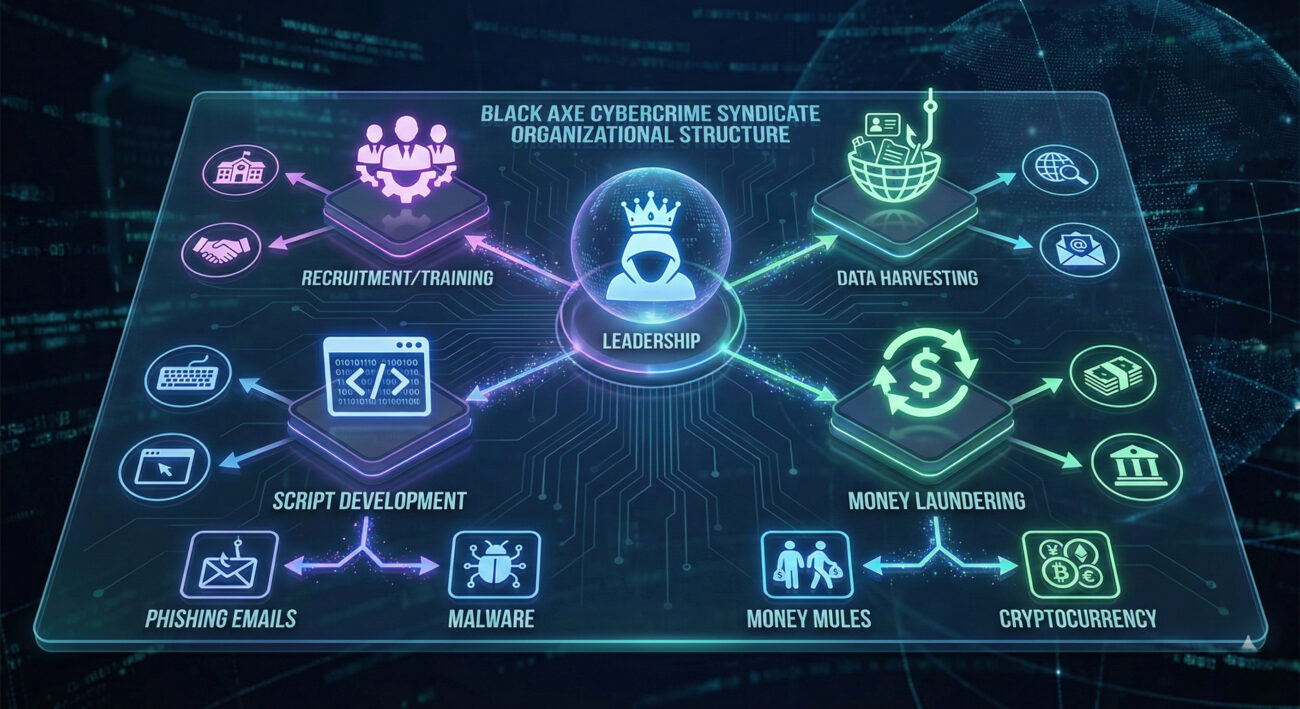
The success of Operation Jackal was due to unprecedented international collaboration. Authorities didn't just target low-level operatives; they followed the money and data trail to mid-level managers and financiers.
This operation demonstrates a modern defense strategy: combining traditional policing with cyber forensic expertise to dismantle the entire criminal enterprise, not just its digital tools.
The MITRE ATT&CK framework is a globally accessible knowledge base of adversary tactics and techniques. Mapping the Black Axe takedown to this framework helps security teams understand and defend against similar threats.
| MITRE ATT&CK Tactic | Technique (ID) | How Black Axe Used It |
|---|---|---|
| Reconnaissance | Gather Victim Identity Info (T1589) | Scraped LinkedIn and social media for employee profiles to target in BEC attacks. |
| Initial Access | Phishing (T1566) | Mass phishing campaigns with malicious attachments (disguised as invoices, resumes) to deploy malware. |
| Execution | User Execution (T1204) | Relied on victims opening attachments or clicking links, often using psychological triggers like urgency or fear. |
| Persistence | Scheduled Task (T1053) | Used macros in documents to create scheduled tasks that would reinfect systems or maintain access. |
| Command & Control (C2) | Application Layer Protocol (T1071) | Used HTTPS and DNS tunnels to communicate with infected machines, blending traffic with normal web activity. |
| Exfiltration | Exfiltration Over C2 Channel (T1041) | Stolen credentials and financial data were sent back to attacker-controlled servers via the established C2 channel. |
| Impact | Financial Theft (T1657) | The ultimate goal: diverting funds via fraudulent wire transfers, gift card scams, and cryptocurrency theft. |
Understanding this attack chain is the first step in building defenses at each stage, a concept known as defense-in-depth.
Let's walk through a typical attack, highlighting the technical and social components.
The group identifies a mid-sized company. Using open-source intelligence (OSINT), they compile a list of executives (CEO, CFO) and accounting staff from LinkedIn and the company website. They note email format (e.g., [email protected]).
They send a phishing email to an accountant, impersonating a trusted vendor with a "past due invoice" attachment. The attachment is a weaponized Microsoft Word document containing a malicious macro.
If the user enables content, the macro executes a PowerShell command that downloads a remote access trojan (RAT) from a hacker-controlled server, establishing a foothold.
The RAT allows the attacker to move laterally within the network. They use keyloggers or dump credential stores (like the Windows LSASS memory) to steal login credentials for email and financial systems.
Using the stolen credentials, the hacker logs into the CFO's email account. They study email threads, then impersonate the CFO to send an urgent, legitimate-looking email to the accounting department, authorizing a large wire transfer to a fraudulent account controlled by a money mule. Funds are immediately transferred and laundered.
This section contrasts the attacker's mindset (Red Team) with the defender's (Blue Team) in the context of a Black Axe-style attack.
Objective: Infiltrate, establish persistence, steal money.
Objective: Prevent, detect, respond, and recover.
A: Absolutely. Small and medium-sized businesses are often targeted precisely because they may have fewer security resources than large enterprises. The attack is automated and scalable; you don't need to be a specific target to get caught in their net.
A: Enable Multi-Factor Authentication (MFA) on all business-critical accounts, especially email, cloud services, and banking. This single step would have thwarted most of Black Axe's successful BEC scams, even if they stole the password.
A: The official MITRE ATT&CK website is the best resource. Visit https://attack.mitre.org/. For practical learning, platforms like TryHackMe and Cybrary offer hands-on courses that incorporate the framework.
A: Follow reputable sources. Besides The Hacker News, consider following advisories from CISA US-CERT, UK NCSC, and threat intelligence blogs from companies like Mandiant and CrowdStrike.
The story of the Black Axe takedown is more than a victory for law enforcement; it's a roadmap for your own cybersecurity journey. Don't let awareness be the end goal.
Action Plan for This Week:
Cybersecurity is a continuous process. By learning from the tactics of groups like Black Axe, you empower yourself and your organization to build a strong, resilient defense.
© 2026 Cyber Pulse Academy. This content is provided for educational purposes only.
Always consult with security professionals for organization-specific guidance.
Every contribution moves us closer to our goal: making world-class cybersecurity education accessible to ALL.
Choose the amount of donation by yourself.