










































Certification Courses
Hands-On Labs
Threat Intelligence
Latest Cyber News
MITRE ATT&CK Breakdown
All Cyber Keywords
Learn what AAA (Authentication, Authorization, Accounting) is and why it's the foundation of cybersecurity. Our beginner's guide breaks down the three A's with real-world examples and step-by-step implementation.
Imagine trying to enter a high-security office building without any guards, ID checks, or visitor logs, that's what digital systems are like without AAA (Authentication, Authorization, Accounting).
AAA (Authentication, Authorization, Accounting) is a cybersecurity framework that controls who gets access to what resources and tracks what they do with that access.
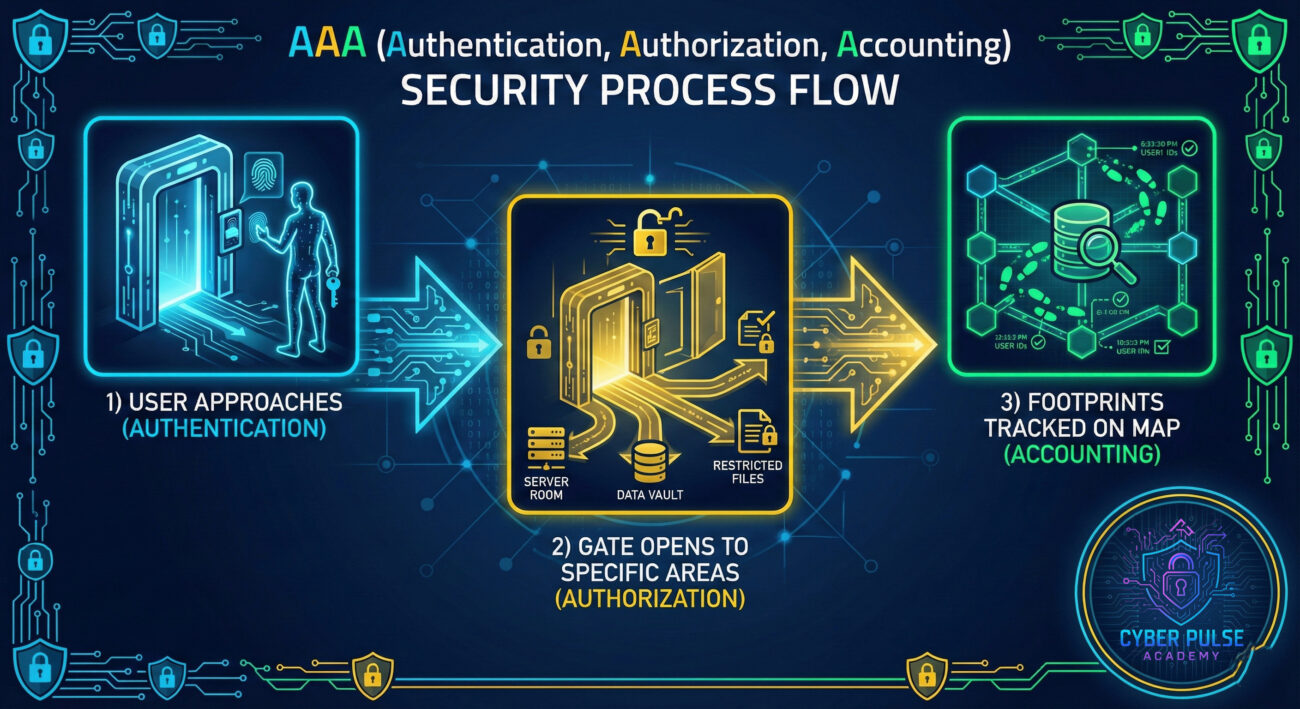
Think of it as a three-step security check at an airport: Authentication is showing your ticket and ID (who you are), Authorization is being allowed through security to your specific gate (what you can do), and Accounting is having your luggage scanned and movement tracked (what you actually did).
In this guide, you'll learn: What exactly AAA means, why every organization needs it, how to implement it step-by-step, and how to avoid common security mistakes that leave systems vulnerable.
AAA (Authentication, Authorization, Accounting) is a secure framework used to manage user access to computer resources, enforce policies, and track user activities.
This framework is critical because it provides layered security, even if one layer is compromised, the others continue to provide protection. Without AAA, systems are vulnerable to unauthorized access, data breaches, and malicious insider activity.
Whether you're logging into your work email, accessing cloud storage, or using a banking app, AAA works behind the scenes to keep your information protected.
| Term | Meaning | Analogy |
|---|---|---|
| Authentication | Verifying the identity of a user or device | "Like showing your driver's license at airport security" |
| Authorization | Determining what resources a user can access | "Think of it as having a key that only opens certain doors in a building" |
| Accounting | Tracking user activities and resource usage | "It's similar to security cameras recording who entered which room and what they did" |
| RADIUS/TACACS+ | Protocols that implement AAA frameworks | "Imagine specialized security guards who manage the entire access control system" |
| Multi-Factor Authentication | Using multiple methods to verify identity | "Like needing both a keycard AND a fingerprint to enter a secure facility" |
In today's digital world, cyber attacks are increasingly sophisticated. According to recent reports, data breaches cost organizations an average of $4.35 million per incident. AAA provides a fundamental defense against these threats.
Organizations that implement robust AAA frameworks experience:
💡 Pro Tip: Even if you're not a cybersecurity professional, understanding AAA helps you make better security decisions in your personal and professional digital life.
Meet Sarah, a healthcare administrator at City Hospital. Without proper AAA implementation, her hospital faced a security breach when a receptionist accidentally accessed patient medical records beyond their job requirements. After implementing a comprehensive AAA framework:
• Authentication: All staff now use multi-factor authentication with hospital ID badges and PINs
• Authorization: Receptionists can only access scheduling systems, not medical records
• Accounting: Every access attempt is logged, creating an audit trail
When an employee tried to access restricted files, the system immediately flagged it, and administrators could review exactly what happened, preventing a potential data breach and HIPAA violation.
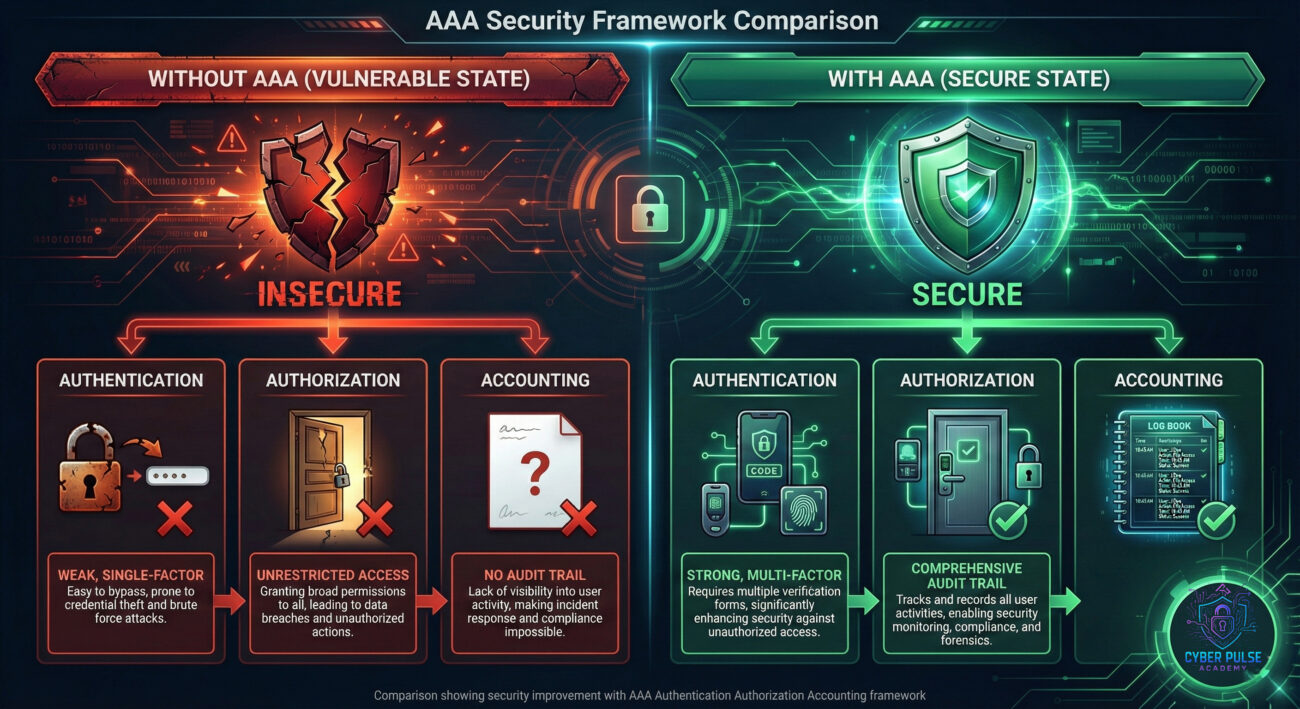
| ❌ Without AAA Framework | ✅ With AAA Framework |
|---|---|
| Unauthorized access to sensitive data | Role-based access control limits user permissions |
| No accountability for user actions | Complete audit trails track all activities |
| Weak password policies leading to breaches | Strong authentication with MFA requirements |
| Difficulty proving compliance during audits | Automated reporting simplifies compliance |
This scenario demonstrates why AAA (Authentication, Authorization, Accounting) is essential for protecting sensitive information in any organization.
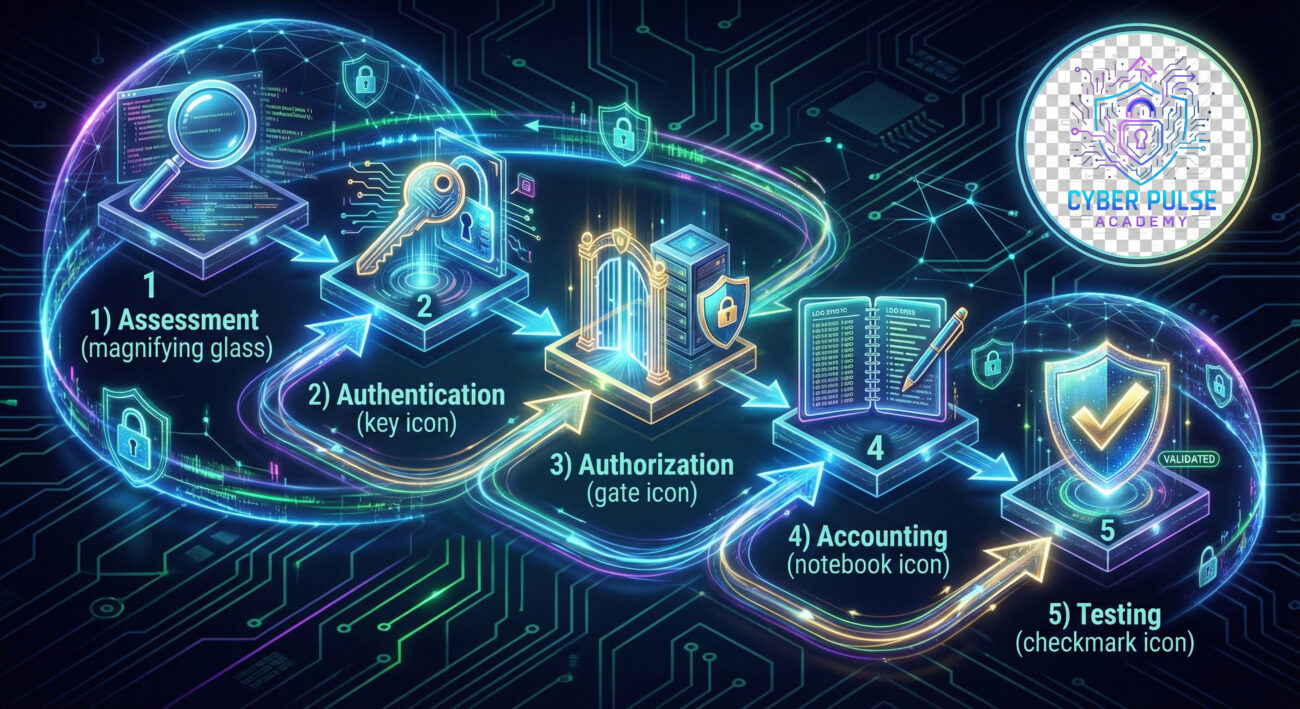
Follow these 5 steps to implement a basic AAA framework in your organization:
Start by mapping all digital resources and identifying who currently has access to what. Document authentication methods, permission levels, and existing logging capabilities.
Key Point: You can't protect what you don't know exists. Create a comprehensive asset inventory first.
Implement strong authentication methods based on your risk assessment:
Implement the principle of least privilege, users should only have access to what they absolutely need to perform their jobs. Create role-based access control (RBAC) groups:
Set up systems to track: Who accessed what resources, when they accessed them, what actions they performed, and from where they connected. Ensure logs are secure and tamper-proof.
Conduct penetration testing to identify vulnerabilities. Monitor logs regularly for suspicious activities. Establish procedures for regular review and updates of your AAA policies.
💡 Pro Tip: Start small with a pilot program for one department before rolling out AAA organization-wide. This lets you work out issues on a smaller scale.
⚠️ Critical Warning: Never store authentication logs on the same system they're monitoring. If that system is compromised, attackers can erase evidence of their activities. Always use separate, secure logging servers.
Want to deepen your knowledge? Check out these trusted resources:
These resources provide deeper technical documentation and practical examples for mastering AAA (Authentication, Authorization, Accounting).
AAA (Authentication, Authorization, Accounting) isn't just technical jargon, it's the foundation of modern cybersecurity that protects organizations from data breaches, insider threats, and compliance violations.
Remember these three pillars: Authentication verifies identity, Authorization controls access, and Accounting tracks activities. Together, they create a secure framework that adapts to evolving threats.
AAA (Authentication, Authorization, Accounting) isn't optional, it's a fundamental requirement for protecting digital assets in today's threat landscape. By understanding and implementing what you've learned today, you're taking a significant step toward comprehensive digital security.
Every contribution moves us closer to our goal: making world-class cybersecurity education accessible to ALL.
Choose the amount of donation by yourself.