












Certification Courses
Hands-On Labs
Threat Intelligence
Latest Cyber News
MITRE ATT&CK Breakdown
All Cyber Keywords
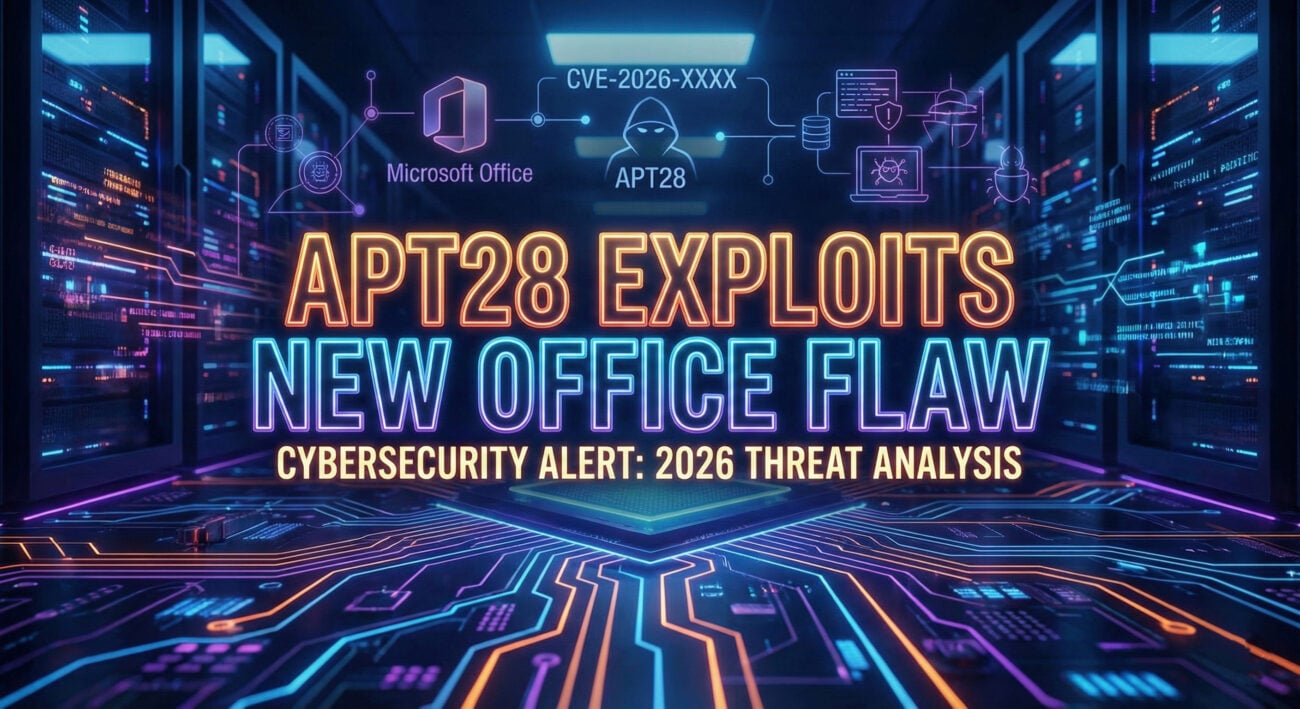
In late January 2026, the Russia-linked threat group APT28 (also known as Fancy Bear, UAC-0001) began exploiting a Microsoft Office zero-day vulnerability (CVE-2026-21509) in highly targeted espionage operations. Dubbed “Operation Neusploit” by Zscaler ThreatLabz, the campaign focuses on government and military entities in Ukraine, Slovakia, Romania, and later expanded to Poland, Turkey, and the UAE. The attackers use weaponized RTF documents that exploit CVE-2026-21509 to deliver two distinct malware families: MiniDoor (an email stealer) and PixyNetLoader (which deploys the COVENANT Grunt implant). This post breaks down the entire attack chain, maps it to MITRE ATT&CK techniques, and provides actionable steps for defenders.
APT28 crafted phishing emails with geopolitical themes, such as transnational weapons smuggling, military training programs, and meteorological emergencies, to lure victims. The emails contained malicious RTF files that, when opened in vulnerable versions of Microsoft Office, automatically triggered CVE-2026-21509 without any user interaction (no macros required).
To evade detection, the threat actors employed server-side evasion: the malicious payload was only served if the request originated from a targeted geographic region (Ukraine, Slovakia, Romania) and contained the correct HTTP User-Agent header. This ensured sandboxes and security researchers outside the target zone received benign content.
According to CERT-UA, more than 60 email addresses within central executive authorities of Ukraine were targeted. Metadata from one lure document showed it was created just one day after Microsoft’s public disclosure, highlighting how rapidly APT28 weaponizes new vulnerabilities.
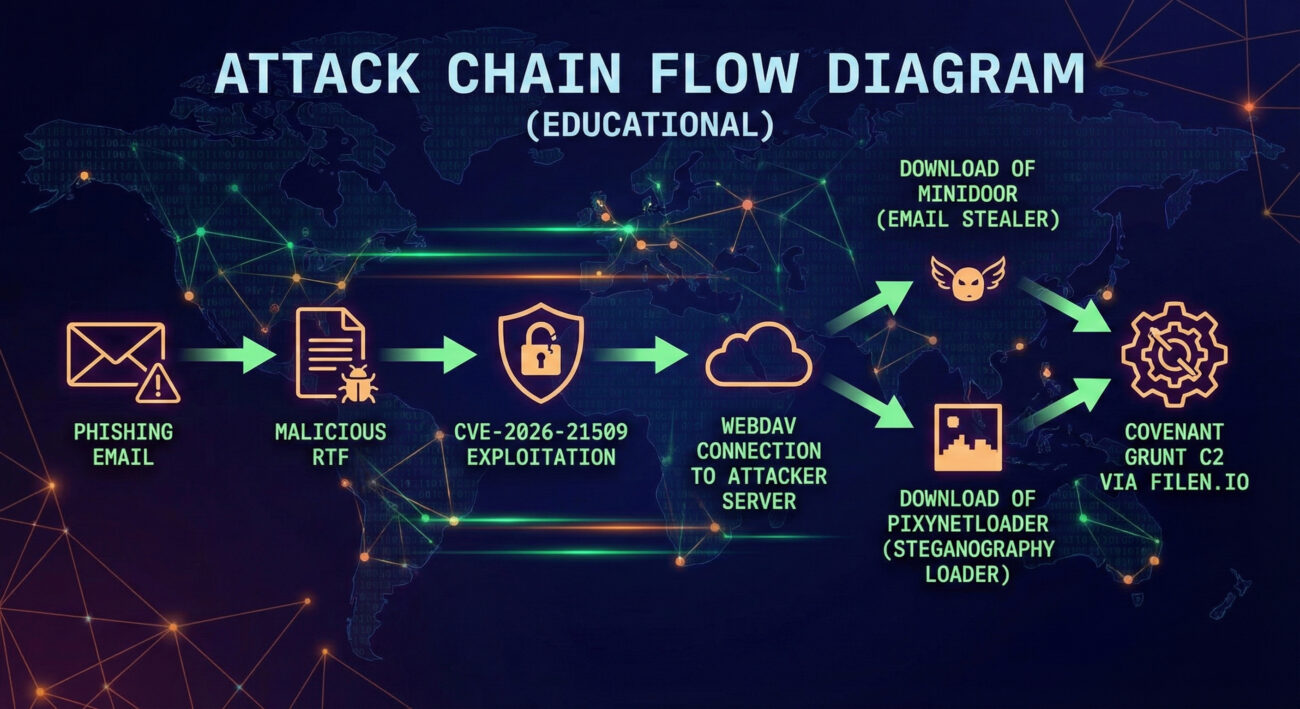
CVE-2026-21509 is a security feature bypass in Microsoft Office (CVSS 7.8). An attacker can send a specially crafted Office file that bypasses protected view or other security mechanisms, allowing code execution. Below is the step-by-step infection process observed by Zscaler, Trellix, and CERT-UA.
Victims receive an email with a weaponized RTF attachment. The document contains geopolitical lures in localized languages (Romanian, Slovak, Ukrainian, English). When opened, the RTF exploits CVE-2026-21509, triggering a WebDAV connection to an attacker-controlled server.
The attacker's server checks the incoming request's User-Agent and IP geolocation. Only if it matches expected targets, the server responds with a malicious DLL (either MiniDoor or PixyNetLoader). Otherwise, it returns a decoy or nothing.
Path A – MiniDoor: A C++ DLL that steals emails from Outlook folders (Inbox, Junk, Drafts) and exfiltrates them to two hardcoded attacker email addresses: ahmeclaw2002@outlook[.]com and ahmeclaw@proton[.]me. MiniDoor is a stripped-down version of NotDoor (aka GONEPOSTAL).
Path B – PixyNetLoader: A more complex loader that extracts two embedded components: a shellcode loader (EhStoreShell.dll) and a PNG image (SplashScreen.png) containing hidden shellcode via steganography. The loader only activates if the parent process is explorer.exe and the machine is not an analysis environment.
The shellcode from the PNG loads a .NET assembly, a Grunt implant associated with the open-source COVENANT C2 framework. The implant establishes persistence via COM hijacking and communicates with command-and-control servers hosted on legitimate cloud storage (filen[.]io) to blend in with normal traffic. In some cases, a custom backdoor called BEARDSHELL is also deployed.
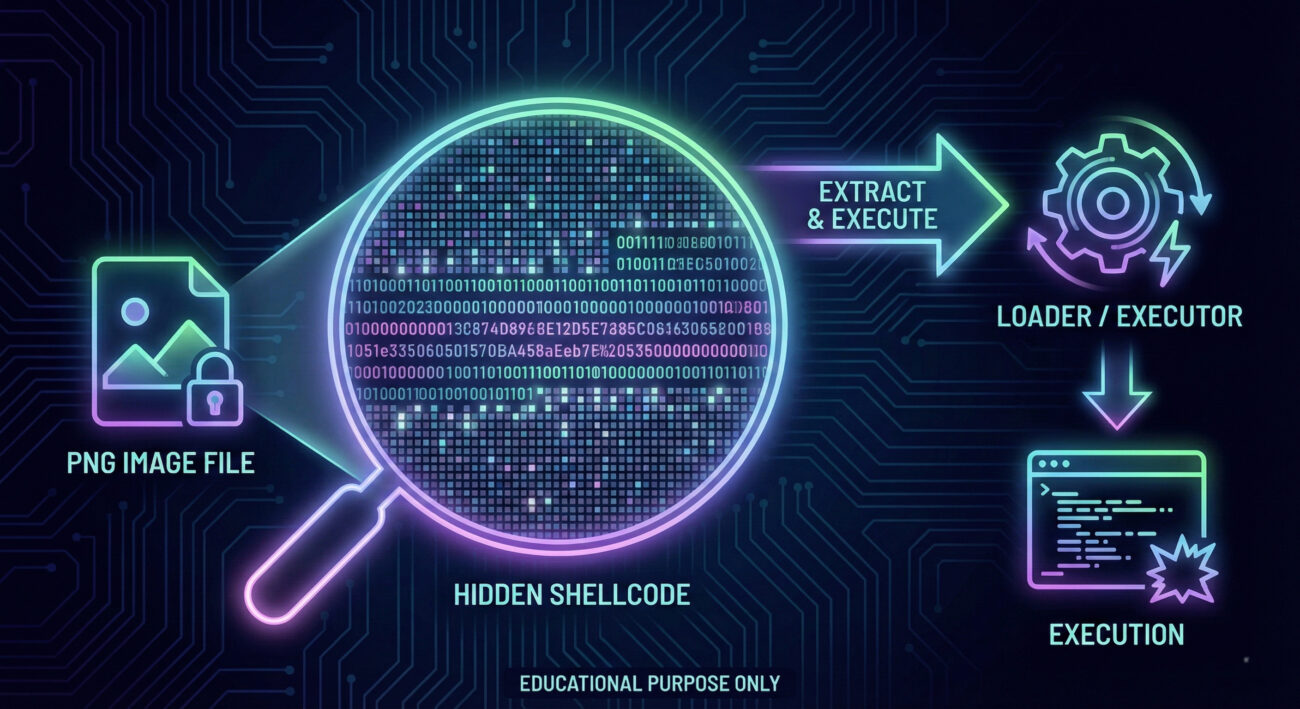
This multi-stage approach, combined with encrypted payloads and in-memory execution, minimizes forensic artifacts and evades traditional signature-based detection.
Understanding the adversary's behavior through the MITRE framework helps defenders build better detections. Here are the key tactics and techniques used in this campaign:
| Tactic | Technique ID | Technique Name | Context |
|---|---|---|---|
| Initial Access | T1566.001 | Spearphishing Attachment | Malicious RTF files delivered via email. |
| Execution | T1204.002 | Malicious File | User opens the RTF, triggering exploitation. |
| Defense Evasion | T1027 | Obfuscated Files or Information | Steganography in PNG, XOR string encryption. |
| Defense Evasion | T1546.015 | Event Triggered Execution: COM Hijacking | Persistence via COM object hijacking. |
| Credential Access | T1114 | Email Collection | MiniDoor steals emails from Outlook. |
| Command and Control | T1071.001 | Web Protocols | C2 over HTTPS using filen.io cloud storage. |
| Exfiltration | T1048 | Exfiltration Over Alternative Protocol | Stolen emails sent to attacker-controlled email addresses. |
For a complete overview of APT28, visit the MITRE ATT&CK group page for APT28.
For more detailed hardening guidance, see Microsoft's official CVE-2026-21509 advisory and the Trellix deep-dive on BEARDSHELL.
Yes. Multiple security firms (Zscaler, Trellix, CERT-UA) have confirmed active exploitation by APT28 targeting Eastern European and NATO-aligned countries.
Automatic updates should deploy the patch, but verify that your Office installation is up-to-date. Also consider the additional hardening steps above.
Attackers modify Registry keys (e.g., HKCU\Software\Classes\CLSID) to execute malicious code when a legitimate application loads a COM object. Monitor Registry changes and use Sysmon Event ID 13 for Registry value modifications.
Detection is difficult, but you can monitor for unusual processes (like explorer.exe) that suddenly load image files and then make network connections. Endpoint detection and response (EDR) tools can flag such anomalies.
Now that you understand the inner workings of this sophisticated APT28 campaign, take action:
© Cyber Pulse Academy. This content is provided for educational purposes only.
Always consult with security professionals for organization-specific guidance.
Every contribution moves us closer to our goal: making world-class cybersecurity education accessible to ALL.
Choose the amount of donation by yourself.