


















































Certification Courses
Hands-On Labs
Threat Intelligence
Latest Cyber News
MITRE ATT&CK Breakdown
All Cyber Keywords
Have you ever wondered how nation-state hackers operate in the shadows, stealing secrets without leaving a trace? What if I told you one of the most sophisticated groups targets everything from university research to critical government systems – and they might already be looking at networks you use daily?
Welcome to the world of APT40 (Leviathan), a Chinese state-sponsored hacking group that represents the pinnacle of cyber espionage. In this beginner-friendly guide, you'll learn exactly what APT40 is, how they operate like digital spies in a James Bond movie, and most importantly – how to recognize and defend against their advanced attacks. By the end, you'll understand state-sponsored threats in simple terms and have actionable steps to boost your digital security.
In today's interconnected world, state-sponsored hacking isn't just a plot from spy movies – it's a daily reality affecting governments, businesses, and even individuals worldwide. APT40 (Leviathan), specifically linked to China's Ministry of State Security, represents a perfect storm of advanced techniques, significant funding, and strategic patience that makes them exceptionally dangerous.
Recent reporting from security agencies like CISA and private cybersecurity firms has consistently highlighted APT40's evolving tactics. Unlike random cybercriminals looking for quick money, this group conducts long-term espionage campaigns targeting intellectual property, diplomatic communications, and defense technologies. Their operations directly impact national security and economic competitiveness across multiple countries.
Think of APT40 not as burglars breaking windows, but as master locksmiths who can enter through the front door without leaving evidence. They matter because their success means stolen research, compromised negotiations, and eroded trust in digital systems. For beginners, understanding APT40 provides crucial insight into how modern cyber warfare actually works beyond the headlines.
Imagine a team of highly trained digital spies with unlimited resources, working on behalf of a government to steal secrets from other countries. That's essentially what APT40 (Leviathan) is – an Advanced Persistent Threat group linked to China that specializes in cyber espionage.
The "APT" stands for Advanced Persistent Threat, which means three things: 1) They use sophisticated techniques, 2) They maintain long-term access to targets, and 3) They pose a serious threat. "40" is their tracking number among security researchers, and "Leviathan" is one of their codenames. Think of them as the special forces of hacking – patient, well-equipped, and strategically focused.
Unlike hackers who broadcast their attacks, APT40 operates in complete silence. They're not trying to crash systems or make headlines; they want to sneak in, gather intelligence for months or years, and leave without anyone noticing. Their primary targets include maritime technology, defense contractors, universities with sensitive research, and government agencies across Southeast Asia, Europe, and the United States.
In this guide, you'll learn: how APT40's operations actually work in simple terms, what makes them different from regular cybercriminals, real-world examples of their attacks, and most importantly – practical steps you can take to protect yourself and your organization from similar advanced threats.
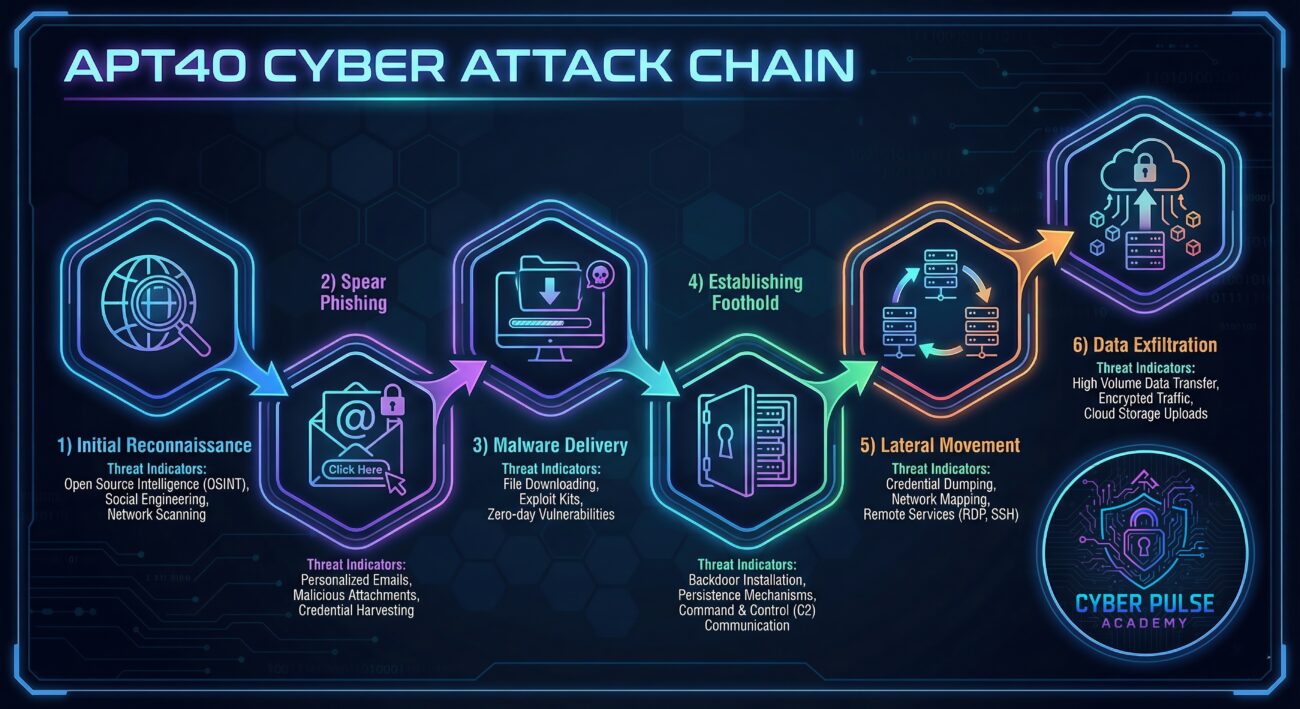
The significance of APT40 extends far beyond technical hacking – it represents a fundamental shift in how nations compete in the digital age. According to a joint advisory from cybersecurity agencies, including CISA and international partners, groups like APT40 "pose a severe threat to government and private sector networks worldwide."
What makes APT40 particularly concerning is their adaptability and speed. When new vulnerabilities are disclosed, security researchers have documented APT40 weaponizing these flaws within hours or days – much faster than most organizations can patch their systems. This creates a dangerous window where even updated systems remain vulnerable.
For everyday internet users, understanding APT40 matters because their tactics often trickle down to less sophisticated attackers. The spear-phishing techniques they pioneer eventually get copied by criminal groups targeting ordinary people. By learning how state-sponsored groups operate, you're better equipped to recognize early warning signs in your own digital life.
Consider this: if a government-backed team with virtually unlimited resources targets an organization, what chance do standard security measures have? This is why studying APT40 isn't just about one group – it's about understanding the cutting edge of cyber threats and preparing defenses accordingly. Their success demonstrates that traditional perimeter security is insufficient against determined, well-resourced adversaries.
| Term | Simple Definition | Everyday Analogy |
|---|---|---|
| Advanced Persistent Threat (APT) | A sophisticated, long-term cyber attack usually conducted by nation-states or well-funded groups | Like a team of professional burglars who move into your attic silently and steal small amounts over months instead of breaking in loudly one night |
| Spear Phishing | Highly targeted fraudulent emails tailored to specific individuals or organizations | Receiving a fake invoice that looks exactly like what your accounting department sends, versus the generic "Nigerian prince" email everyone gets |
| Living-off-the-Land (LotL) | Using legitimate system tools already present on computers to conduct malicious activities | A thief using your own kitchen knife to open your safe instead of bringing burglary tools that might be detected |
| Lateral Movement | How attackers spread from one compromised system to others within a network | Like getting access to one office in a building, then using keys found there to unlock adjacent offices until you reach the executive suite |
| Zero-Day Exploit | Attacking a software vulnerability before the developer knows about it or has created a fix | Discovering a secret back door to a bank that even the bank's architects don't know exists |
Let's follow Dr. Elena Rodriguez, a marine robotics researcher at a prestigious coastal university. Her team is developing underwater drone technology with potential military and commercial applications. Unknown to Elena, her work has appeared on APT40's target list for months.
The Setup: APT40 analysts spent weeks studying Elena's professional background. They noted her recent presentation at an oceanography conference, her collaboration with defense contractors, and even her habit of working late nights from her university office. This reconnaissance phase is meticulous – the digital equivalent of casing a building before a heist.
The Initial Compromise: One Tuesday evening, Elena receives an email appearing to come from the conference organizers. It references her specific presentation topic and includes a "revised schedule" attachment. The document contains malicious code that exploits a recently disclosed Microsoft Office vulnerability. When Elena opens it, the malware silently installs, giving APT40 their initial foothold.
| Time/Stage | What Happened | Impact |
|---|---|---|
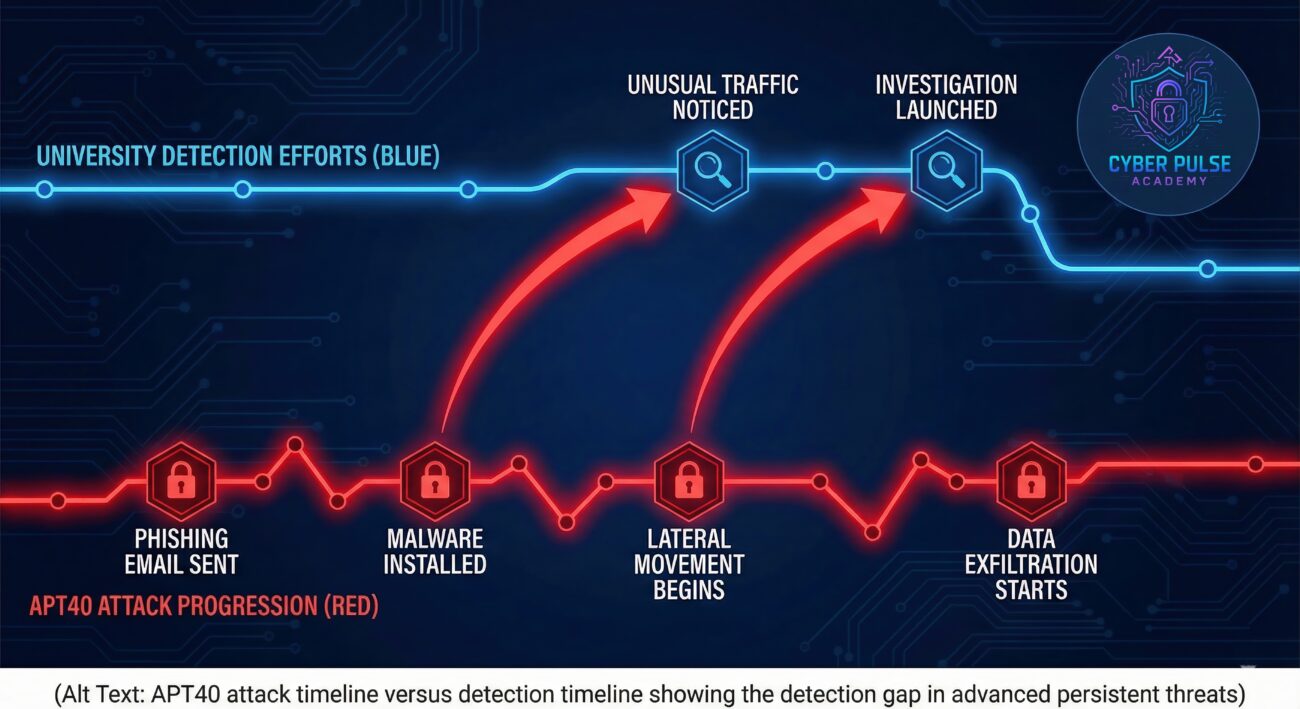
| Week 1-2: Reconnaissance | APT40 researchers gather intelligence on Elena and her university's network structure | They understand who to target and which vulnerabilities might work |
| Day 1: Initial Access | Elena opens the malicious attachment, installing malware that bypasses standard antivirus | APT40 gains a silent foothold on her workstation inside the university firewall |
| Day 2-7: Establishing Persistence | The malware creates scheduled tasks and registry entries to survive reboots | Even if Elena's computer restarts, APT40 maintains access to her system |
| Week 2-3: Lateral Movement | Using stolen credentials, APT40 moves to research servers and other faculty systems | They now access the entire marine robotics research database, not just Elena's files |
| Week 4+: Data Exfiltration | Research files are slowly encrypted and sent to external servers disguised as normal traffic | Months of proprietary research are stolen without triggering data loss alerts |
The Discovery: Three months later, a network administrator notices unusual after-hours traffic patterns during routine monitoring. By then, APT40 has exfiltrated gigabytes of sensitive research data. The university faces not just data loss but reputational damage and potential regulatory violations. Elena's team must restart months of work, all because of one carefully crafted email.
Related reading: Complete Guide to Spear Phishing Defense
Related reading: Zero Trust Implementation for Beginners
Related reading: Building Your First Incident Response Plan
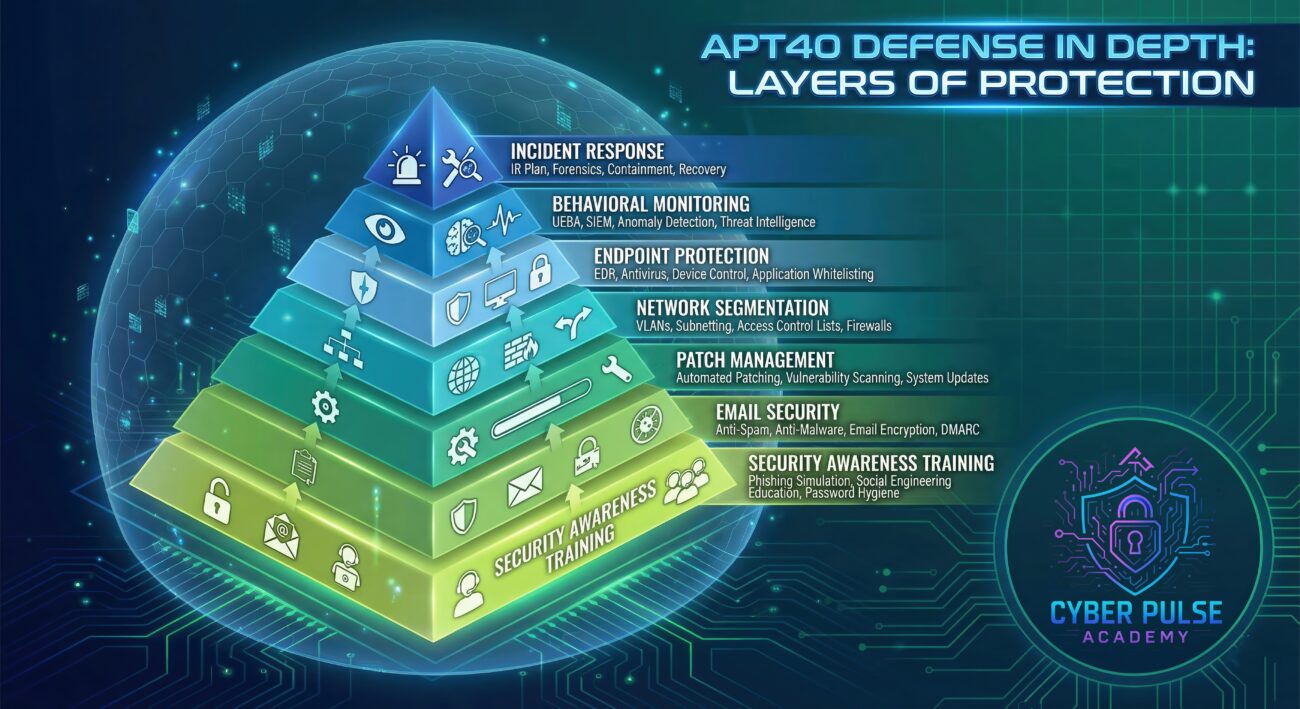
The Simple Attack Path: An attacker following APT40's playbook might begin by searching for employees who recently posted about new projects on professional networks like LinkedIn. They'd craft a fake invitation to a relevant industry event, attaching a "presentation template" containing malicious code. Once opened, the malware would use built-in Windows tools like PowerShell to download additional payloads, create hidden user accounts, and begin mapping the network, all while appearing as normal administrative activity.
The Defender's Counter-Move: A vigilant security team would monitor for unusual patterns, like PowerShell executing network scanning commands during non-business hours, or the same user account accessing systems they normally wouldn't. Instead of just blocking known bad files, they'd establish behavioral baselines and investigate deviations. The key mindset shift: stop looking only for "malware" and start looking for "abnormal activity," even when it uses legitimate tools.
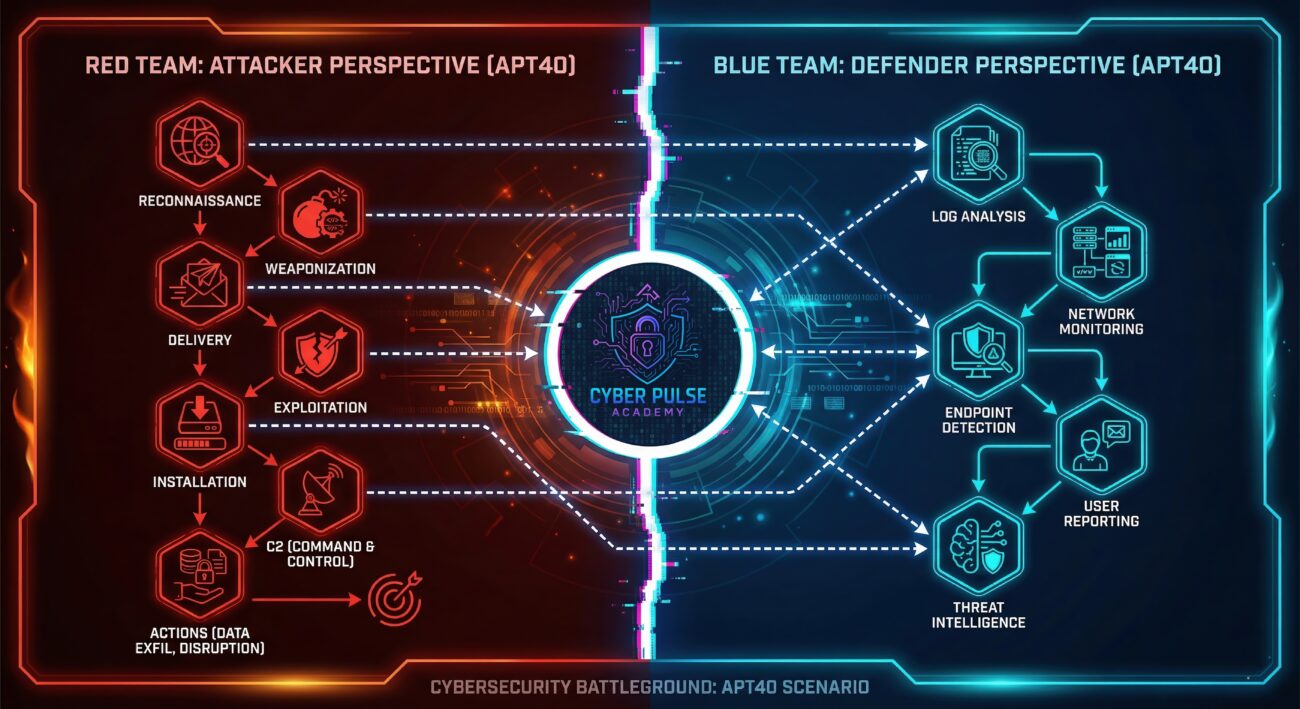
For APT40 operators, every intrusion is a patient game of digital hide-and-seek. They care about maintaining persistent access without detection, often for months or years. Their focus is on operational security, avoiding patterns that might trigger alerts, blending in with normal traffic, and carefully choosing which data to exfiltrate and when. They're not trying to "win" quickly; they're trying to remain undetected while gradually achieving their intelligence objectives. Time is on their side, and they'll wait weeks between actions if needed to avoid suspicion.
Defenders against APT40 face the challenge of detecting subtle anomalies in vast amounts of normal activity. They care about reducing their organization's "dwell time", how long an attacker remains undetected inside their network. Their focus is on visibility, logging, and correlation, connecting seemingly unrelated events that might indicate a sophisticated intrusion. They must balance security with business functionality, implementing controls that hinder attackers without crippling productivity. For them, every alert is a potential APT40 until proven otherwise.
Understanding APT40 (Leviathan) isn't just about learning technical details, it's about recognizing how cybersecurity has evolved into a domain of state competition. This Chinese state-sponsored group represents the cutting edge of cyber espionage, combining technical sophistication with strategic patience to achieve long-term intelligence goals.
Let's recap the essential insights about APT40:
Remember that while APT40 represents an elite threat, many of their techniques eventually filter down to less sophisticated attackers. By implementing the protection strategies outlined here, especially multi-factor authentication, rapid patching, and user awareness training, you're not just defending against state-sponsored groups; you're building resilience against the entire spectrum of cyber threats.
The digital landscape continues to evolve, with groups like APT40 constantly refining their methods. Staying informed, maintaining vigilant security practices, and fostering a culture of cybersecurity awareness are your best defenses in this ongoing silent conflict.
What surprised you most about how APT40 operates? Have you encountered security measures in your organization that would effectively counter these techniques? Share your thoughts, questions, or experiences in the comments below, let's build our collective defense knowledge together!
Further Learning Resources: For those wanting to dive deeper into APT threats, I recommend checking out Mandiant's threat research, the CISA cybersecurity advisories, and the MITRE ATT&CK entry for APT40.
Stay curious, stay vigilant, and remember: in cybersecurity, knowledge isn't just power, it's protection.
Every contribution moves us closer to our goal: making world-class cybersecurity education accessible to ALL.
Choose the amount of donation by yourself.