















Certification Courses
Hands-On Labs
Threat Intelligence
Latest Cyber News
MITRE ATT&CK Breakdown
All Cyber Keywords
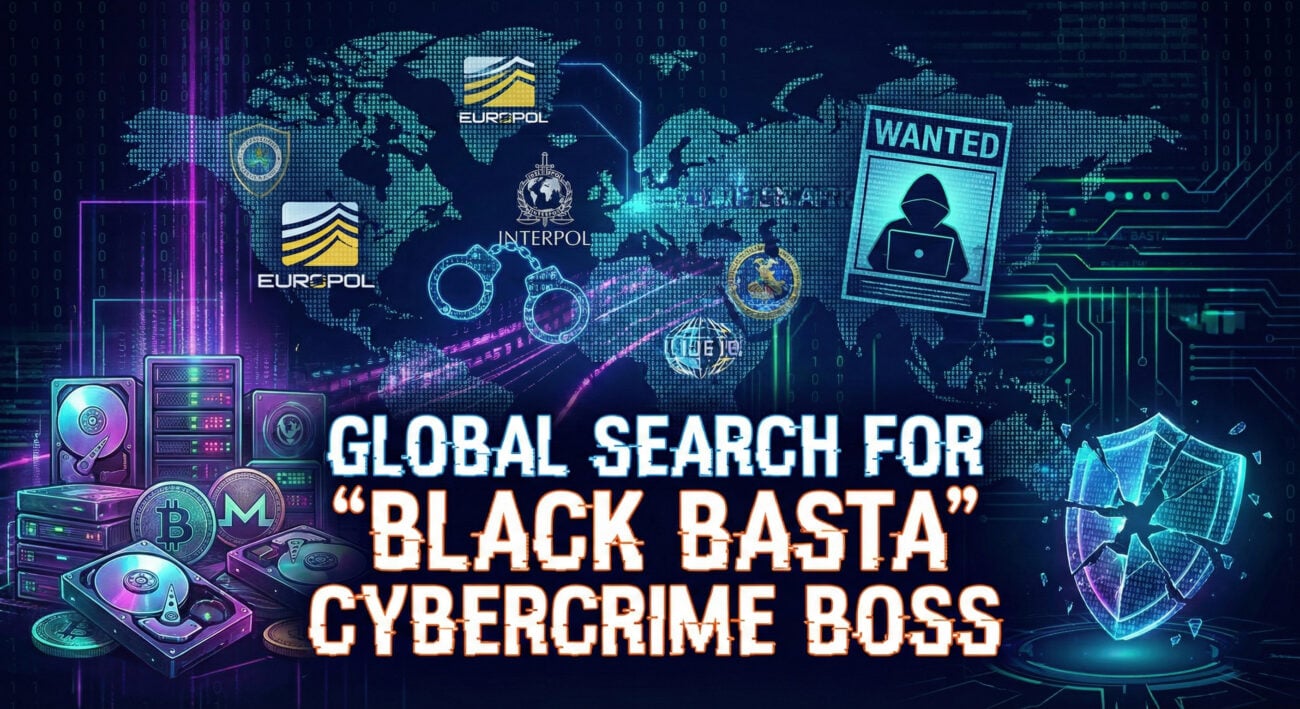
In a significant blow to one of the most aggressive ransomware groups, authorities recently apprehended a key leader of the Black Basta cybercrime syndicate. This development offers a rare glimpse into the operational structure of these digital extortion rings and provides critical lessons for defenders. This analysis breaks down the Black Basta ransomware operation, maps its tactics to the MITRE ATT&CK framework, and provides actionable guidance for cybersecurity professionals and beginners alike to understand and counter this pervasive threat.
The arrest represents a major victory for international law enforcement, disrupting a group responsible for extorting hundreds of millions from global enterprises. Black Basta operates as a Ransomware-as-a-Service (RaaS) model, where developers create the malware and "affiliates" carry out the attacks, sharing profits. This arrest targeted a high-level figure involved in recruiting affiliates and laundering cryptocurrency payments, highlighting the business-like structure of modern cybercrime.
For cybersecurity teams, this event underscores the importance of understanding not just the malware's code, but the human and procedural elements behind the threat. Defense must evolve beyond technical controls to include intelligence gathering, robust identity management, and preparation for the "double extortion" tactic, stealing data before encrypting it.
Emerging in early 2022, Black Basta quickly established itself as a top-tier ransomware threat. It is written in C++ and primarily targets Windows systems, though a Linux variant also exists for VMware ESXi servers. The group is notorious for its "double extortion" model:
Their public-facing "shame site" lists victims who refuse to pay, increasing pressure. The group's efficiency and aggression have been linked to members from the now-defunct Conti and REvil groups, suggesting a high level of sophistication.
Understanding Black Basta's methods through the MITRE ATT&CK framework is crucial for building effective defenses. Here are their core tactics and techniques:
| MITRE ATT&CK Tactic | Specific Technique (ID) | How Black Basta Uses It |
|---|---|---|
| Initial Access | Phishing (T1566) Valid Accounts (T1078) |
Uses sophisticated spear-phishing emails with malicious QakBot attachments or exploits known vulnerabilities in public-facing applications (like VPNs) to gain a foothold. Often purchases stolen corporate credentials from initial access brokers. |
| Execution | Command and Scripting Interpreter (T1059) User Execution (T1204) |
Initial payloads (e.g., QakBot) execute PowerShell or CMD commands to download the main ransomware binary. Users are tricked into enabling macros or running disguised installers. |
| Persistence & Lateral Movement | Exploitation of Remote Services (T1210) Pass the Hash (T1550.002) |
Uses tools like Cobalt Strike and Mimikatz to steal credentials and move laterally across the network. Creates new local/domain admin accounts to maintain access. |
| Defense Evasion | Impair Defenses (T1562) File and Directory Permissions Modification (T1222) |
Disables Windows Defender, antivirus software, and deletes volume shadow copies (vssadmin.exe delete shadows /all /quiet) to prevent file recovery. Uses living-off-the-land binaries (LoLBins) to blend in. |
| Impact | Data Encrypted for Impact (T1486) Data Destruction (T1485) |
Deploys the final ransomware payload, encrypting files with a strong algorithm and appending the .basta extension. Exfiltrates data prior to encryption for double extortion. |
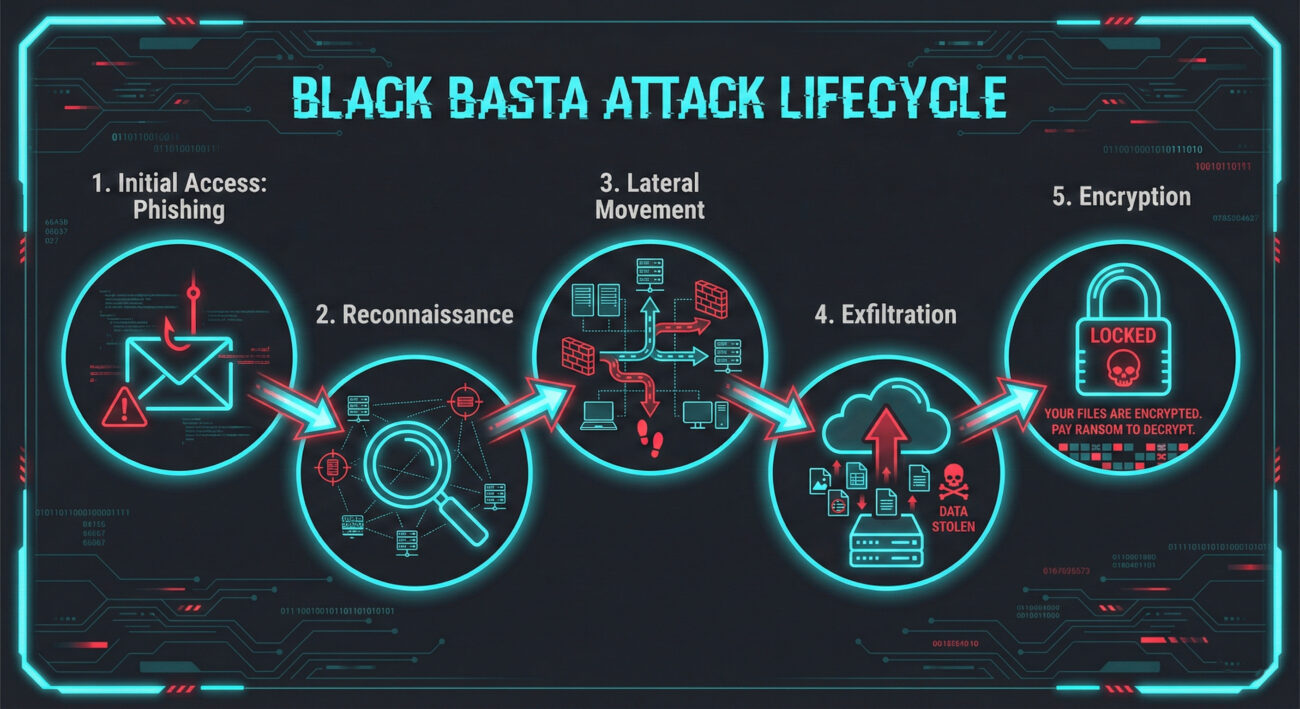
Let's walk through a typical attack sequence, based on incident reports from cybersecurity firms like CISA and SentinelOne.
An employee in the finance department receives a tailored email pretending to be a vendor invoice. The attachment is a weaponized Excel document. When opened, it prompts the user to "Enable Content," executing a macro that drops the QakBot malware.
QakBot establishes communication with its command-and-control (C2) server. It then injects itself into running processes, harvests email threads for further phishing, and begins basic reconnaissance of the network, looking for domain controllers and file servers.
Using stolen credentials and exploits like CVE-2022-30190 (Follina), the attackers move laterally. They deploy Cobalt Strike beacons and use Mimikatz to dump LSASS memory, obtaining admin credentials.
The attackers identify and exfiltrate sensitive data (financial records, PII, intellectual property) to cloud storage using tools like Rclone or MegaSync. Concurrently, they disable security software and delete backups.
The final Black Basta payload is deployed across the network, often via Group Policy. Files are encrypted. A ransom note (README.txt) appears on every desktop, directing the victim to a Tor negotiation site where they are threatened with public data leakage if the ransom isn't paid.
Goals: Maximize financial gain, maintain operational stealth, and achieve total network control.
Goals: Detect intrusion early, contain lateral movement, protect critical assets, and ensure recoverability.
A: Law enforcement and cybersecurity agencies universally advise against paying. Payment funds future criminal activity and does not guarantee data recovery or that data won't be leaked later. The only guaranteed recovery path is from secure, offline backups.
A: Evidence suggests Black Basta evolved from members of the Conti and REvil cartels. It shares similar code, tactics, and infrastructure, representing a "rebranding" or splinter group, a common practice to evade law enforcement focus after a major takedown.
A: Implement and enforce Multi-Factor Authentication (MFA) on all accounts, especially email and remote access. This simple step blocks the vast majority of credential-based attacks that lead to ransomware.
A: Currently, there is no publicly available, reliable decryptor for recent versions of Black Basta. This reinforces the need for prevention and backups. Stay updated via resources like the No More Ransom project.
The Black Basta ransomware saga is a stark reminder of the evolving cyber threat landscape. Don't wait for an attack to test your resilience. Take these steps this week:
For further learning, explore these essential resources:
Share this knowledge. Forward this article to your colleagues and start a conversation about improving your organization's cyber posture. Defense is a team sport.
© 2026 Cyber Pulse Academy. This content is provided for educational purposes only.
Always consult with security professionals for organization-specific guidance.
Every contribution moves us closer to our goal: making world-class cybersecurity education accessible to ALL.
Choose the amount of donation by yourself.