



















Certification Courses
Hands-On Labs
Threat Intelligence
Latest Cyber News
MITRE ATT&CK Breakdown
All Cyber Keywords
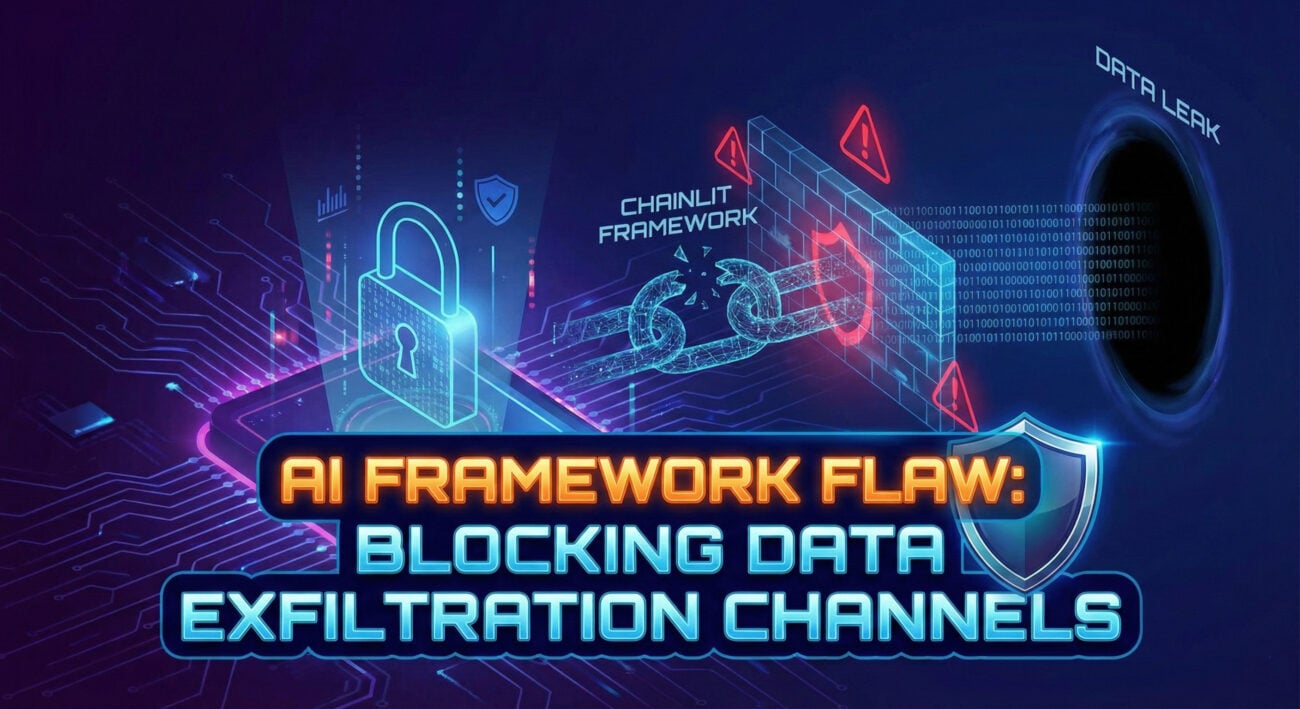
The rapid adoption of AI frameworks like Chainlit is introducing familiar but dangerous security vulnerabilities into new, critical infrastructure. Recently discovered Chainlit vulnerabilities, tracked as CVE-2026-22218 and CVE-2026-22219, reveal how a popular tool for building conversational AI can be weaponized to steal sensitive files, cloud keys, and breach internal networks. This analysis breaks down the technical attack chain, maps it to the MITRE ATT&CK® framework, and provides a clear defensive roadmap for developers and security teams.
In January 2026, security researchers at Zafran disclosed two high-severity flaws in the open-source Chainlit AI framework, collectively dubbed "ChainLeak." Chainlit, with over 7.3 million downloads, is used to create and deploy conversational chatbots. These Chainlit vulnerabilities create a perfect storm for data breach:
When combined, these flaws allow an attacker to move from a limited application attack to full-scale compromise of the hosting environment, leading to lateral movement and massive data exfiltration. The vulnerabilities were patched in Chainlit version 2.9.4, released in December 2025.
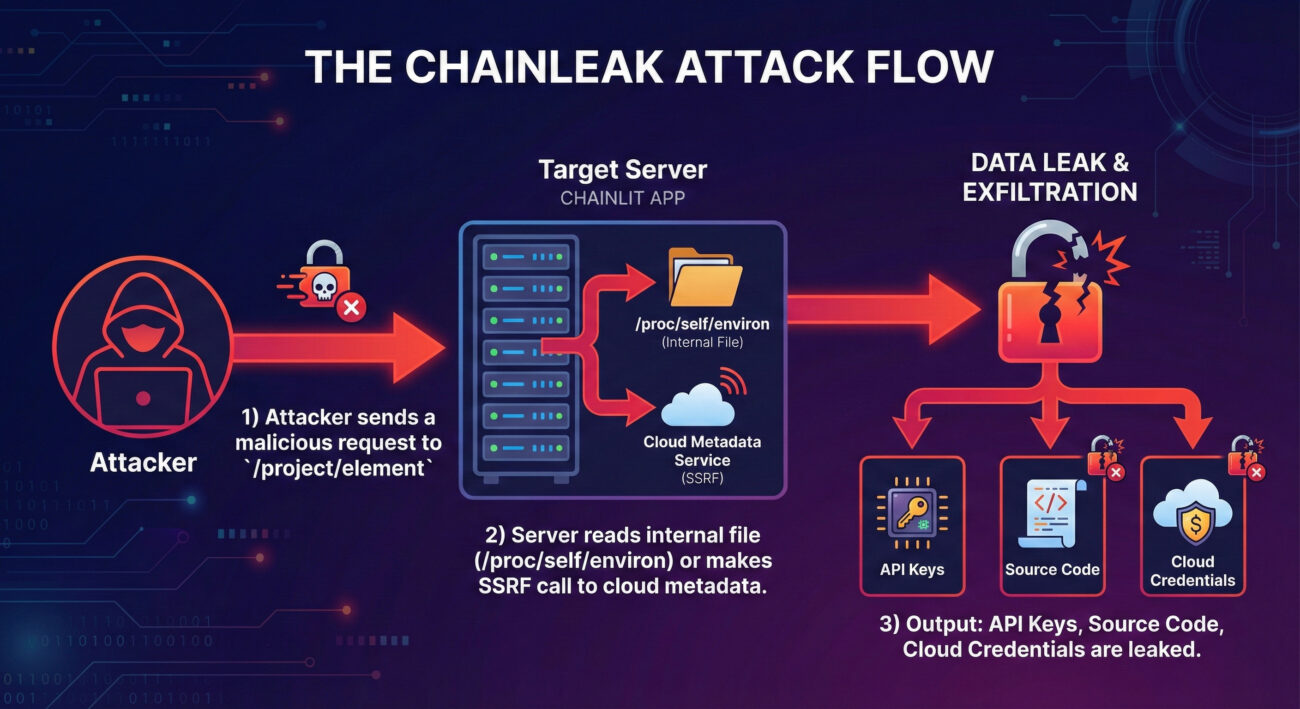
To defend effectively, you must understand the attack mechanics. Let's dissect each CVE.
The flaw existed in the file upload logic for chat "elements" (like images, PDFs). The endpoint failed to properly validate user-controlled input that specified file paths. An attacker could manipulate a request to point to a sensitive system file instead of a uploaded file.
Technical Impact: By submitting a path like ../../../../proc/self/environ, an attacker could read the server's environment variables. This file is a goldmine, often containing:
DATABASE_URL)This vulnerability was triggered when Chainlit was configured to use SQLAlchemy with a database like PostgreSQL. The flaw allowed an attacker to inject a URL into a parameter that the server would then fetch. Crucially, this request originated from the Chainlit server itself, bypassing network firewalls that might block external traffic.
Prime Target: Cloud Metadata Services. In cloud environments like AWS, a special internal endpoint (169.254.169.254) provides credentials for the instance's assigned role. By exploiting this SSRF, an attacker could steal these cloud IAM credentials, granting them permissions to other services (S3 buckets, databases) within the cloud account, enabling catastrophic lateral movement.
Imagine "TechCorp," which uses a Chainlit-powered internal AI assistant to help employees query company documentation. The app runs on an AWS EC2 instance.
/proc/self/environ. They extract the AWS_ACCESS_KEY_ID and a path to the application source code.Understanding these Chainlit vulnerabilities within the MITRE ATT&CK framework helps defenders recognize the tactics and plan detection strategies.
| MITRE ATT&CK Tactic | Technique (ID) | How ChainLeak is Utilized |
|---|---|---|
| Initial Access | Valid Accounts (T1078) | The attack requires an authenticated session, exploiting legitimate user credentials. |
| Discovery | File and Directory Discovery (T1083), Cloud Infrastructure Discovery (T1580) | Reading /proc/self/environ and source code discovers secrets and configs. SSRF queries cloud metadata to discover IAM role info. |
| Credential Access | Unsecured Credentials (T1552), Cloud Instance Metadata API (T1552.005) | The core impact: stealing API keys from environment variables and cloud IAM roles via the metadata API attack. |
| Lateral Movement | Use Alternate Authentication Material (T1550) | Stolen cloud credentials are used to move from the compromised app server to other services (S3, RDS) within the cloud environment. |
| Exfiltration | Exfiltration Over Web Service (T1567) | Sensitive data from internal files and cloud services is transmitted back to the attacker. |
Objective: Leverage the app to gain cloud access and exfiltrate data.
/proc/self/environ first for quick wins.Objective: Detect and prevent exploitation, limit damage.
/project/element endpoint. Set alerts for outbound requests from the app server to internal metadata IP (169.254.169.254).Here is a simplified technical walkthrough of how an attacker might chain these Chainlit vulnerabilities together.
The attacker already has a valid session cookie. They probe the application and discover the /project/element endpoint used for uploading files. They intercept a legitimate request and analyze its structure.
They modify the POST request to the vulnerable endpoint, changing a file path parameter to traverse to a sensitive location. For example:
POST /project/element HTTP/1.1
Host: vulnerable-ai-app.com
... (session cookies) ...

{
  "file_path": "../../../proc/self/environ", // Malicious path traversal
  "element_id": "attacker_controlled_id"
}
The server, lacking validation, reads the environment file and includes its contents in the response, leaking secrets.
From the leaked data, the attacker confirms the use of SQLAlchemy. They craft a new request that injects a URL pointing to the cloud metadata service.
{
  "data_source": "http://169.254.169.254/latest/meta-data/iam/security-credentials/",
  "action": "update_element"
}
The Chainlit server makes this request and returns the IAM role name, which the attacker then queries further to get temporary access keys.
The Chainlit vulnerabilities stem from classic security failures. Here’s what to avoid and what to implement.
.., /proc, or URLs with internal IP ranges.Q1: I'm using Chainlit version 2.8. Am I definitely vulnerable?
Yes, if you are using a version prior to 2.9.4, your application is vulnerable to these specific CVEs. You should plan an immediate upgrade.
Q2: Can these vulnerabilities be exploited remotely without any user account?
No. Both flaws require an authenticated session. This highlights the critical importance of strong authentication controls and monitoring user accounts for compromise.
Q3: Besides updating, what's the single most important mitigation?
For cloud deployments, enforcing IMDSv2 is a critical, network-level mitigation that can break the SSRF exploit chain even if the application flaw is unpatched. AWS provides tools to enforce this at the account level.
Q4: Are other AI frameworks vulnerable to similar issues?
Absolutely. The disclosure coincided with a similar SSRF flaw in Microsoft's MarkItDown MCP server. The pattern is clear: as AI frameworks integrate diverse data sources (files, URLs, APIs), they create new surfaces for classic vulnerabilities like SSRF and Path Traversal. A proactive security review of any AI framework is essential.
Q5: Where can I learn more about secure development for AI applications?
Start with the OWASP Top 10 for LLM Applications. For cloud security, the AWS Security Best Practices and Google Cloud Security Foundations Guide are excellent resources. The MITRE ATT&CK Navigator is also invaluable for understanding adversary behavior.
The Chainlit vulnerabilities serve as a powerful case study: AI innovation does not negate classical security risks. Frameworks that handle files and network requests are prime targets for well-known attack techniques.
Don't let your innovative AI projects become the weakest link in your security chain. Begin with these actionable steps today.
1. Audit: Inventory all your applications using AI frameworks like Chainlit.
2. Patch: Prioritize updating to the latest secure versions.
3. Harden: Implement the network and cloud controls discussed above.
For ongoing insights into cybersecurity threats and defenses, explore more resources on our site or follow trusted sources like the CISA Secure Our World campaign.
© Cyber Pulse Academy. This content is provided for educational purposes only.
Always consult with security professionals for organization-specific guidance.
Every contribution moves us closer to our goal: making world-class cybersecurity education accessible to ALL.
Choose the amount of donation by yourself.