



























Certification Courses
Hands-On Labs
Threat Intelligence
Latest Cyber News
MITRE ATT&CK Breakdown
All Cyber Keywords
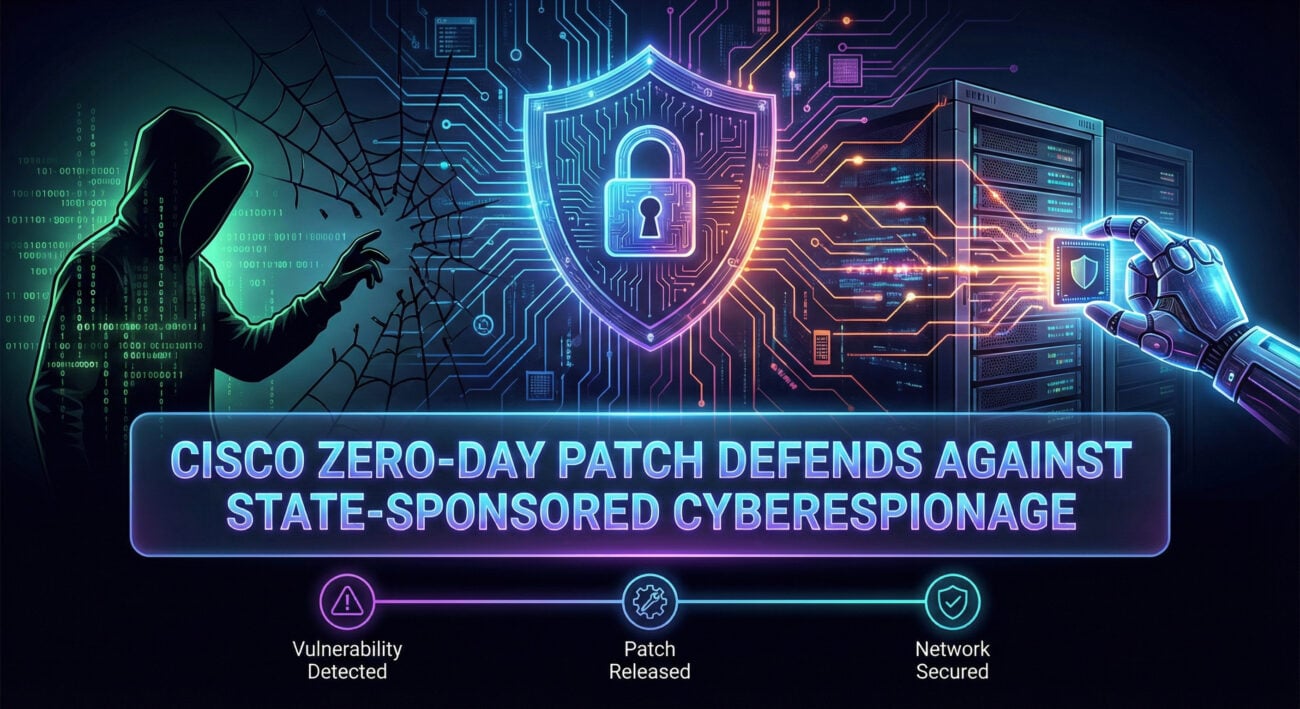
In January 2026, Cisco issued an urgent patch for a critical zero-day vulnerability, tracked as CVE-2025-20393, with a maximum CVSS score of 10.0. This flaw in Cisco's AsyncOS software for Secure Email Gateway and Secure Email and Web Manager appliances was not just theoretical, it was actively exploited in the wild by a China-linked Advanced Persistent Threat (APT) group, codenamed UAT-9686, for at least a month before discovery.
This Cisco zero-day RCE vulnerability serves as a powerful case study in modern cyber attack chains. The attackers leveraged an insufficient validation bug in the Spam Quarantine feature to achieve remote command execution (RCE) with root privileges. This post provides a complete, beginner-friendly breakdown of the exploit, the APT's tactics, and the concrete steps you must take to defend your organization.
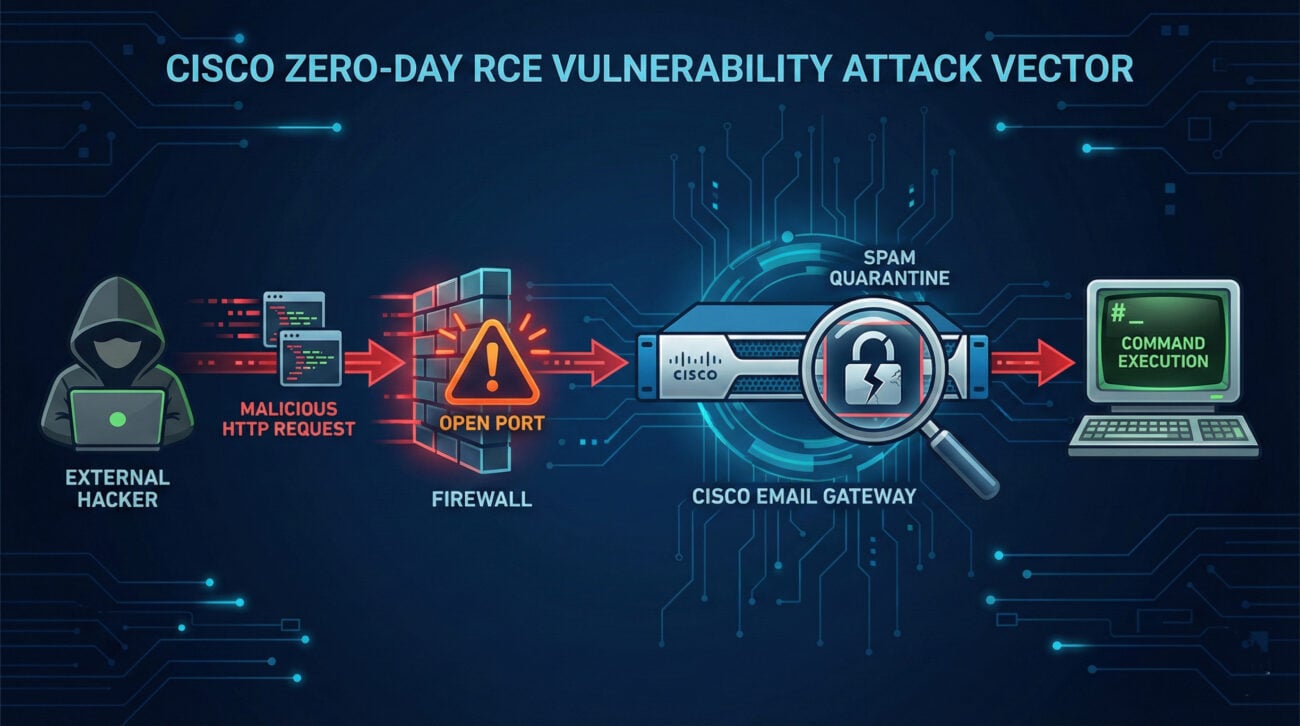
At its core, CVE-2025-20393 is a classic case of "insufficient input validation." The vulnerability resided in the Spam Quarantine feature of Cisco AsyncOS. This web-based feature allows administrators to review emails flagged as spam.
Think of the Spam Quarantine web interface as a receptionist. Its job is to accept specific requests (like "show me quarantined emails from user X") and fetch that data. The flaw meant this receptionist did not properly check the identity or the instructions of the person making the request. A malicious actor could craft a specially formatted HTTP request that, instead of asking for data, contained hidden commands.
Because the software didn't validate the request sufficiently, it would pass these malicious commands directly to the underlying Linux operating system of the appliance. Since the Spam Quarantine service ran with the highest level of privilege (root), the attacker's commands were executed with total control over the system.
Understanding the preconditions is key to risk assessment. For this Cisco zero-day RCE vulnerability to be exploitable, three conditions had to align:
This last point is crucial. It highlights a major theme in modern security: reducing attack surface. A service that should only be accessed internally was left exposed, turning a critical vulnerability into a catastrophic one.
The China-linked group UAT-9686 didn't just crash systems. They used the Cisco zero-day RCE vulnerability as a precise surgical tool to gain a stealthy, long-term foothold. Their actions post-exploitation map a textbook APT campaign focused on persistence and stealth.
After exploiting CVE-2025-20393 to gain a root shell, the attackers immediately deployed tunneling tools:
With reliable access established, they installed a custom backdoor for sustained control:
The final touch demonstrates their sophistication and intent to remain hidden:
The MITRE ATT&CK framework is a globally accessible knowledge base of adversary tactics and techniques. Mapping the UAT-9686 campaign to it helps defenders understand the "how" and plan their defenses. This Cisco zero-day RCE vulnerability was just the entry point in a larger chain.
| MITRE ATT&CK Tactic | Technique Used (ID & Name) | How UAT-9686 Applied It |
|---|---|---|
| Initial Access | T1190: Exploit Public-Facing Application | Exploited the vulnerable Spam Quarantine web interface exposed to the internet. |
| Execution | T1059: Command and Scripting Interpreter | Used the RCE vulnerability to execute shell commands, later via the Python-based AquaShell. |
| Persistence | T1505.003: Server Software Component (Web Shell) | Installed AquaShell, a persistent backdoor that allowed continued access. |
| Defense Evasion | T1070: Indicator Removal (via AquaPurge) | Deleted log files to erase evidence of intrusion and tool execution. |
| Command & Control (C2) | T1572: Protocol Tunneling | Used ReverseSSH and Chisel to create encrypted tunnels for C2 traffic, blending into normal network flows. |
By understanding this mapping, blue teams can look for these specific techniques in their environments. For instance, detecting unexpected SSH tunnels from an email gateway or anomalous Python processes running on a network appliance are clear indicators of compromise (IOCs).
If you manage Cisco Secure Email Gateways or Web Managers, immediate action is required. Follow this structured guide to secure your systems.
Log into your Cisco appliance's administrative console. Navigate to System Administration > Software Version. Compare your version against the patched versions listed by Cisco (e.g., 15.0.5-016 for ESAs on 15.0). If you are vulnerable, consider temporarily blocking internet access to the appliance's management interface at the firewall while you prepare to patch.
Download the correct patch file from the official Cisco Software Center. Follow Cisco's detailed upgrade guide for your specific model. Always perform this during a maintenance window, as it requires a system reboot. Ensure you have a recent configuration backup.
Assume breach. Patching fixes the hole but doesn't remove intruders already inside. Examine system logs for unknown processes, particularly for ReverseSSH, Chisel, or Python scripts with unusual names. Look for unexpected outbound network connections from the appliance. Cisco's advisory includes specific IOCs, use them. If you lack internal forensics capability, engage a Cybersecurity incident response firm.
Go beyond patching to prevent future exploitation of similar flaws:
This incident perfectly illustrates the constant cat-and-mouse game in cybersecurity. Let's break down the mindset and actions from both sides of the firewall.
Objective: Establish covert, long-term access to victim networks for espionage.
Their success hinged on exploiting a known weakness: exposed, vulnerable services combined with a lack of input validation.
Objective: Protect the integrity, confidentiality, and availability of email services and the network.
Their challenge is defending a vast attack surface with limited resources, making prioritization based on threat intelligence (like this advisory) critical.
This Cisco zero-day RCE vulnerability exploit campaign highlights widespread security failures. Let's turn those failures into actionable lessons.
Q: I've applied the patch. Am I now safe from this specific threat?
A: You have closed the initial entry point (CVE-2025-20393). However, if your system was compromised before you patched, the backdoors (AquaShell, tunnels) may still be present. Patching must be followed by a thorough investigation for indicators of compromise (IOCs).
Q: My appliance isn't exposed to the internet. Was I still at risk?
A: Your risk was significantly lower, but not zero. An attacker who gains initial access to your internal network (e.g., via a phishing email) could then target the vulnerable appliance from inside. Internal patching is still critically important for defense-in-depth.
Q: What is the difference between a vulnerability and an exploit?
A: A vulnerability (like CVE-2025-20393) is a weakness or flaw in the software. An exploit is a piece of code or a technique that actively attacks and takes advantage of that vulnerability to achieve an effect, like remote code execution.
Q: Where can I find more technical details and IOCs?
A: Always refer to the primary source for the most accurate and detailed information. Cisco's official security advisory is the definitive guide. You can also follow trusted threat intelligence feeds from organizations like CISA or MITRE.
Don't let this be just another news article you read. Take these steps in the next 24 hours:
Cybersecurity is a continuous practice. Stay informed, stay patched, and stay vigilant.
For more in-depth guides and analysis, explore our Network Security Fundamentals series.
© 2026 Cyber Pulse Academy. This content is provided for educational purposes only.
Always consult with security professionals for organization-specific guidance.
Every contribution moves us closer to our goal: making world-class cybersecurity education accessible to ALL.
Choose the amount of donation by yourself.