



Certification Courses
Hands-On Labs
Threat Intelligence
Latest Cyber News
MITRE ATT&CK Breakdown
All Cyber Keywords
The cybersecurity landscape is undergoing a seismic shift. The volume and sophistication of attacks are overwhelming human analysts. Enter Anthropic's Claude AI, a specialized secure assistant designed not to replace cybersecurity professionals, but to radically augment their capabilities. This guide dives deep into how this AI cybersecurity assistant works, its connection to frameworks like MITRE ATT&CK, and how both red teams and blue teams can leverage it.
Anthropic's launch of Claude as a specialized AI cybersecurity assistant marks a pivotal move from general-purpose chatbots to domain-specific, secure AI partners. Unlike tools that can hallucinate or produce risky code, this assistant is constrained and trained to prioritize security context, accuracy, and safety. Its core function is to act as a force multiplier in Security Operations Centers (SOCs), sifting through petabytes of logs, linking isolated events to known adversary behaviors in the MITRE ATT&CK framework, and drafting clear, actionable reports, all at machine speed.
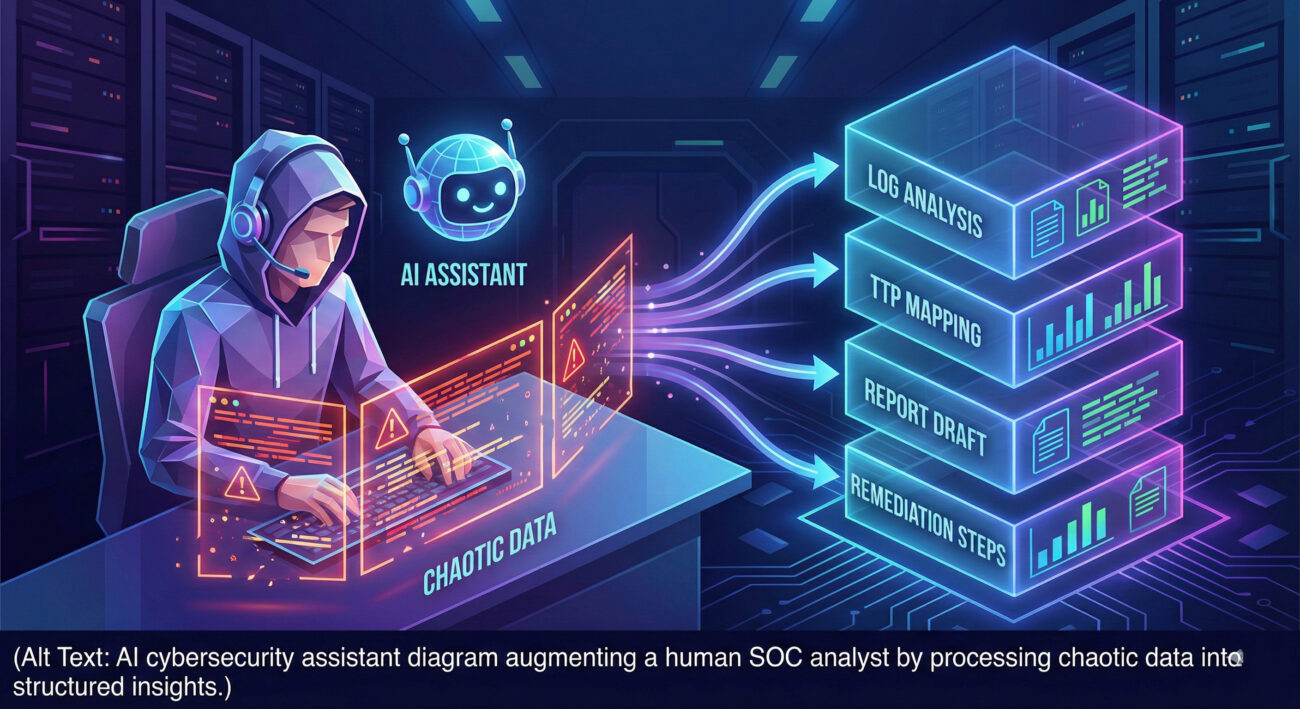
This isn't magic; it's applied machine learning with a security-first constitution. The assistant is fine-tuned on a massive corpus of cybersecurity data: threat reports, malware analyses, CVE descriptions, and, critically, the entire MITRE ATT&CK knowledge base.
When an analyst provides a prompt, like a suspicious PowerShell command or a snippet of a phishing email, the assistant performs a multi-step reasoning process:
The AI parses the input, identifying key entities: file paths, registry keys, IP addresses, URLs, code syntax, and natural language descriptions of activity.
It cross-references these entities against its internal model of adversary Tactics, Techniques, and Procedures (TTPs). For example, a command to disable Windows Defender maps directly to MITRE ATT&CK T1562.001: Impair Defenses – Disable or Modify Tools.
The AI doesn't just name a technique; it explains the "why." It might say, "This technique (T1562.001) is commonly used by ransomware actors like LockBit during the Execution phase to operate without detection before file encryption."
Finally, it produces structured output: the mapped MITRE technique, confidence level, recommended investigative queries (e.g., Sigma or Splunk rules), and hardening steps.
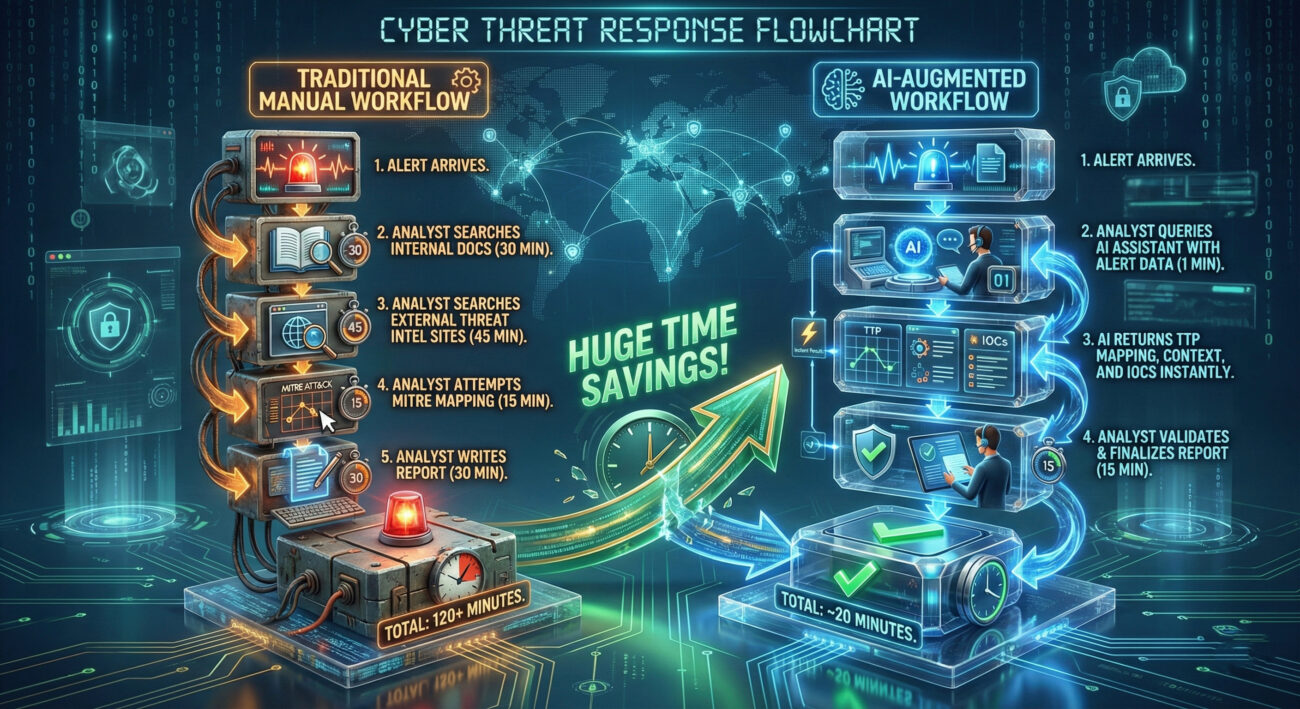
This process turns a single indicator into a narrative of the potential attack, saving hours of manual research.
The MITRE ATT&CK framework is the common language of cybersecurity. A key superpower of this AI cybersecurity assistant is its ability to automate the mapping of observed activity to this framework.
Imagine a user reports a sophisticated phishing email that bypassed filters. An analyst can feed the email body, headers, and attached file hash to the assistant.
This instant, contextualized mapping accelerates threat hunting and incident response dramatically.
The assistant shines across the security workflow. Here’s how it translates to daily tasks:
The AI cybersecurity assistant is a dual-use tool. Its value depends entirely on who holds the reins.
Adversaries could theoretically use similar AI to:
Important Note: Anthropic's Claude is built with safety "guardrails" to refuse generating explicitly malicious content, but open-source or maliciously fine-tuned models may not have such constraints.
Defenders leverage the assistant to:
The key defender advantage is scale and speed, turning individual analysts into high-output threat research teams.
Adopting an AI cybersecurity assistant requires strategy, not just a subscription.
| Phase | Key Actions | Success Metrics |
|---|---|---|
| 1. Assessment & Scope | Identify pain points: slow triage, alert fatigue, knowledge gaps. Define clear use cases (e.g., "assist Tier 1 with alert enrichment"). | Clear definition of 2-3 pilot use cases. |
| 2. Pilot & Integration | Run a controlled pilot with a small analyst team. Integrate outputs into ticketing (e.g., Jira, ServiceNow) and SIEM workflows. | Reduction in time spent per initial alert analysis; user satisfaction scores. |
| 3. Training & Refinement | Train analysts on effective prompt engineering (e.g., being specific, providing context). Refine the AI's use based on feedback. | Improved quality and actionability of AI-generated reports. |
| 4. Scale & Evolve | Expand access. Use AI to help build new detection logic and automate routine report generation for compliance. | Increased SOC capacity (alerts handled per analyst); decreased MTTR. |
A: Absolutely not. It's designed to augment and elevate them. It automates the tedious research and correlation, freeing analysts to do what they do best: strategic thinking, complex investigation, and making critical decisions. The future is human-machine teaming.
A: It's highly accurate for well-documented TTPs but should be treated as a hypothesis. The assistant provides confidence levels and evidence. The analyst must confirm the mapping aligns with all observed data. It's a starting point, not the final verdict.
A: This is crucial. When evaluating an AI assistant, you must choose a deployment model that fits your risk tolerance. Opt for enterprise versions that guarantee data is not used for training and is encrypted in transit and at rest. Never feed highly sensitive data into a public, free chatbot.
A: Start with low-risk tasks. Use it to explain security concepts you don't understand. Ask it to summarize long threat reports. Practice by giving it snippets from public breach disclosures and see how it maps them. Focus on learning to craft better prompts, it's a skill in itself.
The evolution from manual analysis to AI-assisted operations is no longer speculative; it's here. To stay ahead of sophisticated adversaries, cybersecurity teams must explore and integrate these tools thoughtfully.
Your next steps:
The goal isn't to create a SOC run by machines, but to build an unbeatable team where human intuition, creativity, and experience are supercharged by an AI cybersecurity assistant. Start building that future today.
© 2026 Cyber Pulse Academy. This content is provided for educational purposes only.
Always consult with security professionals for organization-specific guidance.
Every contribution moves us closer to our goal: making world-class cybersecurity education accessible to ALL.
Choose the amount of donation by yourself.