

















Certification Courses
Hands-On Labs
Threat Intelligence
Latest Cyber News
MITRE ATT&CK Breakdown
All Cyber Keywords
How APT28's Sophisticated Phishing Campaigns Target Global Energy and Policy Infrastructure
In early 2026, cybersecurity researchers uncovered a sophisticated credential harvesting attack campaign orchestrated by the Russian state-sponsored group APT28, also known as BlueDelta or Fancy Bear. This group, linked to the GRU, has systematically targeted individuals within a Turkish energy and nuclear research agency, a European think tank, and organizations in North Macedonia and Uzbekistan.
The core of this attack involves highly convincing fake login pages that mimic legitimate services like Microsoft Outlook, Google, and Sophos VPN. The campaign's sophistication lies not just in its appearance, but in its post-theft behavior: after stealing credentials, victims are seamlessly redirected to the real service, leaving them unaware of the breach. This analysis will break down this pervasive credential harvesting attack vector, providing a clear understanding for professionals and beginners alike.
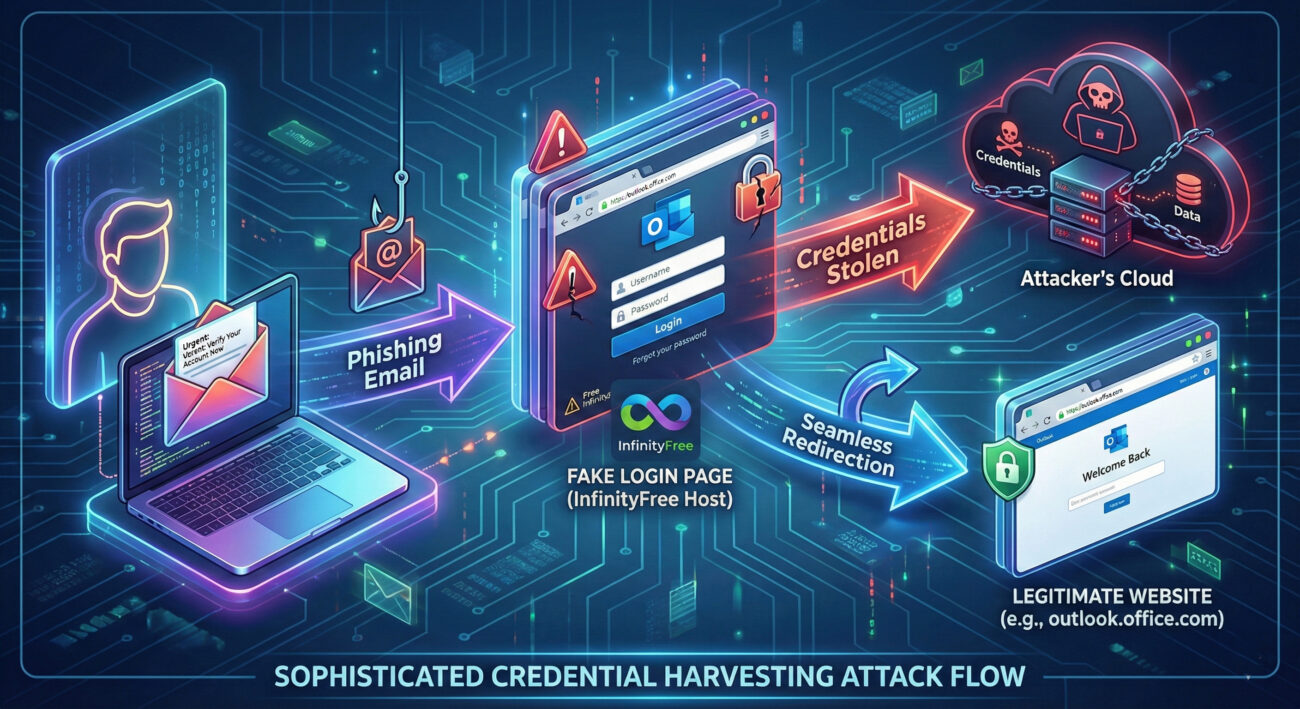
Understanding the mechanics of this credential harvesting attack is crucial for defense. APT28's method is a multi-stage process designed for maximum deception and minimal detection.
The attack begins with a targeted spearphishing email. Unlike generic spam, these emails contain contextually relevant lures. For example, APT28 used a real PDF publication from the Gulf Research Center about the Iran-Israel war and a climate policy briefing from think tank ECCO. The email contains a shortened URL link.
Clicking the link starts a fast-paced redirect chain designed to disorient the victim:
The fake page is often hosted on free or disposable infrastructure like InfinityFree, Byet Internet Services, or ngrok. This allows the attackers to quickly set up and tear down malicious pages, making them hard to track.
This is the cleverest part of the attack. The fake page contains hidden JavaScript code that performs two critical actions simultaneously when the victim submits their username and password:
From the user's perspective, they simply entered their password and successfully logged in, noticing nothing amiss. This "clean exit" is what makes this credential harvesting attack particularly dangerous and effective.
Frameworks like MITRE ATT&CK help us categorize adversary behavior. The APT28 credential harvesting attack is a textbook example of several techniques working in concert.
| MITRE ATT&CK Tactic | Technique (ID & Name) | How APT28 Applied It |
|---|---|---|
| Initial Access | T1566.002 - Phishing: Spearphishing Link | Sending targeted emails with shortened links to regional and professional lures (energy reports, policy briefs). |
| Credential Access | T1589.001 - Credential Access: Credential Harvesting | Deploying fake OWA, Google, and Sophos VPN login pages to steal usernames and passwords. |
| Collection | T1534 - Internal Spearphishing | Using stolen credentials from one victim to spearphish others within the same organization for lateral movement. |
| Defense Evasion | T1071.001 - Application Layer Protocol: Web Protocols | Using legitimate-looking web services (Webhook.site, InfinityFree) to host malicious content and blend in with normal traffic. |
| Resource Development | T1583.001 - Acquire Infrastructure: Domains | Registering and leveraging free hosting services and dynamic DNS providers for disposable attack infrastructure. |
By understanding this mapped attack sequence, defenders can build more effective detection rules. For instance, monitoring for rapid redirects between unrelated free-hosting domains and legitimate corporate login pages could be a key indicator.
Let's walk through a specific instance from the September 2025 campaign to see how a credential harvesting attack unfolds in real-time from the victim's viewpoint.
Ahmet, an analyst at a Turkish energy research institute, receives an email from a seemingly trusted sender. The subject references a recent, relevant industry report on Mediterranean energy policy. The body text is professional and urges him to "review the attached briefing." The "attachment" is actually a shortened link (e.g., bit.ly/xxxx).
Curious, Ahmet clicks the link. His browser opens a tab showing a genuine-looking PDF document hosted on Webhook[.]site. He sees it's a real ECCO climate briefing. After just two seconds, the page automatically refreshes.
The new page looks exactly like his organization's Microsoft Outlook Web Access (OWA) login portal. The URL in the address bar shows "https://secure-login-infinityfree[.]net/owa/" – which looks plausible but is actually a malicious page hosted on free infrastructure. A message states, "Your session has expired. Please re-authenticate."
Ahmet enters his corporate email and password and hits "Sign In." Hidden JavaScript code instantly sends his credentials to an APT28-controlled Webhook endpoint. Simultaneously, his browser is redirected to "https://outlook.office.com" – the real Microsoft login page.
Ahmet may be prompted to log in again on the legitimate page (as his credentials weren't actually submitted there). He does so and gains access to his real mailbox. He assumes the first prompt was just a glitch or pre-login screen. He is completely unaware his credentials are now in the hands of APT28 hackers.
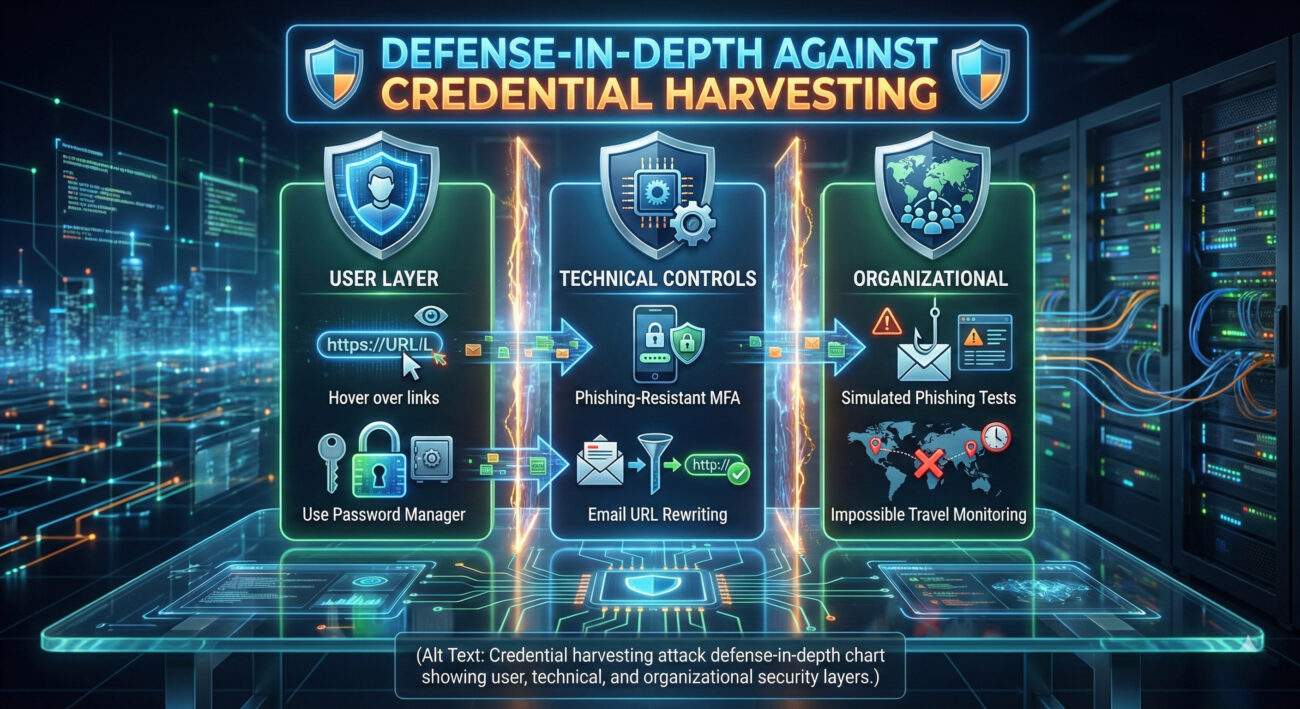
Learning from both victim mistakes and defender successes is key to building resilience against a credential harvesting attack.
A: Its effectiveness stems from three factors: highly believable targeting (spearphishing), flawless technical execution (perfect clone pages), and the clever psychological trick of the seamless redirect. The victim's confirmation bias ("I got to my real inbox, so all is well") overrides any initial suspicion.
A: Absolutely. While APT28 targets organizations, the same attack techniques are used by countless cybercriminals against individuals for banking fraud, identity theft, and personal data breaches. The personal best practices listed above (password manager, MFA on personal accounts) are just as critical.
A: Often, no. The malicious page is just HTML/JavaScript hosted on a legitimate, benign web service. No malware is downloaded to the victim's computer, so file-based antivirus is ineffective. Network firewalls see the victim connecting to a standard web service (like InfinityFree) and then to Microsoft, both allowed. This is why behavioral detection (monitoring the sequence of events) and user education are paramount.
A: The official MITRE ATT&CK® website is the definitive source. For practical guidance on defense, the CISA Cybersecurity Best Practices site is an excellent public resource. To understand APT28's historical activities, refer to advisories from the UK's NCSC or the FBI's Cyber Division.
The APT28 credential harvesting attack campaign is a stark reminder that even simple techniques, when executed with precision and psychological insight, can threaten critical infrastructure. It exploits the inherent trust we place in familiar login screens and the hurried nature of modern work.
Cybersecurity is a shared responsibility. By understanding the mechanics of a credential harvesting attack, from its initial spearphishing lure to its silent data exfiltration, we empower ourselves to build stronger defenses, cultivate vigilant habits, and significantly raise the cost for adversaries like APT28.
© 2026 Cyber Pulse Academy. This content is provided for educational purposes only.
Always consult with security professionals for organization-specific guidance.
Every contribution moves us closer to our goal: making world-class cybersecurity education accessible to ALL.
Choose the amount of donation by yourself.