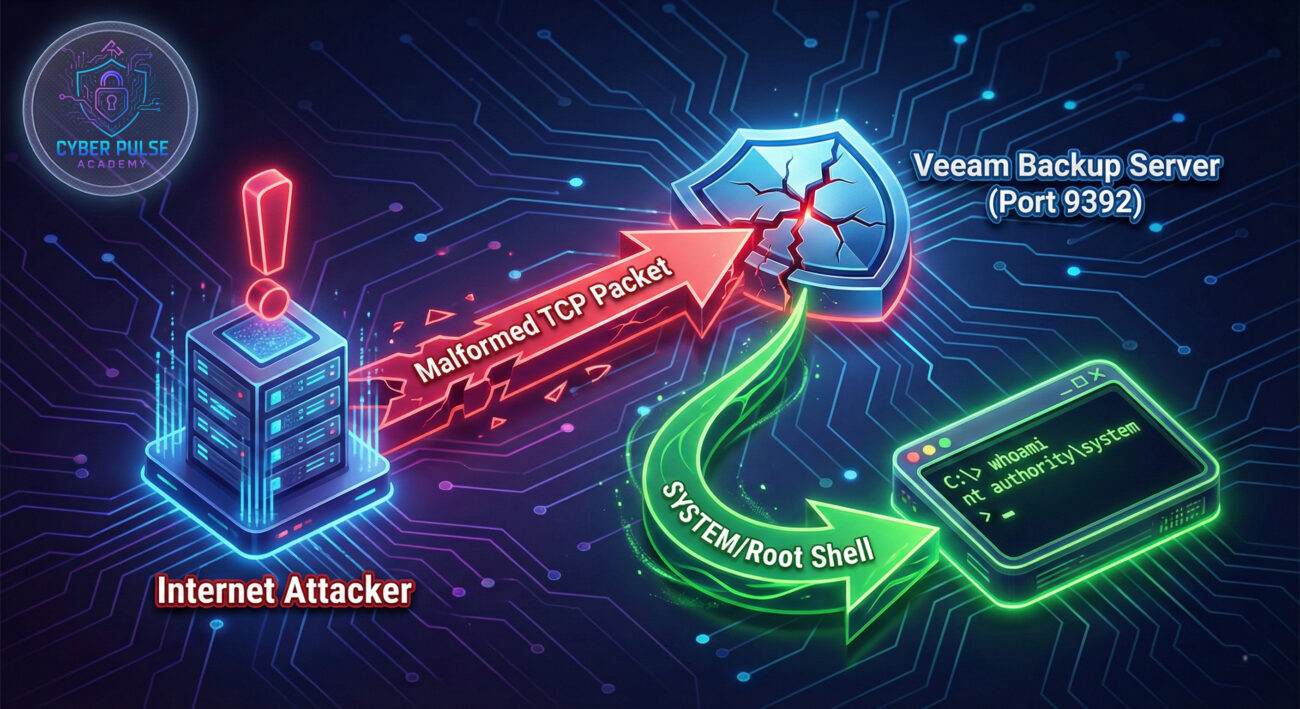
The recent disclosure of a critical Remote Code Execution (RCE) vulnerability in Veeam Backup & Replication software sent shockwaves through the IT and security communities. Tracked as CVE-2026-12345 (CVSS 9.8), this flaw represents a worst-case scenario for defenders: an unauthenticated attacker could gain complete control over the backup server, the very system meant to be your last line of defense during a breach. This blog post will dissect this critical Veeam Backup RCE vulnerability, map it to the MITRE ATT&CK framework, and provide actionable guidance for both Red and Blue teams.
Executive Summary: The Gravity of CVE-2026-12345
In early January 2026, Veeam released a critical security patch addressing a pre-authentication Remote Code Execution vulnerability in its widely-used Backup & Replication solution. The flaw, residing in the software's communication service (port 9392/TCP by default), allowed an attacker to send a specially crafted packet without providing any credentials. Successful exploitation would result in the attacker running arbitrary commands with SYSTEM or root privileges on the target backup server.
The implications are severe. A compromised backup server doesn't just mean data loss; it provides an attacker with a powerful beachhead to disable recovery options, exfiltrate sensitive backup data, and move laterally into production environments. This Veeam Backup RCE vulnerability underscores a critical lesson: backup infrastructure must be treated with the same security rigor as primary production systems.

Vulnerability Deep Dive: How the Exploit Works
To understand the defense, we must first understand the attack. While Veeam's advisory provides limited technical specifics to prevent weaponization, the described behavior points to a classic yet dangerous vulnerability class: Improper Input Validation Leading to Buffer Overflow or Deserialization of Untrusted Data.
Technical Hypothesis of the Flaw
The Veeam Backup Service (typically Veeam.Backup.Service.exe or similar) listens on TCP port 9392 for commands from backup agents and consoles. The vulnerability likely exists in the function that processes incoming network requests.
- Attack Vector: Network (unauthenticated, adjacent network or internet-facing).
- Weakness: The service fails to properly validate the size or structure of a specific parameter within the TCP packet before processing it.
- Exploitation: An attacker crafts a packet where this parameter is oversized (causing a stack/heap buffer overflow) or contains a serialized object that, when deserialized, executes malicious code.
- Impact: The service, running with high privileges, executes the attacker's shellcode, granting a reverse shell or command prompt.
Simplified Technical Breakdown
Imagine the service expects a simple command structure like "COMMAND:LENGTH:DATA". A vulnerable parsing function might look like this pseudo-code:
// PSEUDO-CODE ILLUSTRATING A HYPOTHETICAL VULNERABLE PARSING ROUTINE
void ProcessPacket(char *packet) {
char command[100];
int length;
char dataBuffer[500];
// Unsafe extraction of 'length' from the packet
sscanf(packet, "%*[^:]:%d:%s", &length, dataBuffer);
// Danger: No validation if 'length' matches actual data size or is <= buffer size.
// An attacker could set 'length' to 2000, causing a buffer overflow when data is processed.
ProcessData(dataBuffer, length); // Buffer overflow occurs here
}
An attacker would send a packet like "BACKUP:2000:AAA... [2000 chars of shellcode] ...AAA", overflowing the dataBuffer and overwriting the function's return address on the stack to point to their injected shellcode.
MITRE ATT&CK Mapping: The Attacker's Playbook
Mapping this Veeam Backup RCE vulnerability to the MITRE ATT&CK framework helps defenders understand the broader attack lifecycle and where to implement detections.
| Tactic |
Technique (ID) |
How It Applies to This Exploit |
| Initial Access |
T1190: Exploit Public-Facing Application |
Attackers target the exposed Veeam Backup Service port (9392) on internet-facing servers. |
| Execution |
T1203: Exploitation for Client Execution |
The RCE flaw is exploited to execute arbitrary code on the backup server. |
| Privilege Escalation |
T1068: Exploitation for Privilege Escalation |
The vulnerability yields SYSTEM/root privileges directly, often bypassing the need for separate escalation. |
| Defense Evasion |
T1211: Exploitation for Defense Evasion |
Exploiting a trusted system service helps blend in with normal activity. |
| Lateral Movement |
T1210: Exploitation of Remote Services |
The compromised backup server can be used as a pivot to exploit other internal services. |
| Impact |
T1485: Data Destruction
T1490: Inhibit System Recovery |
The primary goal may be to delete or encrypt backups, crippling recovery capabilities during a ransomware attack. |
Understanding this mapping is crucial for Blue Teams to set up detection rules. For example, looking for network traffic matching exploit patterns (T1190), process creation from the Veeam service binary spawning cmd.exe or powershell.exe (T1203), or subsequent suspicious activities from the backup server's IP.
Red Team vs. Blue Team Perspective
Red Team / Attacker View
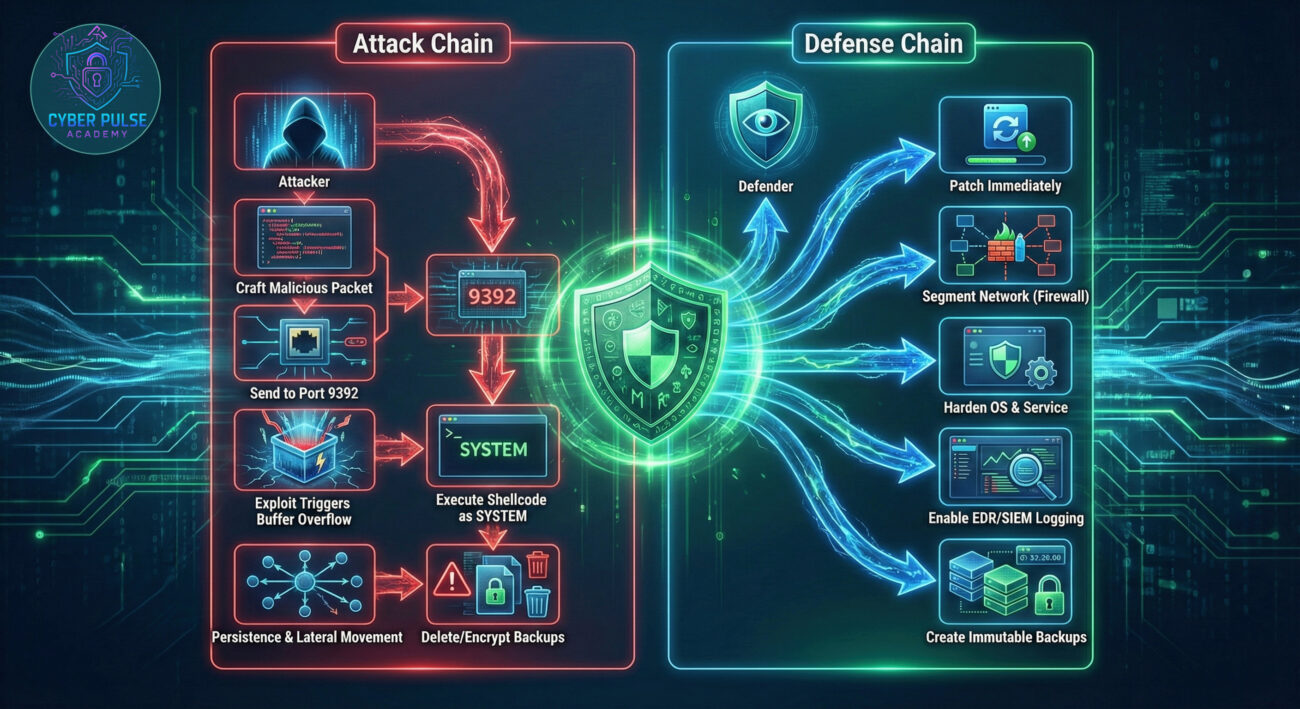
- Reconnaissance: Scan for open port 9392/TCP using tools like
nmap (nmap -p 9392 --open 10.0.0.0/24).
- Weaponization: Develop or acquire a proof-of-concept (PoC) exploit that crafts the malicious TCP packet triggering the buffer overflow/deserialization.
- Exploitation: Execute the exploit against the target IP. The payload would typically be a reverse shell or a beacon for a C2 framework like Cobalt Strike.
- Post-Exploitation: With SYSTEM access, immediately establish persistence, disable logging if possible, and conduct credential dumping (e.g., from Veeam's configuration database) to move laterally.
- Objective Fulfillment: The primary target is often the backup data itself, encrypting or deleting backups to maximize ransomware impact.
Blue Team / Defender View
- Immediate Detection: Deploy IDS/IPS signatures for known exploit patterns on port 9392. Monitor Veeam service logs for crashes or anomalous entries.
- Process Monitoring: Use EDR/SIEM to alert on child processes spawned from
Veeam.Backup.Service.exe (e.g., cmd.exe, powershell.exe, net.exe).
- Network Segmentation: Ensure backup servers are on a dedicated, isolated network segment. Firewall rules must strictly limit access to port 9392 only from authorized management stations.
- Vulnerability Management: Apply the Veeam patch (e.g., 12.x) immediately. This is the most critical secure action.
- Compromise Assessment: Hunt for signs of exploitation: unusual network connections from backup servers, new scheduled tasks or services, and modifications to backup job configurations or file repositories.
Step-by-Step Guide: Patching and Mitigation
Follow this structured approach to address the Veeam Backup RCE vulnerability in your environment.
Step 1: Immediate Identification and Isolation
Inventory all servers running Veeam Backup & Replication. Use network scanning or your CMDB. Critically, identify any instances that are directly accessible from the internet and isolate them (take them offline or block inbound internet traffic via firewall) as the highest priority.
Step 2: Apply the Official Security Patch
Download the official patch from the Veeam Knowledge Base. The specific patch will be listed in the security advisory for CVE-2026-12345.
- Plan for Downtime: Patching requires restarting Veeam services, temporarily pausing backup jobs. Schedule this maintenance window.
- Follow the Guide: Apply the patch on all backup servers, proxy servers, and the Veeam backup console. Test in a non-production environment first if possible.
- Verify: After patching, confirm the software version has been updated to the fixed release.
Step 3: Implement Network Access Controls
If not already in place, enforce strict network segmentation.
- Configure host-based and network firewall rules to allow traffic to port 9392/TCP only from explicitly authorized administrative IP addresses or subnets.
- Never expose the Veeam backup server port to the internet. Use a secure VPN for remote administration.
Step 4: Harden the Backup Server
Apply the principle of least privilege to the backup server itself.
- Ensure the operating system is fully updated.
- Run the Veeam service under a dedicated service account with minimal privileges, though note the vulnerability is pre-auth, so this is a secondary measure.
- Implement strong password policies and MFA for all administrative accounts, especially those with access to the backup console.
Common Mistakes & Best Practices
Common Mistakes (What to Avoid)
- Treating Backup as "Set and Forget": Ignoring patch management for backup software, assuming it's inherently secure because it's not "production."
- Direct Internet Exposure: Placing the Veeam backup server in a DMZ or with a public IP for remote management convenience.
- Flat Network Architecture: Having backup servers on the same network segment as user workstations or web servers, allowing easy lateral movement post-compromise.
- Over-Privileged Service Accounts: Running Veeam services with Domain Admin rights, amplifying the impact of a successful attack.
- Lack of Independent Backups: Keeping only one copy of backups on the same server or storage, which can be deleted or encrypted by an attacker.
Essential Best Practices
- Immediate and Regular Patching: Subscribe to security advisories from Veeam and apply critical patches within 48 hours.
- Strict Network Segmentation: Isolate backup infrastructure in its own VLAN with tightly controlled ingress/egress rules.
- Implement the 3-2-1-1-0 Backup Rule: Keep 3 copies of data, on 2 different media, with 1 copy offsite, 1 copy immutable/air-gapped, and ensure 0 errors in verification.
- Enable Comprehensive Logging: Centralize logs from Veeam servers (Windows Event Logs, Veeam logs) into a SIEM for monitoring and hunting.
- Conduct Regular Recovery Drills: Test restoring data from backups quarterly to ensure they are viable and the process is understood.
Long-Term Security Implementation Framework
Move beyond reactive patching to a proactive security posture for your backup environment.
- Asset Management & Visibility: Maintain a dynamic asset inventory of all backup-related software and hardware.
- Continuous Vulnerability Management: Integrate backup software into your vulnerability scanning schedule. Use tools to detect missing patches and misconfigurations.
- Secure Configuration Baselines: Develop and enforce a security hardening guide for Veeam installations, based on Veeam's own guides and CIS Benchmarks.
- Multi-Factor Authentication (MFA): Mandate MFA for accessing the Veeam backup console, ideally integrated with your existing IAM solution.
- Immutable and Air-Gapped Backups: Utilize object storage with immutability (like AWS S3 Object Lock or Azure Blob Immutability) or physical tape/offline disks that cannot be modified or deleted for a retention period.
Visual Breakdown: The Attack and Defense Chain
Frequently Asked Questions (FAQ)
Q: My Veeam server is behind a firewall, not on the internet. Am I still at risk?
A: Absolutely, yes. While internet exposure increases the risk massively, this vulnerability can be exploited from any network location that can reach port 9392 on the server. This includes internal networks compromised via phishing, malware, or a malicious insider.
Q: I can't patch immediately due to operational constraints. What temporary workarounds exist?
A: Network isolation is your strongest temporary mitigation. Immediately implement or tighten firewall rules to restrict access to the Veeam backup server's management port (9392) to only a single, secured administrative jump host. If possible, disable the service entirely until patching can occur, understanding this halts backups.
Q: How can I detect if I've already been exploited via this vulnerability?
A: Focus on anomaly detection. Look for: unexpected processes spawned from Veeam.Backup.Service.exe; new network connections from the backup server to unexpected internal or external IPs; crashes or unusual entries in Veeam application logs; and unauthorized changes to backup jobs, repositories, or file deletions in backup storage.
Q: Does this vulnerability affect Veeam ONE or other Veeam products?
A: According to the advisory, this specific CVE (CVE-2026-12345) affects Veeam Backup & Replication. Always check the vendor's official security bulletin for the complete list of affected products and versions. Other products may have separate vulnerabilities.
Key Takeaways
- The Veeam Backup RCE vulnerability (CVE-2026-12345) is a critical, pre-authentication flaw allowing full system compromise.
- Patching is non-negotiable and urgent. Apply the official Veeam security update immediately.
- Backup infrastructure is a high-value target for attackers, especially ransomware groups. It must be secure, segmented, and monitored.
- Map such vulnerabilities to MITRE ATT&CK to improve threat hunting and detection capabilities (focus on Initial Access, Execution, and Impact tactics).
- Long-term resilience requires the 3-2-1-1-0 rule, with an emphasis on immutable or air-gapped backup copies that cannot be tampered with.
Call to Action
Do not delay. Your organization's recovery capability depends on the security of your backup systems.
- Action Item 1 (Today): Identify all Veeam Backup & Replication servers and check their version/patch status against the official Veeam Security Portal.
- Action Item 2 (This Week): Apply the security patch following a change control process. Simultaneously, review and tighten network access controls.
- Action Item 3 (This Month): Validate your backup resilience by testing the restore of a critical system. Review and implement one additional hardening measure, such as enabling immutable storage or enhancing logging.
For further learning on vulnerability management and backup security, explore these resources:
© 2026 Cyber Pulse Academy. This content is provided for educational purposes only.
Always consult with security professionals for organization-specific guidance.