







































Certification Courses
Hands-On Labs
Threat Intelligence
Latest Cyber News
MITRE ATT&CK Breakdown
All Cyber Keywords
Imagine your computer suddenly running slower than usual, the fan whirring loudly even when you're just checking email, and your electricity bill mysteriously spiking. What's going on? You might have an uninvited guest: a cryptominer.
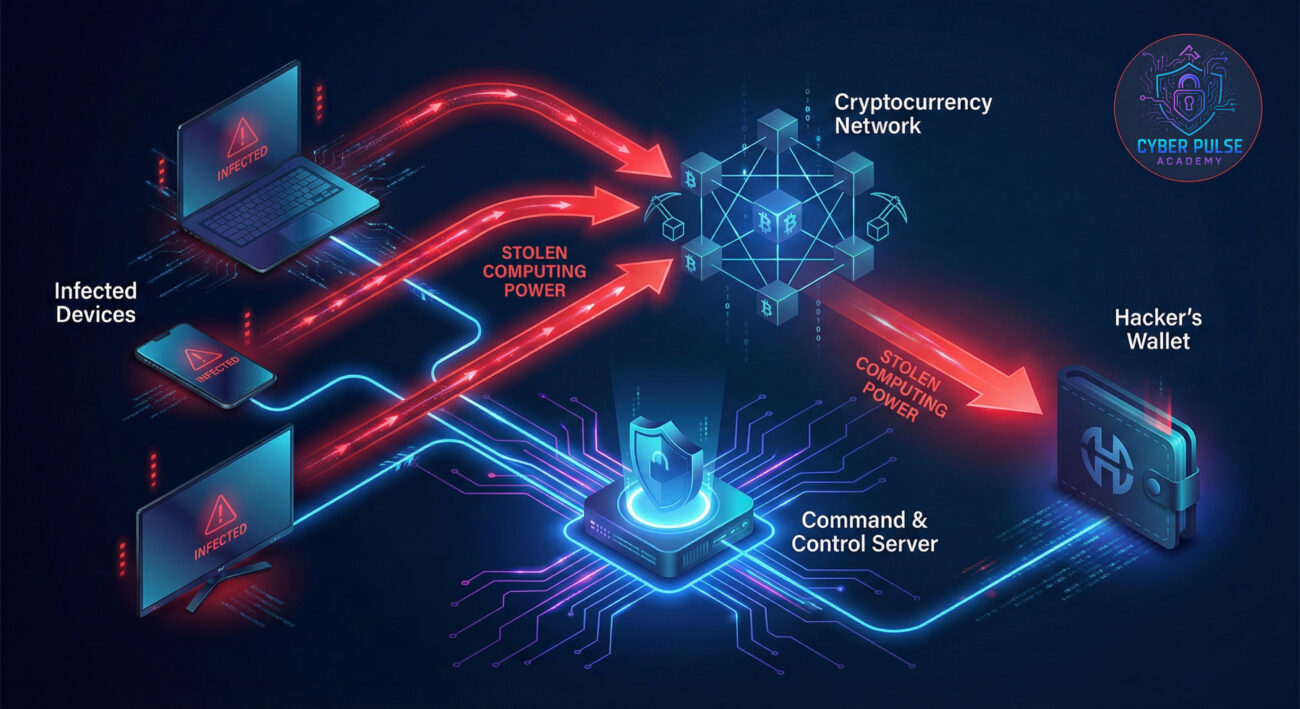
A cryptominer is a type of software or malware that secretly uses your device's processing power to generate cryptocurrency for someone else. Think of it like a digital parasite that steals your computer's "brain power" to make money for hackers.
In this essential guide, you'll learn: what cryptominers really are, how they secretly operate on your devices, the real-world risks they pose, and most importantly, 7 actionable steps to protect yourself from these hidden digital thieves.
Has your laptop felt unusually warm lately? Does your smartphone battery drain faster than it should? These might not just be signs of an aging device, they could indicate a cryptominer secretly running in the background.
A cryptominer is essentially digital leech software that hijacks your computer, phone, or even smart device to "mine" cryptocurrency, a process of solving complex math problems that earns digital money. Legitimate miners do this openly with their own equipment, but malicious cryptominers do it stealthily on YOUR devices, stealing your resources to line their pockets.
Think of it like this: If your computer's processing power were electricity in your home, a cryptominer would be a secret tenant tapping into your power lines, running energy-intensive appliances 24/7, and sending you the bill while keeping all the profits.
By the end of this guide, you'll understand this hidden threat that affects millions, recognize its signs, and know exactly how to build digital defenses against it. Let's start by understanding why cryptominers have become such a pervasive cybersecurity issue.
Cryptominers represent one of the fastest-growing cybersecurity threats today, not because they steal your data, but because they steal something equally valuable: your device's computing power and your electricity. Unlike ransomware that announces its presence with dramatic messages, cryptominers work silently in the background, often going undetected for months.
According to recent reports from CISA, cryptojacking (the act of secretly installing cryptominers) incidents increased by over 400% in recent years. A study by CSO Online revealed that approximately 1 in 3 businesses have experienced cryptojacking attempts. Why this explosion? Because cryptocurrency mining is computationally expensive, it requires massive amounts of processing power and electricity. By hijacking thousands of devices, attackers create a "botnet" mining farm with zero infrastructure costs.
This affects you directly: slower devices, reduced hardware lifespan (from constant overuse), higher electricity bills, and potential security vulnerabilities that can lead to other malware infections. Even your smart TV or security camera could be mining cryptocurrency without your knowledge. The democratization of this threat means anyone with a connected device is a potential target for these digital resource thieves.
Understanding cryptominers is no longer just for tech enthusiasts, it's essential digital literacy for every device owner in our connected world.
Let's break down the essential terminology around cryptominers using simple, relatable analogies:
| Term | Simple Definition | Everyday Analogy |
|---|---|---|
| Cryptocurrency Mining | The process of validating transactions and creating new coins by solving complex mathematical problems using computing power. | Like a digital gold rush where computers compete to solve puzzles, and winners get digital coins as reward. |
| Cryptominer | Software specifically designed to perform cryptocurrency mining operations. Can be legitimate or malicious. | A specialized worker (or thief) that uses brainpower (computing power) to earn digital money. |
| Cryptojacking | The unauthorized use of someone's device to mine cryptocurrency without their knowledge or consent. | Like someone secretly plugging their appliances into your electrical outlets and making you pay the bill. |
| Botnet | A network of infected devices controlled by hackers without the owners' knowledge, often used for mining. | A zombie army of devices doing the hacker's bidding while their owners are unaware. |
| Legitimate Mining | Using your own devices and electricity to mine cryptocurrency openly and legally. | Running your own legitimate business with your own resources and paying your own bills. |
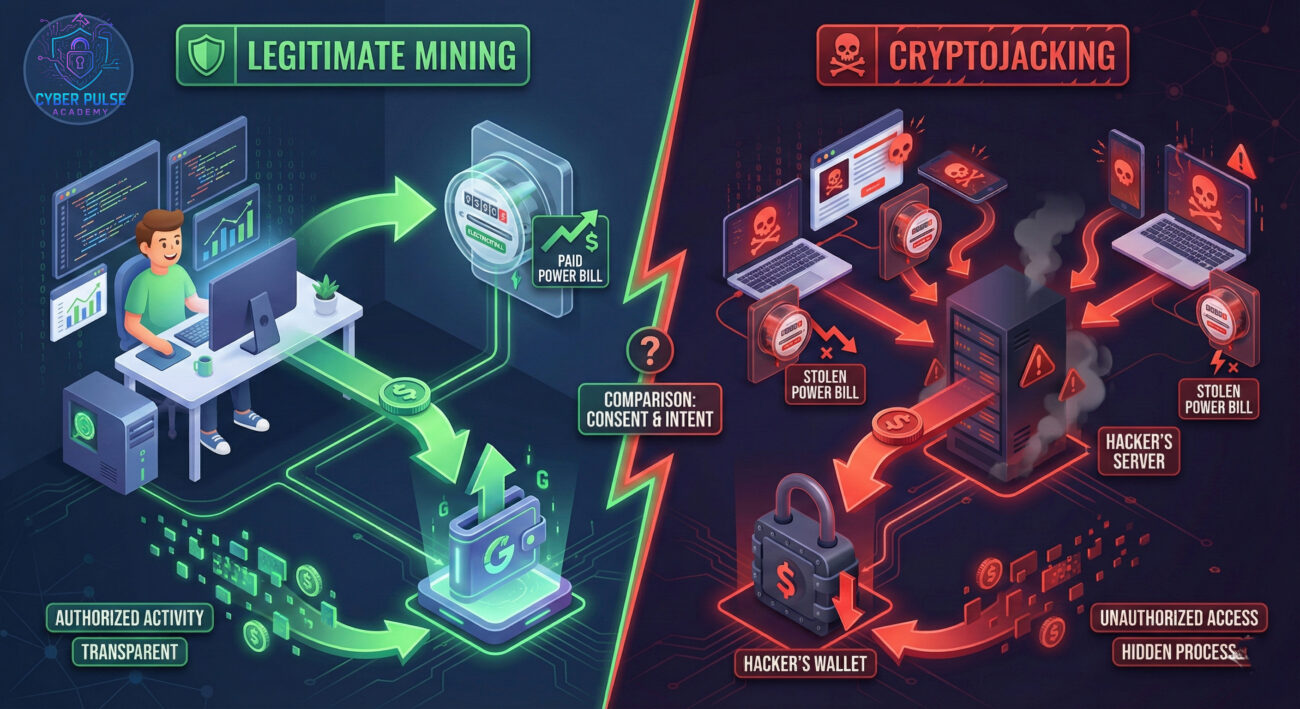
Sarah, a graphic designer, noticed her year-old gaming laptop was suddenly struggling with simple tasks. Her rendering times doubled, the device felt hot to touch, and her apartment's electricity bill jumped 30% despite no change in usage. Initially blaming "computer aging," she almost upgraded her hardware, until a tech-savvy friend suggested checking for cryptominers.
Sarah discovered she had accidentally installed a "free" design plugin months earlier that contained a hidden cryptominer. While she worked, the malware used 80% of her GPU to mine Monero cryptocurrency, sending all profits to an anonymous digital wallet. The plugin had looked legitimate, with positive (but fake) reviews, making it a perfect trap.
| Time/Stage | What Happened | Impact on Sarah |
|---|---|---|
| Day 1 | Downloaded "free premium design plugin" from unofficial website | Malware installed alongside legitimate software |
| Week 1 | Cryptominer activated, using GPU only when computer was idle | Minor slowdowns noticed but attributed to "background updates" |
| Month 1 | Miner became more aggressive, running constantly at 50-80% capacity | Computer fan constantly loud, rendering projects took 2x longer |
| Month 2 | Electricity consumption significantly increased | Utility bill increased by $45/month without explanation |
| Month 3 | GPU began showing signs of premature wear from constant high usage | Artifacts appeared in graphics, potential $400 hardware replacement needed |
| Discovery | Friend noticed suspicious process using Task Manager | Malware removed, performance restored, but hardware damage remained |
Sarah's story illustrates how cryptominers create a slow-burn financial drain rather than an immediate crisis. The attacker earned approximately $15/month in cryptocurrency from her single device, seemingly small, but when multiplied across thousands of victims, it becomes highly profitable with minimal risk of detection compared to other cybercrimes.
Protecting against cryptominers involves both proactive security measures and reactive detection strategies. Follow this actionable guide to secure your devices:
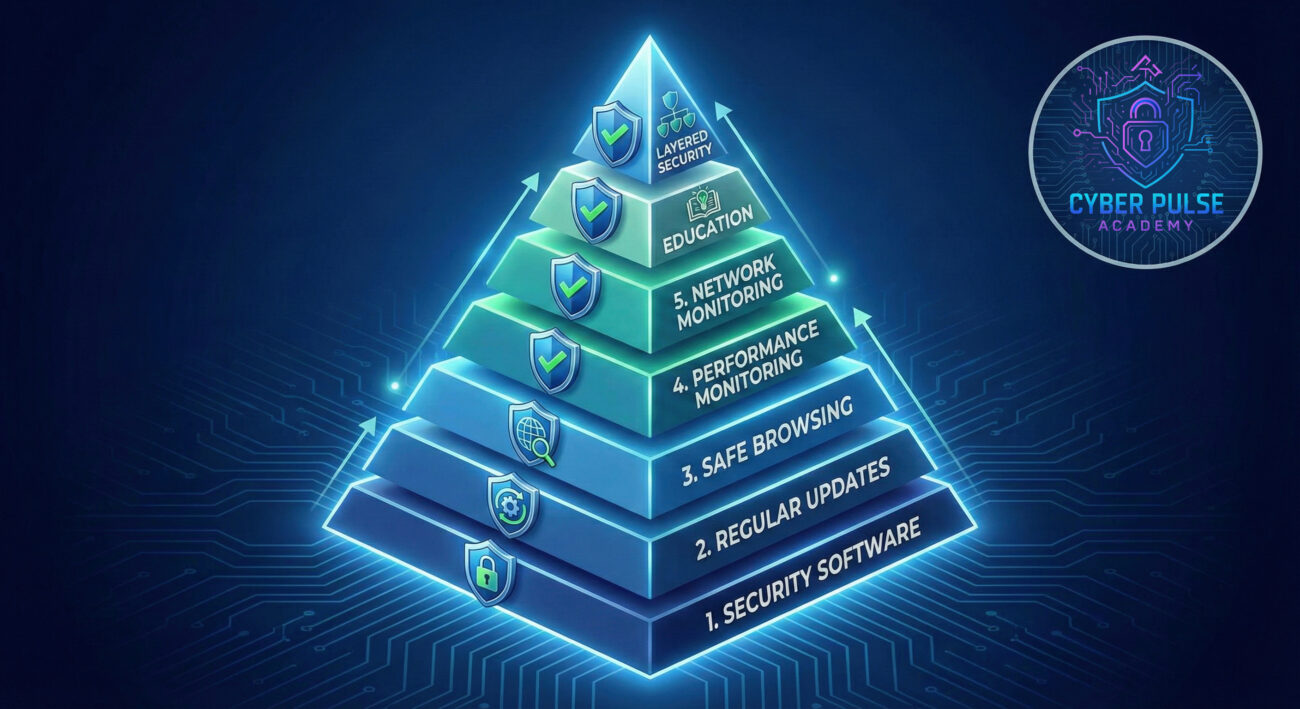
Understanding how attackers think helps you defend better. Here's a simplified view of a cryptojacking operation from both sides:
Step 1: The attacker creates or modifies legitimate-looking software (like a free PDF converter or game mod) and embeds a cryptominer within it.
Step 2: They distribute it through unofficial download sites, torrents, or even poisoned search results, often using fake positive reviews.
Step 3: Once installed, the miner activates either immediately or after a delay. It connects to a mining pool controlled by the attacker.
Step 4: The miner uses sophisticated techniques to evade detection: running only when other programs are active, using minimal resources when monitored, and disguising its network traffic.
Detection: Monitor for unusual patterns: consistent high CPU/GPU usage during idle times, processes with random names, or connections to known mining pool domains.
Prevention: Implement application whitelisting, use next-gen antivirus with behavioral detection, and maintain strict software installation policies.
Response: When detected, immediately isolate the device, identify the infection vector, scan all connected devices, and strengthen the vulnerability that was exploited.
Mindset: Assume any performance anomaly could be malicious. Regular audits and user training create a human firewall that complements technical controls.
For attackers, cryptominers represent a low-risk, steady-income model. Unlike ransomware that requires negotiation and has legal consequences, cryptojacking is subtle and often goes unreported. The goal is maximum stealth and persistence, infect as many devices as possible without triggering detection. Attackers prefer cryptocurrencies like Monero that offer greater anonymity. They value compromised devices with powerful GPUs (gaming computers, workstations) but will happily infect anything, quantity often beats quality in this game.
For defenders, cryptominers are indicators of broader security failures. A cryptominer infection often means other security controls have failed: users installed unauthorized software, detection systems didn't trigger, or vulnerabilities weren't patched. Beyond the immediate resource theft, cryptominers create openings for more dangerous malware. Defenders focus on detection through anomalous resource usage, network traffic to mining pools, and behavioral analysis of processes. They also prioritize user education since many infections start with social engineering.
Cryptominers represent a pervasive, often overlooked threat in today's digital landscape. Unlike dramatic cyberattacks that make headlines, they work silently, stealing your resources while avoiding detection. Here's what every beginner should remember:
The quiet nature of cryptominers makes them particularly dangerous, they can operate for months before detection, causing gradual but significant financial and operational damage. By understanding their mechanisms and implementing the 7-step protection guide, you transform from a potential victim to an informed defender.
Start by checking your devices right now: open Task Manager or Activity Monitor and look for unfamiliar processes using high CPU/GPU resources. Share this guide with friends and family, cybersecurity is a team effort.
Have questions or want to share your experience with cryptominers? Leave a comment below or join our beginner cybersecurity community to continue learning in a supportive environment.
🔒 Remember: In cybersecurity, what you don't know CAN hurt you, but what you learn CAN protect you.
© 2026 Cyber Pulse Academy. This content is provided for educational purposes only.
Always consult with security professionals for organization-specific guidance.
Every contribution moves us closer to our goal: making world-class cybersecurity education accessible to ALL.
Choose the amount of donation by yourself.