




Certification Courses
Hands-On Labs
Threat Intelligence
Latest Cyber News
MITRE ATT&CK Breakdown
All Cyber Keywords
Imagine a thief who doesn't steal your money, but instead silently copies your business plans, your secret recipes, or your private communications for years without you ever knowing. This isn't a spy movie plot, it's the reality of cyber espionage in our connected world.
Cyber espionage is the secret, digital theft of confidential information by governments, organizations, or individuals for strategic advantage. Think of it as digital spycraft, instead of trench coats and dead drops, attackers use malware and phishing emails to infiltrate computer systems.
In this essential guide, you'll learn:
Have you ever wondered how foreign governments seem to know military secrets, or how competitors miraculously develop similar technology? Welcome to the shadowy world of cyber espionage, where digital spies steal secrets without ever setting foot in a building.
Unlike noisy ransomware attacks that demand payment, cyber espionage is designed to be silent. The attacker's goal isn't to disrupt, but to observe and extract. It's like having a hidden microphone in your boardroom for years, recording every strategic discussion without anyone noticing.
This guide will take you from complete beginner to informed defender. You'll understand not just what cyber espionage is, but how it happens in practice, and, most importantly, how you can build defenses against it.
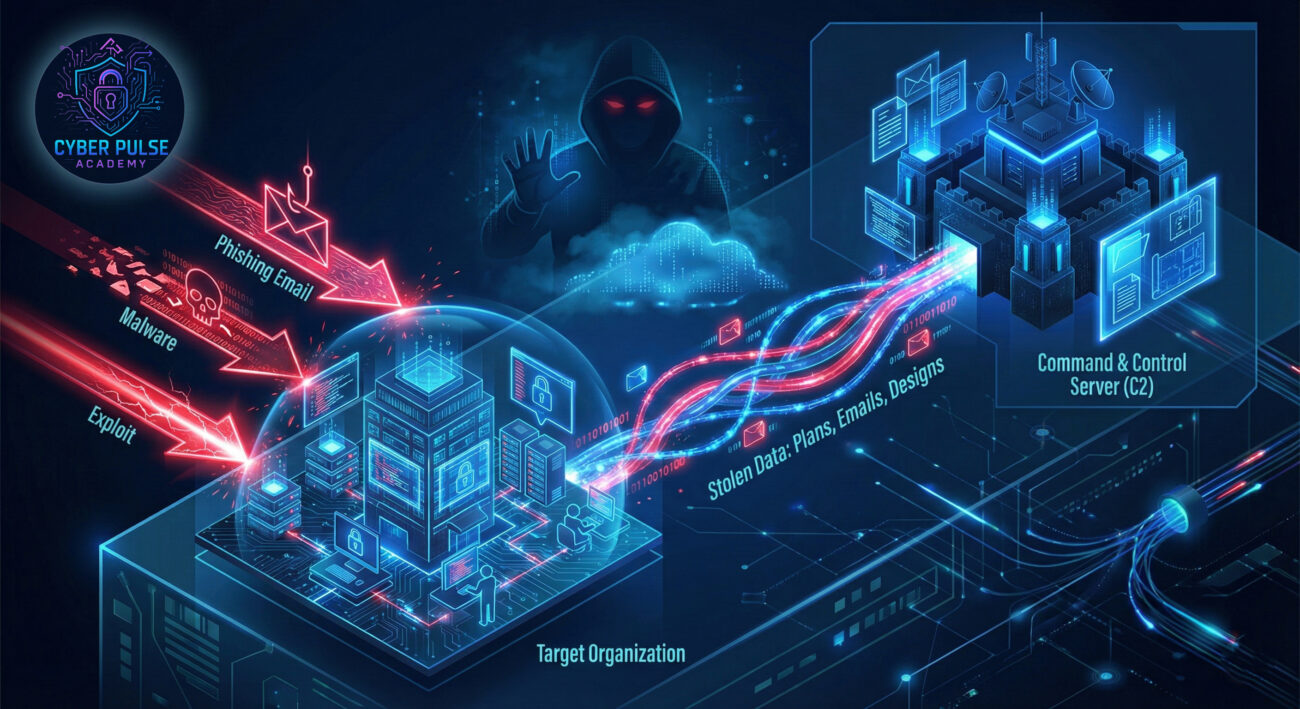
In 2023 alone, the U.S. Cybersecurity and Infrastructure Security Agency (CISA) reported a 300% increase in state-sponsored cyber espionage attacks targeting critical infrastructure. This isn't just about stealing intellectual property, it's about geopolitical advantage, economic dominance, and national security.
Every organization, from small businesses to governments, holds valuable information: customer databases, product designs, strategic plans, financial projections. Cyber espionage turns this information into a commodity that can be stolen at the speed of light.
Consider these real impacts: A pharmaceutical company's decade of research stolen before clinical trials. A government's diplomatic strategies exposed before negotiations. A manufacturer's proprietary designs copied by foreign competitors. The damage often remains hidden for years, multiplying as the stolen information is used strategically.
What makes modern cyber espionage particularly dangerous is its scalability. A single successful attack can compromise thousands of organizations through supply chain vulnerabilities, as seen in the SolarWinds attack that affected multiple U.S. government agencies.
Let's break down the essential vocabulary without technical overwhelm. Understanding these terms is your first line of defense.
| Term | Simple Definition | Everyday Analogy |
|---|---|---|
| Advanced Persistent Threat (APT) | A sophisticated, long-term cyberattack where attackers maintain undetected access to a network | Like a burglar who moves into your attic, lives there silently for months, and only takes small valuable items occasionally so you don't notice |
| Data Exfiltration | The unauthorized transfer of data from a computer or network | Someone secretly photocopying all your confidential documents and smuggling them out piece by piece in their lunchbox |
| Zero-Day Exploit | An attack that targets a software vulnerability unknown to the vendor | A secret backdoor into a building that even the architect doesn't know exists |
| Multi-Factor Authentication (MFA) | A security system that requires more than one method of verification | Needing both a key and a fingerprint scan to enter a vault instead of just a key |
| Command & Control (C2) | Servers that attackers use to communicate with compromised systems | A spy handler communicating with their field agents using coded messages at designated dead drop locations |
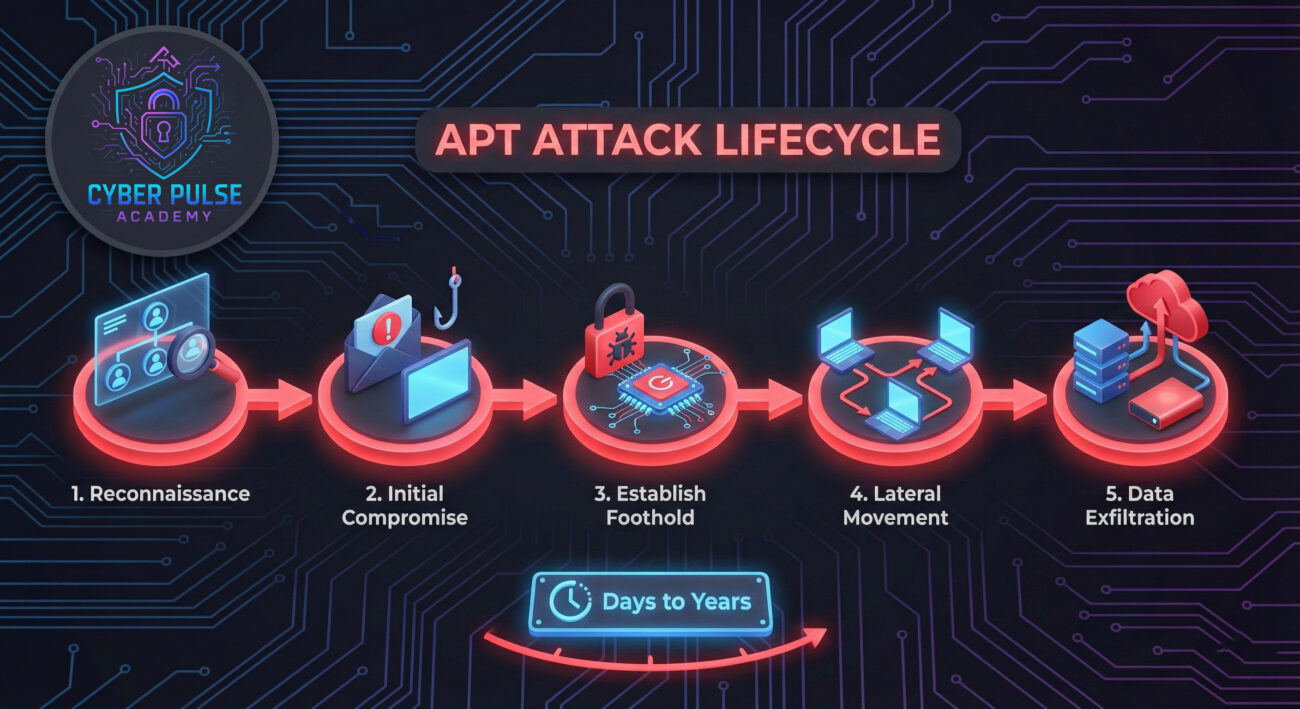
Let's follow "Sarah," a mid-level manager at "NextGen Energy," a company developing innovative solar technology. For three years, her company was the victim of cyber espionage without anyone realizing it.
The Initial Compromise: It started when an engineer received a seemingly legitimate email from a research conference he had attended. The attachment contained a zero-day exploit that installed malware giving attackers a foothold in the network.
The Silent Spread: Over months, the attackers moved laterally through the network, eventually accessing the R&D department's servers. They stole design documents, test results, and manufacturing specifications, all while maintaining such a low profile that network monitoring tools didn't detect the data exfiltration.
| Time/Stage | What Happened | Impact |
|---|---|---|
| Month 1-3 | Initial phishing attack; malware establishes foothold | Attackers gain basic network access |
| Month 4-9 | Lateral movement to R&D servers; credential theft | Access to intellectual property core |
| Month 10-24 | Continuous data exfiltration; establishing backup access points | 90% of solar cell designs stolen |
| Month 25-36 | Competitor releases identical technology; investigation begins | $250M in lost competitive advantage; stock drops 40% |
The breach was only discovered when a competitor, later found to be state-sponsored, released nearly identical solar technology at half the cost. The forensic investigation revealed the attack had been ongoing for 36 months, with data slowly trickling out to command and control servers disguised as normal web traffic.
Protection isn't about building an impenetrable fortress, it's about making theft so difficult and detectable that attackers move on to easier targets. Here's your actionable guide:
Every organization has something valuable. Change your mindset from "if" to "when."
One password is never enough for sensitive systems.
Unpatched systems are unlocked doors for attackers.
You can't stop what you can't see.
Make stolen data useless without the key.
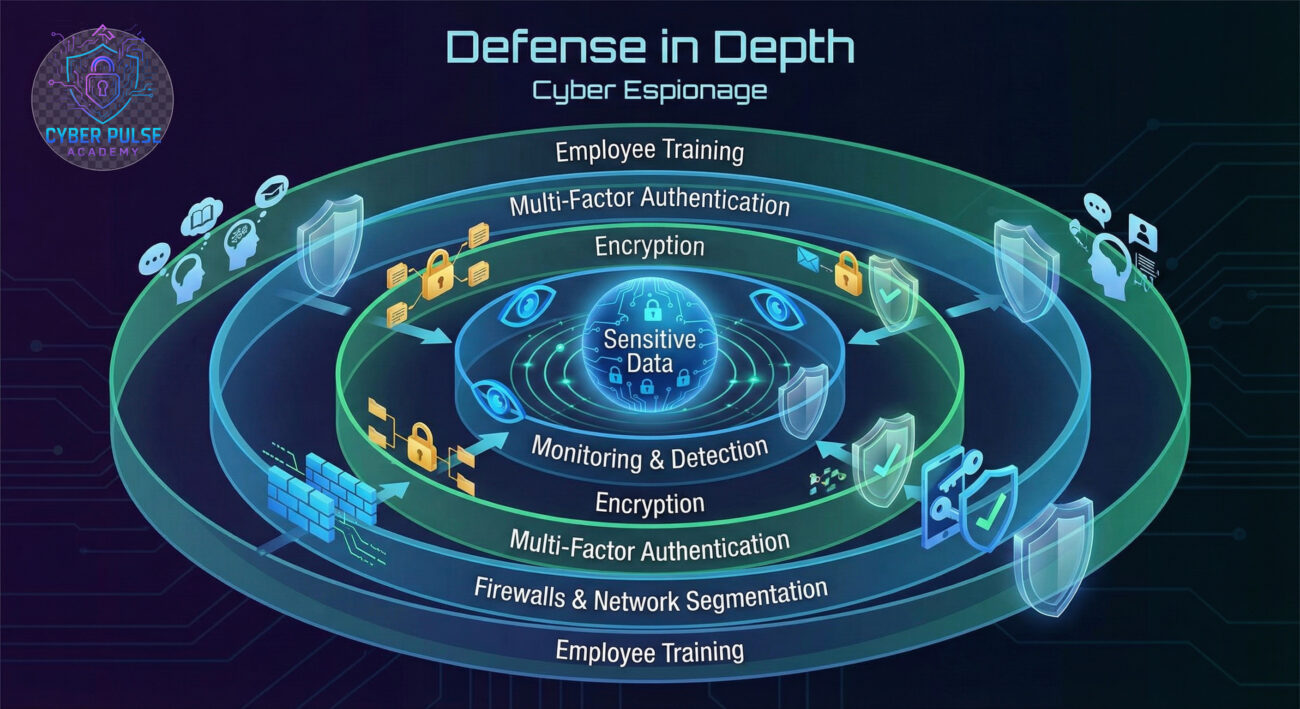
Let's walk through how a cyber espionage operation might unfold, and how defenders can spot and stop it.
The Attack Path: An attacker targeting a tech company starts not with code, but with LinkedIn. They identify an engineer working on a new AI project, then craft a personalized phishing email posing as a recruiter from a prestigious firm. The attached "salary survey" contains malware that exploits a recently patched vulnerability, but this engineer hasn't updated their software in months. Once inside, the attacker moves to the engineer's project repository, stealing AI models and training data over weeks, disguised as normal Git operations.
The Defender's Move: A vigilant security team has implemented application allowlisting, preventing unauthorized software from running. They also use network segmentation, so the engineer's system can't directly access the AI repository without additional authentication. Most importantly, they monitor for unusual data access patterns, when the malware tries to exfiltrate 50GB of data at 2 AM, an alert triggers immediately, and the incident response team contains the breach within hours.
For a cyber espionage operative, success means persistence and stealth above all. They're not looking for a quick score but establishing long-term access. Their priority is identifying the path of least resistance, often the human element through sophisticated social engineering. They'll spend weeks researching targets, understanding organizational structure, and waiting for the perfect moment. Every action is measured against one question: "Will this alert defenders?" Their goal isn't to take systems down but to become a ghost in the machine, blending with normal traffic while quietly siphoning the most valuable data.
Defenders against cyber espionage operate on a different principle: assume breach. They know they can't prevent every intrusion, so they focus on detection and response. Their strategy is about reducing the "dwell time", how long an attacker remains undetected. They implement layered defenses, knowing that any single layer might fail. Constant monitoring for anomalies, regular security training, and swift patch management form their core activities. Their win condition isn't a perfectly secure network (an impossibility) but early detection and rapid containment when breaches occur.
Cyber espionage represents one of the most sophisticated and persistent threats in our digital age. Unlike dramatic cyberattacks that make headlines, these operations thrive in silence, making detection and prevention particularly challenging.
Key takeaways from our exploration:
The most important shift is mental: moving from "if we get attacked" to "when we get attacked, how quickly will we detect and respond?" By implementing the strategies outlined here, especially multi-factor authentication, regular patching, and employee education, you transform from an easy target into a hardened one.
Remember, in the world of cyber espionage, the goal isn't perfect security (which doesn't exist) but making yourself a sufficiently difficult target that attackers move on to easier prey. Your vigilance, combined with strategic defenses, creates a formidable barrier against even the most persistent digital spies.
Ready to take the next step in protecting yourself or your organization?
Share your thoughts, questions, or experiences with cyber espionage in the comments below. What security practice will you implement first?
For deeper learning, explore our guides on Advanced Persistent Threats and Incident Response Planning.
Stay curious, stay vigilant, and stay secure.
Every contribution moves us closer to our goal: making world-class cybersecurity education accessible to ALL.
Choose the amount of donation by yourself.