







Certification Courses
Hands-On Labs
Threat Intelligence
Latest Cyber News
MITRE ATT&CK Breakdown
All Cyber Keywords
Every year, the cybersecurity industry is flooded with dire predictions and sensational headlines. As we look toward 2026, separating the credible threats from the overhyped noise is more critical than ever for effective defense. This analysis cuts through the hype, focusing on the evolving tactics of adversaries, the practical implications for defenders, and the actionable steps you can take to build resilience. We'll map these future trends to real-world frameworks like MITRE ATT&CK to give you a concrete, technical understanding of what's coming.
The landscape of cybersecurity predictions for 2026 is a mix of continued evolution and speculative leaps. While headlines scream about AI-powered cyber-doom and quantum apocalypses, the more pressing dangers are refinements of existing attack vectors. The core vulnerability remains: the human element and complex, interconnected digital ecosystems. This post will demystify the predictions, focusing on the practical defenses you need to prioritize.
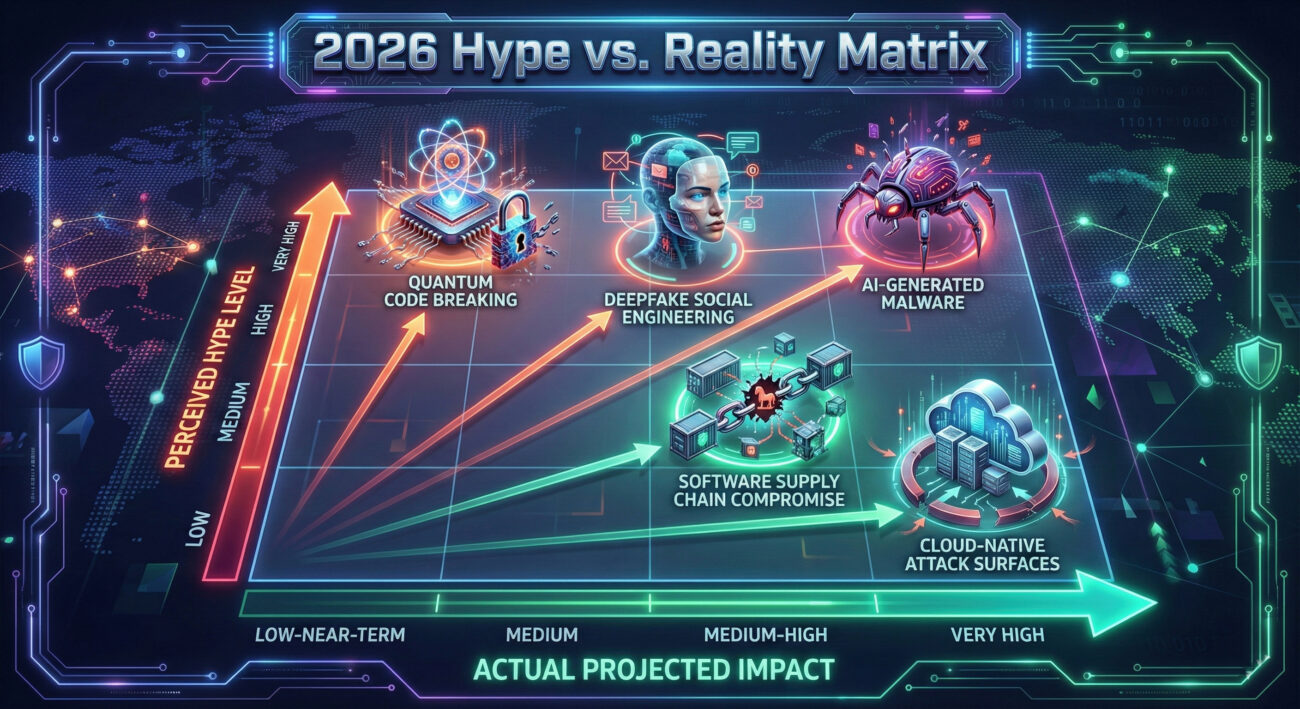
The use of Artificial Intelligence (AI) and Large Language Models (LLMs) by both attackers and defenders is a guaranteed trend for 2026. The hype suggests fully autonomous hackers, but the reality is more nuanced: AI will act as a powerful force multiplier.
Threat actors will use LLMs to dramatically scale and enhance social engineering. Imagine phishing campaigns with thousands of unique, grammatically perfect emails tailored by scraping your LinkedIn profile. Beyond emails, AI will generate convincing deepfake audio for CEO fraud (Business Email Compromise) or synthesize video for disinformation campaigns.
On the technical side, AI will be used to mutate malware code in real-time to evade signature-based detection (a technique related to Obfuscated Files or Information, T1027 in MITRE ATT&CK). It will also help attackers analyze vast amounts of stolen data to identify high-value targets for further exploitation more efficiently.
Attacks like SolarWinds and Log4j demonstrated the catastrophic ripple effects of compromising a single piece of trusted software. In 2026, software supply chain attacks will become more frequent and sophisticated, moving from a headline-grabbing event to a persistent background threat.
Here’s how a typical sophisticated supply chain compromise might occur:
The attacker gains access to a software vendor's development environment. This is often done via spear-phishing a developer (Initial Access) or exploiting a vulnerability in the vendor's public-facing systems.
The attacker subtly injects malicious code into a legitimate library or update. They use sophisticated obfuscation (T1027) to hide the malicious payload within normal-looking code, ensuring it passes initial code reviews.
The tainted software, signed with the vendor's legitimate digital certificate (Trusted Relationship, T1199), is distributed to thousands of victims through automatic update channels.
Once the update is installed, the malicious code executes (User Execution, T1204), often establishing a backdoor (Persistence) and moving laterally (Lateral Movement) within the victim's network.
Mapping future threats to the MITRE ATT&CK framework provides a common language for understanding and defending against them. Here are key techniques expected to rise in prominence:
| MITRE ATT&CK Tactic | Technique (ID & Name) | 2026 Prediction & Context | Defensive Action |
|---|---|---|---|
| Initial Access | T1195.002 (Compromise Software Supply Chain) | Will be the primary vector for large-scale, espionage-focused campaigns. Targeting open-source repositories and CI/CD pipelines will increase. | Implement software bill of materials (SBOM) and strict code signing verification. |
| Execution | T1204.002 (Malicious File via User Execution) | AI-crafted lures will make file-based execution (docs, PDFs) more effective, bypassing user suspicion. | Enhanced user training on AI-generated lures and application allow-listing. |
| Defense Evasion | T1027 (Obfuscated Files or Information) | AI will automate the creation of polymorphic and metamorphic code, making static analysis nearly useless. | Shift to behavioral and heuristic detection (EDR/XDR) and network traffic analysis. |
| Credential Access | T1649 (Steal or Forge Authentication Certificates) | As certificates become more central to zero-trust models, attackers will increasingly target certificate authorities and steal machine identities. | Robust certificate lifecycle management and hardware security modules (HSMs). |
| Impact | T1486 (Data Encrypted for Impact) | Ransomware will evolve into more targeted "big game hunting" with triple extortion (data encryption, theft, and DDoS). | Immutable, air-gapped backups tested regularly and a practiced incident response plan. |
Don't wait for 2026. Follow this actionable framework to build resilience against these evolving threats.
Move from a perimeter-based model to "never trust, always verify." Implement strict access controls (like Multi-Factor Authentication (MFA) everywhere), micro-segmentation for your network, and continuous verification of user and device identity. The CISA Zero Trust Maturity Model is an excellent guide.
Since signature-based AV will fail against AI-mutated malware, invest in Endpoint Detection and Response (EDR) or Extended Detection and Response (XDR) solutions. These tools monitor for anomalous behavior (e.g., a process trying to encrypt hundreds of files) rather than known bad code.
Update your security awareness training. Run exercises using simulated AI-generated phishing content. Implement technical controls like email authentication (DMARC, DKIM, SPF) and advanced anti-phishing gateways that analyze language patterns.
Regularly test your defenses using purple teaming exercises, where your red (attack) and blue (defense) teams collaborate. Simulate the specific MITRE ATT&CK techniques highlighted for 2026 to find gaps in your detection and response playbooks.
The evolving threat landscape changes the game for both attackers and defenders. Here’s how each side is preparing for 2026.
Primary Goal: Maximize impact and stealth while minimizing cost and effort.
Primary Goal: Reduce mean time to detect (MTTD) and mean time to respond (MTTR) while building systemic resilience.
Avoid these pitfalls and embrace these proven strategies to navigate 2026 securely.
A: Not exactly. AI is a powerful tool that enhances existing threats (like phishing and malware creation), but it's not an autonomous threat itself. The biggest danger is the human element being exploited by more convincing, AI-powered social engineering. Your defense should focus on training and technical controls for this hybrid threat.
A: This is often overhyped for the near term. While quantum computing poses a long-term risk to current public-key encryption (like RSA), widespread, practical attacks are not expected by 2026. However, the transition to quantum-resistant cryptography is a multi-year process. The best practice now is to start inventorying where critical, long-term data is protected by current encryption and follow NIST's Post-Quantum Cryptography project for migration plans.
A: Focus on the fundamentals, which stop the vast majority of attacks regardless of their sophistication:
Many of these are low-cost or built into modern cloud services.
The cybersecurity predictions for 2026 aren't a distant future problem, they are trends already in motion. Begin your journey now:
Map your current controls against the MITRE ATT&CK techniques listed in this article. Can you detect or prevent T1195.002 (Supply Chain Compromise) in your environment? If not, that's your starting point.
Continue Learning: Bookmark and regularly review resources from CISA's Secure Our World campaign, the OWASP Top Ten for application security, and the SANS Institute Blog for in-depth technical analysis.
Remember: Cybersecurity is a continuous process, not a destination. By understanding the real threats beyond the hype and taking systematic, actionable steps, you can confidently face the challenges of 2026 and beyond.
© 2026 Cyber Pulse Academy. This content is provided for educational purposes only.
Always consult with security professionals for organization-specific guidance.
Every contribution moves us closer to our goal: making world-class cybersecurity education accessible to ALL.
Choose the amount of donation by yourself.