


















































Certification Courses
Hands-On Labs
Threat Intelligence
Latest Cyber News
MITRE ATT&CK Breakdown
All Cyber Keywords
Imagine ordering a pizza online, and when the restaurant receives your order, it doesn't just see "1 large pepperoni" but somehow gets instructions to unlock your front door instead. That's essentially what a deserialization attack does to computer systems. These attacks exploit a fundamental process that applications use to handle data, turning what should be a routine task into a serious security vulnerability.
In this guide, you'll learn: what serialization and deserialization are, how attackers exploit this process, real-world examples of these attacks, and most importantly, how to protect your applications from these threats.
Have you ever wondered how your online shopping cart remembers what you added hours later, or how a mobile game saves your progress? These everyday conveniences rely on a process that, when insecure, creates one of the most dangerous cybersecurity vulnerabilities in modern applications. A deserialization attack occurs when malicious actors manipulate this data-saving process to execute unauthorized commands on a system.
Think of serialization like packing a suitcase for a flight. You carefully arrange your clothes (data) in a specific way so they fit efficiently. Deserialization is unpacking at your destination. Now imagine if someone secretly replaced your packed clothes with hazardous materials that airport security wouldn't detect until unpacking. That's the essence of a deserialization attack – the malicious payload hides in what appears to be legitimate data until it's "unpacked" by the application.
In this comprehensive guide, we'll demystify this technical concept with clear explanations, real-world examples, and practical protection strategies. Whether you're a developer, IT professional, or cybersecurity enthusiast, you'll finish with a solid understanding of how these attacks work and how to prevent them.
Deserialization attacks aren't just theoretical threats, they're actively exploited in the wild with devastating consequences. According to the 2021 CWE Top 25 Most Dangerous Software Weaknesses, insecure deserialization ranks among the most severe vulnerabilities. Major companies including PayPal, LinkedIn, and numerous financial institutions have fallen victim to these attacks, resulting in data breaches affecting millions.
What makes deserialization vulnerabilities particularly dangerous is their stealth and impact. Unlike a brute force attack that might trigger alarms with repeated failed attempts, a successful deserialization attack often looks like legitimate data processing until it's too late. The attacker gains the same privileges as the application, which could mean full control over servers, databases, and connected systems.
In our increasingly interconnected digital world where applications constantly exchange data (between microservices, with APIs, across distributed systems), the risk surface for deserialization attacks grows exponentially. Every web application, mobile app, or cloud service that stores and retrieves user sessions, preferences, or transaction data could be vulnerable if proper security measures aren't implemented.
Before diving deeper, let's establish a common vocabulary. These fundamental concepts will help you understand how deserialization attacks work and why they're so effective.
| Term | Simple Definition | Everyday Analogy |
|---|---|---|
| Serialization | The process of converting an object or data structure into a format that can be easily stored or transmitted (like JSON, XML, or binary). | Taking a photo of your messy room to send to a friend. The photo is a flattened representation of the 3D room. |
| Deserialization | The reverse process, reconstructing the original object from the serialized format. | Your friend receiving the photo and understanding what your room looks like based on the 2D image. |
| Insecure Deserialization | A vulnerability that occurs when an application deserializes data without proper validation, allowing malicious code execution. | Receiving what looks like a photo but is actually a disguised instruction to unlock your front door when viewed. |
| Remote Code Execution (RCE) | The ability for an attacker to run arbitrary code on a target system, often the goal of a deserialization attack. | A thief not only seeing your room photo but being able to actually rearrange your furniture remotely. |
| Data Validation | The security practice of checking input data meets expected criteria before processing it. | Checking a package for hazardous materials before opening it, not just assuming it's safe because it arrived in the mail. |
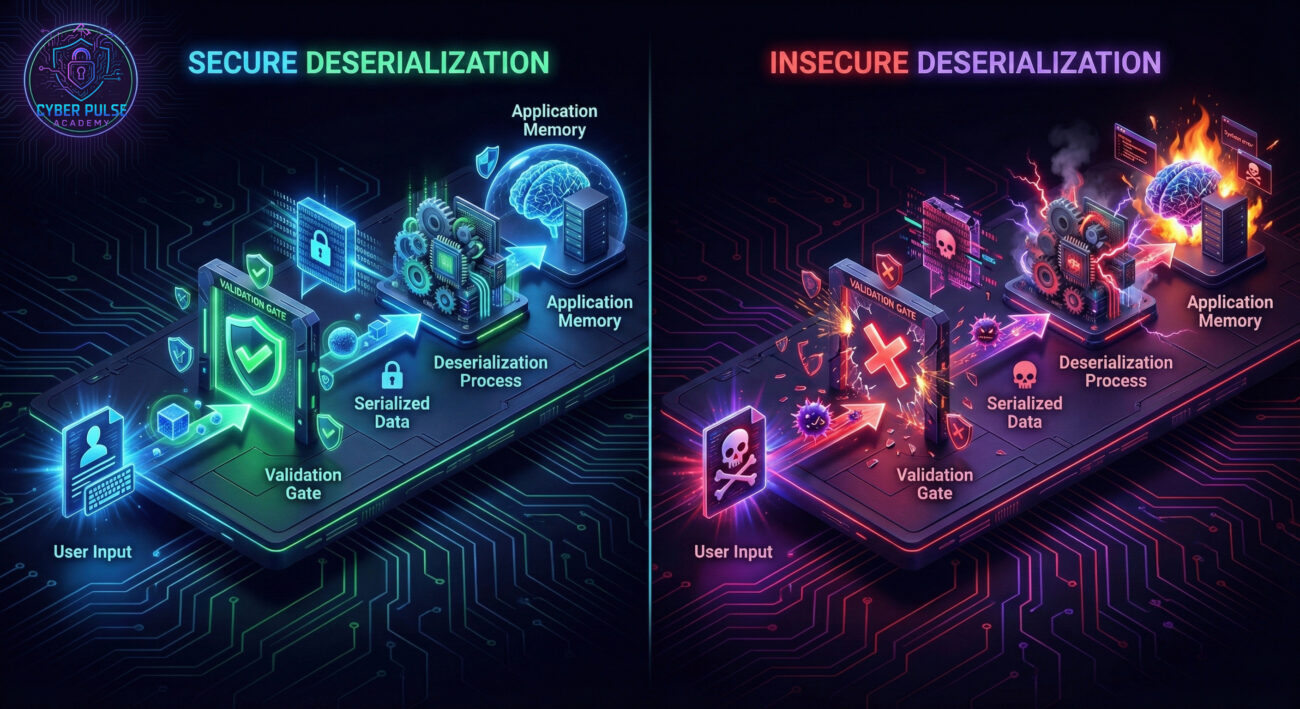
Let's follow "ShopSecure," a fictional but representative e-commerce platform, through a deserialization attack incident. ShopSecure uses Java with a popular framework that serializes user session data to manage shopping carts across visits.
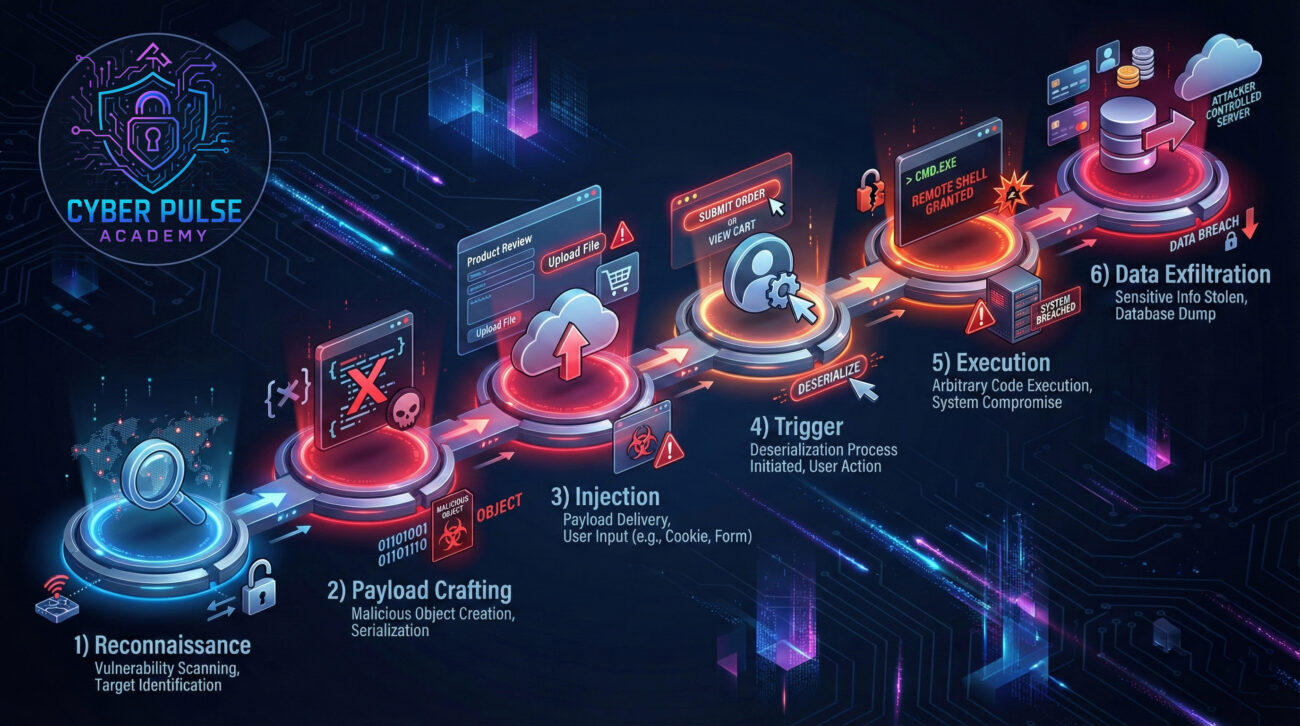
Alex, a security researcher, discovers ShopSecure's shopping cart stores session data as serialized Java objects in cookies. Worse, the site doesn't validate these cookies before deserializing them. Alex creates a proof-of-concept exploit:
| Time/Stage | What Happened | Impact |
|---|---|---|
| Day 1: Reconnaissance | Alex examines ShopSecure's cookies and identifies a Java-serialized object in the session cookie. | Discovers potential attack vector without triggering alerts. |
| Day 2: Payload Creation | Using publicly available tools, Alex crafts a malicious serialized object that will execute code when deserialized. | Creates weaponized payload targeting the specific Java version ShopSecure uses. |
| Day 3: Initial Test | Alex replaces their session cookie with the malicious one and refreshes their cart page. | The server deserializes the cookie without validation, executing a test command. |
| Day 4: Full Exploitation | The malicious payload establishes a reverse shell, giving Alex command-line access to the server. | Critical breach: Full server control achieved through a simple cookie manipulation. |
| Day 5: Detection & Response | ShopSecure's IDS finally flags unusual outbound connections; security team investigates. | Days of undetected access; customer data potentially compromised; significant remediation required. |
This scenario illustrates why deserialization vulnerabilities are so dangerous: they often bypass traditional security measures, exploit trusted processes, and provide significant access with minimal initial footprint. The fix required ShopSecure to implement proper input validation, use secure deserialization libraries, and audit all data handling processes.
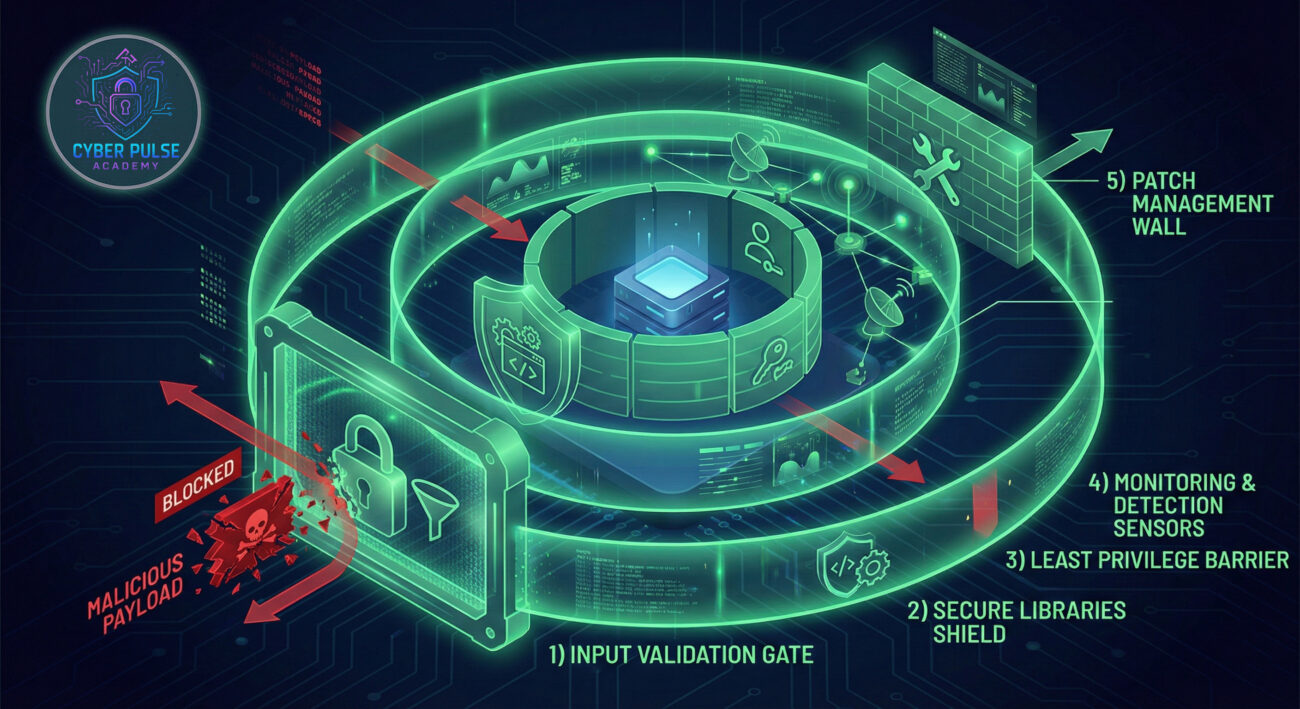
Protecting against deserialization attacks requires a multi-layered approach. Follow these steps to significantly reduce your risk:
Never trust serialized data from untrusted sources. Validate all input before deserialization.
Not all serialization methods are created equal. Choose secure alternatives.
Limit what code can do even if deserialization is compromised.
Detect attacks early through abnormal behavior patterns.
Proactively find vulnerabilities before attackers do.
Many deserialization vulnerabilities exist in third-party libraries.
Understanding how attackers think helps you defend better. Here's a simplified view of how threat actors approach deserialization vulnerabilities:
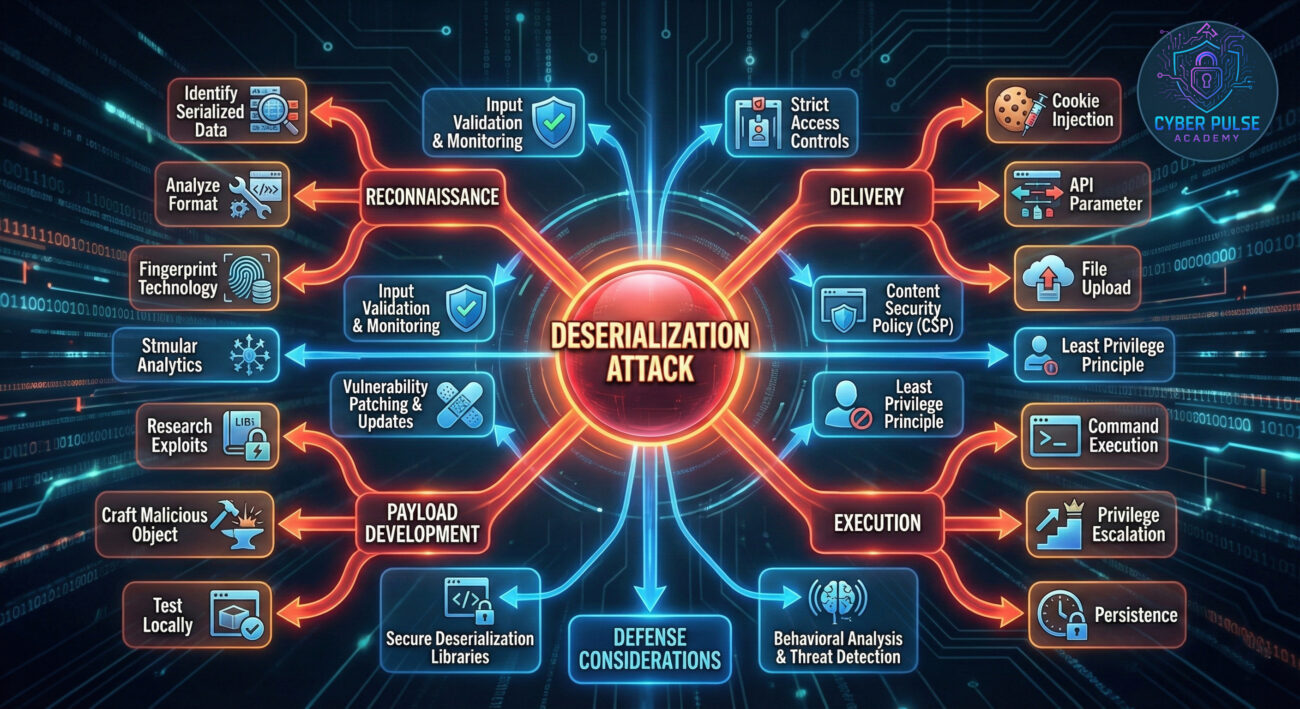
Simple Attack Path: An attacker discovers your application uses Java serialization in session cookies. They use a publicly available tool to generate a malicious serialized object containing code to execute system commands. By replacing their session cookie with this crafted data and refreshing the page, the server deserializes the cookie, executing the attacker's code with the application's privileges.
Defender's Counter-Move: Implement a secure deserialization wrapper that validates all serialized objects before processing. Use a library that checks digital signatures on serialized data. Monitor logs for deserialization exceptions and block IPs exhibiting suspicious patterns. Most importantly, ask: "Do we need serialization here?" Often, simpler alternatives exist.
"Deserialization vulnerabilities are golden tickets. They often bypass web application firewalls, hide in 'trusted' data flows, and provide high-impact access. I look for applications that handle serialized data, session cookies, API responses, file uploads. My favorite targets are Java applications using default serialization or PHP applications with unserialize() on user input. Once I find a vulnerable endpoint, I can often achieve remote code execution in a single request. The beauty is that to the system, my malicious payload looks like legitimate serialized data until it's too late."
What they care about: Finding unvalidated deserialization points, crafting reliable exploits, avoiding detection, maximizing access.
"Insecure deserialization represents a critical failure in input validation and trust boundaries. My goal is to either eliminate unnecessary serialization or implement robust controls around it. I advocate for using simple data formats instead of language-specific serialization, implementing strict validation, and maintaining comprehensive logging. When I find serialization in our codebase, I immediately assess its necessity and security. I work with developers to implement safer alternatives and ensure our monitoring can detect exploitation attempts."
What they care about: Preventing vulnerabilities through secure design, detecting exploitation attempts, minimizing impact through least privilege, educating developers.
Deserialization attacks exploit a fundamental process in modern applications, turning data handling into a potential security vulnerability. As we've explored, these attacks are both dangerous and stealthy, but they're also preventable with proper security practices.
Let's recap the essential points:
Understanding deserialization attacks is crucial for anyone involved in developing, deploying, or securing modern applications. By implementing the practices outlined in this guide, you can significantly reduce your risk and build more resilient systems.
Now that you understand deserialization attacks, take action:
Have questions about deserialization attacks or want to share your experiences? Leave a comment below or contact us directly. Cybersecurity is a continuous journey, and understanding threats like insecure deserialization is a critical step toward building more secure digital environments.
© 2026 Cyber Pulse Academy. This content is provided for educational purposes only.
Always consult with security professionals for organization-specific guidance.
Every contribution moves us closer to our goal: making world-class cybersecurity education accessible to ALL.
Choose the amount of donation by yourself.