




































Certification Courses
Hands-On Labs
Threat Intelligence
Latest Cyber News
MITRE ATT&CK Breakdown
All Cyber Keywords
Gather Victim Host Information via DNS is a critical reconnaissance step where attackers map your digital infrastructure by querying public domain records, identifying key servers, and planning their intrusion.
ATT&CK ID T1590.002
Tactics Reconnaissance
Platforms PRE
Difficulty 🟢 Low
Prevalence High
Imagine a burglar casing a neighborhood before a robbery. They don't just pick a random house. They note which homes have security systems (alarm company stickers), dogs (beware of dog signs), and predictable routines (when lights turn off). Gather Victim Host Information via DNS is the digital equivalent of this reconnaissance phase.
Before launching any attack, adversaries need a map. They turn to the internet's public phone book, the Domain Name System (DNS). By querying DNS records for your company's domain, they can list your public-facing web servers (mail.company.com), identify your email provider (MX records), and even find subdomains for development or staging environments that might be less secure. This technique is low-risk, entirely legal from public infrastructure, and provides the essential blueprint for subsequent intrusions.
| Term | Definition | Why It Matters |
|---|---|---|
| DNS (Domain Name System) | The internet's directory service that translates human-readable domain names (like google.com) into machine-readable IP addresses (like 142.250.185.78). | It's the primary public database attackers query to discover your organization's internet-facing assets. |
| DNS Record | A specific entry in a DNS zone file that provides information about a domain. Common types include A, AAAA, MX, TXT, NS, and CNAME records. | Each record type reveals different pieces of your infrastructure (e.g., A records for web servers, MX for mail servers). |
| Passive DNS | A collection of historical DNS query/response data gathered from various points on the internet, not directly from the authoritative name servers. | Attackers use passive DNS databases to see historical associations between domains and IPs, revealing infrastructure changes and related assets. |
| Subdomain Enumeration | The process of finding all subdomains associated with a primary domain (e.g., dev.example.com, vpn.example.com). | Discovers less-monitored, potentially vulnerable entry points that aren't listed on the main corporate website. |
| Zone Transfer (AXFR) | A DNS transaction where a secondary DNS server requests a full copy of all records from a primary DNS server. | If misconfigured, an attacker can request a zone transfer and get a complete list of all internal hosts, a reconnaissance jackpot. |
The process of Gather Victim Host Information is methodical and automated. Attackers blend basic commands with powerful open-source intelligence (OSINT) tools to build a comprehensive profile without triggering a single internal alert.
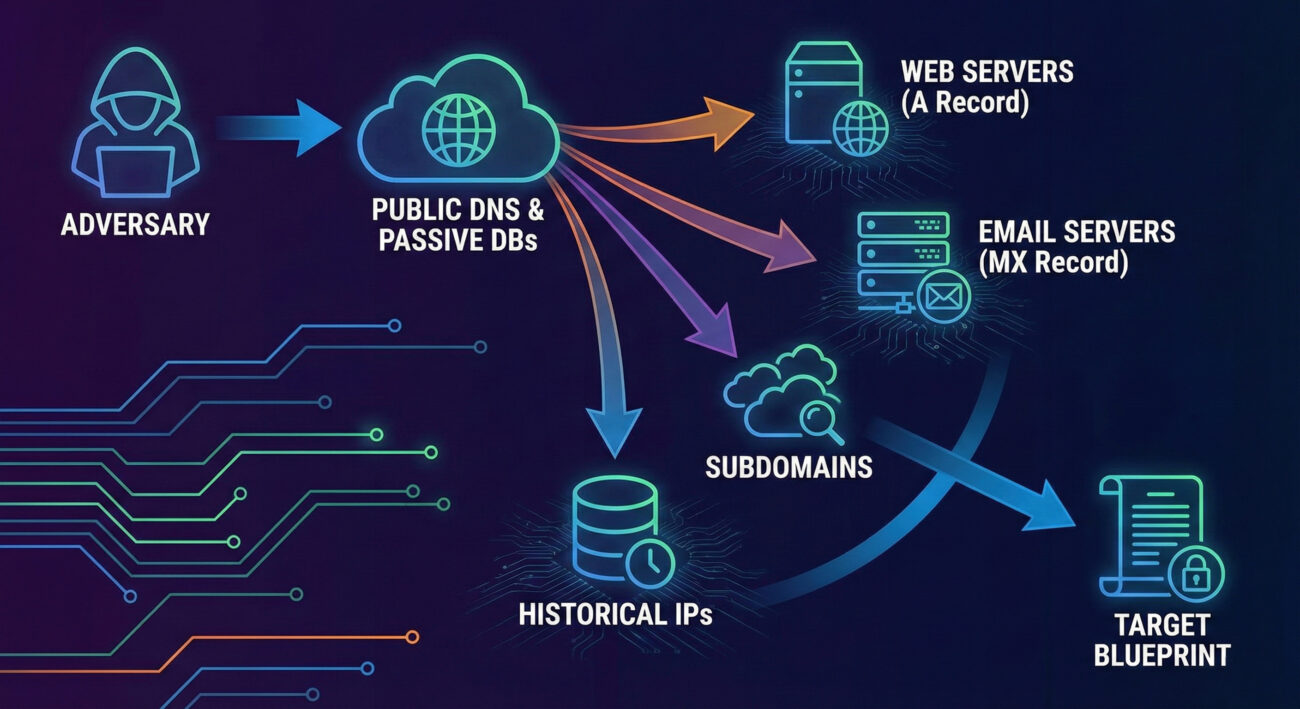
Think like a documentary filmmaker planning to shoot in a remote location. You wouldn't just show up. You'd study maps (DNS), read travel blogs about the area (passive DNS), identify potential campsites (subdomains), and note the weather patterns (service banners). Your goal isn't to interact yet, just to observe and plan. The red teamer's mindset here is one of patient curiosity. Every piece of public data is a clue. A subdomain called `legacy-api` suggests a possibly deprecated, less-patched system. An MX record pointing to a specific cloud provider reveals a potential phishing target or a known vulnerability in that platform.
Example Commands:
# Basic lookup for A and MX records
$ dig acme-corp.com A +short
$ dig acme-corp.com MX +short

# Attempt a zone transfer (often fails, but worth trying)
$ dig @ns1.acme-corp.com acme-corp.com AXFR

# Using dnsrecon for comprehensive enumeration
$ dnsrecon -d acme-corp.com -t std,axfr,brt -D /usr/share/wordlists/subdomains.txt
The APT29 group (also known as Cozy Bear or Midnight Blizzard), associated with Russian intelligence, is renowned for its meticulous reconnaissance. In campaigns targeting government and think-tank networks, APT29 extensively used DNS probing and subdomain enumeration to identify specific individuals and departments.
They would harvest email addresses from public sources, then use DNS to find the associated organization's mail server configuration (MX records). This information was then used to craft highly targeted phishing emails that appeared to come from legitimate internal or partner addresses, dramatically increasing their success rate. This demonstrates how Gather Victim Host Information directly enables more effective social engineering and initial access attacks.
Reference: For an in-depth analysis of APT29's tactics, including reconnaissance, read the joint advisory by the UK's NCSC and the US's CISA, FBI, and NSA: CISA Alert (AA20-106A) on APT29.
You can't stop someone from looking up your public DNS records. Detection of this specific phase is nearly impossible on your own network. Therefore, the defender's focus must shift from detecting the reconnaissance to managing the exposure it creates and detecting the follow-on actions that inevitably come next.
Think of your public DNS information as the company's listing in a phone book. You can't stop people from reading it. But you can ensure the listed numbers are only for the main switchboard (a secure front-end proxy) and not the direct line to the CEO's desk (an internal server). Your philosophy is exposure management. Assume an attacker has your DNS map. Your job is to ensure that map doesn't lead them to a vulnerable, directly accessible system.
Since you won't see the attacker's DNS lookups, look for the next step. Correlate these signals:
Hunt for internal systems conducting suspicious, high-volume scans that mirror a target list built from public DNS data. The following Sigma rule looks for patterns of horizontal scanning.
# Sigma Rule: Horizontal Scanning Pattern Post-DNS Recon
# This rule detects a single source rapidly connecting to multiple different hosts on a specific port,
# mimicking post-reconnaissance service validation.
title: Possible Post-DNS Reconnaissance Horizontal Scan
id: a1b2c3d4-1234-5678-abcd-0123456789ab
status: experimental
description: Detects a source IP making successful connections to many distinct destination IPs on a common port (e.g., 443, 22) within a short time.
author: Your SOC
logsource:
    product: firewall
    category: firewall
detection:
    selection:
        event_type: "connection_allowed"
        dst_port: (443, 22, 3389, 445)
    timeframe: 5m
    condition: selection | count(dst_ip) by src_ip > 20
falsepositives:
    - Legitimate network scanners
    - Load balancer health checks
level: medium
tags:
    - attack.reconnaissance
    - attack.t1590.002
Mitigation is your primary weapon. Make the information gleaned from DNS as useless or misleading as possible to the attacker.
| Attacker's Goal (Red Team) | Defender's Action (Blue Team) |
|---|---|
| Discover all internet-facing assets. | Minimize and actively manage the public attack surface. |
| Identify vulnerable, less-monitored subdomains. | Apply consistent security standards (patching, WAF) to ALL public assets, not just "www". |
| Map the network to plan initial access. | Implement network segmentation so that compromising one public server doesn't grant access to the internal network. |
| Gather info silently and passively. | Assume the info is gathered, and focus on making it obsolete or misleading through architectural controls. |
External IPs conducting rapid, sequential connections to multiple hosts/subdomains on standard ports (22, 443, 3389) shortly after a new subdomain goes live or a DNS record changes.
Conduct quarterly external attack surface assessments. Use tools like yourself to see what an attacker sees. Find and decommission forgotten assets before they do.
Firewall and WAF logs for sources that sequentially hit a list of your known public IPs/subdomains. Correlate with vulnerability scanner signature alerts from your IDS/IPS.
Gather Victim Host Information (DNS) is the unavoidable starting pistol of many cyber campaigns. As defenders, we cannot win the race by trying to stop the starting shot. Instead, we must build a track that is confusing, well-guarded, and full of dead ends.
Your immediate next steps should be operational:
To deepen your understanding of the attack chain, explore related techniques: Phishing for Initial Access (T1566) and External Remote Services for Persistence (T1133).
For further strategic guidance, refer to the NIST SP 800-53 Security and Privacy Controls, specifically the CA-8 (Penetration Testing) and RA-3 (Risk Assessment) families, which formalize the need for understanding and managing your attack surface.
Stay vigilant, manage your exposure, and assume the adversary already has your map.
Every contribution moves us closer to our goal: making world-class cybersecurity education accessible to ALL.
Choose the amount of donation by yourself.