








Certification Courses
Hands-On Labs
Threat Intelligence
Latest Cyber News
MITRE ATT&CK Breakdown
All Cyber Keywords
In the vast digital universe of your organization, a silent, invisible threat is expanding, Identity Dark Matter. Much like the cosmological dark matter that makes up most of the universe's mass yet remains undetectable by telescopes, this cybersecurity phenomenon refers to the sprawling collection of unmanaged, unmonitored, and often forgotten digital identities. These include dormant service accounts, orphaned credentials, stale user profiles, and undocumented API keys that exist outside the purview of your Identity and Access Management (IAM) systems.
Every breach in recent memory, from sprawling supply chain attacks to devastating ransomware, has leveraged these hidden identities as a primary attack vector. This comprehensive guide will illuminate this invisible attack surface, explaining its origins, the specific MITRE ATT&CK techniques it enables, and providing a clear, actionable framework for defenders to bring this dark matter into the light.
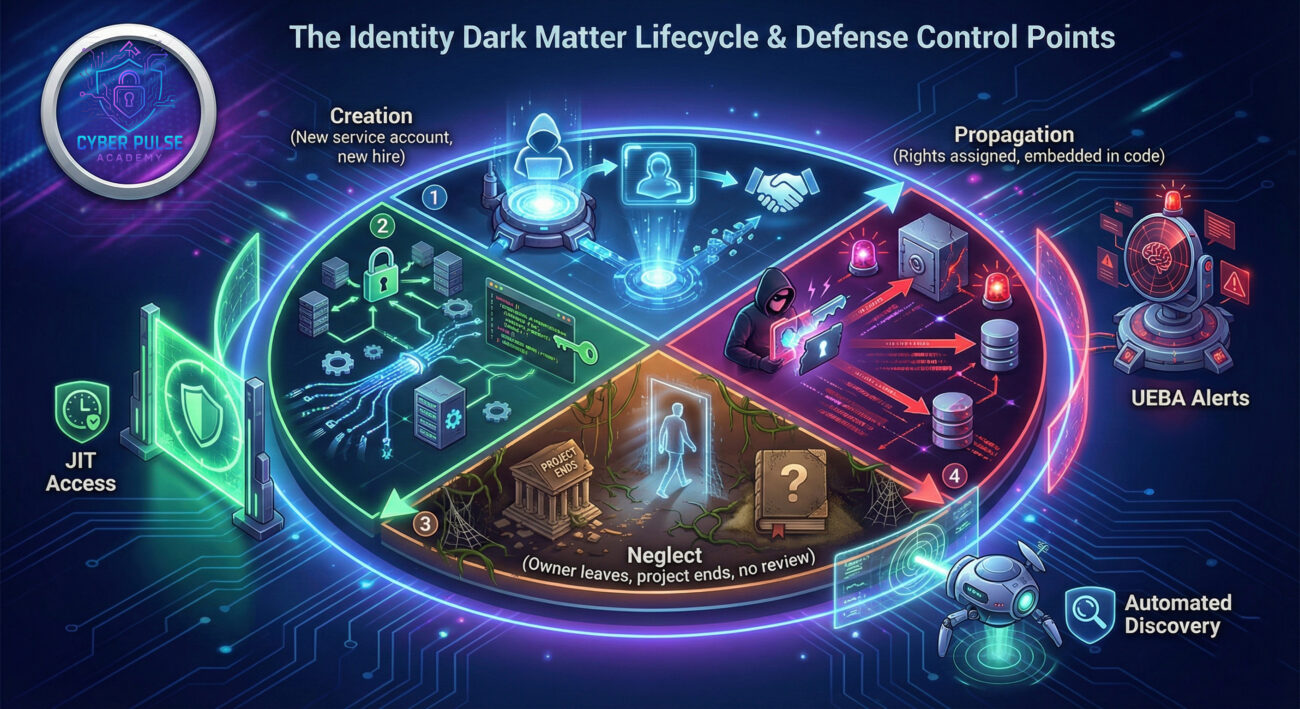
Identity Dark Matter is the collection of digital credentials and access rights that are active within your network but are unknown, unmanaged, and unsecured. It forms naturally through IT evolution, mergers, cloud migration, rapid development, and employee turnover. This shadow identity sprawl provides the perfect hiding place for threat actors, allowing them to move laterally, escalate privileges, and maintain persistence without triggering alerts. Understanding and managing this dark matter is no longer optional; it's the frontline of modern identity-centric defense.
Imagine every light bulb in your house is an identity you manage (employees, IT admins). Identity Dark Matter is all the electrical outlets, old wiring, forgotten extension cords, and junction boxes behind the walls, still live and capable of delivering power, but completely out of sight.
The MITRE ATT&CK framework meticulously documents adversary behavior. Identity Dark Matter directly fuels numerous techniques across the attack lifecycle, particularly in the Persistence, Privilege Escalation, and Lateral Movement tactics.
| MITRE ATT&CK Tactic | Specific Technique | How Identity Dark Matter Enables It |
|---|---|---|
| Persistence (TA0003) | T1136.001 - Create Account: Local Account | Attackers hide new backdoor accounts amidst thousands of existing unmanaged service accounts, making detection nearly impossible. |
| Privilege Escalation (TA0004) | T1078.003 - Valid Accounts: Local Accounts | Compromised, dormant local admin accounts on servers or endpoints provide immediate elevated access. |
| Defense Evasion (TA0005) | T1098 - Account Manipulation | Attackers modify attributes of orphaned accounts (e.g., change email, reset password) to regain control without creating a new, monitored identity. |
| Lateral Movement (TA0008) | T1021.002 - Remote Services: SMB/Windows Admin Shares | Stale credentials with network logon rights allow attackers to move from one system to another using legitimate, but forgotten, access. |
| Credential Access (TA0006) | T1552.001 - Unsecured Credentials: Credentials In Files | Hardcoded API keys and passwords in source code or config files are a goldmine for credential harvesting tools. |
Let's examine how an adversary weaponizes Identity Dark Matter in a realistic, multi-stage attack.
The attacker phishes a low-privilege user. Once inside, they run automated discovery scripts (like PowerSploit) not to find admins, but to find unmonitored service accounts and disabled users listed in Active Directory, often ignored by SIEM alerts.
Using tools like Mimikatz, they dump credentials from memory. Among the current user's hashes, they find the password for a `svc_sql_backup` account. This account, part of the Identity Dark Matter, has unnecessary domain admin rights assigned from a forgotten project years ago. The attacker now has domain-wide access.
Instead of creating a flashy new account, the attacker simply re-enables a stale, orphaned account belonging to a departed employee (MITRE T1098). They reset its password and add it to a privileged group. This account blends into the "noise" of legacy identities. They use it to access file shares and critical servers via SMB (MITRE T1021.002).
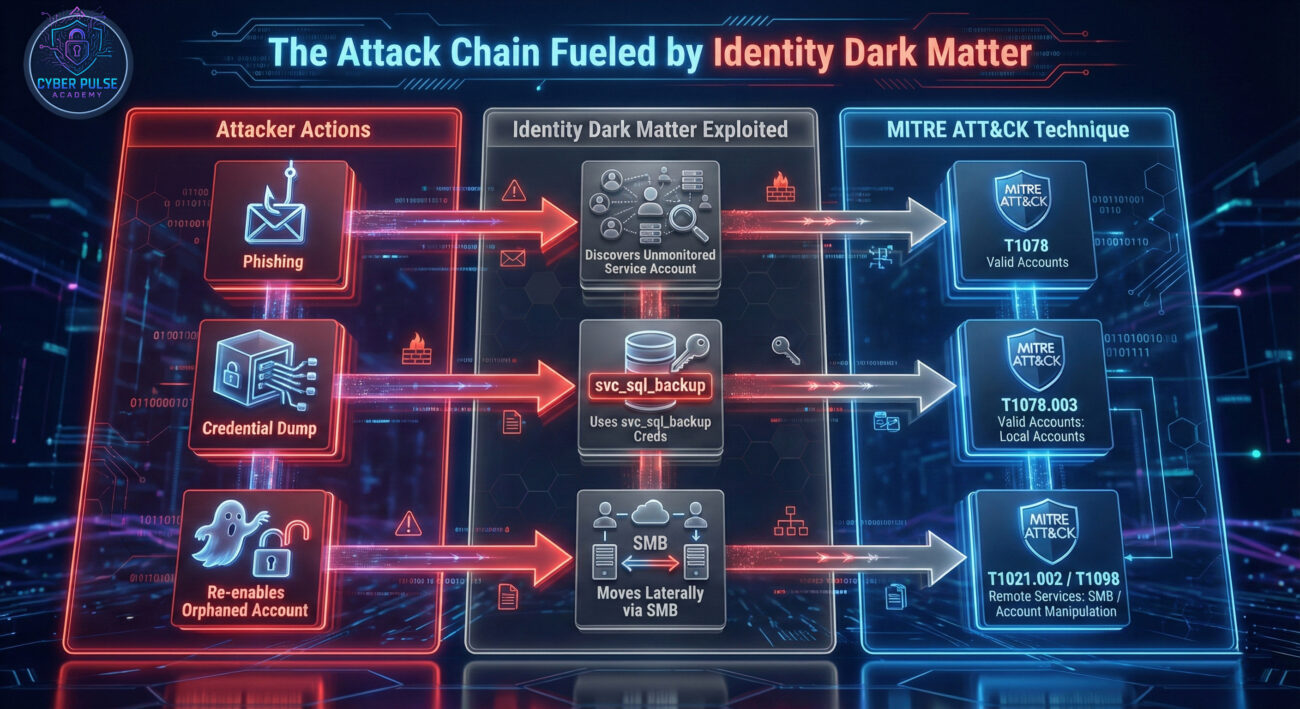
Objective: Find and abuse invisible, legitimate access to achieve goals without detection.
Objective: Illuminate the dark matter, establish governance, and detect anomalous use of any identity.
Follow this phased framework to systematically reduce your Identity Dark Matter footprint.
Goal: Find all identities. Use tools like Microsoft Entra Identity Governance, AWS IAM Identity Center reports, or open-source tools like BloodHound for on-prem AD. Don't forget SaaS applications (use CASB scans). Categorize: Human, Service, Robotic, API.
Goal: Identify risk. For each identity, determine: Privilege level, Last use, Owner, and Business justification. Prioritize action on: Privileged stale accounts (>90 days inactive), accounts with no owner, and identities with weak authentication.
Goal: Reduce attack surface.
Goal: Prevent regression. Implement automated workflows for joiner-mover-leaver processes. Schedule quarterly attestation reviews. Configure alerts for logins from: Recently disabled accounts, service accounts from interactive sessions, or any identity flagged during the discovery phase.
Q: Is Identity Dark Matter only a problem for large enterprises?
No. In fact, small and medium-sized businesses are often more vulnerable. They typically have less mature identity governance processes, rely more on manual administration, and may have a higher proportion of legacy, undocumented systems from rapid growth phases, creating dense, unmanaged Identity Dark Matter.
Q: How is this different from just having "too many admins"?
It's a superset of that problem. "Too many admins" is a known, quantifiable risk. Identity Dark Matter includes the unknown unknowns: accounts you don't know are admins, accounts you don't know exist at all, and credentials that aren't even in your identity store (like a secret in a developer's local config file).
Q: Can cloud-native environments have Identity Dark Matter?
Absolutely. While cloud IAM (like AWS IAM or Azure AD) provides better audit trails, the dynamic nature of cloud resources accelerates dark matter creation. Think: forgotten IAM roles for deprecated Lambda functions, access keys for discontinued CI/CD pipelines, or service principals for pilot applications that were never deleted. The scale is just different.
Q: What's the single most effective technical control to start with?
Implement a Secrets Management solution. This forces the discovery and centralization of the most dangerous form of dark matter, embedded credentials and API keys. It provides immediate risk reduction and a clear inventory of non-human identities.
Don't let your organization's hidden identities be the cause of the next breach. Start small, but start now.
Your Mission This Week: Run one discovery command. In a Windows environment, use `Get-ADUser -Filter * -Properties LastLogonDate | Where-Object {$_.LastLogonDate -lt (Get-Date).AddDays(-180)}` to find stale user accounts. In AWS, run the IAM credential report and look for access keys older than 90 days. Document the count. That number is your first measure of Identity Dark Matter.
For a deeper dive into identity security frameworks, explore the NIST Cybersecurity Framework and the Microsoft Cloud Permission Management guide.
© 2026 Cyber Pulse Academy. This content is provided for educational purposes only.
Always consult with security professionals for organization-specific guidance.
Every contribution moves us closer to our goal: making world-class cybersecurity education accessible to ALL.
Choose the amount of donation by yourself.