




Certification Courses
Hands-On Labs
Threat Intelligence
Latest Cyber News
MITRE ATT&CK Breakdown
All Cyber Keywords
In cybersecurity, Command and Control (C2) is the hidden communication channel that allows an attacker to remotely direct compromised systems inside a victim's network. Think of it as the puppet master's strings: once an initial breach occurs, C2 is what transforms a one-time intrusion into a persistent, controllable threat.
Why It Matters: This tactic is the backbone of modern cyber attacks. Without a reliable C2 channel, an attacker is blind and powerless after the initial infection. Success here enables everything from data theft and lateral movement to deploying ransomware. If defenders fail to detect or disrupt C2, they surrender persistent control of their own infrastructure to the adversary.
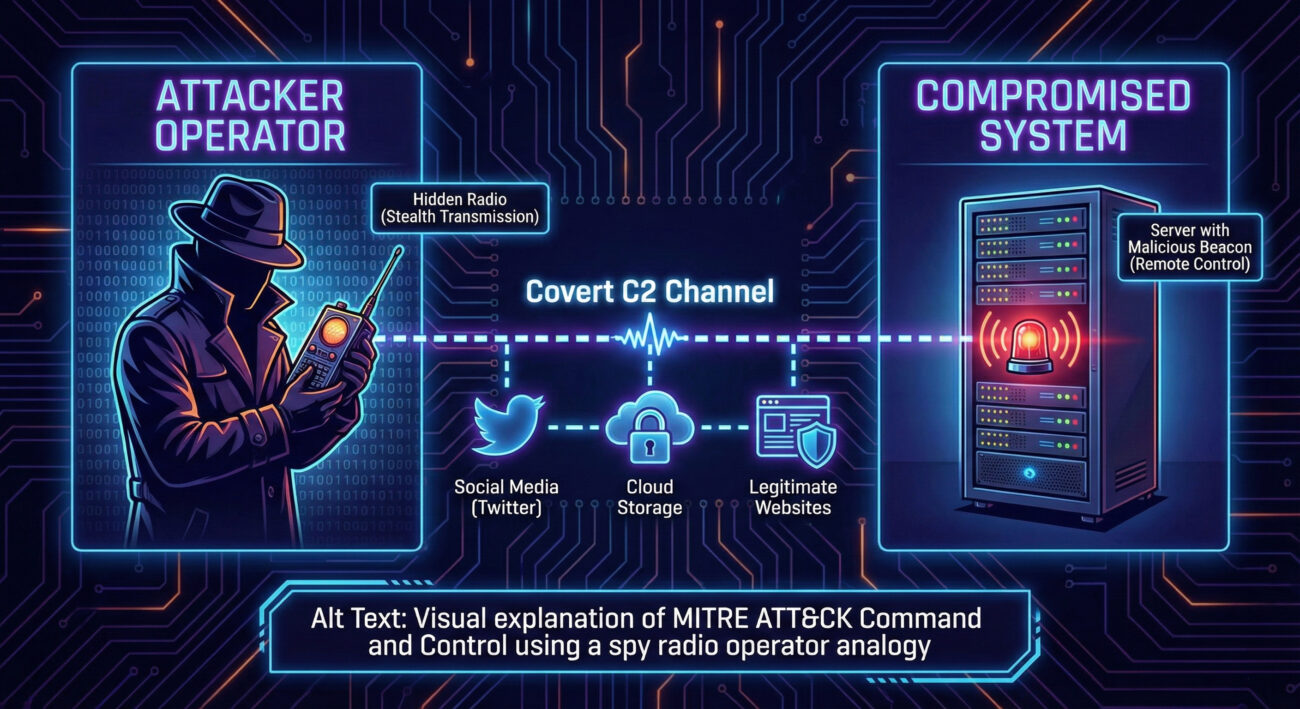
Imagine a spy dropped behind enemy lines during wartime. Their first task isn't to steal secrets immediately; it's to establish a secure, hidden, and reliable way to receive orders and send back information. They bury a small radio transmitter, camouflaged to look like a rock, and use pre-agreed times, frequencies, and encrypted codes to communicate with headquarters.
In the digital world, the compromised computer is the spy. The malware is the hidden radio. The Command and Control server is headquarters. And the "calls home" are the regular beacons the malware sends out, asking: "What should I do next?" Just like the spy, the malware uses camouflage, it might hide its traffic in requests to popular websites like GitHub or Twitter, or use encrypted channels that look like normal HTTPS web traffic.
The Takeaway: Command and Control isn't about the loud, obvious attack. It's the quiet, persistent, and disguised heartbeat of the operation. Detecting it means looking for the subtle, repeating patterns of the "radio checks" amidst the noise of legitimate network traffic.
As the spy master (attacker), your goal is to maintain absolute, stealthy control over your agents (compromised hosts). You feel a mix of patience and paranoia. You've trained your agents to check in at randomized times using encrypted dead drops (beacons). You control multiple safe houses (C2 servers) and have plans to switch if one is discovered (infrastructure fallback). Your methodology is all about blending in, using everyday digital "locations" (like cloud APIs or comment sections) as meeting points that won't raise suspicion.
Top MITRE ATT&CK Techniques for Command and Control:
Toolbox: Cobalt Strike (the industry-standard red team framework), Metasploit (with its Meterpreter payload), and Sliver (a newer, Golang-based alternative).
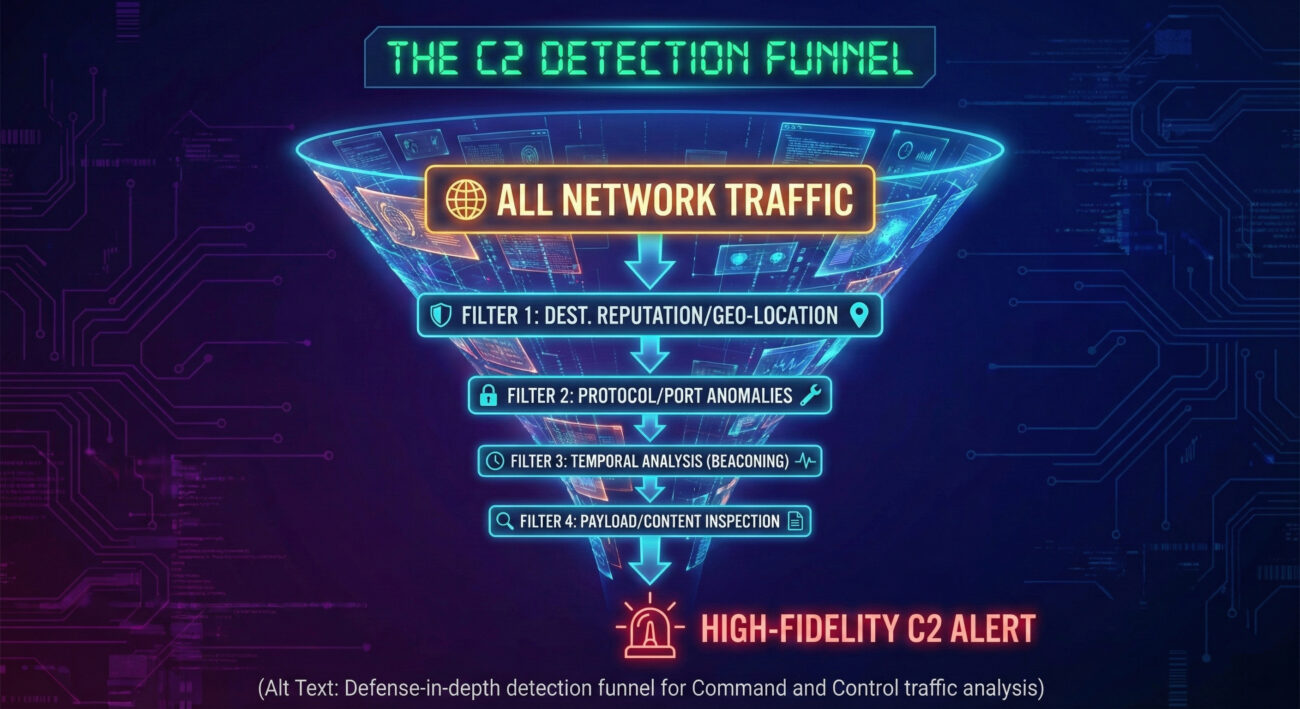
You are part of a signals intelligence (SIGINT) unit. Your job isn't to catch the spy in the act of stealing documents, but to find the anomalous radio transmissions. You're listening to the entire spectrum of network traffic, looking for patterns that don't fit: a radio check that happens exactly every 17 minutes, a signal coming from an unusual geographic location, or encrypted traffic to a server that has no business reason for communication.
Concrete log entries that should raise eyebrows:
Hunt Hypothesis: "Find internal hosts that are performing successful HTTPS connections to IP addresses that have a low global reputation score and have only been registered in the last 30 days, where the connection occurs at regular intervals." This hunts for new, suspicious infrastructure being used for beaconing.
Tools: Network Detection and Response (NDR) platforms, Endpoint Detection and Response (EDR) agents, Security Information and Event Management (SIEM) systems for log correlation, and dedicated DNS security solutions.
Narrative: The SUNBURST Backdoor (SolarWinds Attack, 2020)
One of the most sophisticated supply chain attacks in history involved malicious code inserted into SolarWinds' Orion software updates. When organizations installed the update, the backdoor, called SUNBURST, was deployed.
Explicit Connection: In the SolarWinds attack, the threat group NOBELIUM used Command and Control when the SUNBURST malware initiated its first "call home." This communication was deliberately delayed (up to two weeks), used domain names masquerading as legitimate subdomains of AV software vendors (e.g., avsvmcloud[.]com), and blended seamlessly into HTTPS traffic. This allowed them to remain undetected for months, receive further payloads, and move laterally to high-value targets.
The defenders who eventually caught it did so by noticing the anomalous network traffic from their SolarWinds servers to these suspicious, yet cleverly disguised, domains, a classic hunt for C2 infrastructure.
Below is a high-level map of key Techniques under the Command and Control (TA0011) tactic. This is your starting point for understanding the attacker's playbook.
| Technique ID | Name | Brief Purpose |
|---|---|---|
| T1071 | Application Layer Protocol | Use common web, mail, or file transfer protocols to hide C2 traffic. |
| T1132 | Data Encoding | Encode or encrypt C2 data to evade signature-based detection. |
| T1001 | Data Obfuscation | Make C2 data difficult to discover or analyze (e.g., steganography). |
| T1568 | Dynamic Resolution | Use techniques like DGAs or fast-flux DNS to hide C2 servers. |
| T1102 | Web Service | Use third-party web services (social media, blogs) as an indirect C2 channel. |
| T1095 | Non-Application Layer Protocol | Use lower-level network protocols (ICMP, TCP sockets) for C2. |
| T1573 | Encrypted Channel | Use cryptographic protocols (SSL/TLS) or custom encryption for C2. |
Note: Each of these techniques contains numerous sub-techniques. Future posts will dive into specific sub-techniques like T1071.001 (Web Protocols) or T1568.002 (Domain Generation Algorithms).
For Everyone:
For Leadership:
For Defenders:
Every contribution moves us closer to our goal: making world-class cybersecurity education accessible to ALL.
Choose the amount of donation by yourself.