




Certification Courses
Hands-On Labs
Threat Intelligence
Latest Cyber News
MITRE ATT&CK Breakdown
All Cyber Keywords
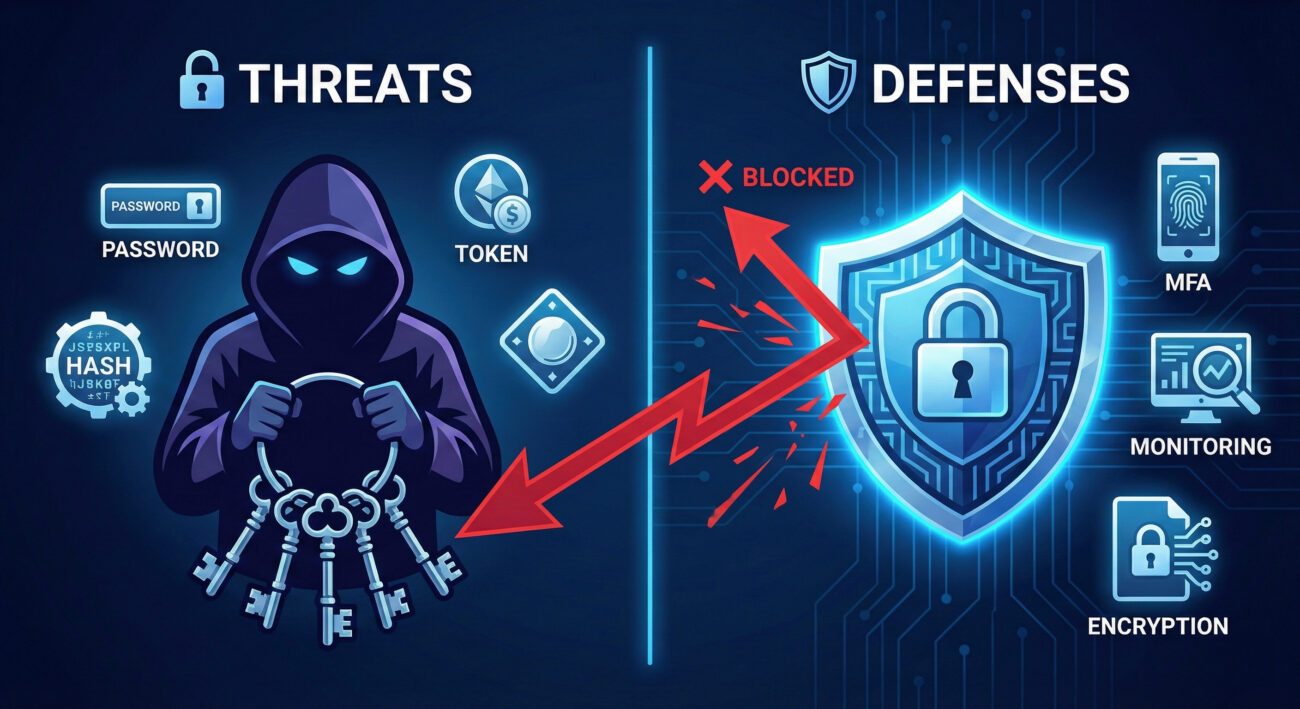
Credential Access is the attacker's art of stealing the digital keys, usernames, passwords, hashes, tokens, that unlock doors within your network. It’s not just about getting in; it’s about getting the keys to move freely, silently, and with authority once you're inside.
Why does this matter so much? Because in the cyber kill chain, initial access is often noisy and temporary. Credential Access is the pivot point that transforms a fragile foothold into a persistent, powerful position. Success here lets an attacker escalate privileges, move laterally to critical systems, and ultimately access the crown jewels, all while mimicking legitimate users, making detection incredibly difficult. If defenders fail at this stage, the entire network can become a playground for the adversary.
Imagine your corporate network is a sprawling, high-security office building. Every door, from the server room to the CFO's office, requires a specific keycard.
An attacker using Credential Access isn't just picking the lock on the back door (Initial Access). They're the professional thief who, once inside the lobby, focuses entirely on stealing the master keyring from the security guard, duplicating keycards left on desks, or tricking employees into handing over their PINs.
With those credentials in hand, they're no longer a suspicious intruder hiding in the stairwell. They can now walk boldly through the halls, open any door they please, and look completely legitimate to every camera and security patrol. This is the devastating power of successful Credential Access.
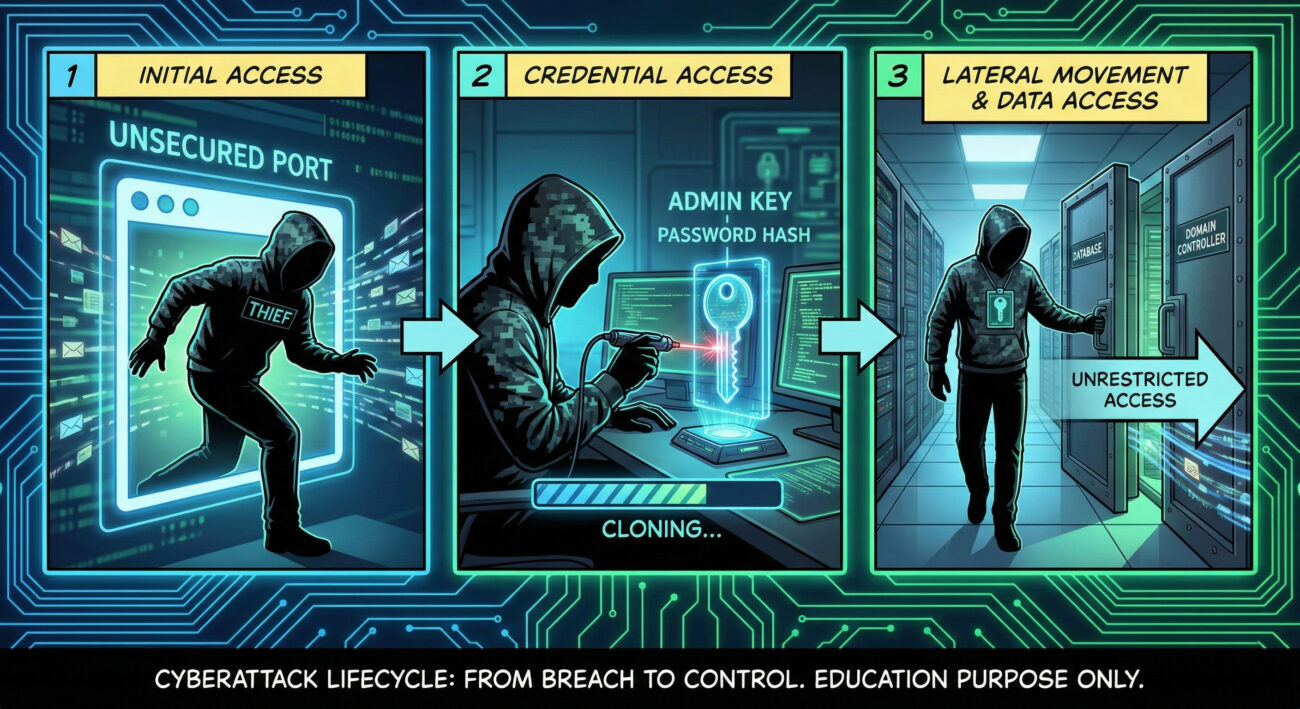
From the attacker's view, the office building is full of opportunities. The goal isn't to break down every door, it's to become invisible. They feel for the "give" of an unlocked workstation (unpatched system), listen for the careless conversation where a password is shared (network sniffing), or craft a perfect fake ID badge request (phishing). Their methodology is patient, systematic theft of identity.
secretsdump.py for remote credential dumping via protocols like SMB.# Using Mimikatz to dump credentials from LSASS memory privilege::debug # Escalate to DEBUG privileges (often needed) sekurlsa::logonpasswords # Extract plaintext passwords and NTLM hashes from memory # Result: Shows user names, domains, and (if cached) plaintext passwords or NTLM hashes. # These hashes can be used for Pass-the-Hash attacks immediately.
As defenders, we're the security team reviewing access logs and camera footage. We're not looking for smashed windows; we're looking for anomalies. Why is the janitor's keycard being used to enter the R&D lab at 2 AM? Why did one employee's login originate from two different countries within an hour? Our job is to spot the legitimate key being used in an illegitimate way.
mimikatz.exe or rundll32.exe) with a parent process of lsass.exe - a huge red flag for credential dumping.HKLM\SAM or HKLM\SECURITY hives: Indicates attempts to dump the SAM database."Hunt for processes with the name lsass.exe that have more than one child process. The legitimate LSASS rarely spawns children. Any child process (especially unknown ones) is highly suspicious and indicative of code injection for dumping."
# Sigma rule to detect potential LSASS credential dumping via process creation
title: Potential LSASS Memory Dump
status: experimental
description: Detects a process creation event where the parent process is lsass.exe, which is highly unusual and indicative of credential dumping.
logsource:
    category: process_creation
    product: windows
detection:
    selection:
        ParentImage|endswith: '\lsass.exe'
    condition: selection
falsepositives:
    - Legitimate administrative or security tools (should be very rare, whitelist explicitly)
level: high
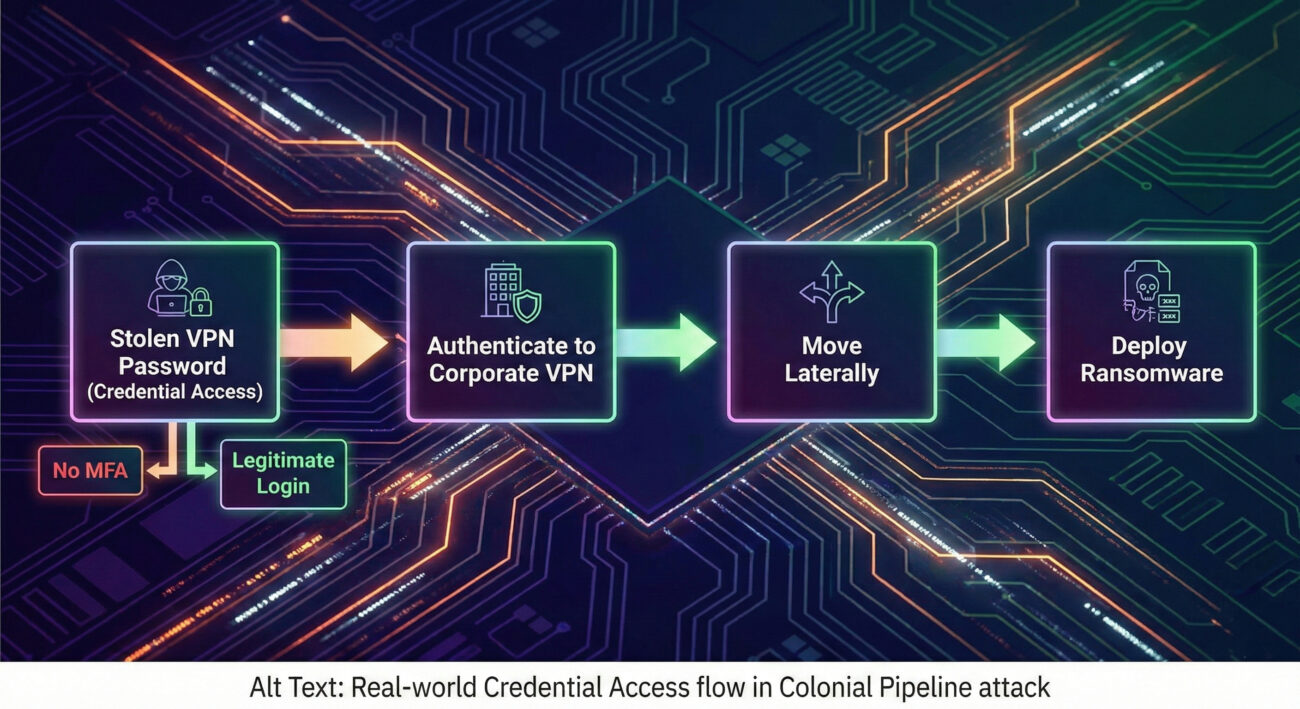
Narrative: The 2021 Colonial Pipeline ransomware attack, attributed to the DarkSide group, crippled a major US fuel pipeline. The initial access vector was a compromised virtual private network (VPN) account that did not have multi-factor authentication enabled.
Explicit Connection: In the Colonial Pipeline attack, the threat group DarkSide used Credential Access when they obtained a single VPN password, likely through a password leak or purchase on the dark web. This allowed them to authenticate directly to the corporate network as a legitimate user, bypassing perimeter defenses and immediately beginning their lateral movement to deploy ransomware.
Below are some of the primary Techniques within the Credential Access tactic (TA0006). Remember, each of these contains numerous sub-techniques, these are the high-level categories.
| Technique ID | Name | Brief Purpose |
|---|---|---|
| T1003 | OS Credential Dumping | Steal credentials stored by the operating system from memory or files. |
| T1110 | Brute Force | Guess credentials by systematic trial and error (password spraying, cracking). |
| T1555 | Credentials from Password Stores | Harvest credentials from third-party applications like browsers or email clients. |
| T1539 | Steal Web Session Cookie | Hijack active web sessions to bypass authentication mechanisms. |
| T1552 | Unsecured Credentials | Find credentials insecurely stored in files, code, configuration, etc. |
| T1056 | Input Capture | Intercept user input via keylogging or credential capture prompts. |
Every contribution moves us closer to our goal: making world-class cybersecurity education accessible to ALL.
Choose the amount of donation by yourself.