


































Certification Courses
Hands-On Labs
Threat Intelligence
Latest Cyber News
MITRE ATT&CK Breakdown
All Cyber Keywords
Network Topography is a critical reconnaissance technique where adversaries map your network structure to identify key assets, trust relationships, and potential attack paths before launching their main assault.
ATT&CK ID T1590.004
Tactics Reconnaissance
Platforms PRE (Preparation)
Difficulty 🟢 Easy
Prevalence High
Imagine you're a burglar planning to rob a museum. You wouldn't just walk in blind. First, you'd study blueprints, note guard patrol routes, identify alarm sensor locations, and find the back door behind the gift shop. Network Topography is the digital equivalent of this planning phase.
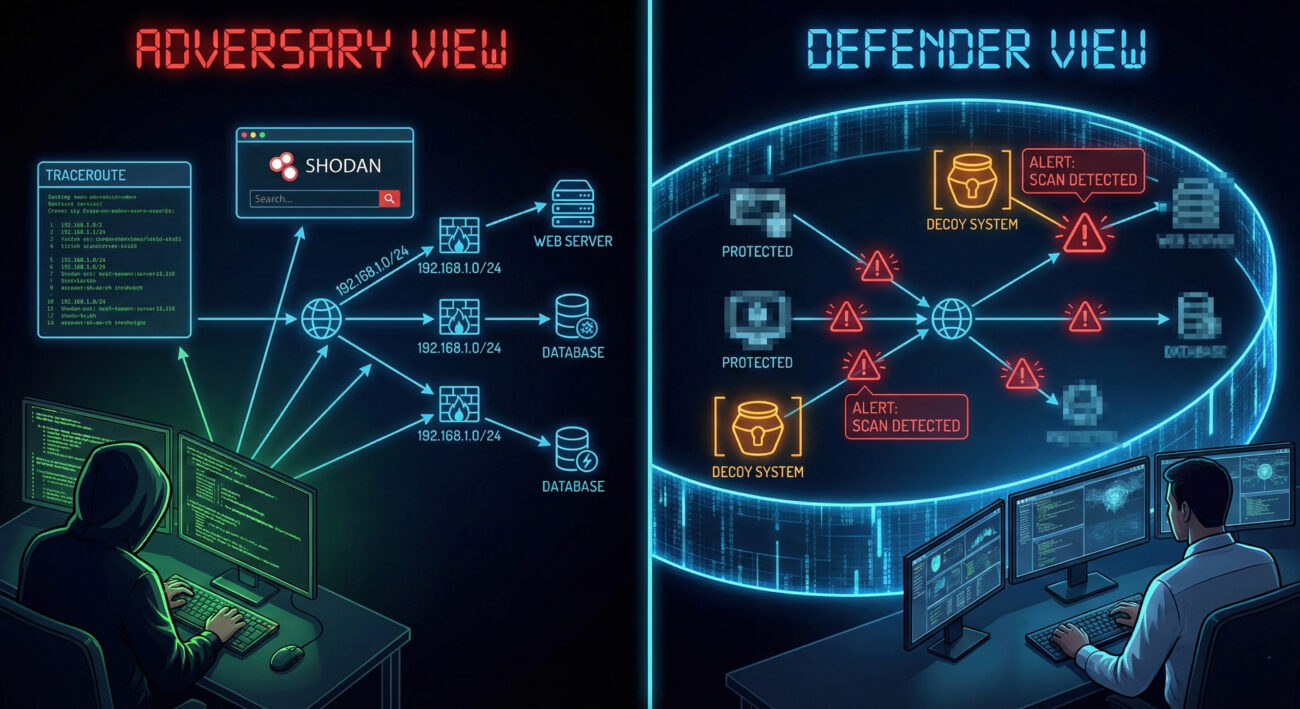
Adversaries, from script kiddies to advanced nation-state groups, start by drawing a map of your digital territory. They want to answer questions like: Where are the servers? How are network segments connected? What security devices (firewalls, IDS) are in place? Which systems talk to each other? This map becomes their attack playbook, allowing them to move stealthily and target the most valuable assets efficiently.
This technique is passive and often goes unnoticed because it uses information that is publicly available or gleaned from routine, allowed network traffic. The goal isn't to break in yet, it's to learn how to break in with the highest chance of success and the lowest risk of detection.
| Term | Simple Definition | Why It Matters |
|---|---|---|
| Network Mapping | The process of discovering and visualizing devices, their connections, and the structure of a network. | This is the core activity of T1590.004. Attackers use it to create their target blueprint. |
| Autonomous System (AS) | A large network or group of networks under a single organization's control, identified by a unique AS Number (ASN). | Attackers can identify all IP ranges belonging to your company, revealing your digital perimeter's true size. |
| Tracerouting | A technique to map the path network packets take from source to destination, revealing intermediate hops (routers). | It exposes internal network architecture, trust paths, and potential chokepoints or security devices. |
| Passive Reconnaissance | Gathering information without directly interacting with the target systems (e.g., searching public databases). | Makes Network Topography extremely stealthy and hard to attribute or detect. |
| BGP (Border Gateway Protocol) | The protocol that manages how packets are routed across the internet via ASNs. | BGP public records are a goldmine for attackers to map an organization's internet-facing infrastructure. |
The process is methodical, often blending automated tools with manual analysis:
Think like a military cartographer before D-Day. Your job isn't to fight yet, but to create the most accurate possible map of the enemy's coastline, defenses, supply lines, and command centers. Every piece of information reduces uncertainty. The red team mindset here is one of patient, thorough observation. They rely on the fact that most organizations don't monitor for low-and-slow information gathering from disparate public sources.
Attackers have a vast arsenal for this phase:
nmap -sS -sV -O 192.168.1.0/24 scans a subnet, discovering hosts, services, and OS.masscan 10.0.0.0/8 -p1-65535 --rate=10000.org:"Acme Corp" port:22 finds all their exposed SSH servers.traceroute -I 10.10.10.5 (Unix) or tracert 10.10.10.5 (Windows) maps the route.APT29 (Cozy Bear / The Dukes), associated with Russian intelligence, is notorious for extensive, patient reconnaissance. In campaigns targeting government and think-tank networks, they have been observed conducting detailed Network Topography mapping over weeks or months.
They use this intelligence to craft highly targeted spear-phishing emails and to identify the perfect initial access point, such as a vulnerable, internet-facing server in a less-secure network segment. Their success is built on this foundational understanding of the victim's digital landscape.
Further Reading: Mandiant's report on APT29 details their reconnaissance-heavy tradecraft.
Your job is to be the counter-intelligence unit. You must assume that adversaries are constantly mapping you. The goal isn't to prevent all mapping (that's nearly impossible) but to distort their map, detect their cartographers, and hide your true treasures. Shift from thinking "we've been scanned" to "what did they learn, and how can we make that information useless or misleading?"
Direct detection of passive reconnaissance (BGP lookups, Shodan scans) from your internal logs is impossible. Focus on detecting the active probing that usually follows or complements it:
Here is a Sigma rule to detect horizontal port scanning behavior, a common tactic used to validate network maps:
# Simple Sigma rule for detecting horizontal port scans
title: Horizontal Network Port Scan
id: 5a4215a7-58a5-4b2b-8c0a-9d3e1f7a2c6b
status: experimental
description: Detects a single source IP attempting to connect to multiple destination ports across multiple hosts in a short timeframe.
author: ATT&CK Field Guide
references:
    - https://attack.mitre.org/techniques/T1590/004/
logsource:
    category: firewall
    product: windows
detection:
    selection:
        action: allowed # Focus on allowed traffic that evades simple blocks
    timeframe: 5m
    condition: selection | count(dst_ip) by src_ip > 50 and count(dst_port) by src_ip > 20
    # Thresholds (50 unique hosts, 20 unique ports) are tunable
falsepositives:
    - Legitimate network scanners
    - Vulnerability assessment tools
level: medium| Attacker Goal (Red) | Defender Action (Blue) |
|---|---|
| Map all IP ranges belonging to the target. | Consolidate and minimize public IP ranges where possible. Use IP reputation to block scanning IPs. |
| Identify all live hosts and services. | Implement strict egress filtering and deploy honeypots to detect probing. |
| Understand network paths and trust relationships. | Enforce network segmentation and encrypt internal traffic to obscure trust paths. |
| Remain stealthy and avoid detection. | Monitor for low-and-slow scanning patterns with NetFlow analytics and behavioral baselining. |
External IPs performing sequential connections to blocks of your IP space on multiple ports, especially if followed by traceroute patterns. A sudden spike in DNS queries for internal hostnames or NXDOMAIN responses.
Implement Network Segmentation & Deception. Limit what can be learned from any single point of observation. Deploy high-interaction honeypots in your external IP ranges to generate high-fidelity alerts on contact.
Firewall/NetFlow logs for "one-to-many" connections. DNS logs for anomalous query volumes or AXFR requests. Correlate events over longer time windows (hours/days) to catch slow, distributed reconnaissance.
Network Topography (T1590.004) is the quiet, patient foundation of nearly every successful cyber attack. By understanding the attacker's methodology, turning your public information into a tactical map, you can develop more effective defenses. The key is shifting from a reactive to a proactive and deceptive posture.
Your Action Plan:
Continue Your ATT&CK Journey:
External Authority Links:
Stay vigilant, think like your adversary, and build a network that's harder to map and even harder to breach.
Every contribution moves us closer to our goal: making world-class cybersecurity education accessible to ALL.
Choose the amount of donation by yourself.