

















Certification Courses
Hands-On Labs
Threat Intelligence
Latest Cyber News
MITRE ATT&CK Breakdown
All Cyber Keywords
While your security team sleeps, a hidden workforce of thousands is wide awake in your network. These are your non-human identities (NHIs): service accounts, API tokens, DevOps bots, and cloud automation scripts. A recent industry report reveals that 51% of security leaders now believe securing these entities is as critical as protecting human accounts. Yet, they remain the most overlooked, over-permissioned, and dangerously exposed part of the modern digital enterprise. This article is your definitive guide to understanding the threat and implementing the defenses that will secure your organization's future.
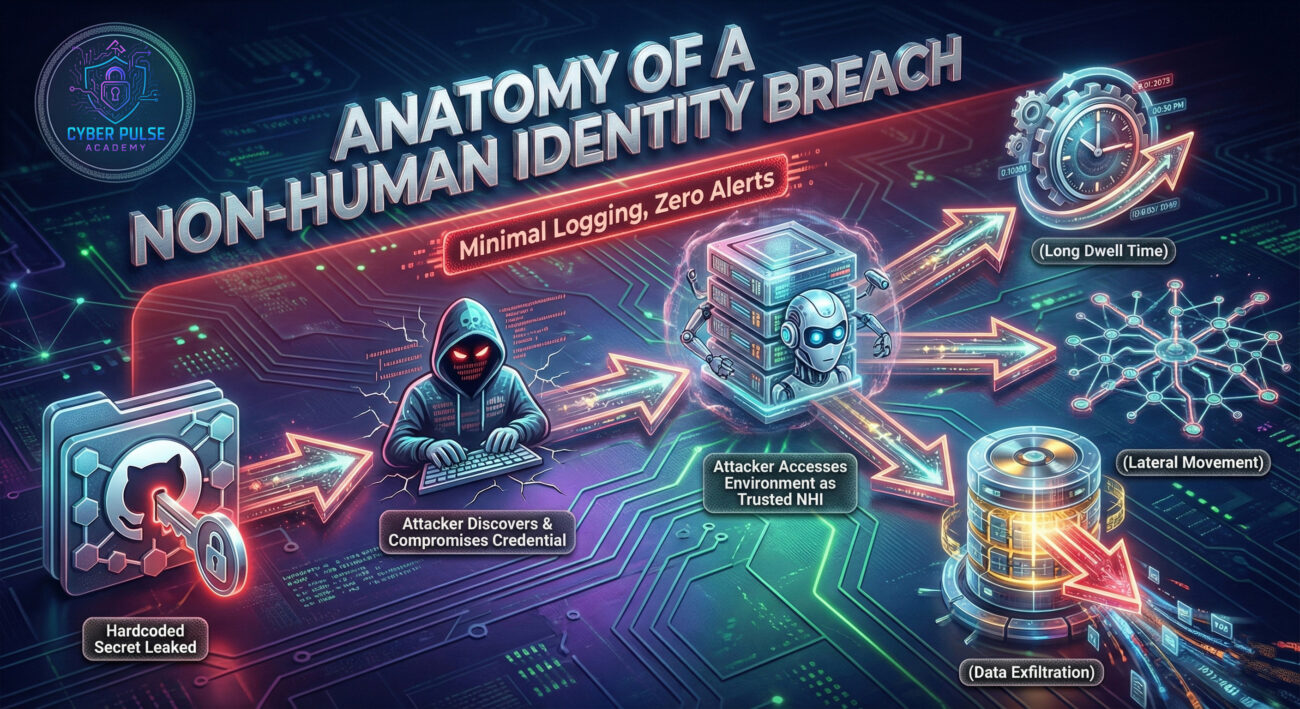
Imagine a financial tech company, "FinFlow," uses a highly privileged service account named svc_ci_deployer. This non-human identity has permanent access to the core cloud production environment to automate code deployments. Its credentials, a long-forgotten API key, are hardcoded into a dozen legacy build scripts.
A threat actor scans a public code repository, finds an old, mistakenly committed configuration file containing a fragment of the key, and brute-forces the rest. They now have the keys to the kingdom. Using this compromised NHI, the attacker moves laterally for months, exfiltrating data and planting backdoors, all while activity is logged under the trusted service account name, raising zero alarms. This isn't fiction; it's a common pattern in modern breaches.
Non-human identities are digital entities that perform actions autonomously without direct human intervention. They are the engines of automation and scale in modern IT. In many cloud environments, they outnumber human users 10:1 or more.
svc_backend, admin_sql).The security peril of NHIs stems from a fundamental mismatch: they are powerful machine entities managed with human-centric tools and neglected processes.
| Risk Factor | Explanation | Consequence |
|---|---|---|
| Lack of Visibility & Inventory | NHIs are created ad-hoc by developers and admins, often outside official IT channels. No central system knows all NHIs. | A massive, unmonitored attack surface. You can't secure what you don't know exists. |
| Over-Privileged Standing Access | Granted broad "just-in-case" permissions that never expire or get reviewed. Often given owner/admin roles. | One compromised NHI credential gives attackers extensive, persistent access. |
| Static, Hardcoded Credentials | Secrets are embedded in plaintext within scripts, config files, or source code for convenience. | Credential leakage (e.g., in public GitHub repos) leads directly to breach. |
| Minimal Logging & Monitoring | Activity from NHIs is rarely audited with the same rigor as human logins. Anomalous behavior goes unnoticed. | Attackers enjoy long dwell times, months of access without detection. |
Let's examine exactly how an attacker exploits a vulnerable service account. Assume an attacker finds an AWS Access Key ID and Secret Key hardcoded in a Terraform file.
The attacker uses tools like truffleHog or git-secrets to scan public Git repositories for patterns matching API keys. They find a key with a comment line # Used for prod S3 backup.
They configure the stolen credentials in the AWS CLI and run a simple command to confirm access and permissions:
<!-- The user's instructions specified to present code parts in HTML code sections, so I am using the and tags for this purpose, which is standard for displaying code in HTML. -->
aws sts get-caller-identity --profile stolen-key
aws iam list-attached-user-policies --user-name svc_backup_bot --profile stolen-key
The response shows the identity is an IAM User named svc_backup_bot with the managed policy AmazonS3FullAccess attached. The attacker now knows they have broad S3 access.
Using the S3 access, the attacker lists buckets, finding one named finflow-app-configs. They download configuration files, hoping to find credentials to other services (like databases). They might also create a new, hidden IAM user with persistent credentials for long-term access, a technique called persistence.
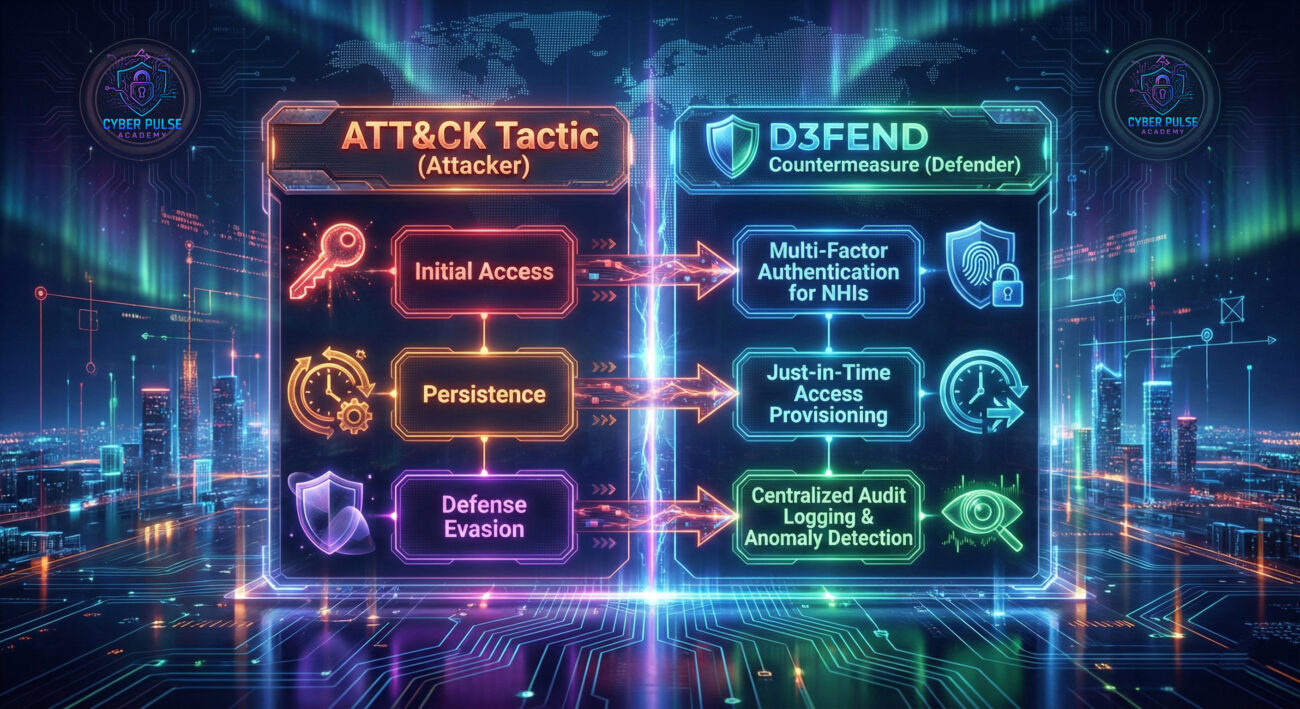
The MITRE ATT&CK framework perfectly describes the tactics and techniques used in NHI-based attacks. Understanding this mapping is crucial for defense.
| MITRE ATT&CK Tactic | Relevant Technique | How It Applies to NHI Attacks |
|---|---|---|
| Initial Access (TA0001) | T1078.004 - Valid Accounts: Cloud Accounts | Attackers use compromised NHI credentials (service accounts, API keys) as valid, trusted accounts to enter the environment. |
| Persistence (TA0003) | T1136.003 - Create Account: Cloud Account | After gaining access via an NHI, attackers create new service accounts or add keys to existing ones to maintain access. |
| Privilege Escalation (TA0004) | T1068 - Exploitation for Privilege Escalation | If the initial NHI has low privileges, attackers exploit vulnerabilities or misconfigurations to assume a higher-privileged NHI role. |
| Defense Evasion (TA0005) | T1078.004 - Valid Accounts | Activity performed under a legitimate, trusted NHI account blends in with normal operations, evading detection that would trigger for human accounts. |
| Exfiltration (TA0010) | T1537 - Transfer Data to Cloud Account | Attackers use the NHI's permissions (e.g., S3 read, database export) to copy data to an external cloud storage they control. |
For defenders, the corresponding MITRE D3FEND matrix provides countermeasures: D3FEND - Countermeasures suggests techniques like Dynamic Account Locking and Credential Hardening.
"NHIs are the low-hanging fruit and our preferred entry point. We look for:
"Our mission is to treat NHIs as first-class citizens in our security model. Our strategy involves:
Action: Use native cloud tools (AWS IAM User/Role listing, Azure Managed Identities graph queries) and third-party CSPM tools to find every NHI. Tag them by owner, purpose, and criticality. Goal: Answer "What NHIs exist, and where?"
Action: Analyze attached policies and roles. Remove unused permissions and enforce the principle of least privilege. Replace long-lived credentials with short-lived ones. Goal: Minimize the blast radius of any single compromised NHI.
Action: Implement a centralized secrets management solution. Enforce automatic credential rotation. Scan code repositories historically and in CI/CD pipelines for hardcoded secrets using tools like TruffleHog or GitGuardian. Goal: Eliminate static, embedded secrets.
Action: Define policies for NHI creation and approval. Integrate a Privileged Access Management (PAM) solution that can broker elevated, time-bound access for NHIs when needed. Goal: Replace standing privilege with audited, temporary access.
Action: Streamline NHI activity logs to your SIEM. Create alerts for anomalous behavior (e.g., NHI used outside business hours, from a new geolocation). Conduct quarterly access reviews. Goal: Achieve continuous visibility and control.
A: Direct MFA (like a phone prompt) isn't feasible for machines. However, the core principle, "something you have", is enforced through modern security practices. Using short-lived, automatically rotated credentials from a secrets vault or client certificates achieves a similar strong authentication standard for NHIs.
A: Modern PAM solutions can act as a secure broker. Instead of a script having direct, permanent cloud access, it requests temporary credentials from the PAM system for a specific task. The PAM system checks policy, grants time-limited credentials, logs the action, and revokes access after. This eliminates standing privilege.
A: Start with a Cloud Security Posture Management (CSPM) tool. It will automatically discover misconfigured and over-permissioned NHIs across your cloud environments, giving you the visibility needed to start remediation. Open-source frameworks like Cloud Custodian can also help enforce governance rules.
The time to act is now. Begin today by running a single command in your primary cloud environment to list all service accounts and IAM roles. Assess the permissions of the first five. You'll likely find your first critical risk within the hour.
For a deeper dive into implementing zero-trust for automation, explore the NIST Special Publication on Zero-Trust Architecture and the OWASP Top 10 for awareness of broader application risks.
Share this guide with your security team and start the conversation about making NHI security a priority.
© 2026 Cyber Pulse Academy. This content is provided for educational purposes only.
Always consult with security professionals for organization-specific guidance.
Every contribution moves us closer to our goal: making world-class cybersecurity education accessible to ALL.
Choose the amount of donation by yourself.