




Certification Courses
Hands-On Labs
Threat Intelligence
Latest Cyber News
MITRE ATT&CK Breakdown
All Cyber Keywords
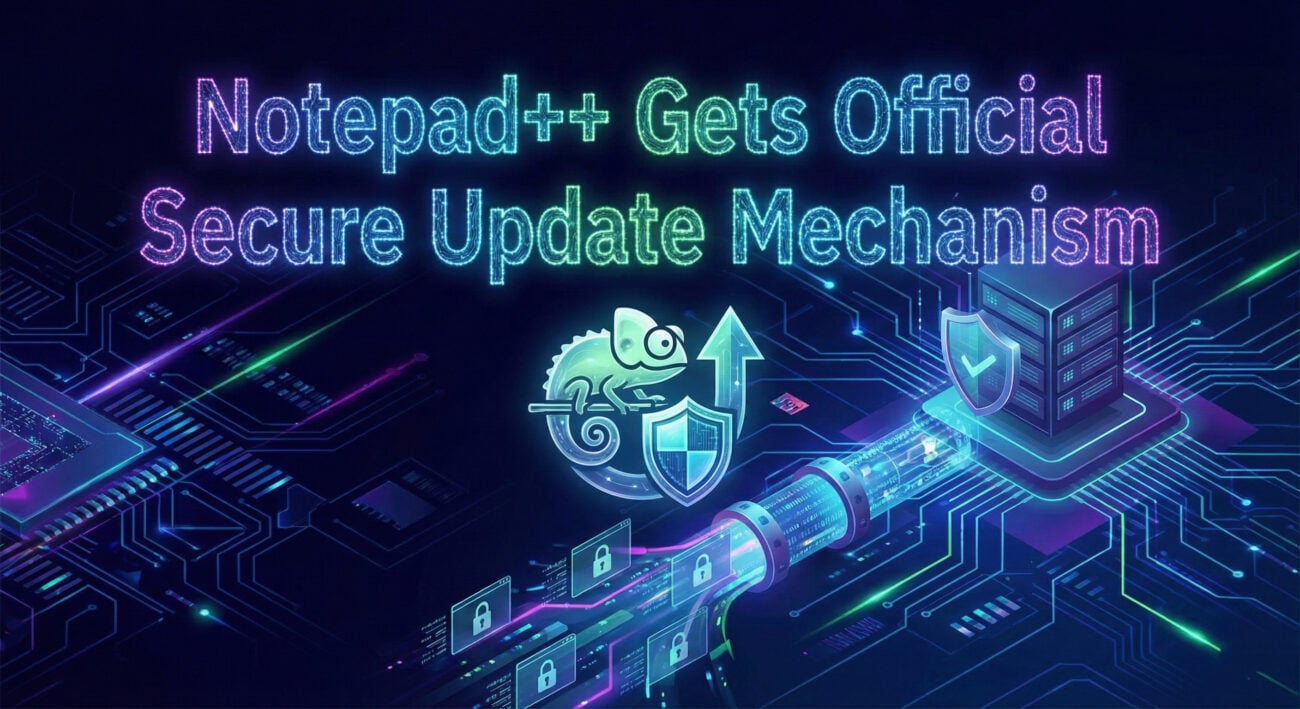
In February 2026, the maintainer of Notepad++ disclosed a sophisticated supply chain attack where the official update mechanism was hijacked to deliver malware to selected users. This attack leveraged an infrastructure-level compromise at the hosting provider, not a vulnerability in Notepad++ code. The updater (WinGUp) was tricked into downloading malicious binaries due to weak integrity verification. Attributed to Violet Typhoon (APT31), the attack targeted East Asian telecom and financial sectors. This post dissects the attack from a beginner-friendly perspective, maps it to MITRE ATT&CK, and provides actionable defenses.
Focus keyword: This Notepad++ update hijack serves as a critical case study in software supply chain security.
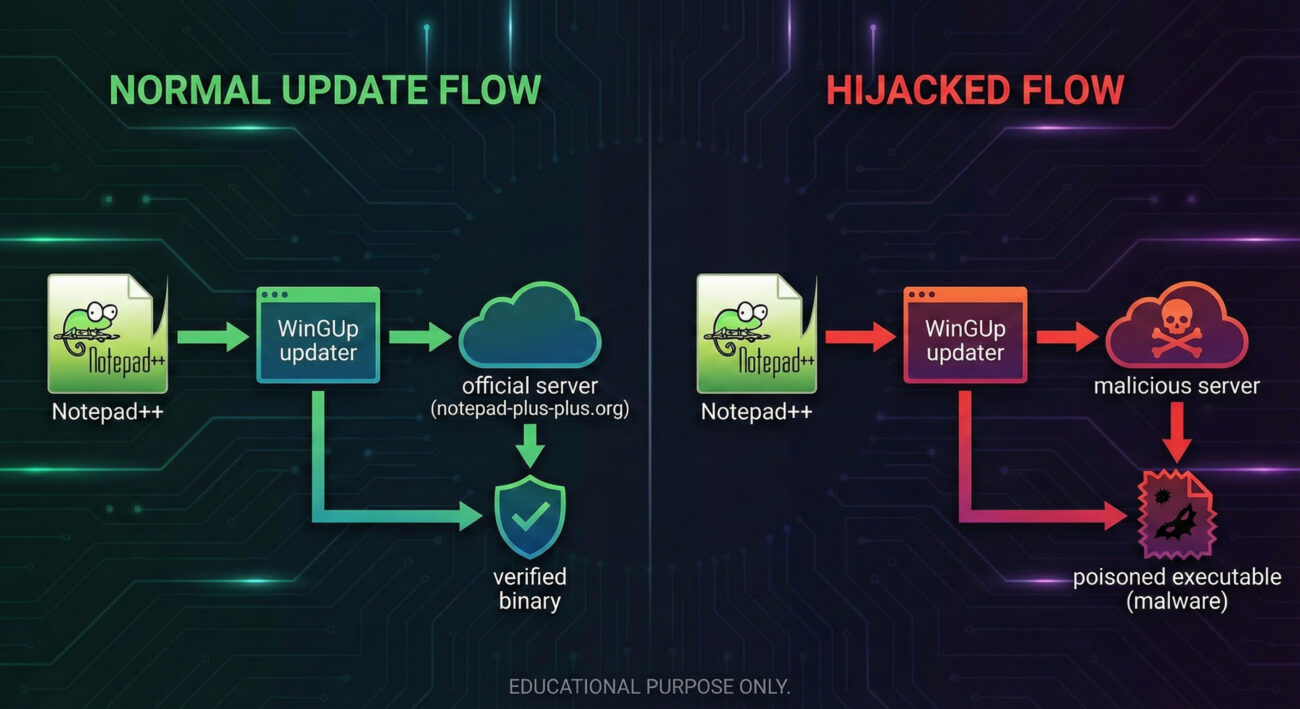
The attack exploited the trust relationship between the Notepad++ application and its update server. Here’s how it unfolded technically:
notepad-plus-plus.org to malicious servers.Below is the mapping to MITRE ATT&CK techniques (v14):
| Tactic | Technique ID | Technique Name | Context |
|---|---|---|---|
| Initial Access | T1195.001 | Supply Chain Compromise: Compromise Software Dependencies | Update mechanism hijacked at infrastructure level |
| Initial Access | T1190 | Exploit Public-Facing Application | Likely exploitation of hosting provider vulnerabilities |
| Command and Control | T1071.001 | Application Layer Protocol: Web Protocols | Malicious servers communicated via HTTPS to deliver payloads |
| Credential Access | T1557 | Adversary-in-the-Middle | Intercepted update traffic to inject malicious binaries |
According to researcher Kevin Beaumont, the attack was highly targeted. The threat actor Violet Typhoon (APT31), a Chinese state-sponsored group, focused on:
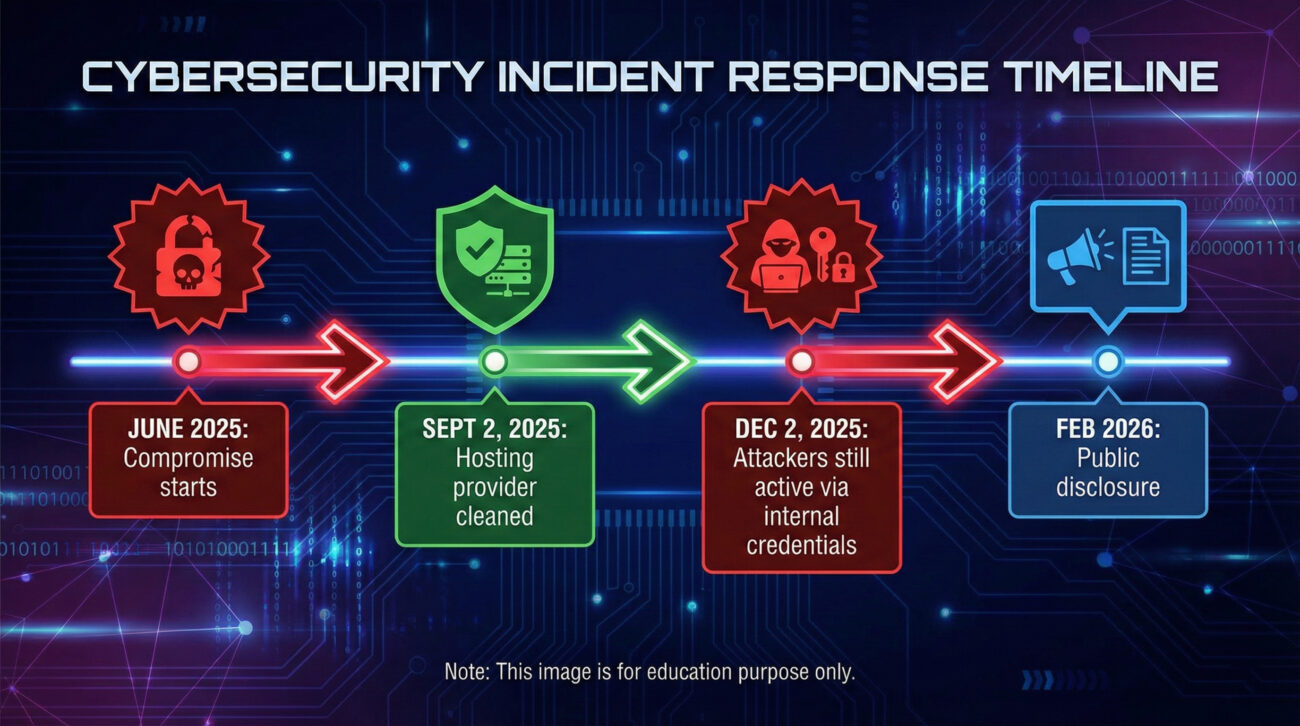
The compromise lasted from June 2025 until discovery in February 2026, even after the hosting provider was cleaned in September 2025, attackers maintained access to internal services until December 2025, allowing continued redirection.
How did the Notepad++ update hijack actually work? Follow these steps:
Attackers breached the hosting provider serving notepad-plus-plus.org. They gained control over DNS settings or web server configurations to redirect update traffic.
When a Notepad++ user in a targeted region triggered an update check, the request was sent to a malicious server instead of the legitimate one. This was done by altering DNS responses or through a reverse proxy at the hosting level.
WinGUp downloaded what it believed was an update. The updater only performed a simple hash check (likely MD5) which could be easily spoofed by the attacker. No digital signature verification was enforced.
Users received a trojanized Notepad++ installer that installed backdoors, enabling persistence and lateral movement within target networks.
Even after the hosting provider removed the attackers from the server in September 2025, they retained credentials to internal services until December, continuing to redirect traffic.
What went wrong, and how can we defend against similar attacks?
Based on the Notepad++ update hijack, here’s a framework for developers and security teams to harden software update processes:
Q: Was Notepad++ itself vulnerable?
A: No. The attack occurred at the infrastructure level (hosting provider), not in Notepad++ code.
Q: How many users were affected?
A: The attack was highly targeted; only users in specific East Asian organizations (telecom/finance) were redirected.
Q: How can I check if I was affected?
A: Look for unexpected Notepad++ updates installed between June 2025 and February 2026. Verify hashes against official announcements. Use endpoint detection tools to scan for known APT31 indicators.
Q: What should developers learn from this?
A: Never trust the transport layer alone; implement defense-in-depth for updates: code signing, certificate pinning, and integrity validation.
Don’t wait for the next update hijack. Audit your update mechanisms, implement code signing, and educate your team. For a deep dive into supply chain security, explore our free resources or book a consultation.
Download Supply Chain Security Checklist
Already using Notepad++? Verify your version and learn more from official Notepad++ site and the MITRE ATT&CK database.
📚 Further reading: Original Hacker News report | APT31 (Violet Typhoon) on MITRE | CISA supply chain guidance | Binary transparency explained | MitM attack defense
© Cyber Pulse Academy. This content is provided for educational purposes only.
Always consult with security professionals for organization-specific guidance.
Every contribution moves us closer to our goal: making world-class cybersecurity education accessible to ALL.
Choose the amount of donation by yourself.