


















































Certification Courses
Hands-On Labs
Threat Intelligence
Latest Cyber News
MITRE ATT&CK Breakdown
All Cyber Keywords
Have you ever wondered why, despite having antivirus software, data breaches and sophisticated online scams seem to be skyrocketing? The answer often points not to a lone teenage hacker in a basement, but to a highly structured, well-funded, and global organized crime syndicate.
Organized cyber crime refers to illegal online activities conducted by structured groups that operate like businesses, with hierarchies, specialized roles, and profit-driven goals. Unlike random hackers, these groups are persistent, strategic, and frighteningly efficient.
Think of it this way: A pickpocket is a threat, but a coordinated syndicate that runs a full-scale identity theft ring, complete with scouts, forgers, and money launderers, is a completely different level of danger. That's the shift we've seen online. In this guide, you'll learn how these digital cartels operate, why your data is valuable to them, and most importantly, the simple yet powerful steps you can take to stop being an easy target.
The scale of modern organized crime online is staggering. It's estimated that cybercrime will cost the world $9.5 trillion USD in 2024, much of it driven by sophisticated criminal organizations. These aren't just kids; they are often groups with attackers specializing in malware creation, others in phishing campaigns, and others in laundering stolen cryptocurrency.
A recent report by the FBI's Internet Crime Complaint Center (IC3) shows record-breaking losses, fueled largely by business email compromise and ransomware, hallmarks of organized groups. These criminals leverage the same tools legitimate businesses do: customer service platforms, software subscriptions, and even professional development.
For you, this means the phishing email in your inbox or the malware on a fake website is likely the result of a well-planned operation with a high chance of success. Your personal information, from login credentials to saved payment details, is a commodity in a bustling digital black market. Understanding this shift from chaotic to corporate crime is the first step in building effective defenses.
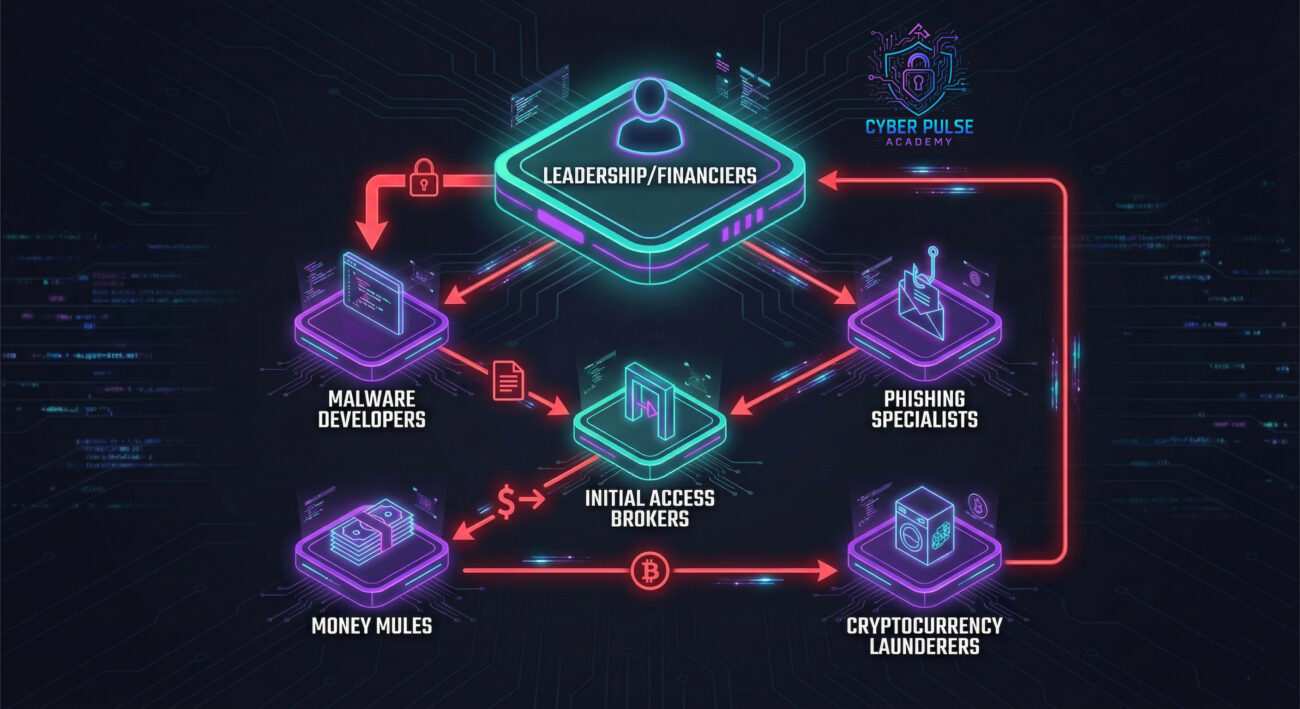
Let's break down the jargon. Here are the essential terms you need to understand the ecosystem of organized cyber crime.
| Term | Simple Definition | Everyday Analogy |
|---|---|---|
| Ransomware-as-a-Service (RaaS) | A criminal business model where developers create and license ransomware tools to "affiliates" who carry out attacks, sharing the profits. | Like a franchised pizza shop. The franchisor (developer) provides the recipe and tools (malware), and the franchisee (affiliate) runs the local shop (attacks targets), sending a cut of the profits back. |
| Initial Access Broker (IAB) | A hacker or group that specializes in breaking into networks and then sells that access to other criminals, often ransomware groups. | A house burglar who doesn't steal anything themselves but sells the address and a copy of your house key to the highest bidder on a dark web marketplace. |
| Money Mule | An individual, sometimes unwittingly recruited, who transfers illegally acquired money on behalf of criminals, obscuring the money trail. | Someone asked to receive a "parcel" (stolen funds) and forward it to another address (criminal's account), taking a small fee, acting as a middleman in a smuggling operation. |
| Botnet | A network of private computers infected with malicious software and controlled as a group without the owners' knowledge, often used for large-scale attacks. | A criminal army of remote-controlled zombie robots (your computer and millions of others) used to overwhelm a target, like sending a tidal wave of spam or requests. |
| Cryptocurrency Mixer/Tumbler | A service used to obscure the source of cryptocurrency funds by pooling and scrambling them with others, making transactions harder to trace. | Taking stolen cash to a currency exchange that mixes it with legitimate money from tourists, then giving you back different bills in another currency to confuse detectives. |
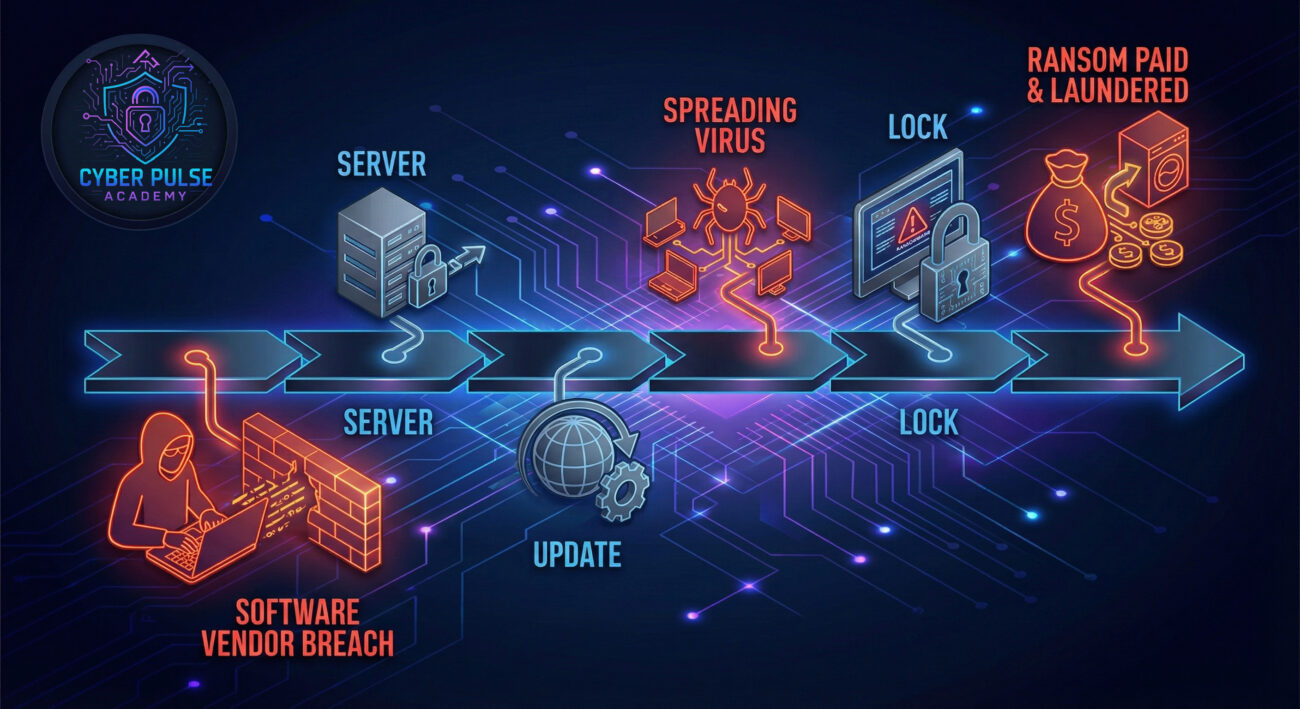
Let's follow "Maria," the office manager at a small accounting firm. Her firm uses a popular, legitimate project management software.
An organized crime group, specializing in supply chain attacks, breaches the software company's update server. They slip malicious code into a legitimate software update. Maria's computer automatically installs this tainted update, believing it to be secure. The malware now inside her system is a "backdoor," giving the criminals remote access.
The group doesn't act immediately. They quietly explore the firm's network for weeks, identifying the most valuable data: client financial records and tax documents. They then deploy ransomware, encrypting every file. Maria sees a screen demanding 10 Bitcoin ($500,000+) to restore access. The firm, unable to operate and fearing client data exposure, feels forced to pay. The funds are routed through money mules and a cryptocurrency mixer, eventually funding more criminal enterprises.
| Time/Stage | What Happened (The Attack) | Impact & Consequence |
|---|---|---|
| Months Before | Criminal group researches and breaches the software vendor. | Vendor's reputation is compromised. A trusted tool becomes a vulnerability for thousands. |
| Update Day | Maria's firm automatically installs the poisoned update. The malware gains a foothold. | Every client using that software is now potentially infected. Traditional antivirus may not flag it. |
| The Silent Period | Criminals map the network, steal data backups, and identify critical servers. | Massive data breach occurs silently. The firm's digital blueprint is stolen. |
| Attack Day | Ransomware is deployed. All files are encrypted by the criminals. | Business operations halt completely. Client data is held hostage. Financial and legal crisis begins. |
| Aftermath | Firm faces impossible choice: pay the ransom (funding crime) or attempt a costly, lengthy recovery. | Financial loss, reputational damage, potential regulatory fines, and loss of client trust. |
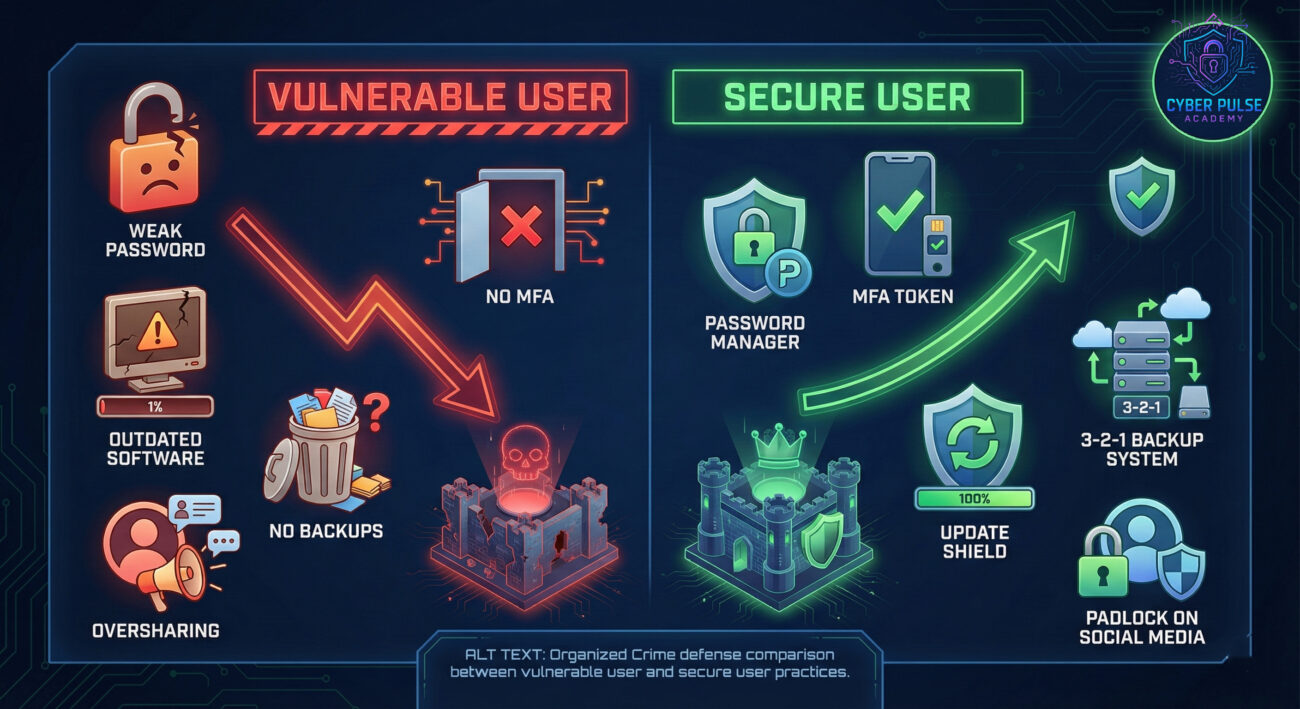
You are not powerless. While the threat is sophisticated, your defense can be straightforward and highly effective. Here is your step-by-step action plan.
This is your first and most critical line of defense.
Cybercriminals exploit known holes. Closing them is simple.
Social engineering is a favorite tool of organized crime.
This is your "undo button" for ransomware. If you have secure, offline backups, you cannot be extorted.
Think of this as your digital immune system.
A criminal group first looks for the path of least resistance. They scan the internet for servers running outdated, vulnerable versions of common software (like a company's VPN gateway or a website plugin). Using automated tools, they exploit this known flaw to gain a foothold. Once inside a single server, they don't rush. They quietly move sideways through the network, searching for higher-value targets, like the server that holds backups or financial data. Their goal is to maximize impact and leverage before triggering the ransomware or stealing data.
The defender's mindset is about shrinking this "attack surface." They rigorously apply software patches, especially for internet-facing systems. They segment their network, so a breach in the guest Wi-Fi zone cannot easily reach the accounting department's servers. They also deploy intrusion detection systems that look for unusual internal movement, like a server suddenly trying to communicate with every other computer on the network, a classic sign of an attacker "exploring." The key is not just building walls, but monitoring the space between them.
For an organized crime group, this is a business operation focused on ROI (Return on Investment). They care about efficiency, scale, and risk management. They prefer automated, weaponized exploits over custom attacks. Their goal is persistent access to monetizable assets (data, computing power, financial systems) with the lowest possible chance of detection. They view users as potential weak links and unpatched software as unlocked doors. Time is money, so they will abandon a well-protected target for an easier one.
The defender's mission is risk reduction and resilience. They assume determined adversaries will get in, so they focus on protected critical assets, detecting anomalous activity quickly, and having reliable recovery plans. They care about asset inventory (what needs protection), vulnerability management (closing doors), and user education (eliminating weak links). Their success is measured by minimizing "dwell time" (how long an attacker goes undetected) and ensuring business continuity, even after an incident.
The nature of cyber threats has evolved. The greatest danger today often comes from highly structured organized crime groups that treat hacking like a profitable business. While this sounds intimidating, your defense strategy doesn't need to be complex.
By understanding the organized, business-like nature of the threat, you can move from fear to focused action. Start with one step from the guide today, enable MFA on your primary email account. You've just made yourself exponentially more secure against one of the world's most dangerous organized crime threats.
Did you find this guide helpful? What step will you implement first? Do you have questions about a specific scenario? Share your thoughts and questions in the comments below. Let's build a more secure community together.
Every contribution moves us closer to our goal: making world-class cybersecurity education accessible to ALL.
Choose the amount of donation by yourself.