

































Certification Courses
Hands-On Labs
Threat Intelligence
Latest Cyber News
MITRE ATT&CK Breakdown
All Cyber Keywords
Ever wonder how the world's most secure organizations stay ahead of hackers? They don't just build walls and hope for the best. They hire ethical hackers to break in first. This is the world of the Red Team.
A Red Team is a group of authorized cybersecurity professionals who simulate real-world attacks on an organization to test its defenses. Think of them as the ultimate "friendly enemy" – a skilled group of penetration testers and social engineers whose sole mission is to find vulnerabilities before the bad guys do.
In this guide, you'll learn what a Red Team actually does, why it's the most proactive defense a company can have, and how their secretive work makes everything from your online banking to your email more secure.
In a digital world where data breaches make headlines daily, waiting for an attack to happen is a recipe for disaster. The Red Team philosophy is simple: "The best way to defend is to understand how to attack." According to a report by IBM, the average cost of a data breach in 2023 was $4.45 million. Organizations with high levels of security testing and simulation, like Red Teaming, saved nearly $1.5 million on average.
For a beginner, imagine your home's security. You could install strong locks (firewalls) and an alarm (intrusion detection). But how do you *really* know it's safe? You could hire a former burglar to try every trick, checking for unlocked windows, distracting you at the door, copying a key, to show you exactly where you're weak. That's a Red Team.
They move beyond automated scans, thinking like a determined adversary to uncover complex vulnerabilities that blend technical flaws with human error. This proactive approach is why governments, financial institutions, and tech giants all rely on Red Teams to stay protected.
Let's break down the jargon. Here are the essential terms you need to understand the Red Team universe.
| Term | Simple Definition | Everyday Analogy |
|---|---|---|
| Red Team | The ethical attacking force. A group that simulates real-world cyber attacks to test an organization's detection and response capabilities. | A team of friendly spies hired to try to steal your company's "crown jewels" to show you how it could be done. |
| Blue Team | The internal defenders. The security staff responsible for monitoring, detecting, and responding to incidents. | The castle guards and security officers, watching cameras and patrolling walls. |
| Penetration Test (Pen Test) | A targeted, time-boxed test of specific systems for vulnerabilities. | A locksmith testing the strength of your front door lock. Focused and technical. |
| Social Engineering | Manipulating people into revealing confidential information or performing actions that compromise security. | A con artist pretending to be from IT support to trick you into giving them your password. |
| Advanced Persistent Threat (APT) | A sophisticated, long-term cyber attack where an intruder remains undetected in a network for an extended period. | A spy who moves into your office building, slowly learns routines, and steals secrets over months without being seen. |
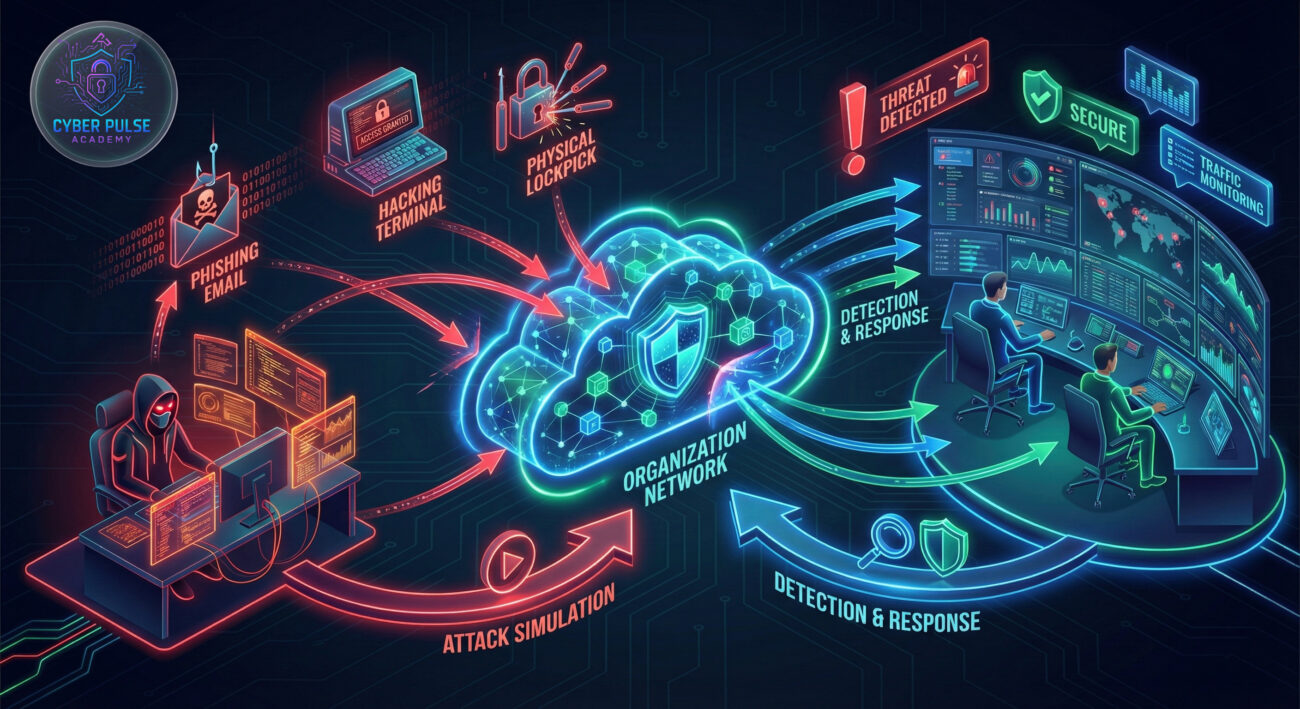
Let's follow "Alex," a Red Team lead hired by "FinTrust Bank." The goal: Can Alex's team steal simulated customer data without getting caught by FinTrust's Blue Team?
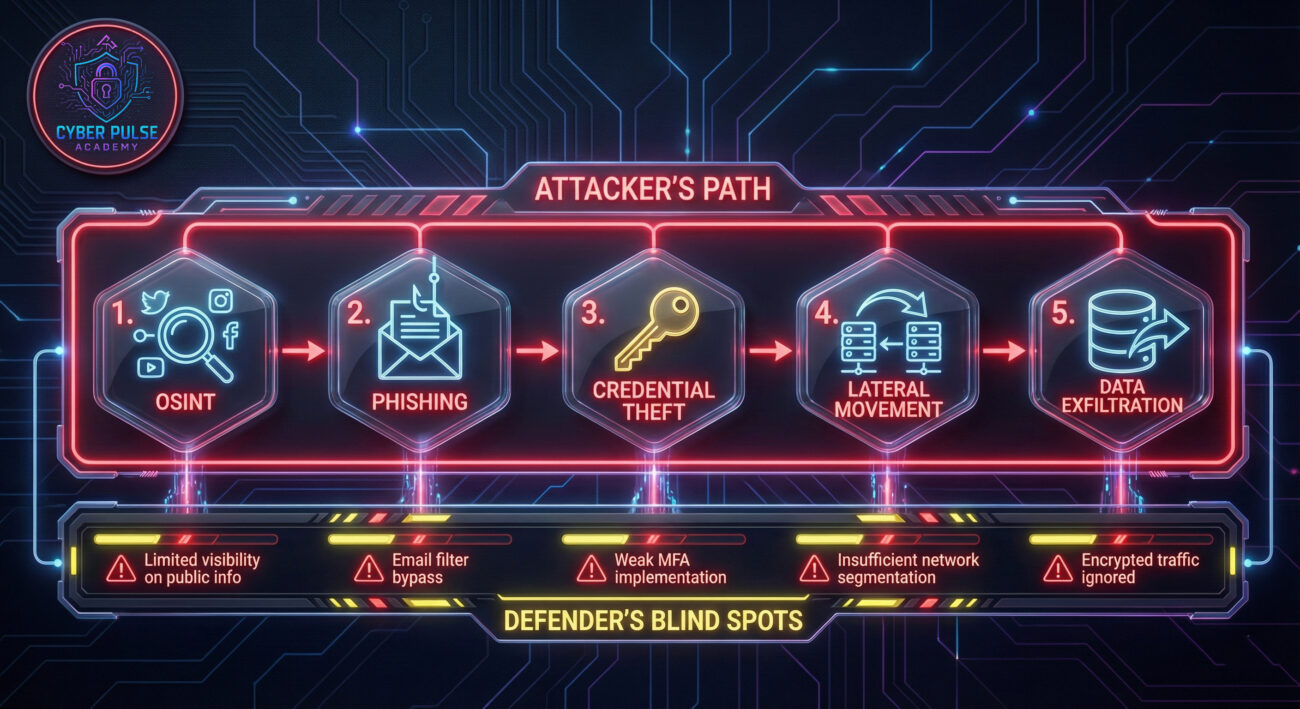
The Story: Alex doesn't start with code. She starts with Open-Source Intelligence (OSINT). Her team scours LinkedIn, finding an IT administrator at FinTrust who posts about his work projects (a mistake). They craft a phishing email posing as a vendor for a software he mentioned. The email contains a link to a fake login page.
The admin, busy and expecting the update, enters his credentials. Now, the Red Team has a foothold. They use these credentials to access a low-level internal system. From there, they look for misconfigured servers, eventually finding one that allows them to move laterally to a database server containing the target data.
| Time / Stage | What Happened (Red Team Action) | Impact & Blue Team Reality Check |
|---|---|---|
| Week 1: Recon | OSINT gathering, identifying potential targets like our admin on social media. | Blue Team unaware. No alerts, as this activity happens on public websites. |
| Day 1: Initial Foothold | Spear phishing email sent. Admin credentials stolen. | Email filter flagged it as suspicious, but it wasn't blocked. No one reported the phishing attempt. |
| Day 2: Internal Movement | Using stolen creds to access internal network, searching for vulnerable systems. | Unusual login time (night) generated a single alert, but it was auto-closed as "false positive." |
| Day 3: Goal Achieved | Critical database accessed. Simulated customer data exfiltrated. | Large data transfer detected only after the exercise was called. Blue Team was completely bypassed. |
This scenario, while simplified, is terrifyingly common. It highlights that technology alone isn't enough. The human element and detection gaps are what a Red Team expertly exploits, providing a priceless lesson for the Blue Team.
A Red Team exercise is a meticulous, multi-stage operation. Here’s how it works, step by step.
This is the planning phase. The Red Team and the client agree on the "rules of the game."
The team gathers information without touching the target's systems.
This is the first "break-in." The goal is to get any access inside the network.
"You're in, but you're nobody." Now they move from the initial point of entry to more valuable systems.
The final act: taking the target data and documenting everything.
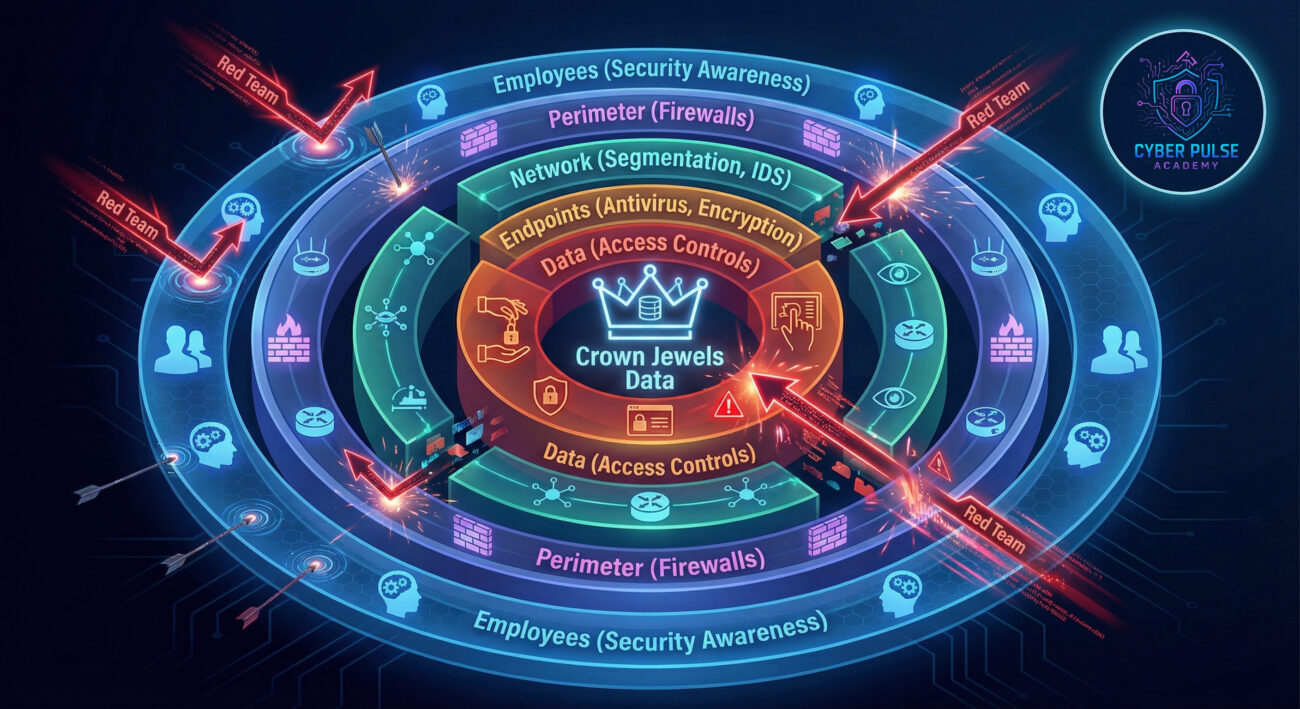
Let's think like a Red Teamer for a moment. Their job isn't to use the loudest tool, but the most effective one that won't get caught.
One Simple Attack Path: Instead of hacking a firewall, they might target the company's forgotten "shadow IT", like a cloud storage bucket an employee set up for a project and never secured. By searching for the company's name on public cloud platforms, they might find this bucket wide open, containing sensitive documents or even credentials to the main network. The vulnerability wasn't in the high-tech defense; it was in an unmanaged, overlooked asset.
The Defender’s Counter-Move (Blue Team): A savvy defender doesn't just look inward. They proactively hunt for their own organization's digital footprint outside the firewall. This involves using the same OSINT tools as the attacker to discover forgotten domains, exposed cloud storage, or leaked employee credentials on the dark web. By continuously monitoring their external attack surface, they can find and close these backdoors before a real attacker does. This shifts the mindset from reactive to proactive hunting.
Understanding both perspectives is key to modern cybersecurity.
Their mission is breach and teach. They care about one thing: achieving their objective (stealing data, causing disruption) by any means allowed within the rules. They think creatively, exploit trust, and chain together small weaknesses to create a major breach. They are measured by their stealth and success in reaching the goal. Their victory is in remaining undetected while proving a point can be made.
Their mission is protect and detect. They care about maintaining secure operations, monitoring logs, analyzing alerts, and responding to incidents. They think in terms of policies, baselines, and anomalies. They are measured by their Mean Time to Detect (MTTD) and Mean Time to Respond (MTTR). Their victory is in spotting the Red Team's activity early, containing it, and learning from it to improve defenses.
Together, they form a continuous feedback loop that makes an organization's security resilient and adaptive.
The world of the Red Team is fascinating because it turns the tables on traditional security. It's about embracing the adversarial mindset to build truly strong defenses.
By understanding the Red Team's role, you've taken a big step into the strategic, human-centric side of cybersecurity. It’s not just about tools, but about thinking differently.
What part of the Red Team process surprised you the most? Are there other cybersecurity roles or concepts you'd like us to break down in simple terms? Share your thoughts or questions below – let's keep the conversation going and build a more secure digital world together.
Ready to take the next step? Explore our beginner's guide to Blue Teaming and SOC Analysis to see the other side of the story.
Every contribution moves us closer to our goal: making world-class cybersecurity education accessible to ALL.
Choose the amount of donation by yourself.