





Certification Courses
Hands-On Labs
Threat Intelligence
Latest Cyber News
MITRE ATT&CK Breakdown
All Cyber Keywords
Have you ever logged into your company's email, then clicked a link to access your project management tool, only to find you're already signed in? That seamless magic, saving you from remembering another password, is often powered by a behind-the-scenes protocol called SAML 2.0.
Security Assertion Markup Language 2.0 (SAML 2.0) is an open standard that allows secure communication between an identity provider (like your company's login portal) and a service provider (like Salesforce, Slack, or Google Workspace) to authenticate users and grant them access.
Think of it like a digital bouncer at a VIP club complex. You show your ID (login) at the main door (your company's portal). The bouncer then gives you a secure, stamped wristband (a SAML assertion). You can then walk into any connected club (web applications) inside the complex without showing your ID again. The wristband proves who you are and what you're allowed to do.
In this guide, you'll learn: what SAML 2.0 really is, why it's critical for modern secure access, how it works step-by-step, common vulnerabilities to watch for, and best practices for implementation.
Remember the last time you had to reset a forgotten password for the tenth time this month? What if you could access dozens of work applications with just one, strong login? That's the promise of Single Sign-On (SSO), and SAML 2.0 is one of the key technologies making it possible. In today's cloud-first world, employees routinely need access to 10+ different web apps. Managing separate logins for each is a security risk (password fatigue leads to weak, reused passwords) and a productivity drain.
SAML 2.0 solves this by creating a trusted handshake between your organization's central user directory and the cloud apps you use. It's the silent protocol working behind your login screen, verifying your identity without constantly shuttling passwords across the internet. By the end of this article, you'll understand not just what SAML 2.0 is, but how it forms the backbone of secure, efficient digital workplaces.
While convenience is a major benefit, the real importance of SAML 2.0 lies in security and control. According to a CISA report, credential-based attacks like phishing and password spraying are among the top initial access methods for cybercriminals. By reducing the number of passwords users need to remember and manage, SSO via SAML 2.0 directly mitigates this risk.
For IT administrators, it provides a central point of control. When an employee leaves, disabling their one central account immediately revokes access to all connected SAML 2.0-enabled applications. This is far more reliable than trying to disable accounts in a dozen different systems. Furthermore, it enables strong authentication methods like Multi-Factor Authentication (MFA) to be enforced once at the identity provider, protecting all downstream apps.
In essence, SAML 2.0 shifts the security perimeter. Instead of each application's login page being a potential attack vector, security is consolidated at a single, fortified identity provider. This standardization, as highlighted by frameworks like the NIST Cybersecurity Framework, is critical for managing identity in complex, hybrid IT environments.
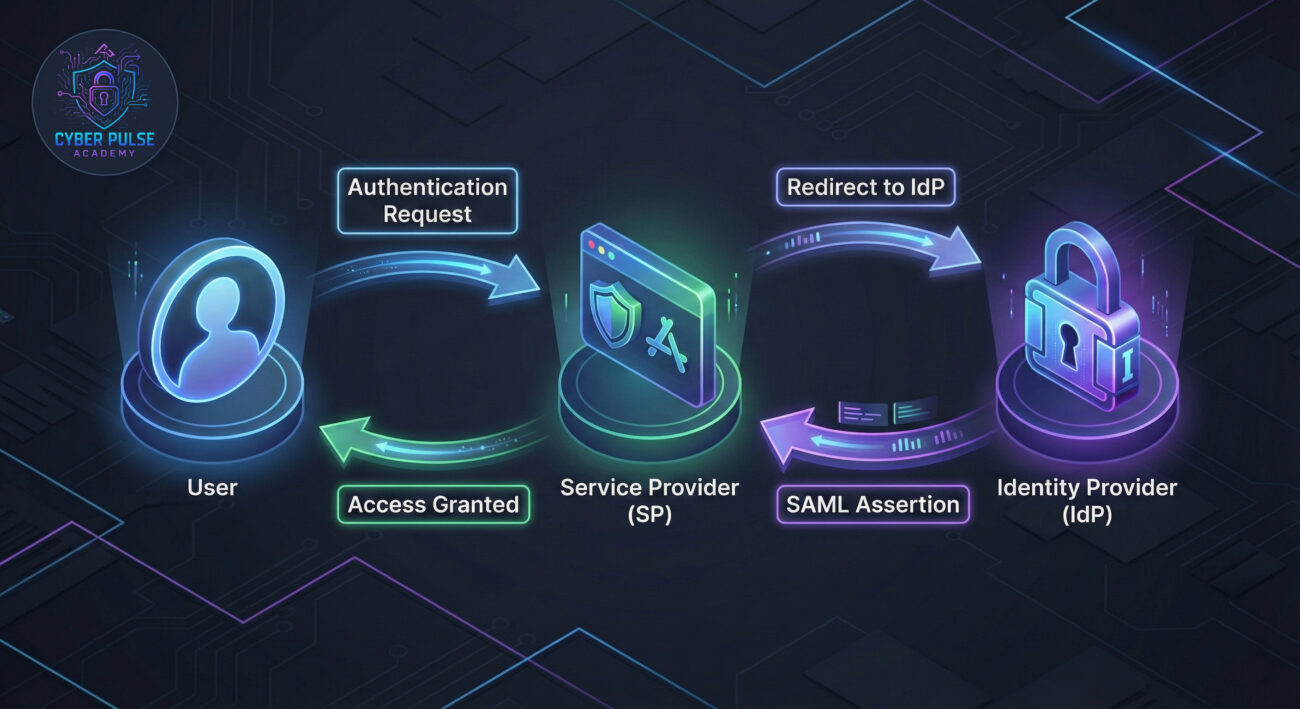
Let's break down the jargon. Understanding these five terms is 80% of understanding SAML 2.0.
| Term | Simple Definition | Everyday Analogy |
|---|---|---|
| Identity Provider (IdP) | The system that holds and verifies user identities (usernames, passwords). | The passport office. It issues the official document that proves who you are. |
| Service Provider (SP) | The application or website the user wants to access (e.g., Salesforce, Slack). | The airport security checkpoint. It needs to see your passport (from the IdP) to let you through. |
| SAML Assertion | The encrypted XML message the IdP sends to the SP, saying "This user is who they claim to be." | The digitally stamped, secure page in your passport. It contains your verified identity data. |
| Trust Relationship | The pre-established, mutual secure agreement between the IdP and SP. | The treaty between countries agreeing to accept each other's passports as valid. |
| Signature Forgery | A type of attack where a bad actor tries to create a fake SAML assertion. | A counterfeiter trying to create a fake passport stamp. The SP must check the signature to spot the fraud. |
Let's follow Alex, a marketing manager at "CyberSafe Inc."
Before SAML Implementation: Alex had separate passwords for email, the CRM, the design tool, and the analytics platform. She reused a variation of one password, a major security risk. When she left the company, IT had to manually disable her account in four different systems, and one was missed for weeks.
After SAML Implementation: Now, Alex goes to cyber-safe-inc.okta.com (the IdP), logs in once with her strong password and MFA. Clicking the Salesforce icon automatically logs her in via SAML 2.0. When her employment ends, IT disables her Okta account, and she instantly loses access to all connected apps.
| Time/Stage | What Happened | Impact |
|---|---|---|
| 9:00 AM | Alex clicks the "Salesforce" tile in her company portal (IdP). | Her browser is redirected to Salesforce (SP) with an authentication request. |
| 9:00:02 AM | Salesforce sees she's not logged in and redirects her back to the company IdP. | The SP and IdP initiate the SAML 2.0 "dance." |
| 9:00:05 AM | Alex enters her credentials (verified) at the IdP. | The IdP creates a digitally signed SAML assertion. |
| 9:00:07 AM | The IdP sends the assertion back to Salesforce. | Salesforce validates the signature (based on the trust relationship) and reads the assertion. |
| 9:00:08 AM | Salesforce sees the valid assertion and logs Alex in. | Alex accesses her data. No separate password needed. Secure and seamless. |
| (Hypothetical Attack) | An attacker tries to send a maliciously crafted SAML response directly to Salesforce. | Salesforce checks the digital signature, finds it invalid or from an untrusted source, and rejects the login attempt. The attack is blocked. |
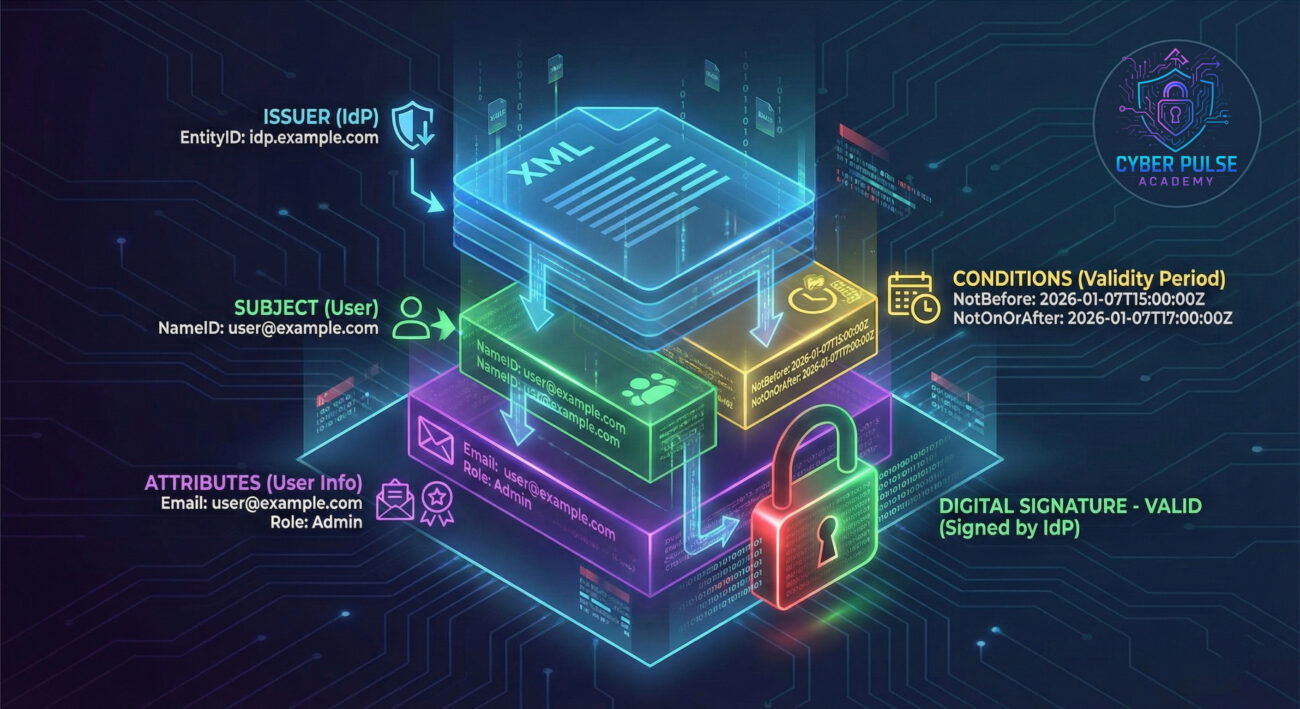
This is your central source of truth for user identities (e.g., Okta, Microsoft Entra ID, PingFederate).
This is the application (like Salesforce, Jira) you want to enable SSO for.
This is the core of SAML: telling the IdP and SP to trust each other.
Define what user information (email, name, groups) the IdP should send to the SP.
Never go live without thorough testing.
A sophisticated attacker doesn't try to guess passwords; they target the SAML 2.0 trust mechanism itself.
One Simple Attack Path (SAML Response Forgery):
One Defender’s Counter-Move (Signature Validation):
The secure SP's defense is automatic and robust. Upon receiving the assertion, it immediately performs a cryptographic check using the IdP's public key (established in the trust relationship). The attacker's modification, no matter how small, breaks the digital signature. The validation fails, the SP rejects the login, logs the attack attempt, and potentially alerts the security team. The defender's mindset is to never trust, always verify the integrity and origin of every single assertion.
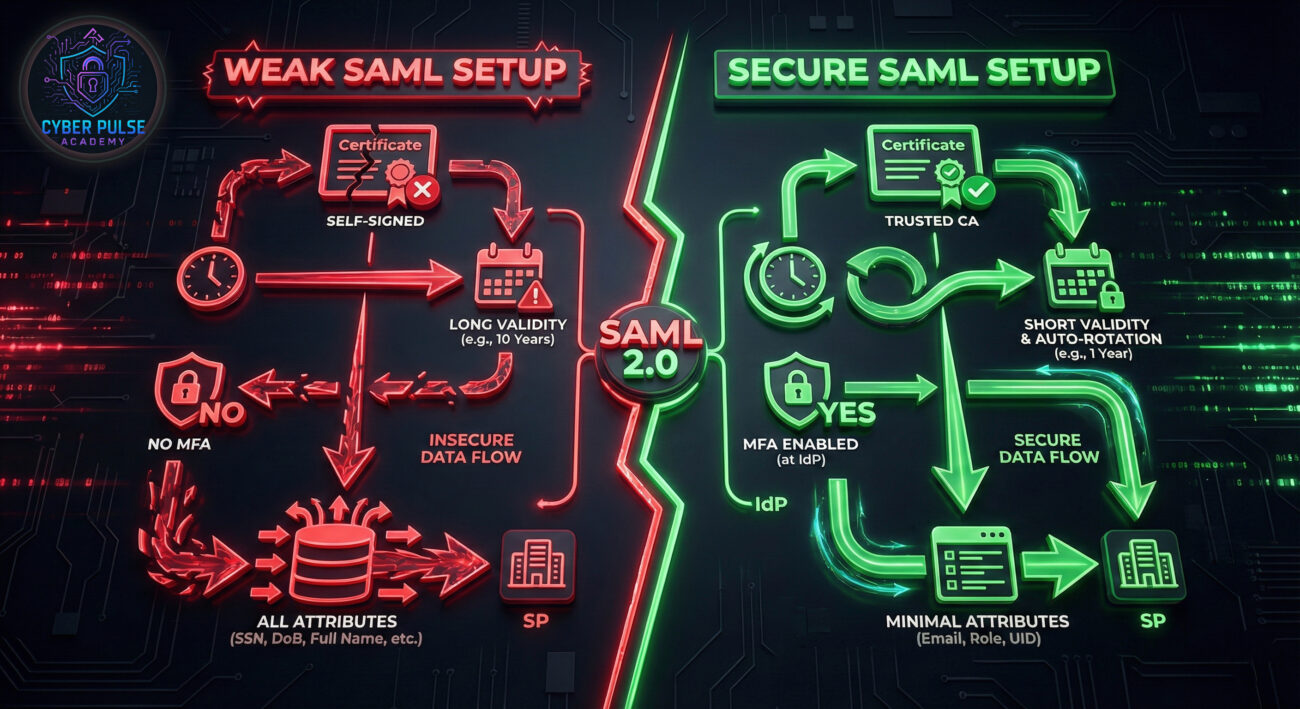
"SAML is a goldmine if it's weakly configured. We look for IdPs with vulnerable libraries (like XML signature wrapping flaws), SPs that don't properly validate signatures or audience restrictions, and metadata files accidentally exposed online. Our goal is to break the chain of trust, forge an assertion, steal a signing certificate, or trick a user into initiating a login to our fake SP. A successful compromise gives us access to all applications connected to that IdP."
"SAML is a force multiplier for security when implemented correctly. We focus on hardening the IdP (MFA, patching), using strong certificates with short lifespans, and ensuring every SP performs strict validation. We monitor logs for failed SAML validations, a spike can indicate an ongoing attack. Our goal is to maintain the integrity of the trust fabric. We care about centralized visibility, rapid user de-provisioning, and making the cryptographic verification process so robust that it's economically unfeasible to attack."
SAML 2.0 is far more than a convenience feature; it's a critical component of modern identity and access management strategy. By understanding its core concepts, you take a major step toward a more secure and manageable digital environment.
Mastering the fundamentals of protocols like SAML 2.0 empowers you to ask the right questions, implement stronger configurations, and build a resilient defense against credential-based attacks.
Has this guide helped demystify SAML 2.0 for you? Do you have experiences (good or challenging) with implementing Single Sign-On? Share your thoughts or questions in the comments below! For more deep dives into cybersecurity fundamentals, explore our guide to Identity and Access Management (IAM).
Every contribution moves us closer to our goal: making world-class cybersecurity education accessible to ALL.
Choose the amount of donation by yourself.