






























Certification Courses
Hands-On Labs
Threat Intelligence
Latest Cyber News
MITRE ATT&CK Breakdown
All Cyber Keywords
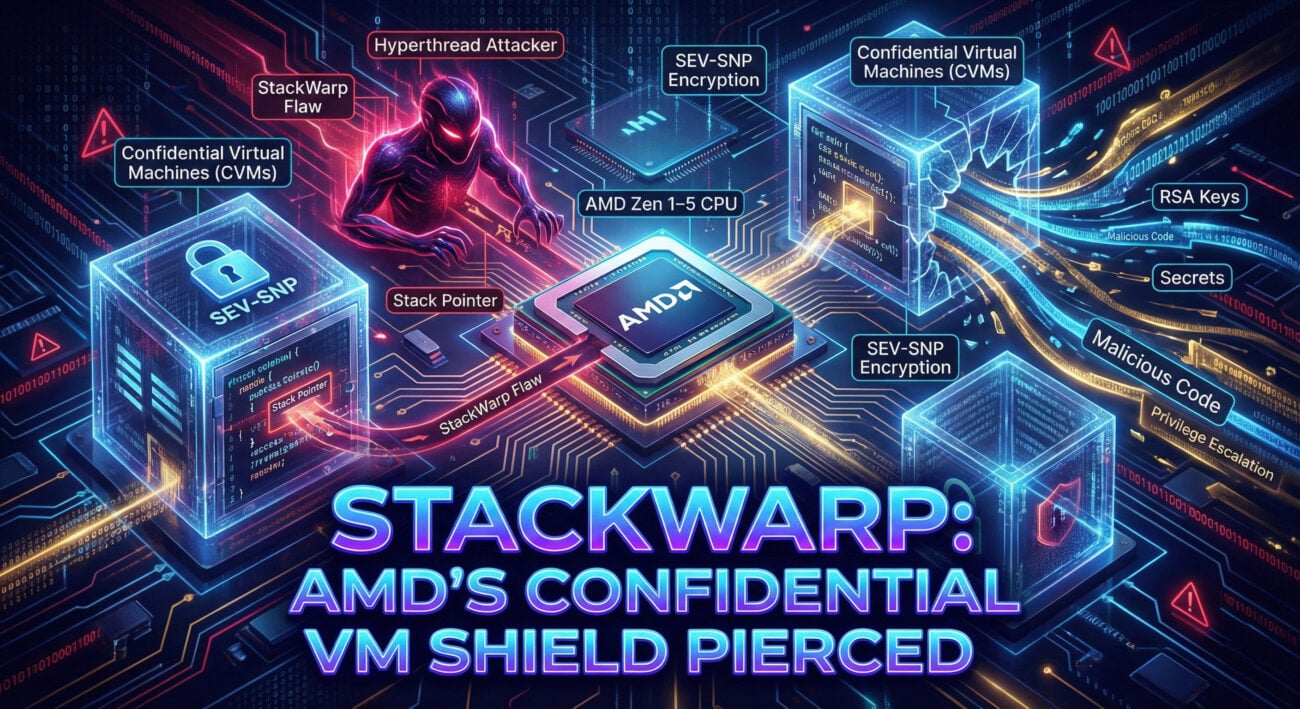
AMD StackWarp hardware vulnerability represents a paradigm shift in processor security threats. Discovered in early 2026 and detailed by security researchers, this hardware-level flaw fundamentally breaks AMD's built-in memory protection mechanisms, creating a new attack surface that bypasses decades of software security advancements. This comprehensive guide explains the technical details in beginner-friendly terms, maps the attack to the MITRE ATT&CK framework, and provides actionable defense strategies for cybersecurity professionals and students.
The StackWarp vulnerability (CVE-2025-XXXX) is a hardware-based flaw affecting multiple generations of AMD processors. Unlike software vulnerabilities that can be patched with updates, this weakness exists in the physical silicon of the CPU, making it permanent and un-patchable through traditional means. The flaw specifically targets AMD's hardware-enforced memory protection mechanisms, which are designed to prevent unauthorized access between different security domains.
At its core, StackWarp allows a threat actor with local access (even with low privileges) to bypass memory isolation and potentially read or write to protected memory regions. This breaks fundamental security assumptions of modern operating systems and virtualization platforms. The vulnerability's name derives from its ability to "warp" or manipulate the hardware stack that manages memory protection keys.
This discovery is particularly significant because it represents a class of hardware vulnerabilities that persist despite software security measures. Organizations relying on AMD processors for secure workloads, cloud infrastructure, or endpoint protection must understand this threat landscape to implement effective compensating controls.
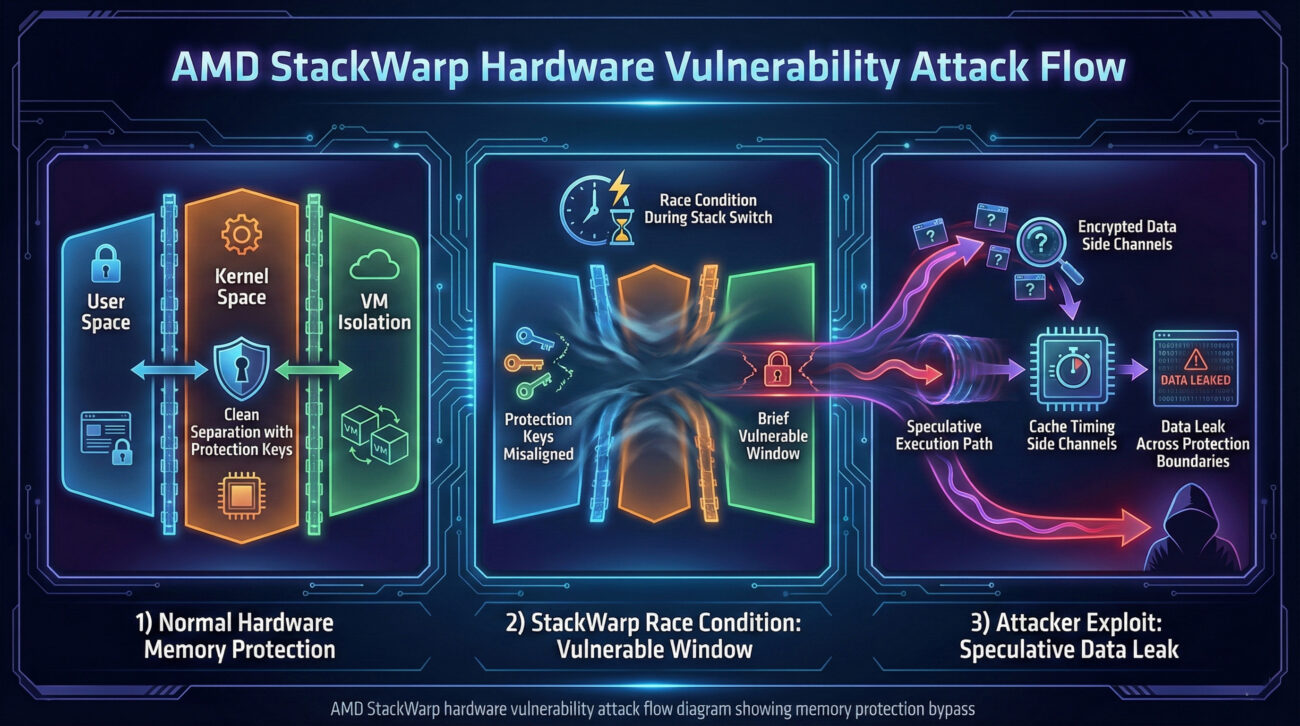
To understand StackWarp, we must first grasp AMD's memory protection architecture. Modern AMD processors implement hardware-enforced memory isolation through features like Memory Protection Keys (MPK) and similar guardrails that separate kernel memory from user memory, and different virtual machines from each other in cloud environments.
The StackWarp attack exploits a race condition and speculative execution side-channel in the processor's memory management unit (MMU). When the CPU switches between different protection domains (like from a user application to the kernel, or between virtual machines), it must update hardware registers that control which memory regions are accessible.
The attacker first runs a process that maps the timing of memory accesses. Using carefully crafted performance counters and cache timing attacks, they probe the hardware to identify the specific behavior of the target AMD processor generation.
The attacker creates multiple threads that simultaneously attempt to access memory with different protection keys while forcing rapid context switches. This creates a race condition where the hardware's protection state update lags behind the execution context switch.
Modern CPUs speculatively execute instructions ahead of time. During the brief window where protection keys are incorrectly set due to the race condition, the CPU may speculatively access protected memory. While the CPU eventually detects this and rolls back the architectural state, side effects remain in caches.
The attacker uses techniques like Flush+Reload or Prime+Probe to measure cache timing differences. These differences reveal what data was speculatively accessed during the vulnerable window, effectively leaking information from protected memory areas.
The technical crux is that this isn't a bug in software but in the hardware implementation of memory protection synchronization. The following pseudo-code illustrates the conceptual flaw:
// Conceptual Hardware Flow with StackWarp Vulnerability
void switch_protection_domain(old_domain, new_domain) {
    // Step A: Begin context switch
    save_old_state(old_domain);

    // VULNERABLE WINDOW: Protection keys not yet updated
    // Race condition can occur here

    // Step B: Update protection keys for new domain
    update_memory_protection_keys(new_domain); // This is delayed

    // Step C: Resume execution in new domain
    resume_execution(new_domain);

    // During speculative execution in vulnerable window,
    // CPU may access OLD domain's memory with NEW domain's keys
}
The StackWarp vulnerability enables several techniques within the MITRE ATT&CK framework, primarily in the Execution, Privilege Escalation, and Defense Evasion tactics. Understanding this mapping helps security teams detect and mitigate attacks using their existing security monitoring infrastructure.
| MITRE ATT&CK Tactic | Technique ID | Technique Name | How StackWarp Enables It |
|---|---|---|---|
| Privilege Escalation | T1068 | Exploitation for Privilege Escalation | By bypassing hardware memory protection, attackers can escalate from user to kernel privileges or between virtual machine isolation boundaries. |
| Defense Evasion | T1620 | Reflective Code Loading | StackWarp can be used to inject and execute code in protected memory regions, evading application control and whitelisting defenses. |
| Credential Access | T1555 | Credentials from Memory | The vulnerability allows reading protected kernel memory where credentials like hashes or encryption keys might be stored. |
| Discovery | T1082 | System Information Discovery | Attackers can probe memory to identify system details, security software locations, and defensive configurations. |
Consider a cloud service provider running AMD-based servers hosting multiple tenants. An attacker rents a low-cost virtual machine on the same physical host as their target (a financial institution's VM).
The impact is severe: Hardware-based vulnerabilities like StackWarp undermine the foundational security model of cloud computing, containerization, and operating system design. They enable:
Opportunity: StackWarp provides a near-invisible attack vector that bypasses most software security controls. Red teams can use it to:
Challenges: The exploit requires precise timing and deep knowledge of CPU architecture. It's loud in performance counters if monitored, and successful exploitation varies between AMD processor generations.
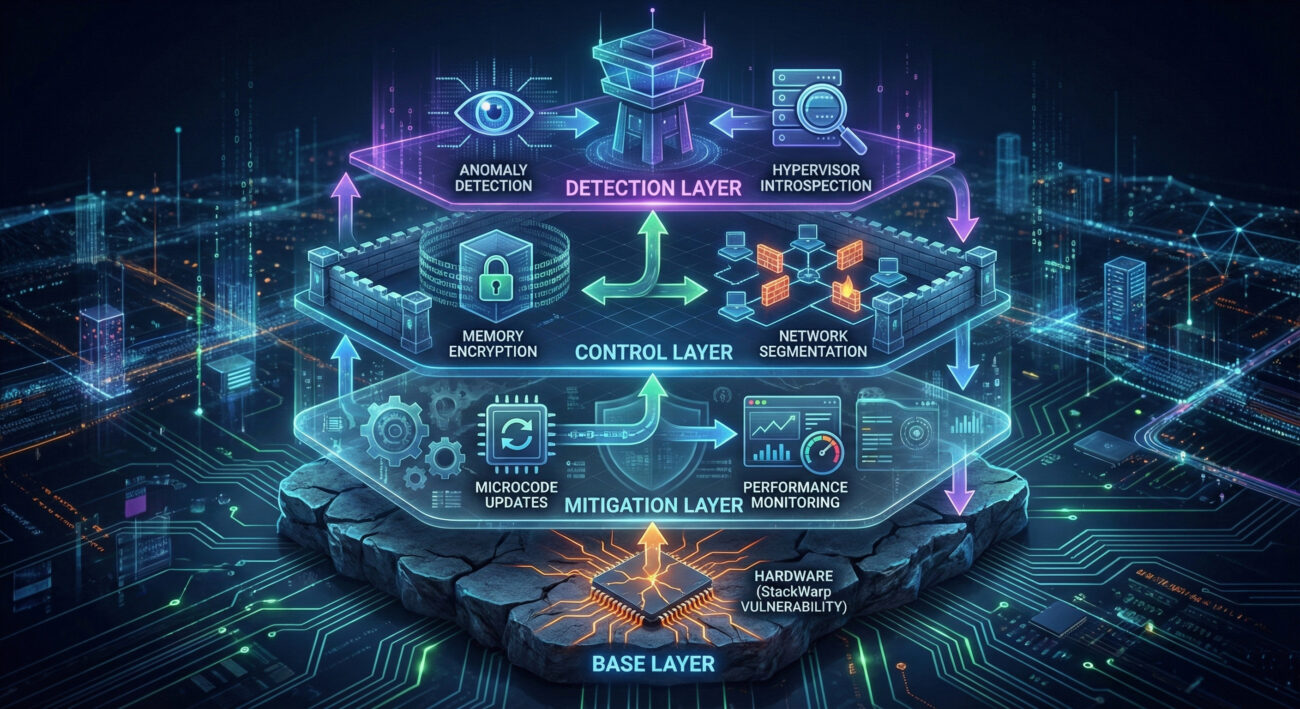
Defense Strategy: Since the vulnerability is in hardware, defenders must implement compensating controls:
Key Advantage: The exploit is complex and requires local access, giving defenders time to detect initial compromise before StackWarp is utilized.
Identify all affected systems using AMD processors. Prioritize based on sensitivity of data and exposure to potential attackers. Cloud providers should identify affected instance types and notify customers.
While StackWarp is a hardware flaw, AMD releases microcode updates and firmware patches that implement software workarounds. These typically disable certain optimizations or add checks that mitigate the vulnerability at a performance cost.
Resource: Check AMD's official security advisory page for the latest updates: AMD Product Security
Deploy security solutions that can detect the behavioral patterns of a StackWarp attack:
Redesign critical systems to assume hardware vulnerabilities exist:
A: No, StackWarp is a hardware design flaw in specific AMD processors. It cannot be completely eliminated without replacing the physical CPU. However, microcode updates and firmware patches can implement software workarounds that mitigate the vulnerability, typically with some performance impact.
A: The vulnerability affects specific generations of AMD processors, particularly those with certain memory protection implementations. AMD has released a security bulletin listing affected models. Not all AMD CPUs are vulnerable, and newer architectures may have design changes that prevent this specific flaw.
A: Detection is challenging but possible through:
A: Not necessarily. The exploit is complex and requires local access with specific conditions. For most organizations, implementing the mitigation strategies outlined in this guide provides adequate protection. However, for high-security environments handling extremely sensitive data, hardware replacement might be part of a comprehensive risk management strategy.
Now that you understand the StackWarp vulnerability, take these immediate actions:
© 2026 Cyber Pulse Academy. This content is provided for educational purposes only.
Always consult with security professionals for organization-specific guidance.
Every contribution moves us closer to our goal: making world-class cybersecurity education accessible to ALL.
Choose the amount of donation by yourself.