




















Certification Courses
Hands-On Labs
Threat Intelligence
Latest Cyber News
MITRE ATT&CK Breakdown
All Cyber Keywords
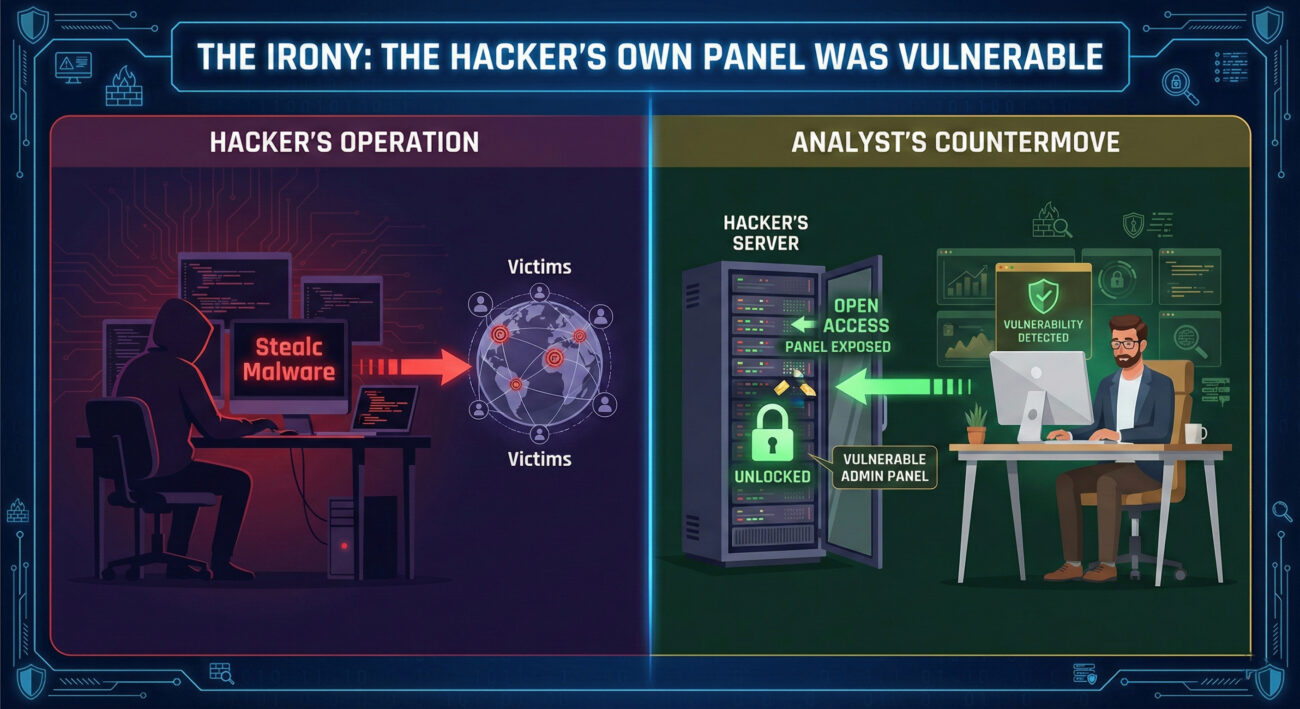
In a stunning twist of cyber irony, a significant security vulnerability was discovered not in a corporate firewall or a popular app, but within the very control panel used by hackers to manage the notorious Stealc information-stealing malware. This bug (CVE-2025-2022) essentially left the backdoor wide open, allowing cybersecurity researchers, and potentially defenders, to access the threat actors' own data, geolocate their servers, and even hijack their operations. This post provides a deep, beginner-friendly analysis of this vulnerability, its implications in the attack chain (mapped to MITRE ATT&CK), and the crucial lessons it teaches both red and blue teams about operational security.
Imagine a thief who masterfully picks locks but forgets to lock their own vault. This is precisely what happened with the operators of the Stealc malware service. A critical vulnerability in their web-based command-and-control (C2) admin panel, discovered by researchers, allowed unauthorized access to the panel's data. This flaw didn't just leak technical data; it exposed the complete operational logs of the attackers, lists of infected victims, stolen credentials, cryptocurrency wallet details, and even the hackers' own server IP addresses.
The Stealc malware panel vulnerability is a profound lesson in operational security (OpSec). It demonstrates that cybercriminals, despite their technical prowess, often fall victim to the same security oversights they exploit in others. For defenders, it represents a rare opportunity for intelligence gathering and "hacking back" in a legal, ethical manner by analyzing exposed data to understand threat patterns.
Stealc is a sophisticated information-stealing malware distributed as a Malware-as-a-Service (MaaS). First identified in early 2023, it quickly became popular in the cybercrime underworld due to its efficiency, user-friendly panel, and comprehensive data theft capabilities. It is designed to harvest a wide array of sensitive information from infected Windows machines.
The stolen data is exfiltrated to a command-and-control (C2) server controlled by the threat actor. The actor then accesses a web-based admin panel to view, manage, and monetize the loot from their victims. It was this very admin panel that contained the critical vulnerability.
The core of the Stealc malware panel vulnerability was a broken authentication mechanism in the PHP-based web panel. The panel's access control logic was fundamentally flawed, allowing unauthorized users to bypass login checks and directly access administrative endpoints.
The panel's PHP code likely included a file (e.g., auth_check.php) that was supposed to run on every protected page to verify if a user was logged in. The bug was that this check could be circumvented if the script incorrectly validated session variables or user roles.
Researchers discovered that by directly navigating to specific URLs (e.g., /panel/admin/victims.php or API endpoints like /api/getLogs) without a valid session, the panel would still return sensitive data. This is a classic Missing Authentication vulnerability.
By exploiting this, an unauthenticated attacker (in this case, a security researcher) could access:
Below is a simplified, hypothetical representation of the flawed logic, not the actual Stealc code.
// FILE: victims.php - THE VULNERABLE VERSION
<?php
// INTENDED: Include authentication check
// include('auth_check.php'); // THIS LINE WAS INEFFECTIVE OR MISSING

// DIRECT DATABASE QUERY WITHOUT PROPER AUTH
$query = "SELECT * FROM stolen_data";
$result = $conn->query($query);

// Output all stolen data as JSON
echo json_encode($result->fetch_all(MYSQLI_ASSOC));
?>
The correct version should have enforced a strict authentication check before any database interaction.
Understanding where this panel vulnerability fits into the broader attack lifecycle is crucial. We can map the Stealc malware operation and the subsequent panel compromise to specific MITRE ATT&CK tactics and techniques.
| MITRE ATT&CK Tactic | Technique Code & Name | How It Applies to Stealc Operations |
|---|---|---|
| Initial Access | T1566.001 Phishing: Spearphishing Attachment |
Stealc is often delivered via phishing emails with malicious attachments (e.g., DOCX, PDF) containing downloaders. |
| Execution | T1204.002 User Execution: Malicious File |
The victim executes the malicious attachment, triggering the malware installation. |
| Collection | T1555 Credentials from Password Stores |
Stealc's primary function: harvesting credentials from browser storage and system files. |
| Command and Control | T1071.001 Application Layer Protocol: Web Protocols |
Stealc uses HTTP/HTTPS to communicate with its C2 server (the panel's backend). |
| Exfiltration | T1041 Exfiltration Over C2 Channel |
Stolen data is sent back to the attacker over the same C2 channel. |
| Discovery (Against Attackers) | T1087 Account Discovery |
The panel vulnerability allowed defenders to discover attacker accounts and victim lists. |
| Collection (Against Attackers) | T1530 Data from Cloud Storage |
Researchers collected attacker data from the poorly secured panel (acting as a cloud service). |
Let's walk through a complete scenario showing both the threat actor's intended flow and how the panel vulnerability interrupted it.
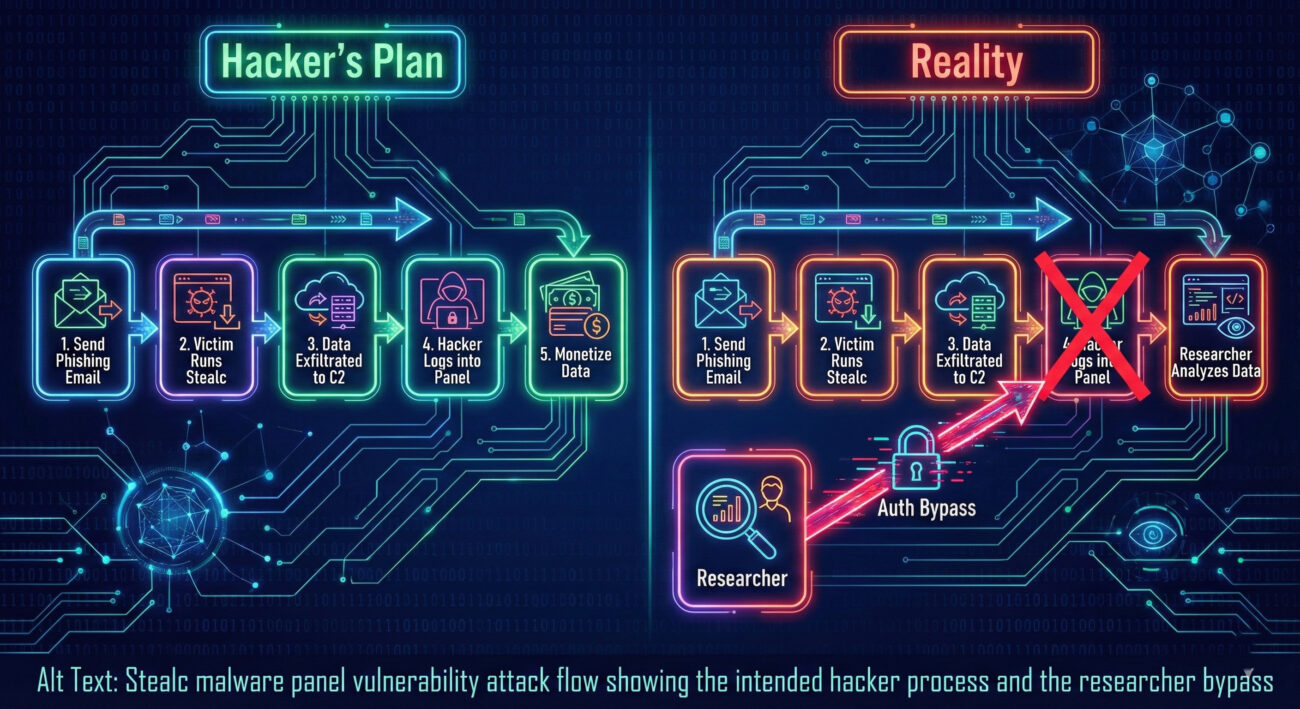
Upon discovering an active Stealc C2 server (e.g., through threat intelligence feeds or malware sandbox logs), a defender could:
The Critical OpSec Failure: For red teams and ethical hackers, this incident is a masterclass in what NOT to do in operational security.
The Intelligence Windfall: For blue teams, this vulnerability is a reminder to think creatively about defense.
How can organizations leverage lessons from the Stealc malware panel vulnerability? Here’s a practical framework.
Since Stealc often arrives via phishing, regular, engaging security awareness training is non-negotiable. Simulated phishing campaigns help gauge resilience.
Q1: Is it legal to "hack back" by accessing a vulnerable malware panel like this?
A: This is a complex legal area. Actively exploiting the vulnerability to disrupt, delete, or modify data is almost certainly illegal in most jurisdictions. However, passive reconnaissance, accessing publicly exposed information without authentication, is often analyzed on a case-by-case basis. The safest approach for organizations is to collect intelligence and immediately report the findings to law enforcement (e.g., the FBI's IC3 or similar). Security researchers often operate under responsible disclosure protocols.
Q2: How can I check if my organization has been infected by Stealc?
A: Look for these indicators:
Q3: Does this vulnerability mean Stealc is no longer a threat?
A: Absolutely not. The vulnerability was in the attacker's panel, not in the malware itself. Stealc binaries remain fully functional. Furthermore, only some panels may have been exposed or unpatched. The threat from information stealers is more prevalent than ever.
Q4: What's the main cybersecurity lesson from this event?
A: Operational security is paramount for everyone, including attackers. For defenders, it reinforces that adversaries are not infallible; their tools and infrastructure can contain critical flaws that provide valuable defensive intelligence. Always practice defense-in-depth.
Don't wait to become a statistic. Use this incident as a catalyst to review your organization's defenses against information-stealing malware.
Cybersecurity is a continuous battle of adaptation. By learning from both our mistakes and the mistakes of our adversaries, we build a more resilient digital world.
External Resources & Further Reading:
© 2026 Cyber Pulse Academy. This content is provided for educational purposes only.
Always consult with security professionals for organization-specific guidance.
Every contribution moves us closer to our goal: making world-class cybersecurity education accessible to ALL.
Choose the amount of donation by yourself.