





























Certification Courses
Hands-On Labs
Threat Intelligence
Latest Cyber News
MITRE ATT&CK Breakdown
All Cyber Keywords
Imagine a fortress with hundreds of doors, but only one master key that every guard uses. If that key gets stolen or copied, your entire castle is vulnerable. That's exactly how many networks operated before protocols like TACACS+ (Terminal Access Controller Access-Control System Plus) revolutionized authentication security.
TACACS+ is a network security protocol that acts as a sophisticated digital bouncer for your routers, switches, and servers. Think of it as an exclusive club's VIP list system that doesn't just check your ID at the door but also tracks what you do inside, who you talk to, and when you leave.
In this beginner-friendly guide, you'll learn: what makes TACACS+ different from other security protocols, why it's crucial for protecting network devices, how to implement it step-by-step, and most importantly, how to avoid the common mistakes that leave organizations vulnerable to cyber attacks.
Network devices like routers, switches, and firewalls form the backbone of modern IT infrastructure. According to a CISA advisory, unsecured network devices represent one of the most common attack vectors for threat actors. Without proper authentication protocols like TACACS+, organizations essentially leave their digital front doors unlocked.
What makes TACACS+ particularly valuable is its separation of authentication, authorization, and accounting, often called the "AAA" framework. This means the system that verifies your identity is separate from the system that decides what you can do, which is separate from the system that tracks what you actually did. This layered approach creates secure barriers that prevent single points of failure.
Consider this: The 2023 Verizon Data Breach Investigations Report found that 74% of breaches involved the human element, often through compromised credentials. TACACS+ helps mitigate this risk by providing detailed logging (accounting) of every command executed on network devices. If an admin's credentials are compromised, you can see exactly what the attacker did and when.
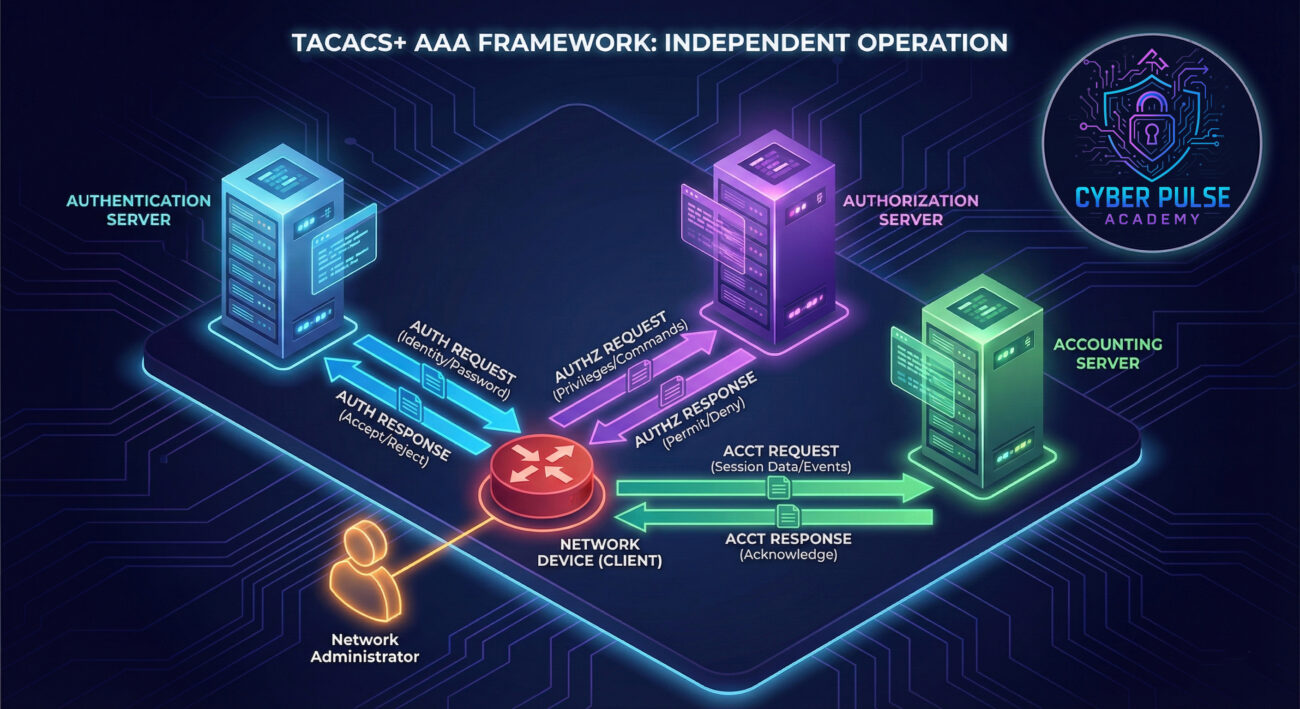
For large organizations with hundreds of network devices and multiple administrators, implementing TACACS+ isn't just a security measure, it's an operational necessity. It centralizes authentication control, meaning when an employee leaves, you disable one account rather than manually updating credentials on dozens of individual devices.
Before diving deeper, let's demystify the essential terminology. These concepts form the foundation of understanding how TACACS+ operates and why it's superior to simpler authentication methods.
| Term | Simple Definition | Everyday Analogy |
|---|---|---|
| TACACS+ | A security protocol that controls access to network devices by separating authentication, authorization, and accounting functions | Like a high-security building with separate checkpoints for ID verification (authentication), access level assignment (authorization), and activity logging (accounting) |
| Authentication | The process of verifying a user's identity before granting access | Showing your ID card to security before entering an office building |
| Authorization | Determining what resources or commands a verified user can access | Being told which floors and rooms you're allowed to enter after your ID is verified |
| Accounting | Tracking and logging user activities for auditing and security purposes | Security cameras and access logs that record who entered which room and when |
| RADIUS | A different authentication protocol often compared with TACACS+, commonly used for network access rather than device administration | Like a concert venue ticket scanner (RADIUS) vs. backstage pass system with individual room permissions (TACACS+) |
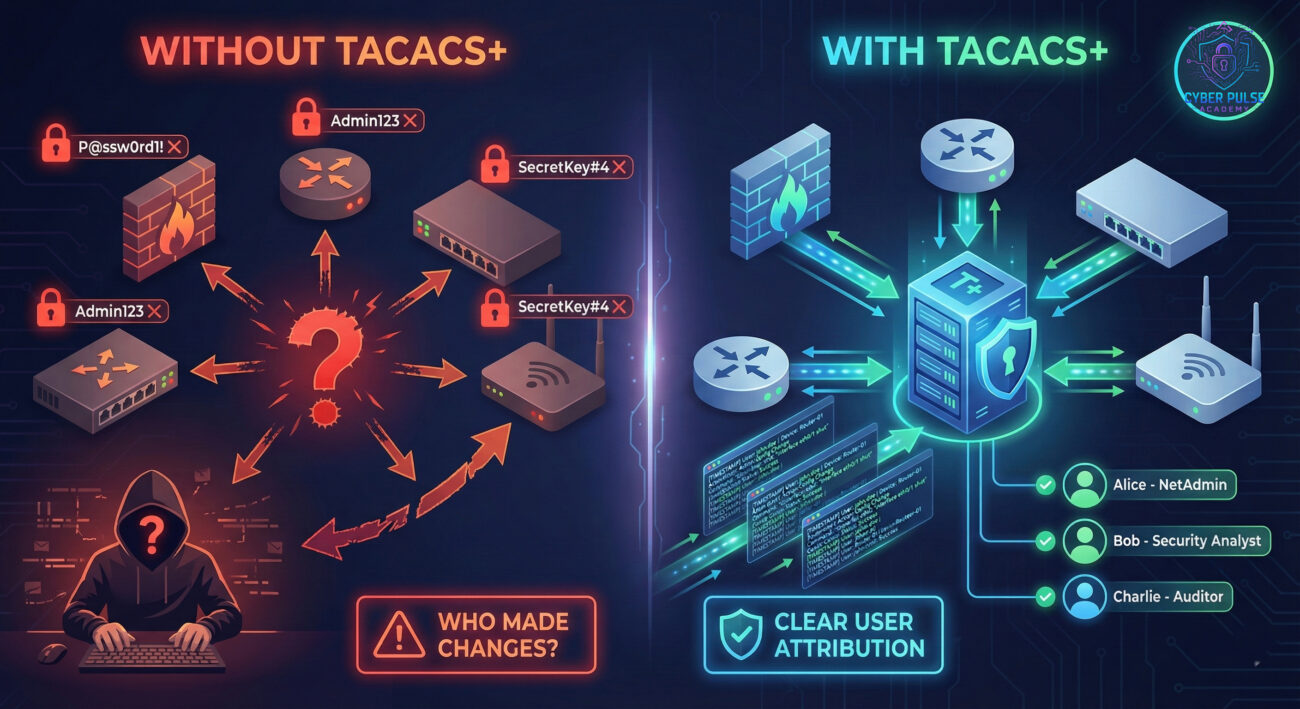
Meet Sarah, the network administrator at TechFlow Solutions, a mid-sized company with 50 network devices and 5 IT staff members. Before implementing TACACS+, TechFlow used local usernames and passwords on each device, a common but risky practice.
One Tuesday afternoon, Sarah received an alert that their main router configuration had been changed. Without TACACS+, she would have faced a nightmare scenario: manually checking each device, interviewing every admin, and hoping someone remembered making changes. Worse, if it was a malicious insider or external attacker, they would have no way to track the specific actions taken.
Fortunately, TechFlow had implemented TACACS+ just three months earlier. Sarah logged into the TACACS+ accounting server and within minutes had her answer:
| Time/Stage | What Happened | Impact |
|---|---|---|
| 2:15 PM | User "jdoe" authenticated successfully via TACACS+ | Normal login detected |
| 2:18 PM | User "jdoe" executed command: "config terminal" | Entered configuration mode |
| 2:20 PM | User "jdoe" changed routing protocol from OSPF to EIGRP | Major network change affecting all traffic |
| 2:22 PM | Session ended - user logged out | Change completed, potential network disruption |
Sarah immediately contacted John Doe (jdoe), who realized he had made the change during routine maintenance but forgot to document it. The detailed TACACS+ logs prevented a multi-hour investigation, restored the configuration in minutes, and provided an audit trail for compliance requirements. This incident alone justified their TACACS+ implementation cost.
Ready to bring TACACS+ security to your organization? Follow this practical 6-step implementation guide. Remember to test in a lab environment first before deploying to production.
Select appropriate TACACS+ server software based on your environment:
Consider your budget, existing infrastructure, and required features when choosing.
Plan how users will authenticate and what privileges they'll receive:
Check out our guide on implementing MFA for enhanced security.
Set up your chosen server with proper security settings:
Always use unique, complex shared secrets for each device group.
Point your routers, switches, and firewalls to the TACACS+ server:
Our network device hardening guide complements this step perfectly.
Enable detailed logging for audit trails and security monitoring:
Proper accounting turns TACACS+ from access control to a powerful security monitoring tool.
Never roll out security changes to all devices at once:
Maintain local authentication as fallback until you're confident in the TACACS+ setup.
Understanding how attackers view TACACS+ helps you defend against them. Let's explore a simple attack scenario and the corresponding defensive mindset.
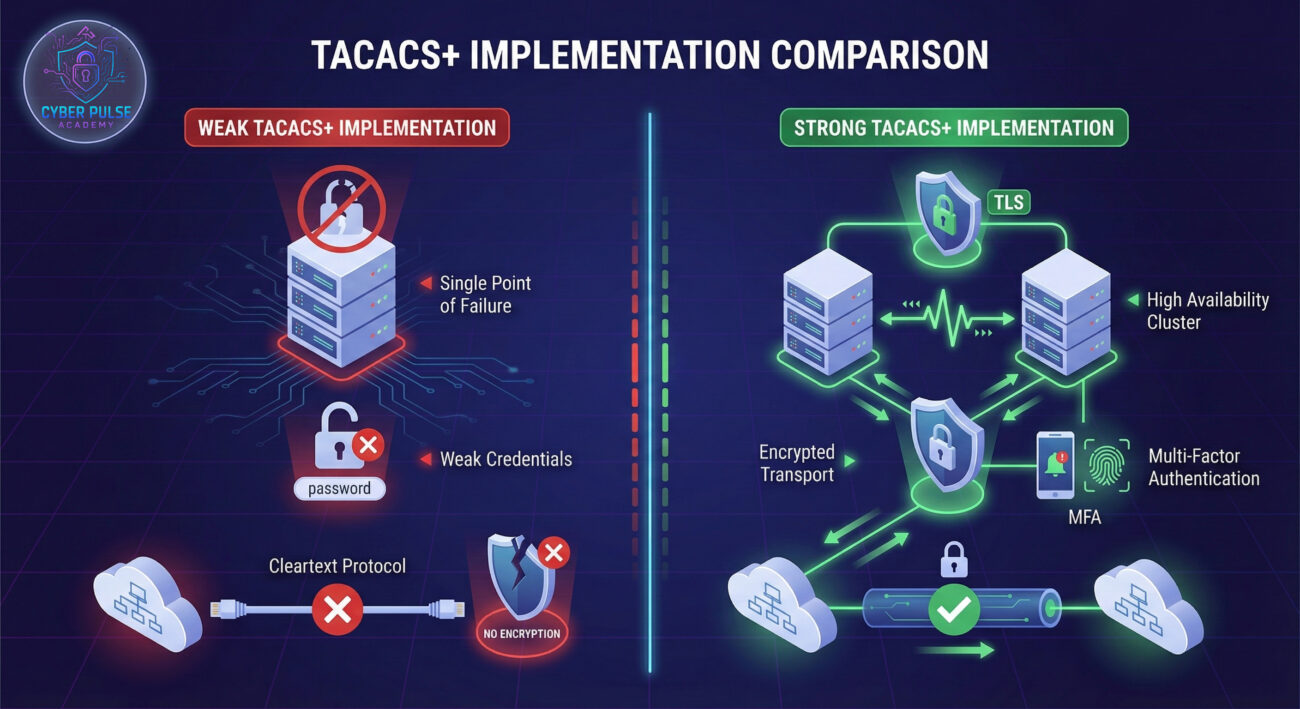
The Attack Path: An attacker discovers a network device with default or weak local credentials (a surprisingly common finding). They gain access and notice TACACS+ is configured but discover the shared secret is weak or reused across devices. By capturing TACACS+ packets or testing common secrets, they compromise the centralized authentication system. Now they can create backdoor accounts or modify existing privileges across the entire network.
The Defender's Counter-Move: A security-aware defender implements defense in depth. They use unique, complex shared secrets for each device group, monitor for authentication failures, and regularly rotate credentials. They also maintain detailed accounting logs and have automated alerts for privilege escalation attempts or configuration changes outside maintenance windows. Most importantly, they periodically conduct penetration tests specifically targeting authentication systems to find vulnerabilities before attackers do.
TACACS+ represents both a challenge and an opportunity. The centralized nature means compromising one strong system could grant access to everything, but that same centralization creates a single point of failure we can target. We look for weak shared secrets, unencrypted communications, or misconfigured authorization rules. The accounting feature is our enemy; it creates audit trails that can expose our presence. We prefer environments without TACACS+ where our actions might go unnoticed.
Our goal: Find the weakest link in the AAA chain. Can we intercept authentication traffic? Guess weak shared secrets? Abuse excessive privileges granted to service accounts? Each successful TACACS+ compromise is a major victory with network-wide implications.
TACACS+ is a force multiplier for network security. It gives us centralized control, detailed visibility, and consistent policy enforcement across all devices. The separation of authentication, authorization, and accounting means we can implement least-privilege access while maintaining comprehensive audit trails. We monitor authentication failures as early warning signs of brute force attacks.
Our strategy: Implement TACACS+ with defense in depth. Strong encryption, unique complex secrets, regular credential rotation, MFA integration, and redundant servers. The accounting logs are our forensic treasure trove, we analyze them for anomalies and ensure they're securely stored and regularly reviewed. TACACS+ isn't just a tool; it's the foundation of our network access control strategy.
You've now journeyed from TACACS+ beginner to informed practitioner. Let's recap your key takeaways:
Whether you're protecting a small business network or an enterprise infrastructure, TACACS+ represents a fundamental security control that should be in every cybersecurity professional's toolkit. Remember that no single protocol makes you invulnerable, but layered security with proper authentication controls significantly reduces your attack surface.
Start your TACACS+ journey today by auditing your current network authentication methods. Identify which devices rely on local credentials, research appropriate TACACS+ server options for your environment, and create a phased implementation plan. The network you protect tomorrow will thank you today.
Have questions about implementing TACACS+ in your specific environment? Curious about how it compares to RADIUS or other authentication protocols? Share your thoughts and questions in the comments below, our community of cybersecurity professionals is here to help!
Additional Resources: Check out our guides on network segmentation, firewall configuration best practices, and incident response planning to build a comprehensive security strategy.
Every contribution moves us closer to our goal: making world-class cybersecurity education accessible to ALL.
Choose the amount of donation by yourself.