






















Certification Courses
Hands-On Labs
Threat Intelligence
Latest Cyber News
MITRE ATT&CK Breakdown
All Cyber Keywords
Imagine searching for a trusted, everyday tool like Google Chrome or Notepad++, clicking the top link from your search engine, and unknowingly inviting a thief into your system. This is the unsettling reality of a SEO poisoning attack, a growing cyber threat that manipulates the very foundation of how we find information online. In early 2026, a group dubbed "Black Cat" executed a widespread campaign targeting users searching for popular software, compromising hundreds of thousands of hosts. This guide deconstructs this attack, explaining not just the "how," but equipping you with the knowledge to defend against it.
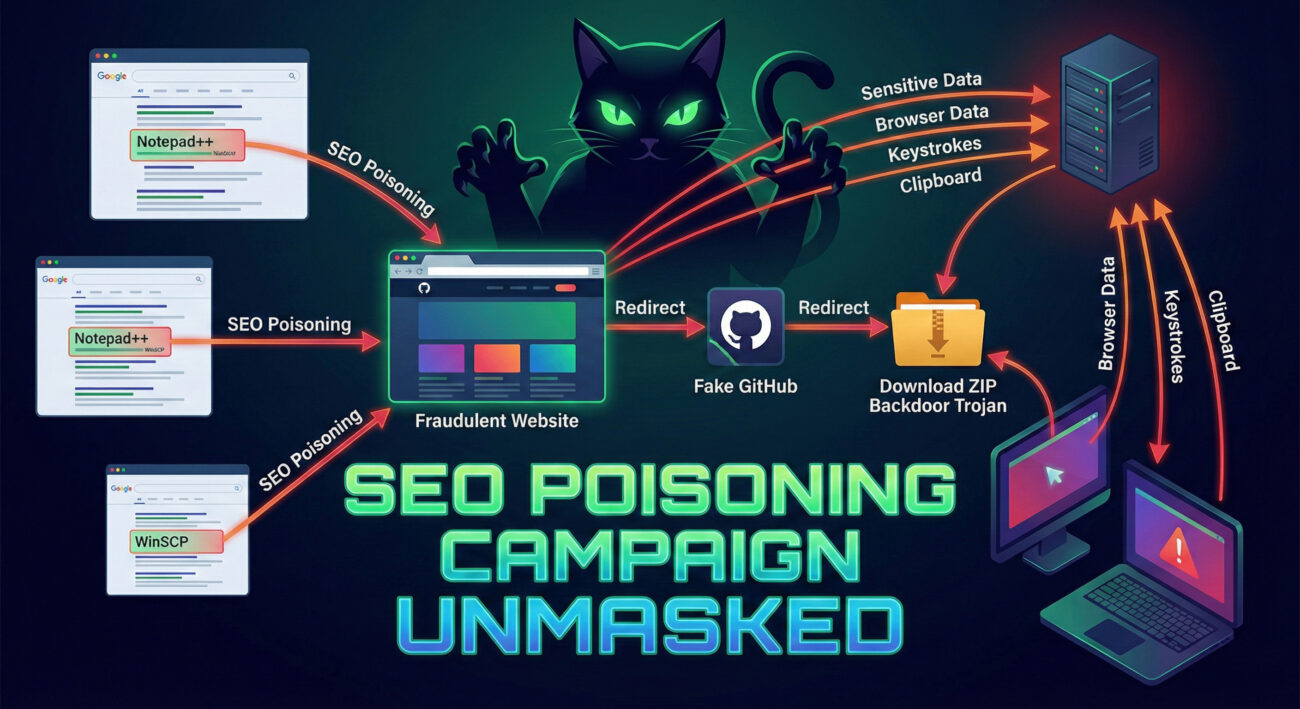
In January 2026, cybersecurity analysts from CNCERT/CC and ThreatBook exposed a large-scale SEO poisoning attack orchestrated by the cybercrime group Black Cat. The group's modus operandi involved creating sophisticated fake websites for ubiquitous software like Google Chrome, Notepad++, and QQ International. By exploiting Search Engine Optimization (SEO) techniques, they manipulated search results on engines like Bing to push these malicious sites to the top, specifically targeting Chinese-speaking users.
The impact was severe: in just a two-week period in December 2025, the group compromised approximately 277,800 hosts in China, with a single-day peak of over 62,000 infections. Victims who downloaded what they believed to be legitimate installers instead received a stealthy backdoor designed for data theft and remote control, highlighting the potent effectiveness of blending social engineering with technical deception in a SEO poisoning attack.

Understanding the mechanics of this SEO poisoning attack is crucial for recognition and prevention. Let's walk through the attack chain, from the initial search to the final breach.
The Black Cat group first registered deceptive domain names designed to mimic legitimate software sites. Examples include cn-notepadplusplus[.]com and cn-winscp[.]com. The "cn" prefix specifically targeted users searching in Chinese. They then built convincing clones of the official software download pages, complete with logos, screenshots, and persuasive text.
Using black-hat SEO techniques, the attackers artificially boosted these fake sites in search engine results pages (SERPs). They likely used methods like creating networks of backlinks, keyword stuffing, and cloaking (showing different content to search engines than to users). The goal was simple: ensure their malicious link appeared as the first or second result for queries like "Notepad++ download."
A user clicks the top result, believing it's official. On the fake site, clicking "Download" doesn't deliver the real software. Instead, it redirects through a series of URLs, finally landing on a domain mimicking GitHub (github.zh-cns[.]top). From here, the victim downloads a ZIP archive containing the malware.
The downloaded file is an installer that performs a dual function. It places a legitimate-looking shortcut on the user's desktop while simultaneously sideloading a malicious DLL. This DLL acts as a dropper, installing the final backdoor payload. The backdoor then calls home to a command-and-control (C2) server at sbido[.]com:2869.
Once connected, the backdoor provides the attackers with extensive control over the victim's machine. As documented, its capabilities include:
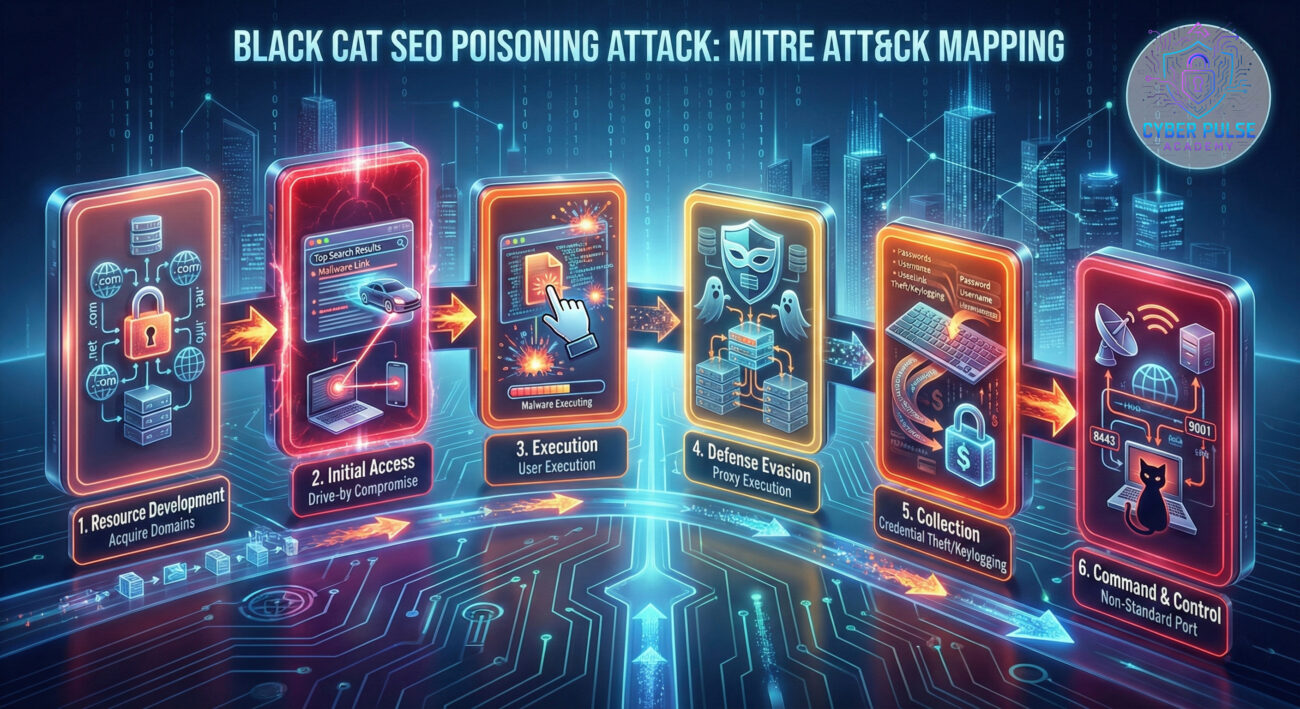
Framing this SEO poisoning attack within the MITRE ATT&CK framework provides a standardized understanding of the adversary's behavior, which is essential for developing effective defenses. The Black Cat campaign utilized techniques across multiple tactical stages.
| MITRE ATT&CK Tactic | Technique (ID & Name) | How Black Cat Applied It |
|---|---|---|
| Resource Development | T1583.001 - Acquire Infrastructure: Domains | Registered deceptive domain names (e.g., notepadplusplus[.]cn) to host fake software download pages. |
| Initial Access | T1189 - Drive-by Compromise | Used poisoned search results to compromise users who visited the malicious sites, a form of a drive-by download. |
| Execution | T1204.002 - User Execution: Malicious File | Relied on the user to execute the malicious installer disguised as legitimate software. |
| Defense Evasion | T1218 - System Binary Proxy Execution | Used a legitimate installer and shortcut to proxy the execution of the malicious DLL (side-loading). |
| Collection | T1555 - Credentials from Password Stores T1056.001 - Input Capture: Keylogging |
The backdoor was designed to steal browser credentials and log keystrokes from the infected host. |
| Command and Control | T1571 - Non-Standard Port | Used port 2869 (not typical for web traffic) for C2 communication to potentially evade detection. |
This mapping reveals a well-planned SEO poisoning attack that leverages human trust (social engineering) and technical stealth to achieve its data-theft objectives. Understanding this kill chain allows defenders to identify and block the attack at multiple points.
Examining the SEO poisoning attack from both offensive (Red Team) and defensive (Blue Team) viewpoints provides a complete picture of the threat landscape and countermeasures.
Objective: Mass compromise of end-users for financial gain via data theft and crypto theft.
Core Strategy: Weaponize the public's trust in search engine rankings and familiar software brands. The attack is a low-cost, high-volume operation.
Key Strengths:
Exploited Weaknesses: User lack of vigilance regarding URLs; over-reliance on top search results; absence of software download policies.
Objective: Prevent infection, detect anomalous activity, and minimize damage from potential breaches.
Core Strategy: Implement layered defenses that address human, technical, and procedural vulnerabilities.
Key Defensive Actions:
Defensive Mindset: Assume users will click malicious links; focus on containing the damage and detecting the subsequent malicious activity quickly.
Preventing a SEO poisoning attack requires avoiding common pitfalls and proactively implementing security best practices at both the organizational and individual level.
No. While the Black Cat campaign specifically targeted Bing and Chinese users, the SEO poisoning attack technique is platform-agnostic. Attackers can and do target Google, Yahoo, and other search engines globally. Any region or language where users search for popular software is a potential target.
Modern Endpoint Detection and Response (EDR) tools are highly effective at spotting the malicious behaviors that follow the initial download, like side-loading DLLs or beaconing to a C2 server on a non-standard port. However, traditional signature-based antivirus may miss a novel payload. The most reliable defense is layered: user awareness to prevent the click, combined with advanced security tools to catch what slips through.
Both aim to deliver malware via trusted channels, but the method differs. SEO poisoning manipulates organic search results by boosting malicious websites. Malvertising (malicious advertising) injects malware into legitimate online ad networks, causing users to get infected even when visiting reputable news or entertainment sites. SEO poisoning relies on the user's active search intent.
The Black Cat campaign is a stark reminder that cyber threats evolve to exploit our most routine behaviors. A SEO poisoning attack is particularly insidious because it corrupts a tool, the search engine, that we fundamentally trust to provide truthful information.
Today, take these three immediate steps to dramatically reduce your risk:
For continuous learning, follow trusted cybersecurity resources like Krebs on Security, The Hacker News, and the CISA Alerts to stay updated on the latest tactics and threats. In cybersecurity, vigilance is not paranoia, it's protection.
© 2026 Cyber Pulse Academy. This content is provided for educational purposes only.
Always consult with security professionals for organization-specific guidance.
Every contribution moves us closer to our goal: making world-class cybersecurity education accessible to ALL.
Choose the amount of donation by yourself.