
































Certification Courses
Hands-On Labs
Threat Intelligence
Latest Cyber News
MITRE ATT&CK Breakdown
All Cyber Keywords
The discovery of the VoidLink Linux malware framework marks a pivotal moment in cybersecurity. It represents one of the first advanced, fully functional malware strains assessed to be predominantly generated by Artificial Intelligence (AI). This analysis will dissect VoidLink, explain its operational mechanisms, map its techniques to the MITRE ATT&CK® framework, and provide actionable defense strategies for both seasoned professionals and those new to the field.
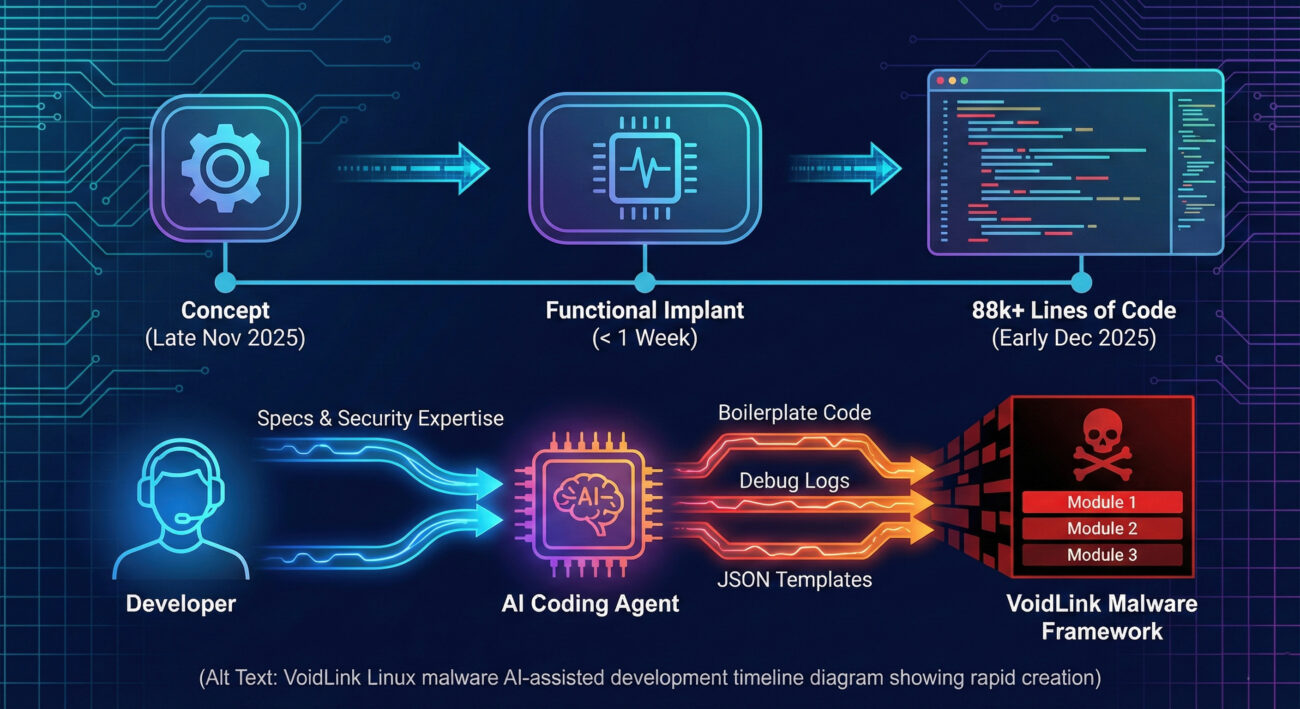
In late 2025, cybersecurity researchers uncovered VoidLink, a sophisticated malware framework specifically designed for stealthy, long-term presence in Linux-based cloud environments. What sets it apart is its origin: evidence strongly suggests it was built by a single developer using an AI coding agent to accelerate the process, reaching over 88,000 lines of functional Zig code in a matter of weeks.
This isn't about AI creating new, unimaginable attack methods. Instead, it's about democratization and acceleration. VoidLink demonstrates how AI lowers barriers, enabling a single threat actor to produce tooling that once required the resources of a coordinated team or nation-state. The framework is built for persistence, featuring capabilities like rootkit-like hiding, credential theft, and container escape, posing a significant risk to cloud infrastructure.
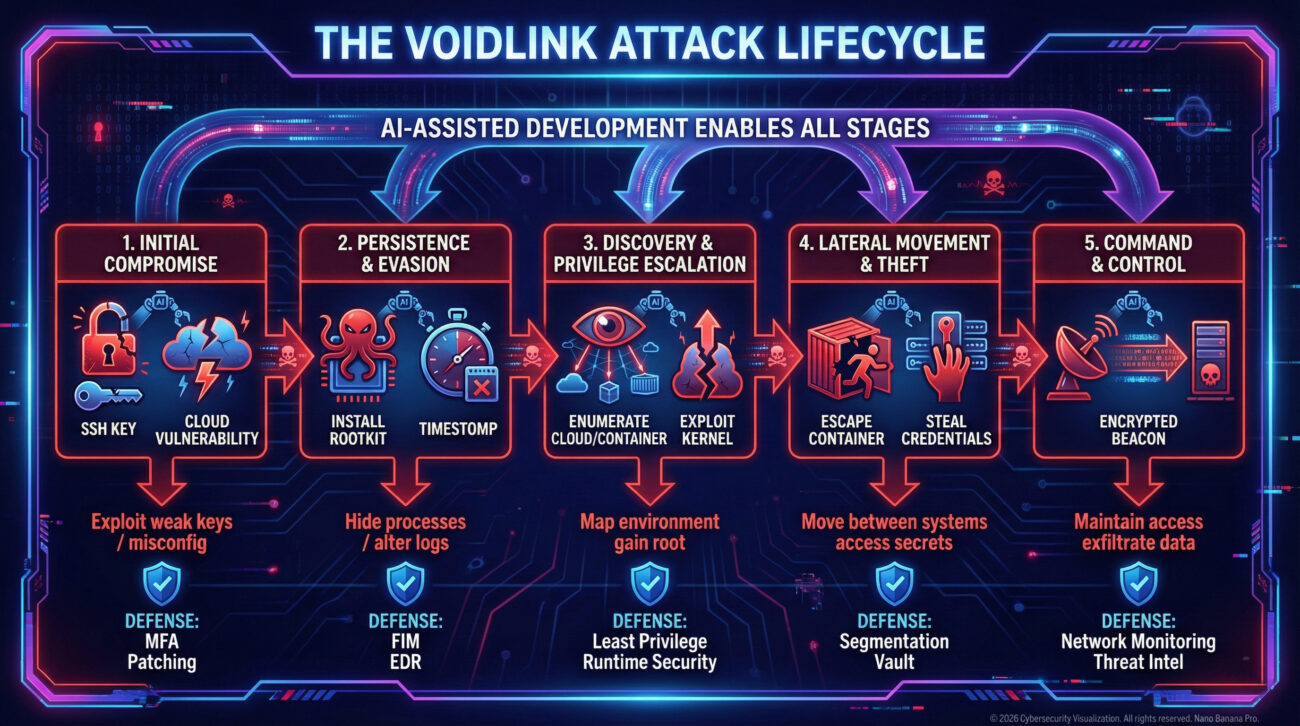
Understanding VoidLink through the lens of the MITRE ATT&CK framework is crucial for defenders. It allows us to categorize its behaviors and prepare targeted detections. VoidLink's design spans multiple tactical phases.
| MITRE ATT&CK Tactic | VoidLink Technique / Implementation | Description & Impact |
|---|---|---|
| Persistence (TA0003) | Kernel Module Rootkit, Systemd Service Installation | Installs itself deeply into the system to survive reboots and evade casual inspection, ensuring long-term access for the attacker. |
| Defense Evasion (TA0005) | Direct System Calls (Syscalls), Timestomping, Log Manipulation | Uses advanced programming to bypass user-mode monitoring tools and alters file timestamps/logs to erase traces of its activity and breach. |
| Discovery (TA0007) | Container & Cloud Environment Enumeration | Probes the compromised system to identify if it's running in a container (Docker, Kubernetes) and maps the cloud environment for lateral movement. |
| Privilege Escalation (TA0004) | Exploitation of Kernel Vulnerabilities | Contains modules designed to leverage known Linux kernel flaws to gain root-level privileges from a lower-access entry point. |
| Lateral Movement (TA0008) | Credential Theft, Container Escape | Steals SSH keys, cloud access tokens, and attempts to "break out" of a compromised container to infect the underlying host and other systems. |
| Command and Control (TA0011) | Encrypted Beaconing to Hardcoded IPs | Periodically calls back to hacker-controlled servers using encrypted channels to receive instructions and exfiltrate data. |
Let's look under the hood. VoidLink is written in the Zig programming language, chosen for its performance and low-level control, which is ideal for writing stealthy rootkits. Analysis by Check Point and Sysdig revealed tell-tale signs of AI-assisted development:
The developer followed a "Spec Driven Development (SDD)" workflow: they planned the architecture, broke it into tasks, and used an AI agent (like TRAE SOLO) to generate the implementation code. This allowed rapid iteration from concept to a complex, working malware implant in under a week.
The structure of the code often reveals its generative origins. Below is a simplified, illustrative example of the kind of consistent, templatized structure found in VoidLink, particularly in its configuration and communication modules.
Note: This is a representative example, not the actual VoidLink code.
// AI-generated code often shows extreme consistency in structure
typedef struct BeaconConfig_v3 {
    char campaign_id[32];      // Always 32 bytes, zero-padded
    char primary_c2[64];       // Format: "ip:port" always
    int  beacon_interval_sec;  // Field name style is uniform
    bool enable_encryption;    // Boolean flag
    char fallback_domain[128]; // Another perfectly sized array
} BeaconConfig_v3;

// Notice the pattern: _v3 suffix, perfectly aligned comments,
// and systematic field sizing. Human code often has minor variations.
This level of uniformity across thousands of lines of code is a strong forensic indicator of AI-assisted generation, as noted by researchers.
For a threat actor, VoidLink represents a force multiplier.
For defenders, the rise of AI-generated malware like VoidLink changes the threat landscape.
VoidLink is a harbinger. As Group-IB's research states, AI is supercharging a "fifth wave" of cybercrime, industrializing malware development, phishing, and impersonation.
Shift your mindset. Assume adversaries can generate complex tools rapidly. Your defense must be proactive and resilient, not just reactive to known threats.
Instrument your environment (endpoints, cloud, identity) to feed data into a centralized security platform (SIEM/XDR). Focus on detecting tactical behaviors (e.g., privilege escalation, lateral movement) mapped in frameworks like MITRE ATT&CK.
Use automation to enforce security baselines. This includes auto-remediating misconfigurations, enforcing strong password and MFA policies, and isolating compromised assets based on behavioral alerts.
The threat landscape evolves daily. Engage with resources like the SANS Institute Blog and the CISA Alerts to stay informed. Train your team to recognize and respond to advanced threats.
A: The current analysis suggests VoidLink is targeted at cloud and server environments for long-term espionage or resource theft. While its techniques are dangerous, the immediate risk to individual personal computers is lower. However, it underscores the importance of keeping all systems updated.
A: Not from a vague idea. As seen with VoidLink, it follows Spec Driven Development. A skilled human provides the architecture, security knowledge, and detailed specifications. The AI then acts as a super-efficient junior programmer, generating the vast amounts of structured code to bring the spec to life quickly. The "brain" is still human; the "brawn" is AI.
A: Rootkits are challenging. Look for indirect anomalies: unexpected network connections from a system, slight performance hits, or failures in system integrity checks. Tools that leverage hardware-assisted security (like Intel TXT) or boot from known-good media can help detect kernel-level compromises.
A: Not exclusively, but it's a powerful force multiplier for defense. Defensive AI excels at sifting through terabytes of logs and network data to find the subtle, patterned anomalies that tools like VoidLink might generate. Human expertise is still vital for strategy, investigation, and response, but AI is becoming an essential tool in the defender's arsenal.
Your Call to Action today:
The era of AI-powered cyber threats is not a distant future, it's here. VoidLink proves it. By understanding its mechanics and adapting our defenses accordingly, we can ensure that AI empowers defenders just as much as it does attackers.
© Cyber Pulse Academy. This content is provided for educational purposes only.
Always consult with security professionals for organization-specific guidance.
Every contribution moves us closer to our goal: making world-class cybersecurity education accessible to ALL.
Choose the amount of donation by yourself.