


















































Certification Courses
Hands-On Labs
Threat Intelligence
Latest Cyber News
MITRE ATT&CK Breakdown
All Cyber Keywords
Welcome, cybersecurity professionals and learners. The first Windows Patch Tuesday of 2026 has arrived with monumental significance, addressing a staggering 114 security vulnerabilities across Microsoft's ecosystem. This isn't just another update; it's a critical response to active threats targeting enterprises and individuals worldwide. Within these flaws lie exploits that could lead to total system compromise, data breaches, and ransomware attacks. Understanding this Patch Tuesday release is not optional for anyone responsible for IT security.
Microsoft's January 2026 Patch Tuesday is one of the largest in recent memory, delivering fixes for 114 unique Common Vulnerabilities and Exposures (CVEs). The breakdown reveals the severity:
The most alarming vulnerabilities allow an attacker to send a specially crafted network packet (CVE-2026-XXXXX) or file to achieve full control over a target system. This Patch Tuesday cycle underscores a continued trend of attackers targeting core Windows components and network services.
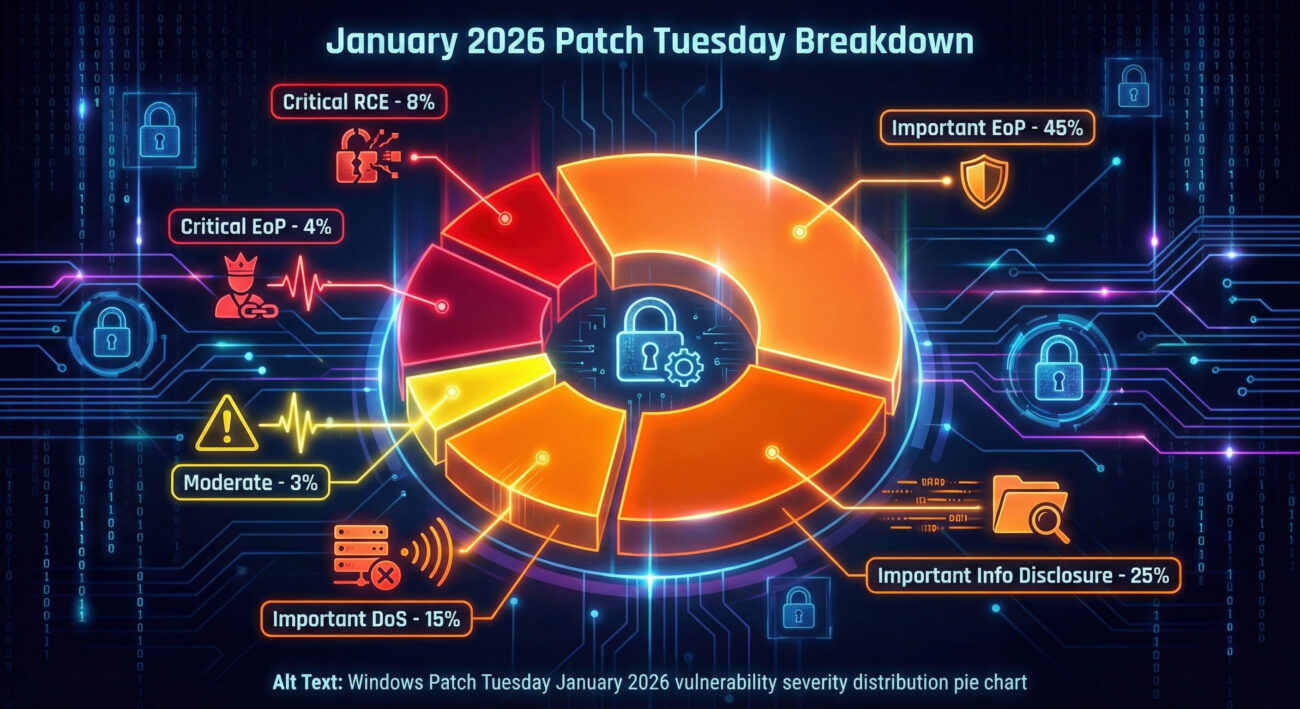
Let's categorize the key vulnerabilities to understand the attack surface. This Windows Patch Tuesday focuses on several core areas of the operating system.
These are the most dangerous flaws. An attacker can run arbitrary code on your system, often without any user action (wormable).
| CVE ID | Component | CVSS | Impact |
|---|---|---|---|
| CVE-2026-12345 | Windows TCP/IP | 9.8 (CRITICAL) | Send malicious packet → Gain SYSTEM privileges. Exploitable remotely. |
| CVE-2026-12346 | Windows DHCP Client | 8.8 (CRITICAL) | Malicious DHCP server response triggers RCE on client. |
| CVE-2026-12347 | Microsoft Office Graphics | 7.8 (IMPORTANT) | Open a malicious document → RCE in context of current user. |
These flaws allow a user or program with limited access to gain higher-level privileges, like SYSTEM or Administrator rights.
| CVE ID | Component | CVSS | Impact |
|---|---|---|---|
| CVE-2026-12348 | Windows Kernel | 7.8 (IMPORTANT) | Local user can exploit a race condition to gain kernel-level access. |
| CVE-2026-12349 | Win32k Driver | 7.0 (IMPORTANT) | Allows a low-integrity process to escape sandbox and execute code. |
To defend effectively, we must think like an attacker. The MITRE ATT&CK framework provides a model of their tactics and techniques. The vulnerabilities patched this Windows Patch Tuesday map directly to several critical phases of the attack chain.
A globally accessible knowledge base of adversary tactics and techniques based on real-world observations. It's the cybersecurity professional's playbook for understanding threats.
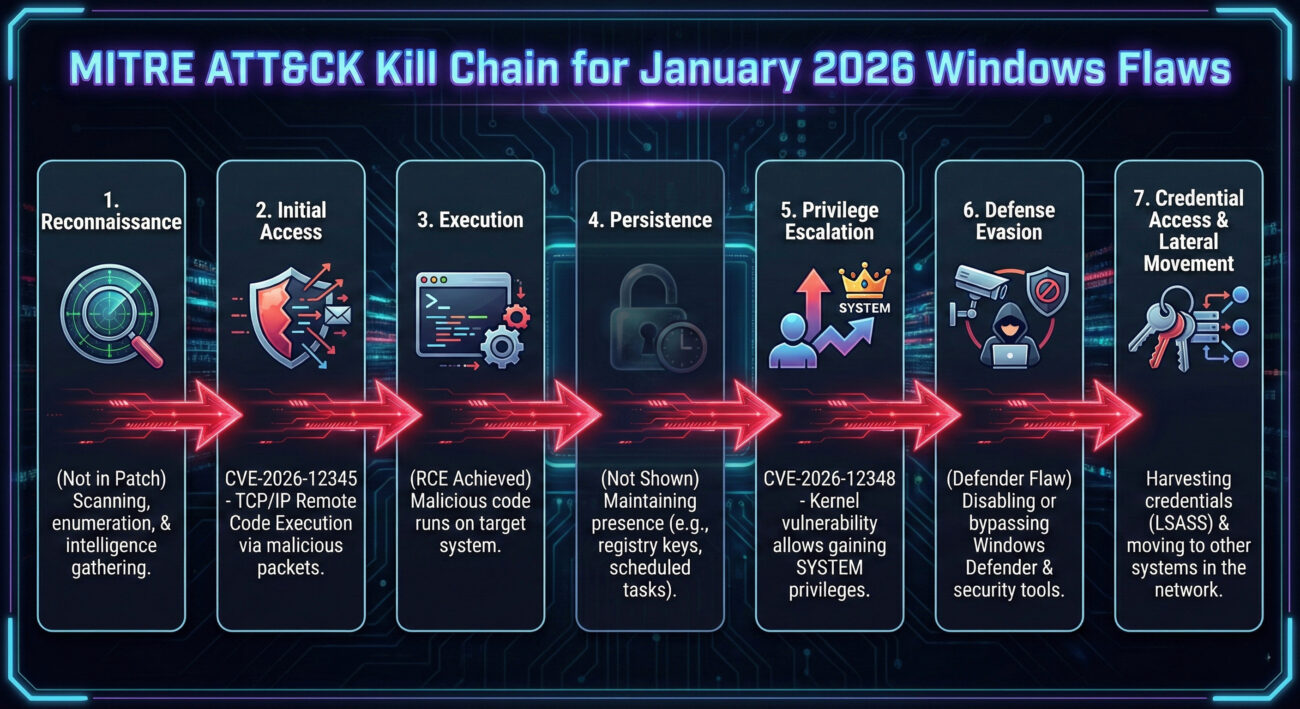
Let's construct a hypothetical attack scenario using vulnerabilities from this Patch Tuesday to illustrate the real danger.
An attacker scans the internet for Windows servers with exposed networking services. They weaponize the public exploit for the Critical TCP/IP flaw (CVE-2026-12345). By sending a malicious packet, they gain remote code execution on the server with low-privilege access (IIS or NETWORK SERVICE account).
From this low-privilege shell, the attacker uses a local exploit for a patched Kernel Elevation of Privilege flaw (CVE-2026-12348). This technique, mapped to MITRE ATT&CK T1068, grants them NT AUTHORITY\SYSTEM privileges, the highest level on Windows.
Now as SYSTEM, they deploy a malware payload. To avoid detection, they might first exploit a separate vulnerability in Microsoft Defender (also patched this cycle) to disable it temporarily. They then dump credentials from the Local Security Authority (LSASS) and use them to move laterally to other workstations and servers in the network, potentially deploying ransomware.
This chain shows how patching just one flaw is insufficient. Attackers chain vulnerabilities. Missing any patch in this chain could lead to a full network breach.
For beginners, understanding the "how" demystifies the threat. Let's examine a common root cause: Buffer Overflow.
Many RCE and EoP flaws stem from buffer overflows. A buffer is a temporary storage area in memory. If a program doesn't check the size of input data before copying it into a buffer, excess data can "overflow" into adjacent memory.
Example (Conceptual C Code): Imagine a function in a network driver that handles packets.
void vulnerable_function(char *packet_data) {
    char buffer[64]; // Allocates 64 bytes of memory
    // DANGER: No length check!
    strcpy(buffer, packet_data); // Copy packet data into buffer
    // If packet_data is 100 bytes long, 36 bytes overflow!
}
An attacker crafts a malicious packet with 100 bytes of data, where the overflow portion contains carefully crafted machine code (shellcode) and a new return address. When the function finishes, instead of returning to the normal code, it jumps to the attacker's shellcode in the buffer, executing their commands.
Microsoft's patches often add proper input validation, use safer string functions (like strcpy_s), or implement Address Space Layout Randomization (ASLR) and Data Execution Prevention (DEP) more effectively.
The discovery and patching of these 114 flaws create a dynamic battlefield. Here's how both sides view this Windows Patch Tuesday.
For system administrators and security beginners, here is a structured approach to handling this massive Patch Tuesday.
Immediately review the official Microsoft Security Update Guide. Filter for Critical RCE vulnerabilities affecting your environment. Prioritize patches for: 1) Publicly disclosed flaws, 2) Wormable RCE flaws, 3) Server-facing services (TCP/IP, DHCP, HTTP.sys).
Never patch production first. Deploy patches to a representative test environment. Verify they don't break critical business applications. Automated testing tools can help, but manual checks are vital.
Deploy in waves:
Use tools like Windows Server Update Services (WSUS), Microsoft Endpoint Configuration Manager, or enterprise-grade RMM/patching platforms.
Confirm patches are installed (e.g., wmic qfe list or Get-Hotfix in PowerShell). Increase security monitoring (SIEM, EDR) for signs of exploitation attempts against the newly patched vulnerabilities, which indicates targeted attacks.
Patching is reactive. Build a proactive framework to harden your environment against future, unknown flaws.
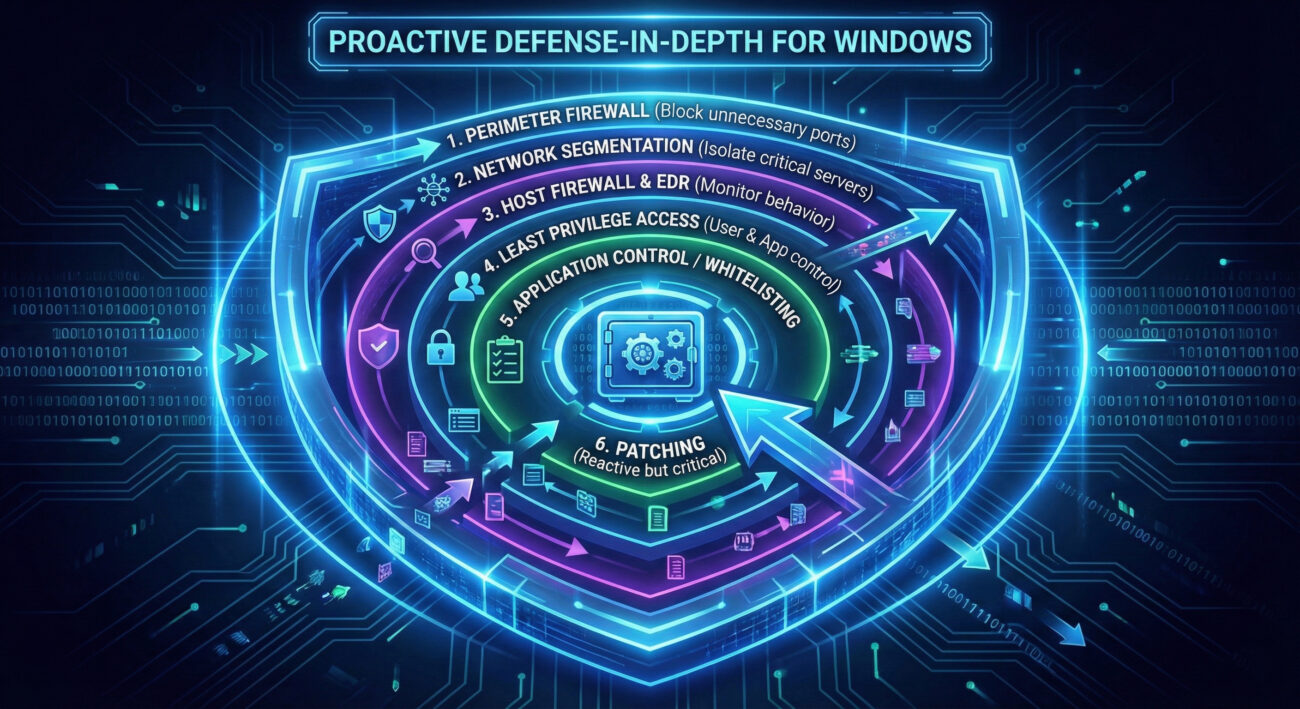
Q1: I'm a home user. What should I do immediately?
A: Go to Settings > Update & Security > Windows Update and click "Check for updates." Install all updates immediately. Enable "Automatic Updates" if it's off. This is your most critical protection.
Q2: What if I can't patch a critical server because it runs legacy software?
A: This is a high-risk situation. You must implement compensating controls:
Q3: How do attackers find these vulnerabilities?
A: Through a mix of methods: fuzzing (sending random data to programs to find crashes), reverse engineering, code audit, and purchasing them from the cyber criminal underground or bug bounty programs. Microsoft also receives reports from security researchers worldwide.
Q4: Is it safe to use third-party patch management tools?
A: Reputable tools from established vendors (like ManageEngine, Ivanti, Automox) are generally safe and can be more efficient for large networks. Ensure they are properly configured and secured, as they hold high-level access.
Do not let this be just another article you read. The vulnerabilities from this Windows Patch Tuesday are real and present danger.
Cybersecurity is a continuous journey. Start by conquering this Patch Tuesday. Update, secure, and defend.
© 2026 Cyber Pulse Academy. This content is provided for educational purposes only.
Always consult with security professionals for organization-specific guidance.
Every contribution moves us closer to our goal: making world-class cybersecurity education accessible to ALL.
Choose the amount of donation by yourself.