

















Certification Courses
Hands-On Labs
Threat Intelligence
Latest Cyber News
MITRE ATT&CK Breakdown
All Cyber Keywords
Have you ever worried that your personal data, or even your company's secrets, could be stolen by invisible hackers working for a foreign government? This isn't the plot of a spy movie, it's the reality of modern cyber espionage, and one of the most prolific actors in this shadowy world is known as APT41. Understanding this group is your first step in building a stronger digital defense.
APT41 is a highly sophisticated, state-sponsored hacking group believed to be based in China. What makes them uniquely dangerous is their "dual mission": they conduct espionage for the state while also running financially motivated cybercrime for personal gain. Think of them as a hybrid of a government intelligence agency and a ruthless mafia cyber-gang, all rolled into one.
In this guide, you'll learn: who APT41 is in simple terms, how their attacks work through a relatable story, the key tools and tricks they use, and most importantly, a step-by-step guide on how to protect yourself and your organization from threats like them.
In today's interconnected world, cyber threats don't just target governments and giant corporations. APT41 has a long history of targeting a frighteningly wide range of victims: from video game companies and telecom providers to healthcare organizations and universities. A 2021 report by Mandiant (now part of Google Cloud) detailed their global campaigns, highlighting their adaptability and reach.
The significance of APT41 lies in their blended approach. While traditional cybercriminals just want money, and pure spies just want secrets, APT41 wants both. This makes them more aggressive, unpredictable, and a threat to virtually any sector. For a beginner, this underscores a critical lesson: cybersecurity isn't just about preventing financial loss; it's about protecting intellectual property, personal privacy, and national security.
Recent analyses, such as those from the Cybersecurity and Infrastructure Security Agency (CISA), emphasize that advanced persistent threats (APTs) are a top-tier concern. They exploit the same common vulnerabilities that individuals and small businesses often neglect, like unpatched software or weak passwords. By learning about APT41, you're learning to defend against the tactics used by the most elite tier of hackers.
Let's break down the jargon. Understanding these few terms will make the rest of this guide crystal clear.
| Term | Simple Definition | Everyday Analogy |
|---|---|---|
| APT (Advanced Persistent Threat) | A highly skilled, well-resourced hacking group that secretly infiltrates a network and stays hidden for a long time to steal information or cause damage. | Like a team of professional burglars who move into your attic without you knowing, slowly mapping your house and stealing valuables over months. |
| State-Sponsored | A group that is supported, funded, or directed by a national government. | Instead of being freelance criminals, they are more like "cyber soldiers" or intelligence agents working on behalf of a country. |
| Supply Chain Attack | Hackers compromise a trusted software provider to infect all of that provider's customers. | Tampering with the water supply at the reservoir to poison everyone in town, rather than targeting individual homes. |
| Zero-Day Exploit | An attack that uses a previously unknown software vulnerability that the vendor has had "zero days" to fix. | Using a secret, hidden flaw in a bank vault's design that even the vault makers don't know about. It's the ultimate skeleton key until it's discovered and patched. |
| Lateral Movement | Once inside a network, hackers move from one computer or system to another to find valuable data or gain more control. | A thief who breaks into your garage, then uses your garage door opener to get into the main house, and then finds the keys to your safe. |
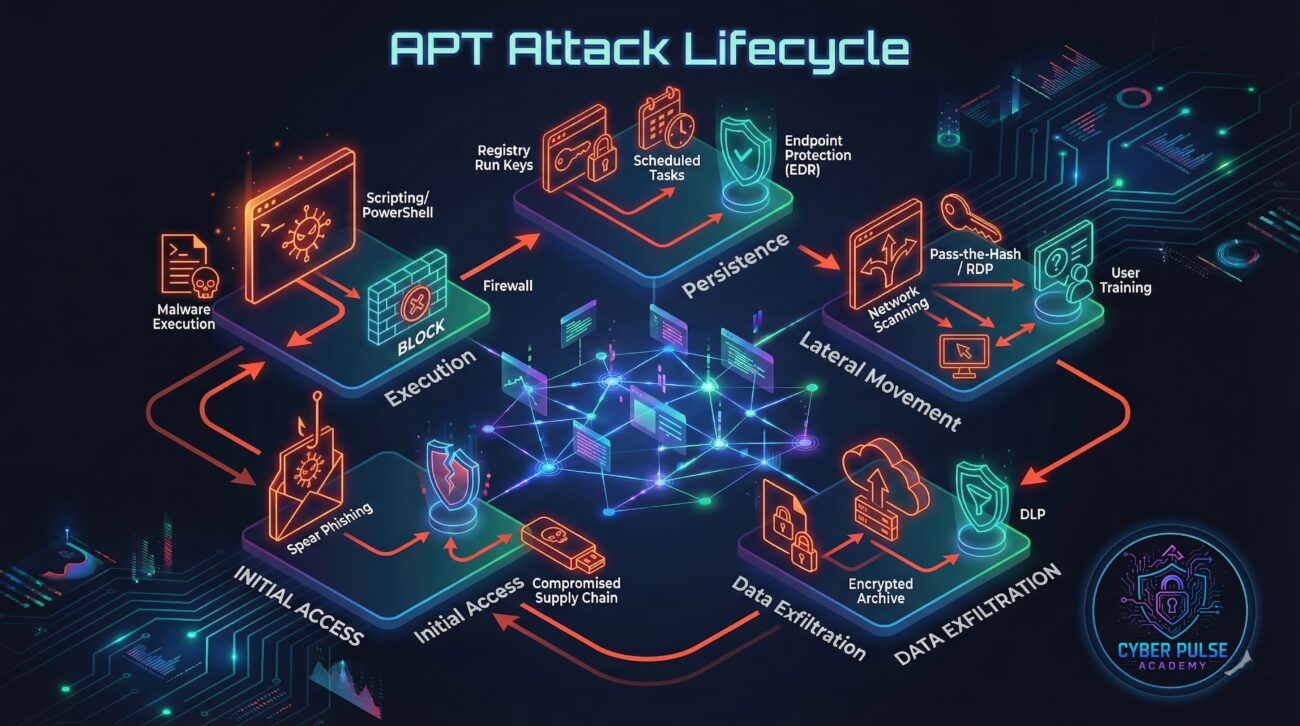
Let's follow a fictional but realistic story to see how APT41 might operate. Meet Sarah, a project manager at "TechFlow Inc.," a mid-sized software company developing innovative data compression algorithms.
The Hook: One Tuesday, Sarah receives an email that appears to be from a popular project management tool her company uses. The subject is "Urgent: Security Update Required for Your Account." The email looks perfect, with the correct logo and a professional tone. It asks her to click a link to review a new privacy policy. Stressed and busy, Sarah clicks it, enters her login credentials, and thinks nothing of it. This was a spear-phishing attack, meticulously crafted by APT41 after researching TechFlow's software stack.
The Breach: Those credentials gave the hackers a foothold in TechFlow's cloud workspace. They didn't rush. Over the next week, they used Sarah's access to silently explore the network, a process called reconnaissance. They identified the server storing the source code for the new compression algorithm, TechFlow's "crown jewels."
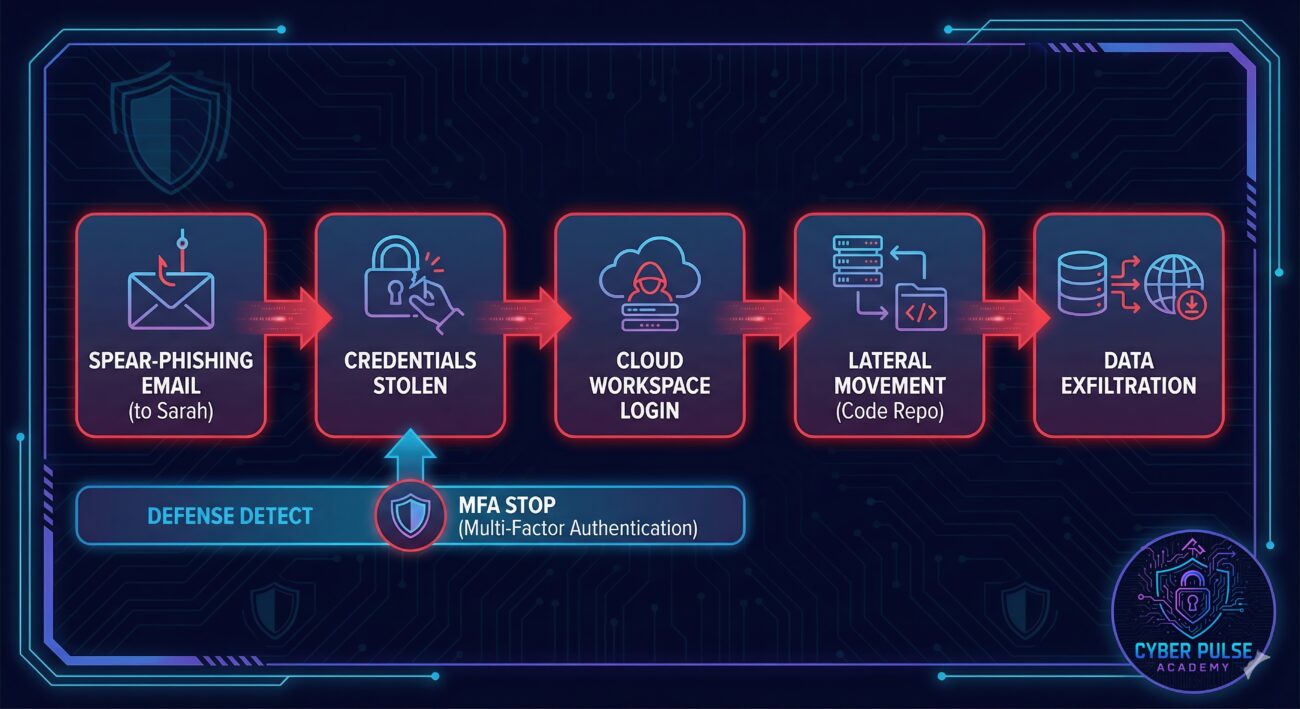
The Heist: To avoid detection, APT41 used a technique called "living off the land," using legitimate IT administration tools already installed on the network to copy the code. They then compressed and slowly smuggled the data out over several days, hiding the traffic in normal-looking web requests. The entire theft was complete before TechFlow's small IT team noticed any unusual activity.
| Time / Stage | What Happened | Impact |
|---|---|---|
| Day 1 (Initial Access) |
Sarah clicks the phishing link and enters her credentials. | Attackers gain a foothold in the company network. |
| Days 2-7 (Recon & Lateral Movement) |
Hackers explore the network, identify key targets (source code server), and escalate privileges. | Full network map created. Path to critical data established. |
| Days 8-14 (Exfiltration) |
Source code is quietly copied and transmitted to external servers controlled by APT41. | Massive intellectual property theft. TechFlow's core product is compromised. |
| Day 30+ (Discovery) |
A competitor releases a suspiciously similar product. TechFlow investigates and finds the breach. | Financial loss, reputational damage, loss of competitive edge, potential legal liability. |
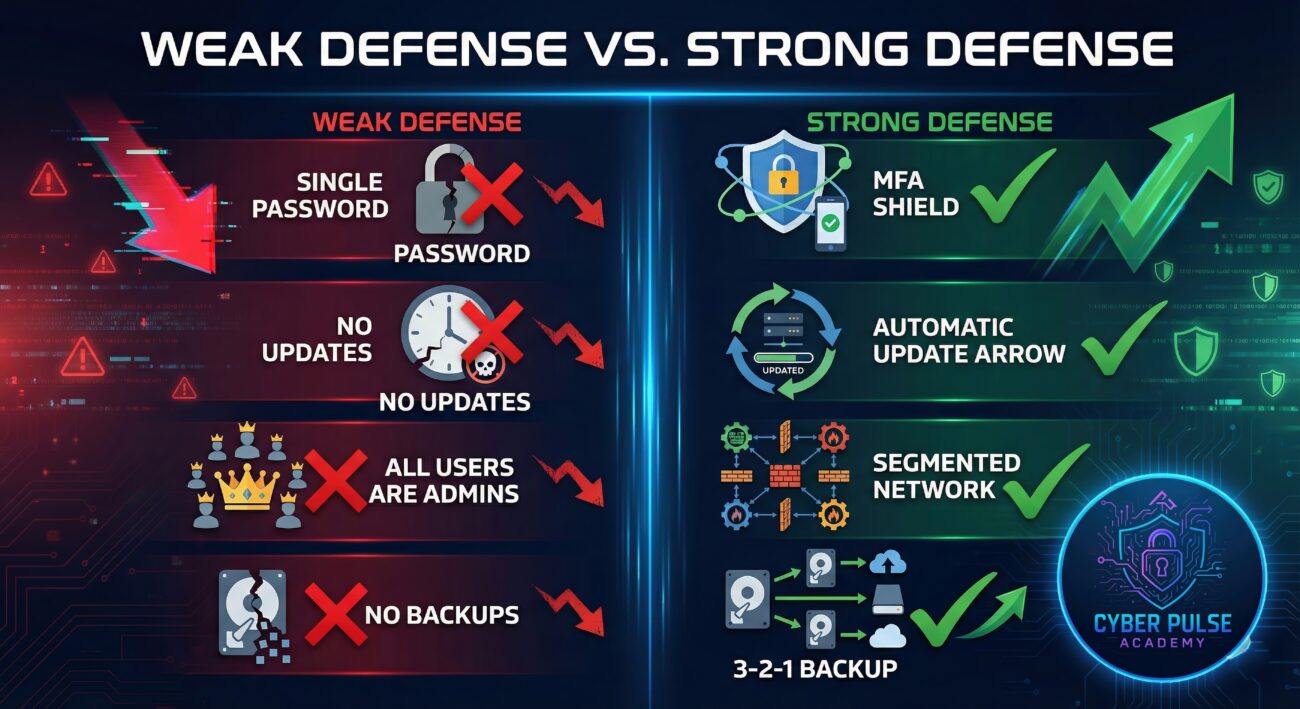
You don't need a government-level budget to defend against the core tactics used by groups like APT41. This 7-step guide focuses on building a strong security foundation.
Since phishing is the #1 initial attack vector, start here.
Hackers exploit known bugs. Patching closes those doors.
This mindset shift is crucial for businesses and advanced home users.
A good backup is the ultimate "undo" button for many attacks, including ransomware.
Only give users (and software) the minimum access they need to do their job.
If data is stolen, encryption makes it unreadable garbage to the thief.
Technology fails if people are tricked. Security is a team sport.
One Simple Attack Path: An attacker from a group like APT41 doesn't start by hacking complex firewalls. They start with information. They might scan a target company's employees on LinkedIn, find a software developer who lists their tech stack, and notice they use a specific open-source library. The attacker then checks if that library has a known, unpatched vulnerability. They craft a malicious code snippet that exploits it and post it on a developer forum the target is known to visit. When the developer copies and uses that code, the attacker gains a foothold inside the development environment, right where the valuable source code lives.
The Defender’s Counter-Move: A savvy defender thinks like an attacker. They know their "attack surface", what information is public (LinkedIN profiles, tech blogs, forum posts). They implement strict policies for using third-party code, requiring security reviews before integration. They also use specialized tools that automatically scan their own code and dependencies for known vulnerabilities, alerting them to patch before an attacker can exploit them. The mindset shift is from "reacting to intrusions" to "proactively hunting for and eliminating the paths an attacker would take."
For a red teamer emulating APT41, the goal is persistence and data. They see a network not as a fortress, but as a system of trust relationships and human errors. They care about finding the one weak link, the unpatched server, the employee who hasn't had phishing training, the service account with a default password. Their behavior is patient and stealthy. They will spend weeks quietly mapping the network, identifying where the true "crown jewels" are stored, and establishing multiple hidden backdoors to ensure they maintain access even if one is discovered. Efficiency is measured in stealth, not speed.
The blue team's mission is to protect the confidentiality, integrity, and availability of data. They view APT41 as a persistent, evolving force of nature. They care about visibility, seeing every login, every process, every data transfer. Their behavior is centered on monitoring, logging, and validation. They assume a breach is inevitable, so they build layers of defense (MFA, segmentation, logging) to make the attacker's life as hard as possible, to detect them as early as possible, and to limit the damage when they are found. Success is measured in "dwell time", how quickly they can detect and eject an intruder.
APT41 represents the apex of modern cyber threats: a blend of espionage and crime with immense resources. While their capabilities are advanced, the defenses against them start with fundamental, actionable steps that everyone can implement.
Let's recap the core lessons:
Understanding the threat landscape, starting with groups like APT41, empowers you to make smarter security decisions every day. Cybersecurity isn't about being perfectly secure, it's about managing risk intelligently and making yourself a harder target than the next one.
Did this guide help demystify advanced cyber threats? Do you have questions about implementing any of these steps in your home or business?
Share your thoughts or questions in the comments below! Let's build a more secure community together. For more detailed guides, explore our posts on implementing MFA and basic incident response planning.
Every contribution moves us closer to our goal: making world-class cybersecurity education accessible to ALL.
Choose the amount of donation by yourself.